Category Archives: Nostalgia

Radio Waves: Sealand’s Caretakers, BitCoin & Ham Radio, CW Training, and 50 Years Ago Casey Kasem Started AT 40

Radio Waves:  Stories Making Waves in the World of Radio

Because I keep my ear to the waves, as well as receive many tips from others who do the same, I find myself privy to radio-related stories that might interest SWLing Post readers.  To that end: Welcome to the SWLing Post’s Radio Waves, a collection of links to interesting stories making waves in the world of radio. Enjoy!

Many thanks to SWLing Post contributors Tony, Mike Terry,  and the Southgate ARC for the following tips:


Sealand’s caretakers (Boing Boing)

Sealand is an unrecognized micronation off the coast of England, established in the 1960s and issuer of stamps, passports and occasional offshore business shenanigans (“BECOME A LORD“). But Sealand is also a rotting sea fortress in need of constant maintenance. Atlas Obscura met the two caretakers who spend two weeks at a time doing what they can to keep the statelet running smoothly. Dylan Taylor-Lehman’s feature article is a great introduction to the place, if you’re not familiar with it or its wild history.[]

How Bitcoin Is Like Ham Radio (Coindesk.com)

Understanding bitcoin is difficult. And so we cast around for the perfect metaphor. Bitcoin is email. Digital gold. eCash.

Here’s a new one. Bitcoin is ham radio.

Bitcoin is old-fangled. It takes days to download the Bitcoin blockchain, just like it took forever to download software back in 1994. In an age of instant email and real-time Zelle payments, a bitcoin transfer takes 60 minutes to safely settle. It’s more volatile than gold, a relic of our previous monetary system. Thousands of computers are constantly replicating each others’ work, making it vastly inefficient. And lastly, there’s no privacy. Like a medieval marketplace, everyone can see everybody’s holdings.

All of these features are anachronistic. But they do sum up to something unique. What exactly is that thing?

A ham radio allows its operator, otherwise known as an amateur radio operator, to use certain bands in the radio spectrum to communicate by voice or code. This is an old technology. Italian inventor Guglielmo Marconi became the first ham radio operator in 1897 when he transmitted Morse code across Salisbury Plain in England.

It seems odd that something as archaic as ham radio continues to exist in a world with email, Snapchat, iPhone and Facebook. A ham transmission can only be used over a couple of kilometers. No emojis. No video. No gifs. Forget about privacy! Anyone can listen into your radio conversation.

Yet, ham radio is a very active niche. Associations all over the world keep the hobby going. According to the American Radio Relay League, there are some 764,000 ham radio operators in the U.S. Japan has more than a million. The International Amateur Radio Union pegs the global number of amateur radio licensees at 3 million.

Like ham radio, Bitcoin is for hobbyists. I’m not talking here about all of the frenetic speculators who keep their coins at Coinbase. I’m talking about users who can run a full node, use Lightning, securely store their own coins and make frequent transactions with the stuff. This pool of bitcoiners is tiny. It’s probably smaller than the number of active licensed ham radio operators.[]

CW Training Program (Southgate ARC)

In this video Howard WB2UZE and John K2NY of the Long Island CW Club talk to David W0DHG about their CW training program

The club started in 2017 offers over 45 hours of CW classes EACH week, and has grown to over 600 members from all 50 states and 15 countries all over the world.

HRN423 Long Island CW Club

50 Years Ago, Casey Kasem Began Counting Down The Hits On American Top 40 (NPR)

On July 4, 1970, the countdown started. Originally hosted by Casey Kasem, American Top 40 played “the best selling and most-played songs from the Atlantic to the Pacific, from Canada to Mexico,” as he stated on the first program broadcast 50 years ago as of tomorrow.

On any given week, American Top 40 could feature a ballad, next to a country song, next to a funk song, next to a rock song. The show became a national obsession but 50 years ago, it was considered a risky idea.

“You remember, at the end of the ’60s, Top 40 was not the most popular format,” Casey Kasem told NPR in 1982. “And here we were coming along with a show called American Top 40, and people said, ‘You must be nuts!’ “[]


Do you enjoy the SWLing Post?

Please consider supporting us via Patreon or our Coffee Fund!

Your support makes articles like this one possible. Thank you!

Tracy discovers a modern replacement for RDP English

Many thanks to SWLing Post contributor, Tracy Wood (K7OU), who writes:

I found a modern replacement for RDP- English. Perhaps even better!

My Portuguese knowledge remains limited to two quarters of university courses; similar Spanish cognates help bridge the Luso-English comprehension gap. Could I find an English-language radio show that would help revive my interest in Portugal, Brazil, and other Portuguese-speaking countries? Yes!

First as a backgrounder, Rádio Difusão Portuguesa International Service in English suspended programs several decades ago. RDP next completely left the shortwaves. Today, RDP Internacional continues to provide its global Portuguese-speaking audience non-stop content from Lisbon. The station broadcasts via satellite and streams via the Internet. Listeners in North America can tune in using a three-foot dish on Galaxy 19 Ku (12152 MHz, s/r 20000).

Now the good news. Fortunately, I stumbled upon a wonderful English-language broadcast that more than fills the RDP-English void. The show even resides on my daily **must-listen** list.

The “Portuguese-American Hour”, sponsored by Fresno State University’s Portuguese Beyond Borders Institute (PBBI), is the one-hour broadcast targeting anyone who is interested in the Portuguese-speaking world. The top-level focus is on the daily life of the Portuguese who settled in California (mostly from the Azores) and the following generations’ struggles to retain their rich traditions. The show has segments on music, history, food, literature, culture, etc. The topics covered the clearly go beyond California and US borders.

The brains behind the show is PBBI’s Dr. Diniz Borges who made a career as a Portuguese language high-school and college professor. He brings a wealth of knowledge and a seemingly unlimited list of radio guests. (Dr. Borges also spent some earlier years on California Portuguese-language radio; he retains a superb on-air presence.)

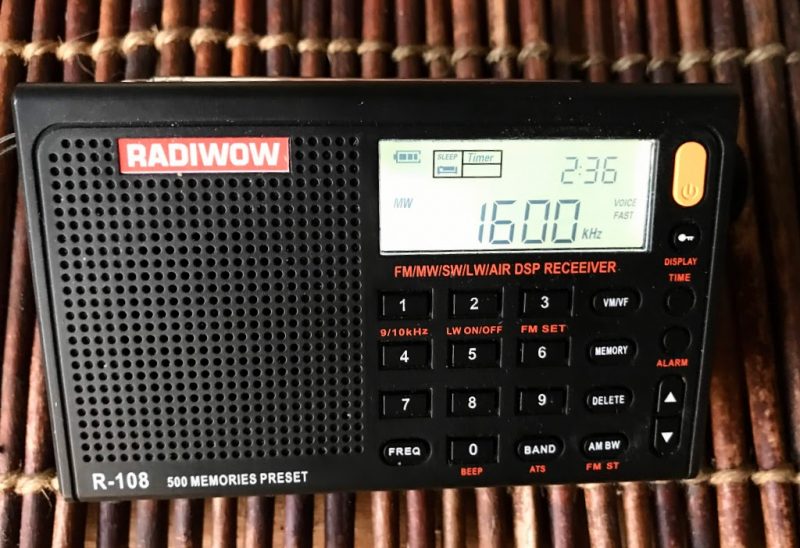
The show is heard Monday-Friday at 1600-1700 Pacific US Time (2300Z-2359Z currently) on KGST AM 1600 in Fresno, California. The station streams at https://www.multicultural1600am.com/ .

For the radio-hobbyist, PBBI now is celebrating the 100th anniversary of Portuguese-language radio broadcasting in the US, apparently started in the summer of 1920 by the unlicensed “Radio Vasco da Gama” in central California. There have been several segments on this unique ethnic broadcasting story and more related interviews are coming. (Check the last few show archives.)

Portuguese American Hour Archives:
https://www.multicultural1600am.com/show/the-portuguese-american-hour/

PPBI’s website:
https://fresnostatecah.com/category/portuguese-beyond-borders-institute/

RDP Internacional’s website:
https://www.rtp.pt/play/direto/rdpinternacional

Thank you so much for sharing this Tracy! To give readers a taste of the Portuguese-American Hour, I’ve embedded their latest episode (the one I’m listening to as I publish this post) below:

Radio Waves: Tallest Structure in Italy, Suggestion to Save AM, Online Radio Exams in Australia, and a Letter From Friends of ABC

Radio Waves:  Stories Making Waves in the World of Radio

Because I keep my ear to the waves, as well as receive many tips from others who do the same, I find myself privy to radio-related stories that might interest SWLing Post readers.  To that end: Welcome to the SWLing Post’s Radio Waves, a collection of links to interesting stories making waves in the world of radio. Enjoy!

Many thanks to SWLing Post contributors Paul Evans, Mike Terry, and Michael Bird for the following tips:


The tallest structure in Italy is a remote radio transmitter in Sicily. (Atlas Obscura)

WHEN TALKING ABOUT THE TALLEST structures in the world, one often thinks of skyscrapers above modern cities, but radio transmitters in remote locations also reach dizzying heights.

Italy is famous for its many architectural marvels built over the millennia, but its tallest building (a sleek, modern structure in Milan) is only 758 feet tall. The title of the tallest overall structure goes to a radio transmitter on the Sant’Anna hill near the town of Caltanissetta, in Sicily. (In between the two are a number of transmitters and power plant chimneys.) This antenna has a height of 938 feet, and was built by the national public broadcasting company, RAI, between 1949 and 1951. At the time it was also the tallest structure in all of Europe, until 1965 when a transmitting station in the United Kingdom was inaugurated.[]

Here’s a suggestion for how to save AM radio (Los Angeles Daily News)

Last week, I wrote a little about streaming audio and how, with the use of smart speakers, smartphones, and plain old computer streaming, the possibility of internet radio essentially replacing traditional broadcast radio.

This week I want to travel to both the past and one of broadcast radio’s possible futures, spurred on by the ideas presented last week, my absolutely illogical love of AM radio, and a letter to the editor that I read online at radioworld.com.

AM radio broadcasting is almost a century old in the United States – numerous stations in Los Angeles, including KHJ (930 AM), KFI (640 AM) and KNX (1070 AM) will celebrate 100 years of broadcasting in two years. That’s an impressive feat, especially considering the technology is essentially the same as it was in 1922.

As I mentioned last week, digital HD Radio, considered for a time as the savior of both AM — due to higher fidelity — and FM — due to potential higher fidelity and extra stations — just hasn’t made the impact many had hoped. For various reasons, many AM stations have turned off the HD signal, even while FMs continue to use it, and consumers don’t seem all that interested in either. But as I said last week, with smart speakers, what’s the point? And a related question comes up: is broadcast AM radio just a dead technology?

Christopher Boone thinks he has the answers. No, AM is not dead. But if you really want to improve it, bring back a technology that already “failed” … AM stereo.[]

Online remote exam sessions in Australia (Southgate ARC)

VEA (Volunteer Examiners Australia) is pleased to advise we are currently able to perform online remote exam sessions for both AMC and ARRL VE Examinations.

VEA has AMC Level 3 examiners that can conduct remote online examinations.

Also, the ARRL VEC has entrusted us by extension the FCC, to be examiners for FCC-issued license via remote online examinations, a volunteer examiner, must ensure the exam conducted fairly and that there is the same level of integrity as there would be for an in-person examination.

Candidates need to be aware there are conditions and eligibility in registering to do an ARRL online remote examination, e.g. living in a remote location, or the candidate is physically impaired to attend an exam session.

VEA does run bi-monthly AMC and ARRL VE exam sessions during the year,
so if you are interested, visit our website www.vea.org.au complete the online registration form.

VEA currently have AMC and ARRL VE examiners in Queensland, New South Wales, Victoria, South Australia, and Western Australia.

VEA looks forward in supporting the ham radio community in providing this valuable service to both AMC and ARRL VEC.

73 from Peter VK3FN

Wireless Institute of Australia[]

An open letter to the Prime Minister from ABC Friends and supporters (ABC Friends)

Posted in Latest news from ABC Friends on 28 June 2020

ABC Friends have written an open letter to the Prime Minister in the wake of the recent staff and funding cuts.

Dear Mr Morrison,

I write on behalf of many angry Australians who want to know why your government continues to undermine Australian public broadcasting with ongoing funding cutbacks at the same time as the commercial media sector is favoured.

Your recent statement that “there have been no cuts to the ABC” sadly reminds us of Tony Abbott’s similar bold election promise in 2013, yet this was followed by major cutbacks in his first Budget as Prime Minister. Clearly in our current media environment there are facts and ‘alternative’ facts, it all depends on the presenter and the audience.

Many of us are more inclined to rely on information from your ABC Board Chair, Ita Buttrose, who said in her 2019 Forward to the Annual Report – “our task has been made harder by the imposition of the three year indexation freeze which comes on top of a $50 million a year cut now embedded in our base.”

We see the recently announced Five Year Plan as a brave attempt by the Managing Director, David Anderson, to live within your governments funding allocation, but obviously further staff cuts and downgrading of ABC services and programs is an inevitable outcome of reduced funding.

We all appreciate that governments rely on a degree of political spin to make their decisions seem more palatable, but do you seriously expect the community to believe that an ABC Managing Director would deliberately retrench so many staff and downgrade services and programmes if the ABC Budget was adequate?

We expected more of your leadership because you have a responsibility to act on our behalf, as ABC shareholders to enable the ABC to fulfil parliamentary approved obligations under its Charter. The Federal Government acts as caretaker of all our national institutions and in this regard the ABC ranks highly with the Parliament and the High Court in protecting the interests of all Australians.

Chair of the ABC Board, Ita Buttrose has consistently tried to work with you and your Communications Minister, Paul Fletcher, to get a realistic re-assessment of the ABC Budget to meet the demands of a changing media environment and national emergencies. Yet these genuine efforts by both Board and Management have been repeatedly ignored. Furthermore, there has been a quite calculated misrepresentation of budgetary analysis since 2014 assuming that official promotion of fake news will provide an effective distraction from the reality of past and current government decision making, which has resulted in an ongoing 10% budget reduction.

Over the past six years the ABC has been the target of funding cuts, various enquiries, political attack and even a police raid. You can not be surprised that Australians are outraged about the latest announcement this week which will culminate in further job losses, valued services and Australian content. You regularly advocate protection of jobs and your COVID-19 employment protection initiatives are admirable. Yet successive Coalition administrations have caused the loss of 1250 ABC professional staff.

Can you explain to us why you are so determined to downgrade the ABC, which is a valued national treasure supported by over 80% of Australians? We understand that you are regularly lobbied by the Murdoch American News Empire and other commercial media interests, which are ideologically opposed to public broadcasting. Furthermore, we know that some members of your cabinet are members of the Institute of Public Affairs, which advocates privatisation of the ABC. However, ABC Friends would respectfully remind you that, as Prime Minister, your first loyalty is to the Australian people and our public institutions.

As a national organisation we have been overwhelmed by expressions of public concern about the way the ABC is being treated. So many comments express ongoing frustration that many of our elected representatives seem incapable of recognising the ABC as an essential public service on which Australians depend. We have received hundreds of letters and comments which we will be collating for public release, but here is just one example to offer you some insight into how Australians feel about the continued assault on the ABC.

“I am shocked, then saddened, then disgusted, then outraged by the governments attack on the ABC. The Federal Government should be creating jobs instead of destroying high quality ‘clever country’ jobs. Prime Minister Morrison led a government that was unique in bringing together differing interests across Australia to benefit the nation and lead us out of disaster. But now? The attack on the ABC is a fundamental attack by the Morrison Government on its claim to govern in the national interest.”

We urge you to reconsider your government’s responsibilities to the ABC by conducting immediate meaningful negotiations with the Ms Buttrose and Mr Anderson to plan a way forward to restore ABC funding. This discussion should include a commitment in the October Budget to recognise ABC staff and services as essential in post COVID-19 planning .

We look forward to a fresh approach to public broadcasting policy and can assure you such commitment will be very much welcomed by the Australian public.

Yours sincerely,

Margaret Reynolds
National President
ABC Friends

P.O.Box 3620
Manuka ACT 2603[]


Do you enjoy the SWLing Post?

Please consider supporting us via Patreon or our Coffee Fund!

Your support makes articles like this one possible. Thank you!

The Allocchio Bacchini RF4D: That mystery radio from “The Last Man on Earth”

Many thanks to SWLing Post contributor, Andrew, who correctly identified the radio Ed spotted in The Last Man On Earth as the Allocchio Bacchini RF4D. Andrew shared the following notes and links:

That radio is an Allocchio Bacchini RF4D (see photo below from this site):

Here’s a snippet from an Italian movie showing the same rig:

Another pic and notes can be seen scrolling down this page:

Year : 1940
TX Frequency Range : 1,270 – 4,300 kHz in 3 bands
RX Frequency range : 220 – 4,400 kHz in 5 bands
Facilities : CW and RT
Receiver Circuit (Valves) : Superhet. 7 tubes type 6RV (same as RF 4)
Transmitter Circuit (Valves): MO(P C05), PA (2x P CO5) Mod.(3x 6RV)
RF Output : 25 W
Aerial : Dipole
Power supply : 12 V storage batteries. Mains for battery charger.

And here you’ll find the shack of an Italian ham which shows an RF4D:

Photo: I5HGM

Further info and schematics can be found here.

Wow! Thank you so much, Andrew! I would love someday to operate an original RF4D.  What a fascinating WWII era radio. Thank you again for all of the details!

Post readers: I’m very curious if anyone here owns or has owned an RF4D.  Please comment!

Video: 1954 Inauguration of REE/RNE Shortwave Radio Transmitters

Many thanks to SWLing Post contributor, Ulis Fleming (K3LU), who shares the following video via Twitter and notes:

Spain: Must see newsreel video of the 1954 inauguration of REE/RNE shortwave radio transmitters:

Click here to watch video at the RTVE archives.

Many thanks for sharing this excellent bit of radio history, Ulis. I was just telling a friend that Radio Exterior de España still has one of the biggest signals out of Europe into North America these days on 9690 kHz.

Help Ed identify this mystery radio in “The Last Man on Earth”

Many thanks to SWLing Post contributor, Ed, who writes:

Recently I’ve been watching some pandemic-themed movies and found “The Last Man on Earth”, a pretty good 1964 post-apocalyptic science fiction horror film (which was remade in 1971 and 2007 with different titles.) In this film, the main character (well played by Vincent
Price) uses an HF transceiver in a fruitless effort to find other survivors of a global plague. It was shot in Italy, and the transceiver doesn’t look like any American radio I’ve ever seen. Perhaps some of your SWLing Post readers can identify it?

BTW: SWLing Post readers might also be interested in knowing this film can be downloaded for free from The Internet Archive.  https://archive.org/details/lastmanonearth-1964

What do you say, SWLing Post Community? Is this radio a fabricated stage prop, or a real model?  Please comment!

In the meantime, I’ll add this post to our ever growing archive of radios in film!

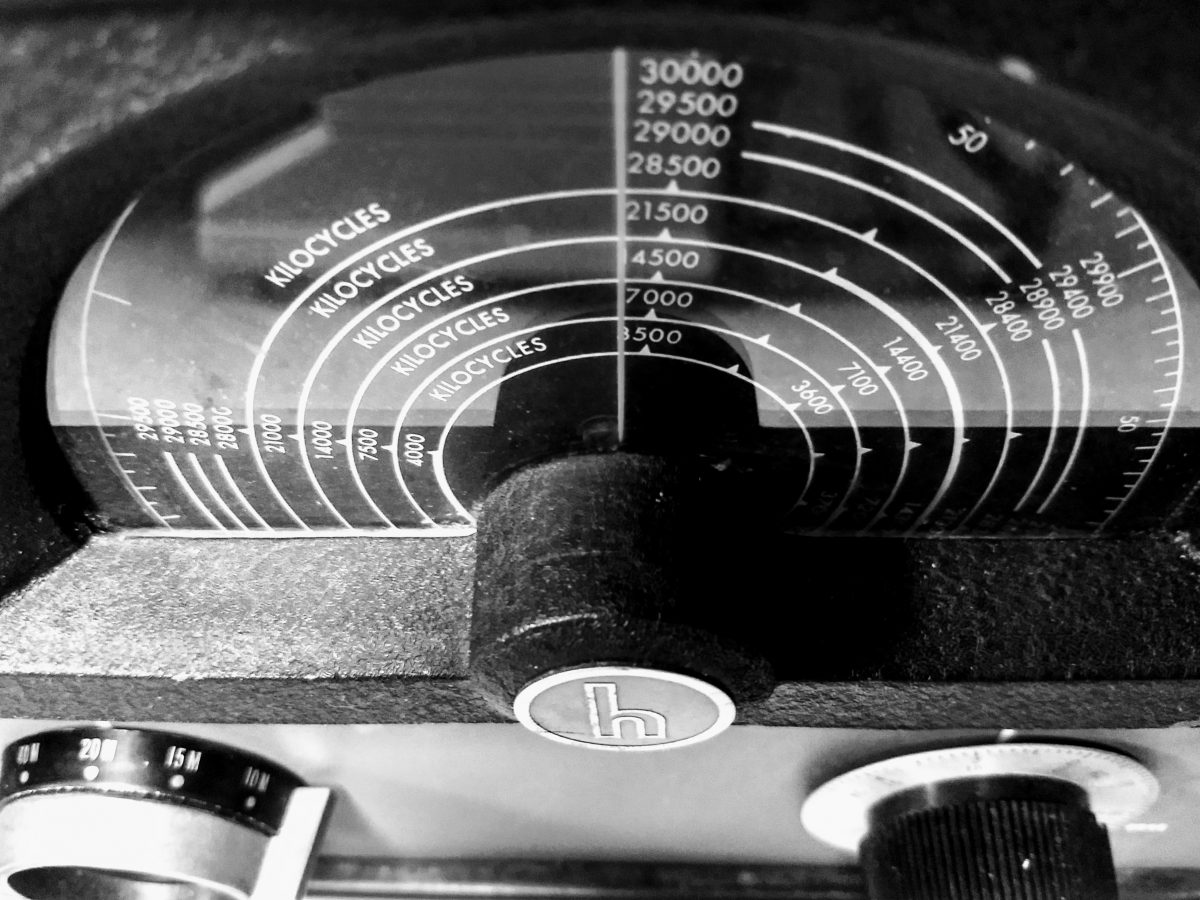
Listener Post: Mike Stutzer’s love of radio began with a Hallicrafters S-120

Photo: Universal Radio

Many thanks to SWLing Post contributor, Mike Stutzer, who recently shared the following listener post:

I started SWLing as a teenager. My favorite uncle gave me a Hallicrafters S-120.

My dad hung a longwire under an eave and through a casement window frame into my bedroom. I marveled at all the AM international stations broadcasting in English, listening to everything from BBC cricket coverage on Saturday morning to hysterically unbelievable Albanian political news coverage.

After college I could afford something better, so I upgraded to a “boat anchor” Hallicrafters SX 110. It had a useful crystal filter to improve selectivity, but it was still nigh on impossible to decipher a Ham on SSB.

Photo: Universal Radio

Many decades later I bought a house on a steep foothill. Realizing that it was a perfect QTH for a Ham station, I got licensed and now am President of the local ARC. Here is a loving look at the original SWL receiver that got me hooked.

Prof. Mike

Boulder, CO

Thank you for sharing this, Mike!

Mike’s radio story is the latest in our multi-year series called Listener Posts, where I place all of your personal radio histories. Feel free to submit your own by contacting me.