Category Archives: Nostalgia

A Look Back: Memories of the Panasonic RF-2200 and its sibling, the National Panasonic DR22

Many thanks to SWLing Post contributor, Mario Filippi (N2HUN), for the following guest post:


A Look Back: Memories of the Panasonic RF-2200 and its Sibling, the National Panasonic DR22

by Mario Filippi, N2HUN

All photos by author unless otherwise noted

One of the preeminent AM/FM/SW portables of all time is the venerable Panasonic model RF-2200 receiver that was sold in the USA starting in the mid-1970’s for around $165.00 US.

Weighing in at a hefty 7 pounds, 13 ounces and vital statistics of 12” x 7” x 4” it came equipped with a robust shoulder strap to schlep from the radio shack to alfresco listening sites and was basically a completely self-contained entertainment center for the radio enthusiast.  My first RF-2200 was purchased in the late ‘70’s from Grand Central Radio Shop in New York City, now just a memory and long gone, but back then they sold a bevy of shortwave and ham radio equipment.
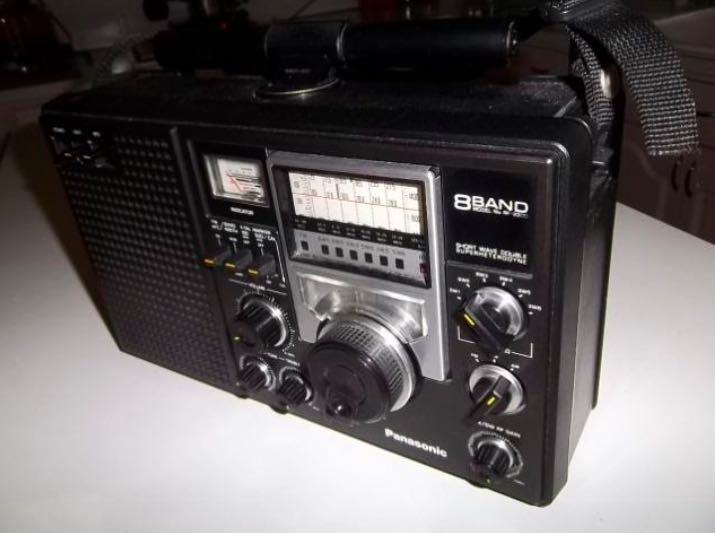
Photo 1. Author’s favorite portable of all time, Panasonic RF-2200

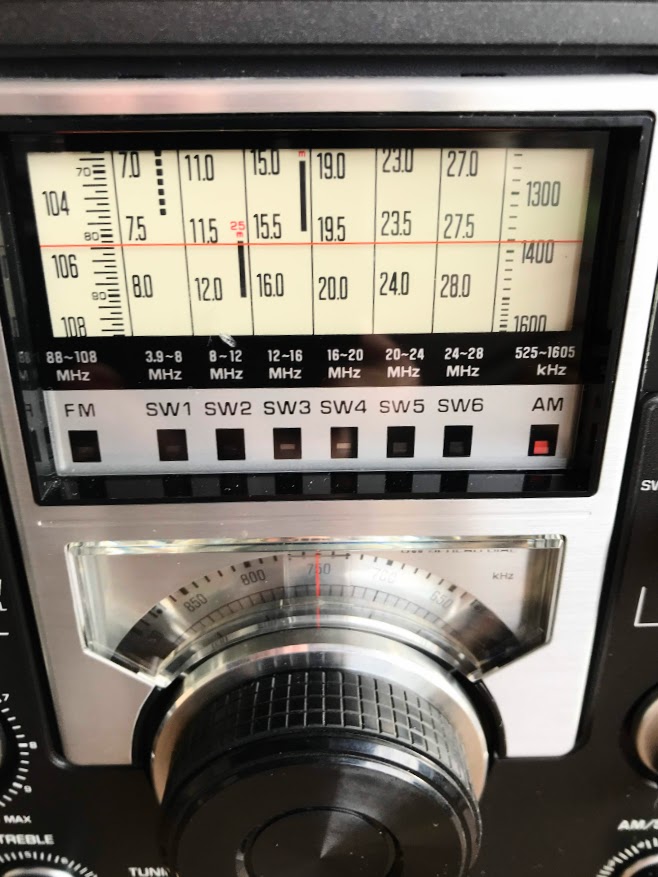
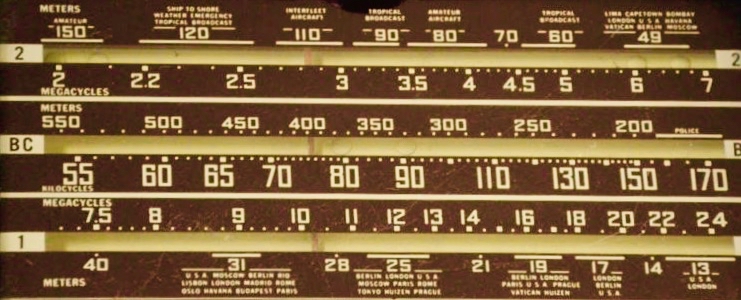
It was love at first sight when I saw the RF-2200 in the store’s gleaming glass display case way back when. The ‘2200 possessed all the bells and whistles to guarantee a good time for the SWL such as a rotatable ferrite AM broadcast band antenna, BFO (Beat Frequency Oscillator) for SSB reception, AM /FM/SW (3.9 – 28 MHz) bands, a D’Arsonval “S” meter that doubled as a battery status indicator, large four inch front mounted speaker, switchable coarse/fine tuning speed, base/treble/RF gain pots, 125/500 kHz crystal markers to calibrate the VFO, wide/narrow bandwidth switch, dial/S meter lights, earphone/recorder jacks and telescopic antenna for SW and FM. Plus it sported the renowned Panasonic trademark.
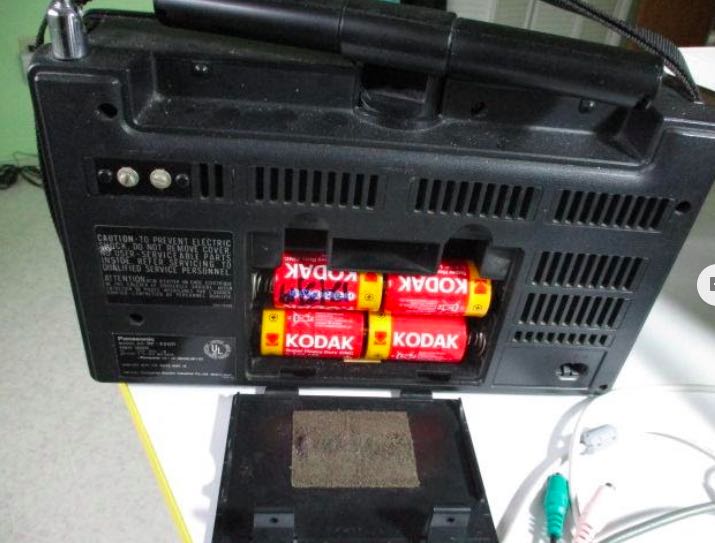
Photo 2. RF-2200’s rear: exposed battery compartment, screw connectors for external antenna, AC plug lower right. Rectangular earphone storage compartment is above batteries. Battery cover’s gray foam pad is dry rotted and needs replacement.

Part of the 2200’s ample avoirdupois can be attributed to the unit’s four “D” battery power plant, but Panasonic also supplied an AC cord to plug into the house mains and an earphone (located inside the battery case).  It runs forever on those four stout dry cells, one of the many positive features of this vintage gem.

Back in those days portable radios generally were not judged and valued based their diminutive size and weight but on the array of features geared to the end-user. Front panels were festooned with an array of controls rivaling an aircraft’s cockpit.  Knobs, analog dials, meters, large front-mounted speakers, switches and lots of black plastic were the order of the day. These all contributed to the beauty and practicality of portable shortwave radios back then.

One thing missing though was built-in memory channels; those existed in the operator’s brain and not yet delegated to memory chips.
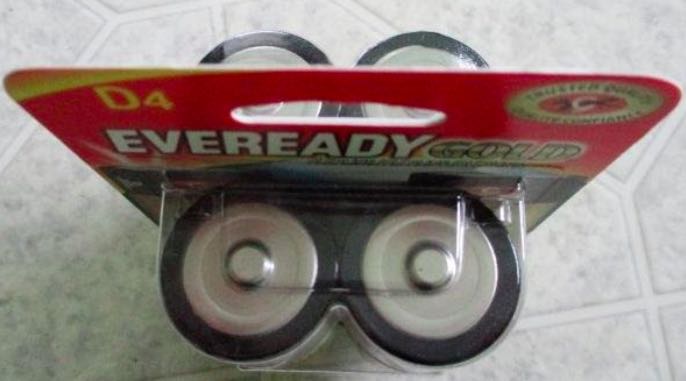
Photo 3. Pack of four “D” cells, at 1 lb 4oz, weighs more than some of today’s portables!

One of the features long gone and missing in modern receivers these days is the “recorder out” jack that looks identical to an eight-inch earphone jack and yes the ‘2200 has one. It was used to plug in a tape recorder to memorialize an op’s favorite radio show. Of course back then there were many more shortwave stations broadcasting.  Gone also are those tiny incandescent bulbs, sometimes described as “grain of wheat” lamps that were used on S meters, dials, etc. The RF-2200 sports ample illumination for the S-meter and tuning dial which makes it a perfect bedside table radio for late night DX’ers and insomniacs.

Speaking of DX, the ‘2200’s rotatable AM ferrite antenna is one of the main virtues this radio possesses.  As an avid AM DX’er and faithful disciple of AM radio in general, the ‘2200’s rotary directional antenna nulls out noise and routinely pulls in stations as far away as Nashville (WSM), Chicago (WBBM), St. Louis (KMOX), Atlanta (WSB), Boston (WBZ) and Toronto (CJBC) when the sun goes down. Look closely at the antenna mount’s base and you’ll even see compass-like degree markings that’ll help when retrieving a favorite local or DX AM station.
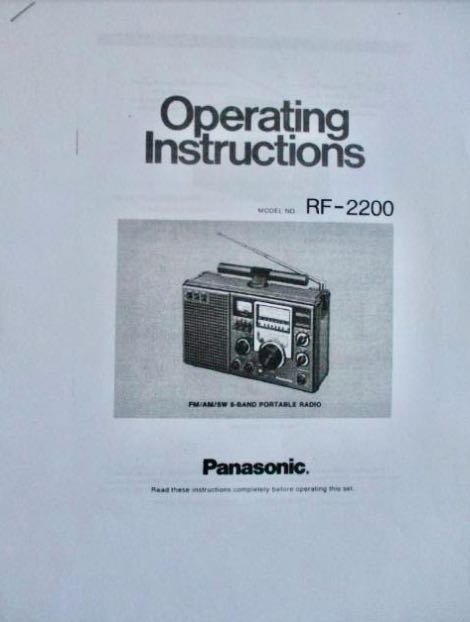
Photo 4. Operating manual copy is available on-line

Shortwave coverage is approximately from 3.9 – 28 MHz as per the service manual, but I’ve checked the actual coverage of my unit using a calibrated service monitor and found it to be 3.47 – 28.9 MHz which makes sense since I’ve tuned to W1AW’s code practice on 3.581 MHz with no problem and have also heard the Volmet station on 3.485 MHz. That’s good news for hams wanting to receive 80m CW.  It gets a bit tricky though using the fine tuning option for CW hi hi.

AM broadcast band coverage is only from 525 – 1610 kHz as per the specifications; the AM band had not yet been extended to 1710 kHz at that time.  The ITU approved the extension in 1988. With that in mind I wanted to determine what the actual band coverage of my unit was. Again, using an IFR service monitor it was found to be from 514 – 1720 kHz; that’s good news for those who listen to stations at the top of the band.  It also explains why I can hear YWA, a non-directional radiobeacon (NDB) from Toronto, Canada just below the AM band on a frequency of 516 kHz. If you own a RF-2200 or DR22 tune to the bottom of the AM band and listen for it. You may also hear the warbling sound of NAVTEX stations on 518 kHz.  Switch on the BFO and wait for dark, you might get lucky like I have.

My apologies for not being an FM broadcast band listener so all I can state is the few times I’ve listened it sounded absolutely great.  The specs state a FM broadcast band frequency range of approximately 87.5 – 108 MHz. Mine measured from 86.8 – 108.9 MHz but I’ve yet to realign my unit so these ranges may vary among the population.  Note that I have undertaken the labor intensive task of aligning my National Panasonic DR-22 which is almost the exact same unit as the ‘2200. You can search this blog for my results that were kindly published by Thomas previously (click here to read).
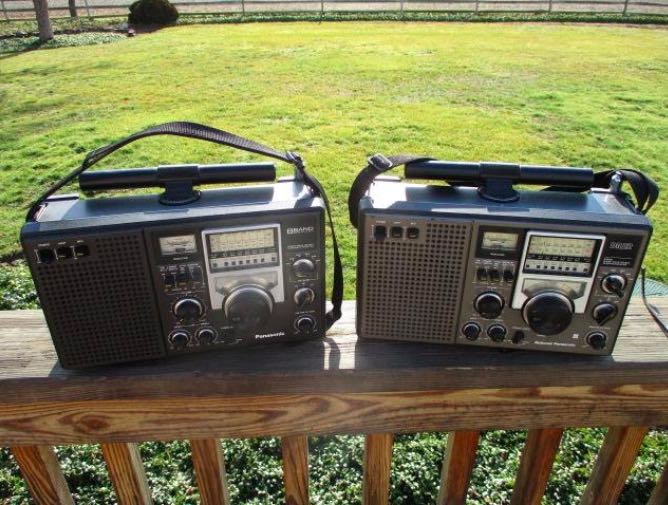
Photo 5. Side by side comparison.  Panasonic RF-2200 on left, National Panasonic DR22 on right.

For those not aware, the RF-2200 was also marketed in Europe as the National Panasonic DR22 and in other parts of the world as the Cougar 2200. My DR22 was an eBay purchase, and that’s the best place to find either model.

DR22s are rather rare compared to the ‘2200 though. First off, one of the major differences with the DR22 is that it runs on either 110 or 220V, and that’s accomplished by a switch on the back of the unit.
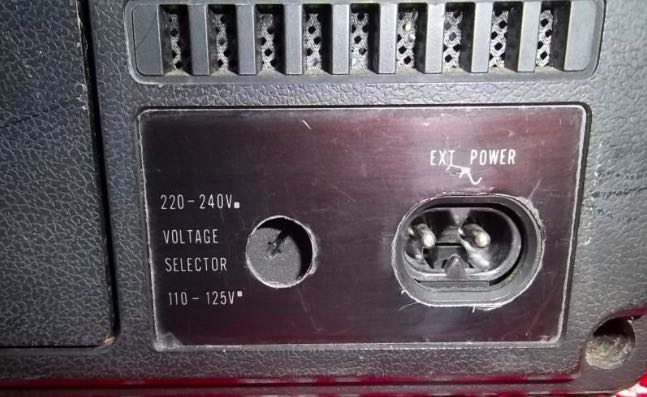
DR22 runs on 120 or 240V via switch on rear panel

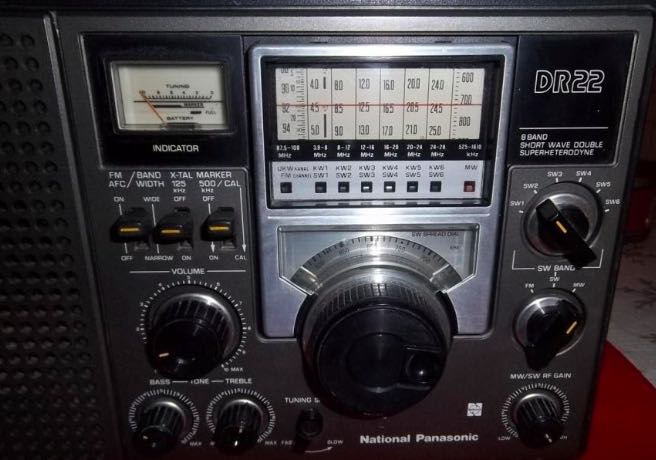
The DR22’s front panel stenciling is slightly different too, as shortwave bands are labeled “KW 1 – KW 6” in addition to “SW1 – SW6”.  Not sure what “KW” means though. Perhaps some reader can enlighten us.

Well, that’s about it, if you want a RF-2200, or DR22 then window shop on eBay.  Lately they have been selling from $40.00 US (parts only) to $455.00 for pristine units. That’s a pretty wide price range and even I’m surprised at the high prices being gotten for clean units.  All I can say is that the two I have now are staying right here in the shack with me.
Thanks for reading and 73’s.


eBay searches (note these eBay partner links support the SWLing Post):


Thank you so much for sharing this excellent post, Mario. Like you, I’m a massive fan of the Panasonic RF-2200; in fact, I own two of them! It is, in my opinion, the best AM/MW portable ever made. 

Post Readers: Any other RF-2200 and DR22 owners out there? Can anyone explain why the DR22 labels shortwave bands as “KW1 – KW6”–?  Please comment!


Do you enjoy the SWLing Post?

Please consider supporting us via Patreon or our Coffee Fund!

Your support makes articles like this one possible. Thank you!

Radio Waves: WBCN, Reactions to AM Digital, More KPH, and Cereal Box Telescopes

Radio Waves:  Stories Making Waves in the World of Radio 

Because I keep my ear to the waves, as well as receive many tips from others who do the same, I find myself privy to radio-related stories that might interest SWLing Post readers.  To that end: Welcome to the SWLing Post’s Radio Waves, a collection of links to interesting stories making waves in the world of radio. Enjoy!

Many thanks to SWLing Post contributors, Mike Terry, Troy Riedel, andGrant Porter for the following tips:


WBCN history reveals revolutionary power in local radio (Boston University News Service)

SOMERVILLE – What started as a midnight to 6 a.m. slot on a failing classical music station, became the voice of a generation in 1970s Boston. Now, more than 50 years after WBCN sparked a “revolutionary new experiment in radio,” the bygone rock station is still making waves.

The 2018 documentary, “WBCN and The American Revolution,” tells the origin story of Boston’s first rock and roll station through a combination of rock hits. Never-before-seen photos, videos and interviews with some of Boston’s most beloved radio hosts, were greeted with cheers at the Somerville Theatre screening Thursday night.

Bill Lichtenstein, who began volunteering with WBCN at 14, directed and produced the film. After crowdfunding and a decade in the making, it has been touring independent theaters and festivals across the U.S. for the last year and a half.

WBCN was grounded in good music. Founded by Ray Riepen, owner of South End music venue The Boston Tea Party, WBCN introduced voices like The Velvet Underground, The Who, Bruce Springsteen and Led Zeppelin to the city, and quickly found a home in Boston’s huge student population. Within three months, the station, run by amateur hosts and young volunteers during classroom breaks, was playing 24 hours per day.[…]


“It Will Make Millions of Receivers Obsolete … This Is Needless” (Radio World)

What people are saying to the FCC about all-digital on the AM band

Radio World is providing an ongoing sampler of comments of what people are telling the FCC about its proposal to allow U.S. stations on the AM band to switch voluntarily to all-digital transmission. Here are more in the series:

Kirk Mazurek told the FCC that he is an avid AM listener who has “invested time and money in equipment towards my hobby as many others have. If this proposal goes through it will make the millions of receivers obsolete requiring the purchase of new equipment. This is needless, there are a lot of people who have vintage radios and a lot of them have been restored. This proposal would make them useless. I urge you not to ratify this proposal.”

Mark Wells raised concern about interference from digital to analog signals on the same channel. “This is especially applicable at night when one is listening to distant stations in out-of-state markets, he wrote. “For example, clear channel stations WBT in Charlotte and KFAB in Omaha are both on both on 1110 kHz. Let’s say one switches to digital, and one does not. As it is they both may fade in and out as the atmosphere does its nightly tricks, but the signals remain mostly useable. But, if one is digital and the other analog would it not ‘blank out’ the analog station?”[…]


Podcast features Coastal Radio Station KPH (DitDit.fm)

There was a time when the airways bristled with Morse Code. There were commercial radio stations all around the world whose business was sending and receiving Morse Code messages to ships at sea. Coast station KPH, located at Point Reyes National Seashore near San Francisco, is one of those stations. Richard Dillman was there in 1997 when KPH sent it’s last message and closed it’s doors. It was the end of the line for the men and women who had spent their careers sending Morse Code to ships at sea. There was nowhere else for them to go…

Two years later, Richard Dillman with a group of volunteers returned to KPH and put it back on the air. Listen as Richard tells us about the future of Maritime Morse Code Coastal Station KPH!


A hydrogen line telescope made from cereal boxes and an RTL-SDR (RTL-SDR.com)

SpaceAustralia.com have recently been hosting a community science project that involves encouraging teams to build backyard radio telescopes that can detect the arms of our Milky Way Galaxy by receiving the Hydrogen line frequency of 1420 MHz.

This can be achieved at home by building a horn antenna out of cardboard and aluminum foil, and a feed from a tin can. Then the Hydrogen line and galactic plane can be detected by using an RTL-SDR, LNA, and software capable of averaging an FFT spectrum over a long period of time.

While most horn antennas are typically made from four walls, one participant, Vanessa Chapman, has shown that even trash can be used to observe the galaxy. Vanessa’s horn antenna is made from multiple cereal boxes lined with aluminum foil and an old tin fuel can. The boxes are held together by some string and propped up by some sticks.

With her cereal box horn antenna combined with an RTL-SDR Blog V3, and an RTL-SDR Blog Wideband LNA, Vanessa was able to use software to average the spectrum over time as the galactic plane passed overhead, revealing the Hydrogen line peak and corresponding doppler shift from the galactic plane.[…]


Do you enjoy the SWLing Post?

Please consider supporting us via Patreon or our Coffee Fund!

Your support makes articles like this one possible. Thank you!
WRMI’s origins in Scituate, MA

(Source: The Patriot Ledger)

WHAT IS IT?

Located off Hatherly Road, the Scituate Proving Grounds was used as an ammunition dump and a testing facility for artillery during World War I. During World War II, it served a different purpose, beaming radio broadcasts to occupied Europe as the transmitter site for shortwave station WRUL. The station’s signal also had strong coverage in Africa, South America and at sea.

LAST WE HEARD

The station traces its origin back to the first shortwave radio license granted in the United States in 1926. In 1936, the station built its transmitters and antennas on the Scituate site, broadcasting university lectures, cultural and news programs from studios on Boston’s Commonwealth Avenue. The call letters stood for World Radio University Listeners.

At the start of World War II, its broadcasts were credited with keeping more than 900 Norwegian ships from being captured by Nazi Germany. The station was used by the U.S. Government during the war, and broadcast the Voice of America service from 1947 to 1953. The station went through some ownership changes and in 1960 its studios moved to New York. The call letters were changed to WNYW in 1966, and the station was knocked off the air by a fire at the Scituate facility in 1967.

When it returned to the air, it was bought by Family Radio in 1973 and was one of only a handful of privately-owned shortwave stations in the United States. Family Radio gradually moved the transmitter site to Okeechobee, Florida. The Scituate transmitters were turned off in 1979.

WHAT’S HAPPENING NOW?

After being vacant for many years, the Hatherly Road property became the site of the Seaside at Scituate Condominiums. As for the station, WYFR went off the air in 2013. Its facilities were taken over by WRMI “Radio Miami,” which is still on the air.

Click here to read the full article at The Patriot Ledger.

Thirty Years of Radio New Zealand’s International Service

RNZI QSL

Yesterday, Radio New Zealand celebrated 30 years of service to the Pacific. Many thanks to SWLing Post contributors Jason Walker and Peter Marks for sharing the following story and audio from Radio New Zealand:

On 24 January 1990, Radio New Zealand International beamed into the Pacific, on a new 100 kilowatt transmitter.

New Zealand has had a short-wave service to the Pacific since 1948. The station broadcast on two 7.5kw transmitters from Titahi Bay, which had been left behind by the US military after the Second World War.

In the late 1980s, following growing political pressure to take a more active role in the Pacific area, the New Zealand government upgraded the service.

A new 100kw transmitter was installed and, on the same day the Commonwealth Games opened in Auckland, the service was re-launched as Radio New Zealand International.

“What we were able to understand was how important radio was and still is in the Pacific, where as here radio had become a second cousin to television… different thing in most of the countries we worked with,” said RNZ International’s first manager was Ian Johnstone, from 1990 to ’93.

Mr Johnstone said news of a dedicated Pacific service into the region was welcomed by Pacific communities.

He also said it was important for New Zealanders to remember that New Zealand is part of the Pacific.[…]

Continue reading the full article and listen to embedded audio at Radio New Zealand.

Audio:

Click here for the audio links.

Shortwave Radio Audio Archive: A treasure trove of radio history and nostalgia

One of the most amazing things about hosting and curating a massive collection of shortwave radio recordings is listening to each recording as they’re published on the site.

I created the Shortwave Radio Audio Archive (SRAA) in 2012 as a dedicated space to post and share off-air recordings with the world. Listening to SRAA recordings and subscribing to the podcast is 100% free, and entirely void of any advertising. The fact is, I pay for this site out of my own pocket, although some of your generous coffee fund and Patreon gifts are used to reinforce the archive’s longevity and future.

Not only does the SRAA serve as a historical record of radio–and even as audio samples for musicians–it’s also for radio listeners like us to enjoy.  We have over 3000 podcast and RSS subscribers. We invite you to subscribe as well as to contribute content in the form of your own radio recordings!

Great content, great contributors

Speaking of recordings, check out a sampling of our latest offerings from our amazing contributors:

Note that you can subscribe to the Shortwave Radio Audio Archive as a podcast via iTunes or by using the following RSS feed: http://shortwavearchive.com/archive?format=rss You can also listen via TuneIn.

Of course, one of the best ways to listen to recordings and read all of the recording notes is by visiting the SRAA website.


Do you enjoy the SWLing Post?

Please consider supporting us via Patreon or our Coffee Fund!

Your support makes articles like this one possible. Thank you!
Radio West catalog at American Radio History

Many thanks to SWLing Post contributor, Zack Schindler, who writes:

Oh this brings back memories. I bought a lot of stuff from Radio West. Here is their catalog from 1983. Had them install a Collins mechanical filter in my Kenwood R-1000.

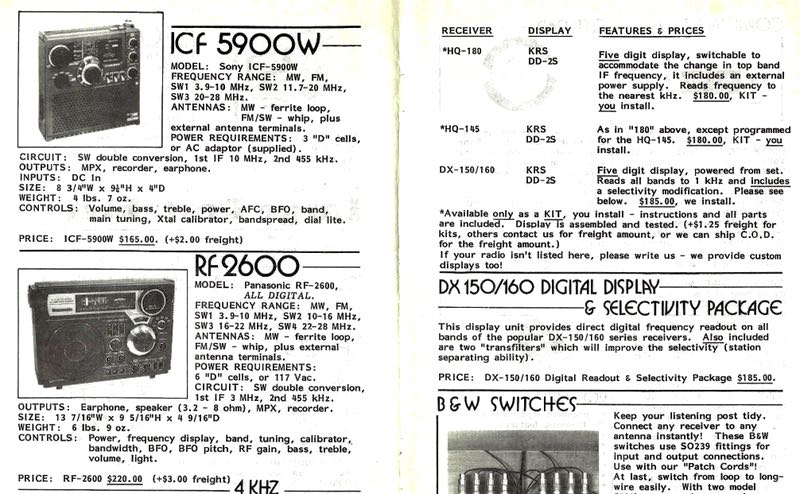
Click here to download Radio West Catalog 5 (PDF).

Thanks for sharing this bit of retail nostalgia, Zack!  This download is one of thousands available at the excellent American Radio History website.

Any other patrons of Radio West?  Please comment!

KPH Article on TechCrunch and Bay Area Backroads

Cypress tree avenue towards KPH. Photo by Frank Schulenburg via Wikimedia Commons

Many thanks to SWLing Post contributor, Dan Van Hoy, who writes:

“The Last Radio Station,” an article about maritime radio station, KPH, is up on TechCrunch ( https://techcrunch.com/2020/01/18/the-last-radio-station/ ).

KPH is silent on maritime frequencies, but through the hard work of volunteers continues operation 24/7 with a 3-30MHz KiwiSDR receiver (http://198.40.45.23:8073/) and various activities throughout the year. Full information on all things KPH can be found the excellent Maritime Radio Historical Society Website (http://www.radiomarine.org/).

Finally an excellent “Bay Area Backroads” episode about KPH is available on Youtube:

Can you copy the CW message at the end of the show?

Please comment if you can copy the CW message!

Thanks to much for sharing this, Dan!