Category Archives: Schedules and Frequencies

Latest version of DXtreme Reception Log now available for download

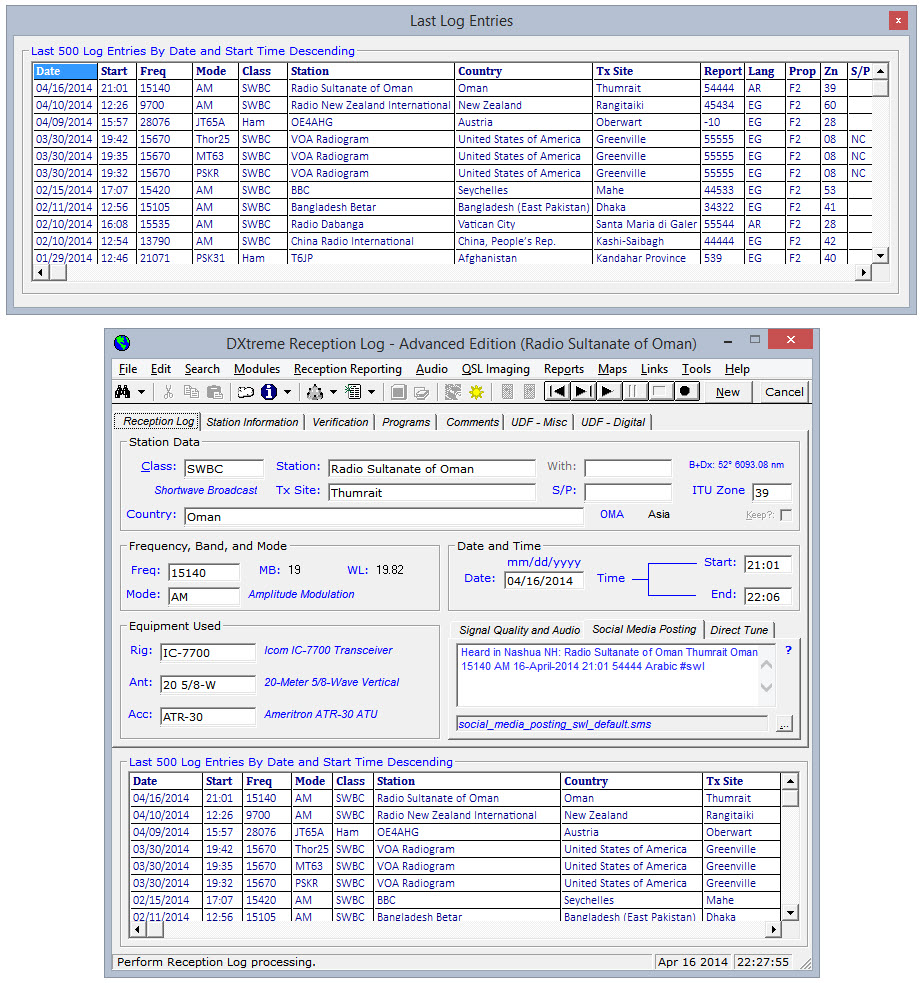
last_log_entries_window_and_reception_log_windowI just received the following note from SWLing Post sponsor, Bob Raymond (NE1I), at DXtreme software:

“I am pleased to announce that the latest version of our logging software for radio and TV monitoring enthusiasts is now available: DXtreme Reception Log — Advanced Edition, Version 9.0.”

For details, check out the DXtreme Reception Log — Advanced Edition, Version 9.0. full press release (PDF).

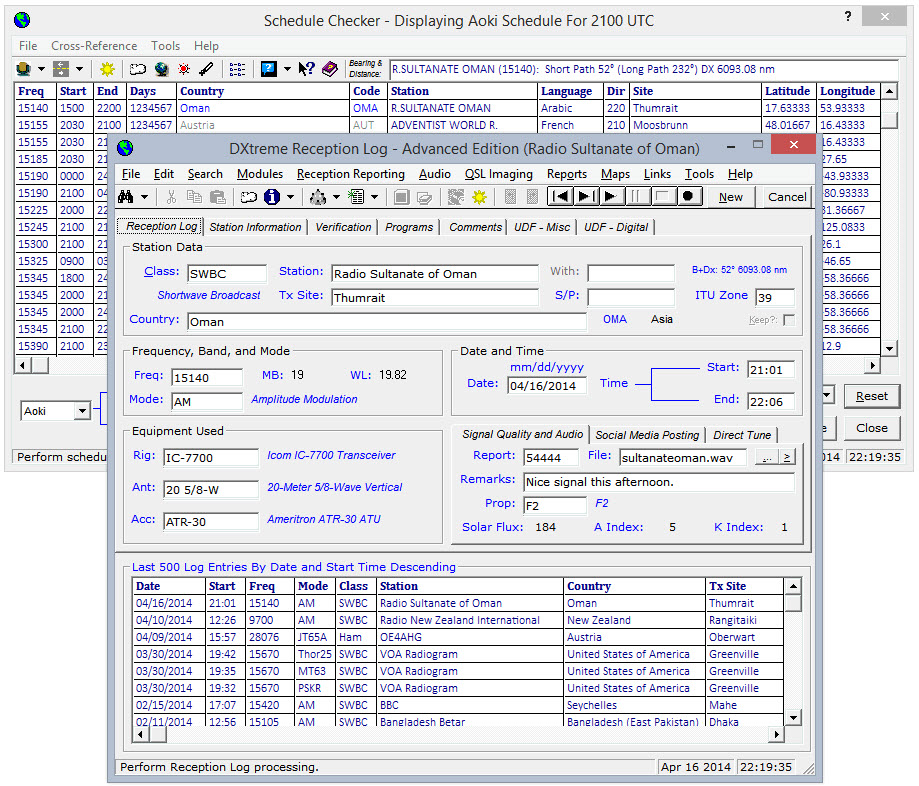
schedule_checker_and_reception_log_wndow

And many thanks to DXtreme for supporting the SWLing Post!

Sean crunches the language numbers

Sean Gilbert, International Editor at WRTH, writes:

I have completed my season-on-season analysis of the top 18 languages used by SW broadcasters. I chose 18 because it is the number we use in our bargraph file (odd number I know, but 18 just fits nicely and it is difficult to find many more colours that are sufficiently different from one another to be easily distinguishable in print).

SeanGilbert-Analysis

If you study the image [click to enlarge], you can see the how the output of various popular languages is declining with each passing season. There are a few surprises, like the 15% increase in German output this season over B13 (but the bigger picture is that it has reduced by nearly one half since B10 -when I first started this analysis). English output has been cut by over 1/3, Spanish, Russian, Farsi, Indonesian, Portuguese and German have all reduced by about 50% from B10.

A couple of languages, however, stand out as being fairly static – Chinese and Tibetan. Chinese (that is mainly Mandarin and Cantonese dialects) has reduced by a mere 5.7% since B10, and Tibetan output by less than 1%.

There can be no doubt that International Shortwave Broadcasting is in its ‘twilight years’ now, but there is still a goodly amount of different programming to listen to, from a large number of stations.

To emphasise that point, for the A14 season, we have the full schedules of 196 international and clan/target broadcasters in our A14 schedules pdf file (which can be downloaded for free from the WRTH website).[…]

I may, at some point in the future, delve in to my archives and see if I have any usable data that will allow me to go further back with this study.

Many thanks to Sean Gilbert and the WRTH for making this analysis available!

You can pick up your copy of WRTH at Universal Radio or Amazon.com.

WRTH 2014 Summer (A) season available for download

wrth-2014(Source: Sean Gilbert, WRTH)

The WRTH Editorial team is pleased to announce that the A14 International broadcast season schedules are now available for free download from the WRTH website, navigate to: http://www.wrth.com and follow the links.

The file is in PDF format and will require the free Adobe Acrobat reader (http://www.adobe.com).

Included in the 76 page, 3MB, file are the full summer ‘A’ Season broadcast schedules for International and Clandestine & Other Target broadcasters and DRM, Selected language broadcasts. Also a by frequency listing of the above schedules and a table of sites and site codes used.

We hope you find this a useful accompaniment to the printed WRTH edition.

Please feel free to pass this information on and/or repost on social media as you wish.

73, and good listening!
Sean D. Gilbert, International Editor –

WRTH (World Radio TV Handbook)
On behalf of the WRTH Editorial team.

PCJ International test broadcast: May 18, 2014

PCJ-Prop-Map

Keith Perron notes that PCJ International will be doing their first test broadcast from the shortwave radio site they have built in Taiwan. Keith notes: “To cut down the bureaucratic process of registering the frequency with the NCC, RTI [Radio Taiwan International] will be letting us use one of their frequencies for the test.”

Here are the details:

  • Target: Southeast Asia
  • Time: 1300 – 1400UTC
  • Frequency: 11765khz
  • Power: 20kW

Detailed reception reports will be appreciated.


Radio Australia in NA: best times and frequencies on Saturdays?

ABC-GrandstandMy good friend, Rob De Santos, is trying to identify the best times and frequencies to hear Radio Australia across North America on Saturdays. Can you help him?

Rob writes:

“I am updating a page on my website with shortwave info on Radio Australia’s Grandstand coverage of Australian football. Typically this occurs on Friday night / Saturday morning US time (0330 to 1230 UTC Saturday, varies). As you all know, RA does not target North America and hasn’t for some time however some of the frequencies can be heard here.

I can tell you which ones I can hear in Columbus, OH but that doesn’t really give me much feel for all of the USA or Canada so I need your feedback. What is best in Vancouver, BC and Naples, FL are not likely identical and not at the same hours.

Which RA frequencies are best at your location between 0330 and 1230 UTC Saturdays? Are there particular hours better than others?

If you can [comment here] with the best frequencies and your QTH that would be terrific. The more geographic diversity and individual experience I can get the better advice I can give on the web page.

Thanks,
Rob de Santos”

Readers: if you can help Rob, please comment below.  Many thanks in advance!

The Mighty KBC: surfing the shortwaves

Many thanks to Peter Quinn at The Mighty KBC for sharing the following announcement for his new summer radio show:BigBeachRadio-KBC

“Great news if you love surf music and like exploring shortwave radio. The Big Beach Radio Show is coming to The Mighty KBC Europe on 6095 kHz for the summer of 2014. The show’s presenter Peter Quinn describes the venture as “a mirage of the perfect day on the beach.”

Peter has been heard on a range of radio stations over the years including Radio Caroline, The Voice of Peace, Island Sound Malta and numerous UK and European radio stations. He says he’s delighted to be appearing on The Mighty KBC and cordially invites you to catch some surf on shortwave every week at 11.00 UTC .

The show starts Saturday 19th April and goes to air whatever the weather. The Big Beach Radio Show Station – The Mighty KBC Freq – 6095 kHz ( 49 meter band shortwave) Day – Saturday Time – 11.00 UTC

Shortwave.am: a new online frequency guide

ShortwaveAMA few SWLing Post readers have recently recommended that I check out a new shortwave radio schedule site: shortwave.am.

Shortwave.am has a unique layout that lists broadcast schedules along with a map that displays broadcast footprints (both short and long path).

Fortunately, I was able to get in touch with the site developer, Stephen Cooper, who frequently comments on the SWLing Post.

Stephen kindly answered a couple of questions I posed.

My first question was why, with the number of shortwave schedule sites on the Internet, he felt motivated to create a new site.  Evidently, inspiration came from Stephen’s Android app, Shortwave Radio Schedules. He responds:

I first created the [Shortwave Radio Schedules] app to give me searchable listings on my phone which I found interfered much less with my radio than on my PC so I could turn my PC off and look at frequencies and schedules on a phone/tablet.

Since then I have just added extra features that I find useful, such as the ability to save logs including the station name, time, SINPO, a comment and a recording of the audio. I’ve used the app to then share my logs to Facebook groups, DXLD Yahoo Group etc. including the audio recordings made on the app.

The maps option I added because I had been using AOKI listings with the beam direction to try and work out favourable beam directions of broadcasts for me in the UK even if they were not targeted to Europe. I realised that it would be much easier to visualise this on a map and started looking at the Google Maps API to work out this would be possible on the app.

Once I added to the app I had noticed screenshots of the maps being posted on groups such as the Rally DX 2012 Facebook group’s and a few people who didn’t have Android asking if there was a web version. I looked into it and it wasn’t too hard to create shortwave.am after converting the Java code to PHP:and Javascript then the site was complete.”

When I asked Stephen what made his site differ from others, he responded:

“[I]t uses data from a combination of Eibi and AOKI to display the listings with maps showing the beam direction. It can also show estimate long paths of each broadcast and uses AJAX web technologies to show search results and maps without having to reload the page for each search or change of parameters.

[…]If you choose a station or language or both and click “Save” (next to the “Set Defaults” part of the site) it will set these as the default that will open each time you go to the site.

Also if you click on a transmitter it now shows all broadcasts coming from that transmitter.

[…]I am going to add some more of the features from the [Shortwave Radio Schedules] app such as the ability to add logging reports, view others reception reports from each station and the options to add recordings of a station and listen to others recordings.”

I think shortwave.am is fantastic, and I’m glad Stephen has put the time behind developing it in his spare time.

Stephen is eager to hear your comments, as he wishes to further develop the shortwave.am. Either post them here, or email Stephen directly.