 WRTH has just announced that updates to the A season international radio broadcasting schedules are available to download on WRTH’s website.
This update includes the cuts and changes to VOA/RFA/RFE etc.
WRTH has just announced that updates to the A season international radio broadcasting schedules are available to download on WRTH’s website.
This update includes the cuts and changes to VOA/RFA/RFE etc.
 For your listening pleasure: three hours of Radio New Zealand International, recorded on June 28, 2014 starting around 7:59 UTC on 9,700 kHz.
This recording begins with the The RNZI interval signal: the charming and unmistakable call of the New Zealand Bellbird. After top-of-the-hour news breaks, you’ll hear Peter Fry’s music request show Saturday Night (click hear to read more about Fry).
SWLing Post reader, Mike, recently informed me that Peter Fry will be retiring this week. His last show will be next Saturday (July 5th). I will certainly miss hearing Peter Fry on the air, but wish him the best in retirement.
Click here to download this recording of RNZI as an MP3, or simply listen via the embedded player below:
The High Frequency Co-ordination Conference’s (HFCC) test of the International Radio for Disaster Reduction (IRDR) broadcasts are on track for June 5-6, 2014.
Many thanks to SWLing Post reader, Mehmet Burk, who has posted the updated schedule on his website, Relief Analysis.
Mehmet also shares this message from HFCC Board member, Oldrich Cip, who mentions a special QSL card that will be issued for IRDR reception reports:
“The Trial of International Radio for Disaster Relief on June 5th and 6th during the Jakarta ABU Media Summit is approaching quickly. The last updated version of the Trial programme is available in a presentation here:
http://hfcc.org/doc/HFCC_RAD_2014-004-IRDR_Jakarta_Presentation.pdf
Let me ask all organisations taking part in the Trial to check on the Trial programme schedule and ask for any changes or additions of the technical details that might be still needed. More details about the IRDR and about the Trial and its background are here:
http://hfcc.org/humanitarian/irdrtrial.phtml
The interest in the Trial created among participants indicates that it is real to set up a world-wide system of a voluntary, disaster relief shortwave radio with tools and services that are already in place. Publicity is needed to raise awareness in the world community about it – since the on-going cuts of shortwave installations might make this increasingly difficult.
Please kindly spread the word about it and encourage people to listen to the Trial programmes. Reception reports will be confirmed by special QSL cards.”
Again, check out Mehmet Burk’s IRDR updates on Relief Analysis.
Many thanks to SWLing Post reader, Richard Cuff, for forwarding this press release from the BBC World Service Group Communications:

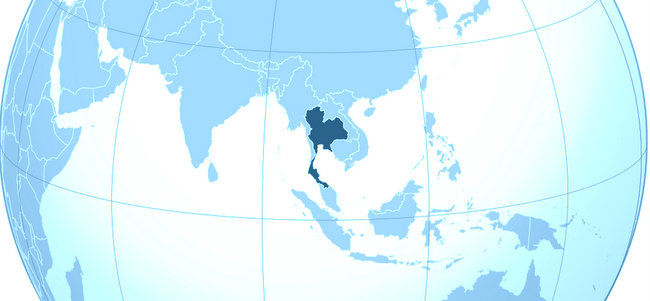
26 May 2014. As authorities in Thailand take key national and international channels off air in the country, BBC World Service has increased its shortwave English-language radio broadcasts to Thailand, to continue the delivery of its independent news and analysis to audiences there.
From 01:00 GMT on Monday 26 May, BBC World Service expanded its availability via shortwave to Thailand by adding [ten] hours of broadcasts to its daily shortwave schedule (all times GMT):
Acting Director, BBC World Service Group, Liliane Landor says: “In times of national crisis, there is an acute need for accurate, trusted and impartial news. This is why, with our international TV news channel off the air in Thailand, we have increased BBC World Service radio broadcasts in the country.”
The above transmissions add to BBC World Service’s six hours of shortwave broadcasts at peak times for Thailand.
Ends//
For more information about the military coup in Thailand, and how it affects international broadcasting, please follow our tag: Thailand Coup
[Update 27 May 2014: Number of broadcast hours corrected. HT to Dan Ferguson and Richard Cuff]
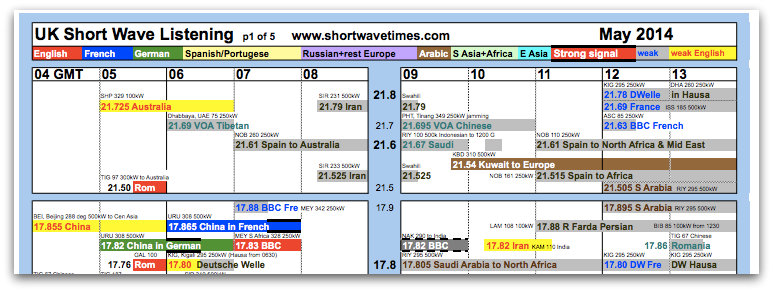
SWLing Post reader, Alex, has just informed me that he’s updated his printer-friendly shortwave frequency charts for the summer broadcasting season. Alex mentions that he posted English in Europe on one A4 sheet, plus 5 A4 sheets running through the vast majority of stations that can now be heard in Europe.
Note that Alex creates his charts based on listening to broadcasters rather than importing schedules from other sources.
You can download the free charts on his website:
Shortwavetimes.com
Many thanks, Alex!
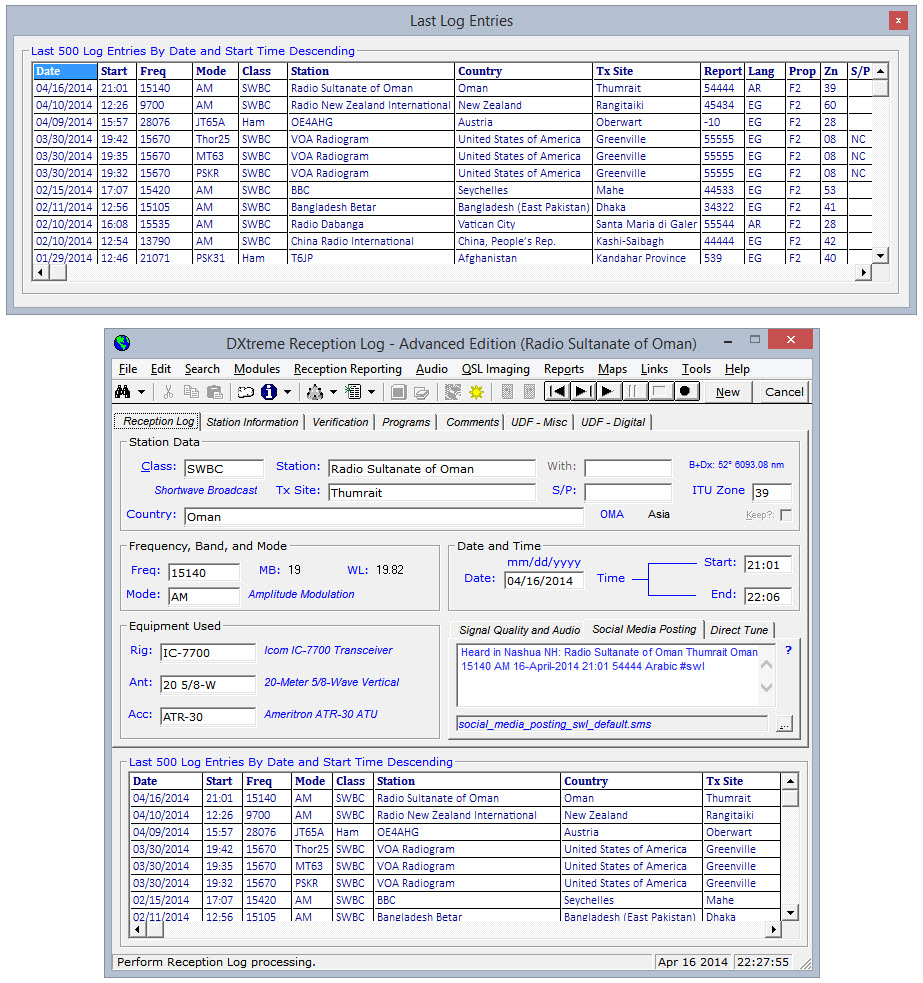 I just received the following note from SWLing Post sponsor, Bob Raymond (NE1I), at DXtreme software:
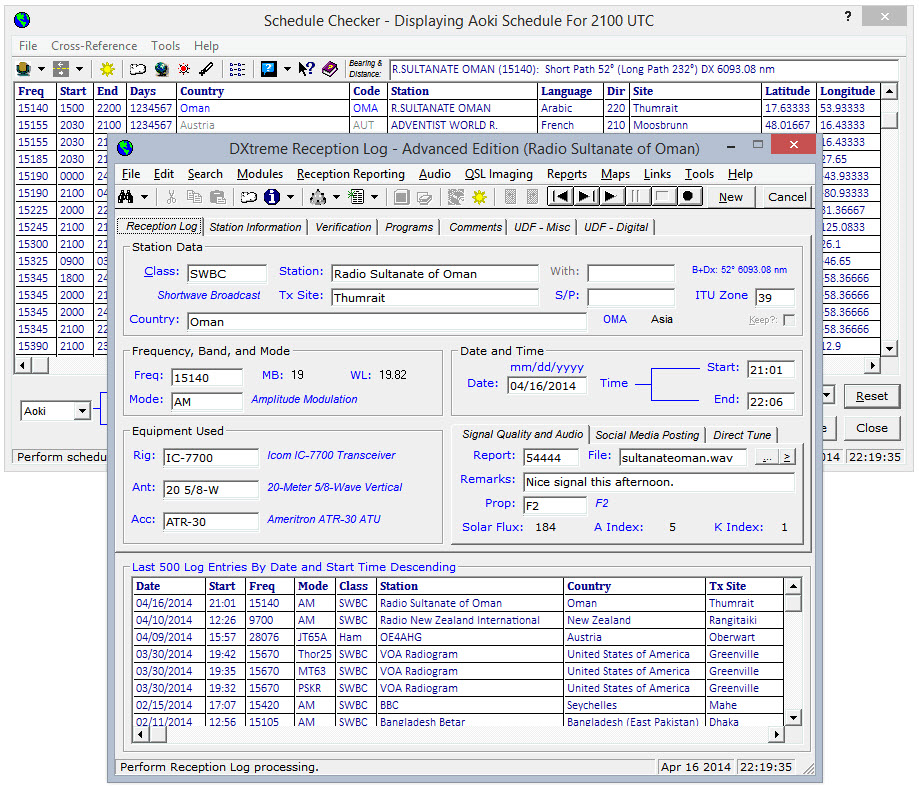
“I am pleased to announce that the latest version of our logging software for radio and TV monitoring enthusiasts is now available: DXtreme Reception Log — Advanced Edition, Version 9.0.”
For details, check out the DXtreme Reception Log — Advanced Edition, Version 9.0. full press release (PDF).
And many thanks to DXtreme for supporting the SWLing Post!
Sean Gilbert, International Editor at WRTH, writes:
I have completed my season-on-season analysis of the top 18 languages used by SW broadcasters. I chose 18 because it is the number we use in our bargraph file (odd number I know, but 18 just fits nicely and it is difficult to find many more colours that are sufficiently different from one another to be easily distinguishable in print).
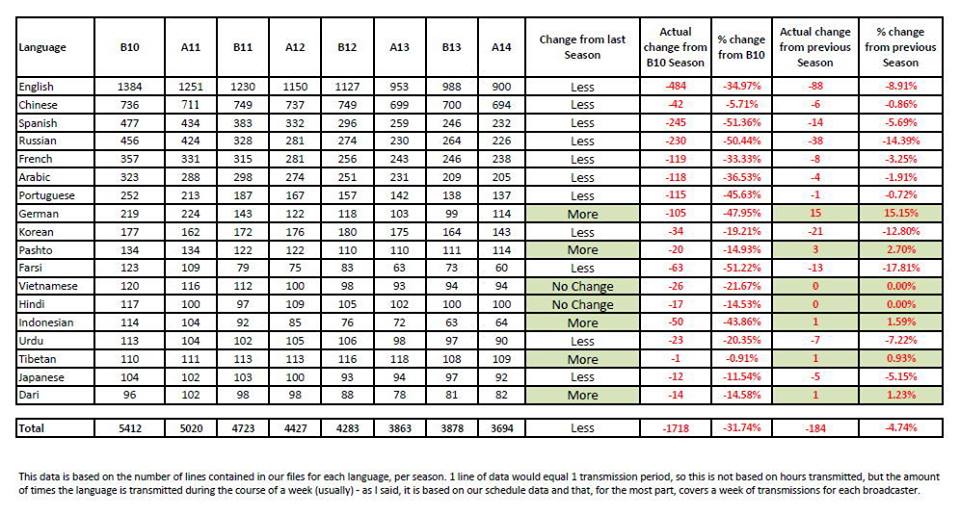
If you study the image [click to enlarge], you can see the how the output of various popular languages is declining with each passing season. There are a few surprises, like the 15% increase in German output this season over B13 (but the bigger picture is that it has reduced by nearly one half since B10 -when I first started this analysis). English output has been cut by over 1/3, Spanish, Russian, Farsi, Indonesian, Portuguese and German have all reduced by about 50% from B10.
A couple of languages, however, stand out as being fairly static – Chinese and Tibetan. Chinese (that is mainly Mandarin and Cantonese dialects) has reduced by a mere 5.7% since B10, and Tibetan output by less than 1%.
There can be no doubt that International Shortwave Broadcasting is in its ‘twilight years’ now, but there is still a goodly amount of different programming to listen to, from a large number of stations.
To emphasise that point, for the A14 season, we have the full schedules of 196 international and clan/target broadcasters in our A14 schedules pdf file (which can be downloaded for free from the WRTH website).[…]
I may, at some point in the future, delve in to my archives and see if I have any usable data that will allow me to go further back with this study.
Many thanks to Sean Gilbert and the WRTH for making this analysis available!
You can pick up your copy of WRTH at Universal Radio or Amazon.com.