Category Archives: Schedules and Frequencies

Off air recording of the Shortwave Shindig?

ShindigLogoWhite

Are there any SWLing Post readers out there who could make an off air recording of the Shortwave Shindig broadcast tonight (22:00 EST, 02:00 UTC)? If so, please comment!  I would like to share your recordings on the Shortwave Radio Audio Archive.

Please note the type of radio used and what part of the world you live in. The more recordings, the merrier! Thank you!

The Shortwave Shindig goes live on shortwave Friday 3/14/14 from the 27th Annual Winter SWL Festival in Plymouth Meeting, PA. The Shindig signs on for one hour at 10 ET/0200 UTC on 7,570 khz via WRMI’s new Okeechobee facility. Please join us for a celebration of the art and culture of long distance listening.

Listen to the Shortwave Shindig live: Friday on WRMI 7,570 kHz

ShindigLogoWhite

If you can’t make it to the Winter SWL Fest this year, you can still listen to one hour of David Goren’s Shortwave Shindig via a live broadcast through WRMI. Here are the details:

The Shortwave Shindig goes live on shortwave Friday 3/14/14 from the 27th Annual Winter SWL Festival in Plymouth Meeting, PA. The Shindig signs on for one hour at 10 ET/0200 UTC on 7,570 khz via WRMI’s new Okeechobee facility. Please join us for a celebration of the art and culture of long distance listening.

Be sure to check out David Goren’s website: Shortwaveology.net

Frequencies added to PCJ 5th Anniversary Special

pcj(Source: PCJ Press Release)

On March 12th, 2014 PCJ Radio International will celebrate it’s 5th Anniversary. For this special event we will broadcast a special program.

Date: March 12, 2014 (UTC)

  • North America – 0130 to 0230 UTC – 7730khz
  • Africa – 1330 to 1430 UTC – 15720khz
  • Asia – 1330 to 1430 UTC – 9335khz
  • Europe – 1330 to 1430 UTC – 5995khz
  • Europe – 1330 to 1430 UTC – 15455khz

A special QSL will be issued for this broadcast.

PCJ Radio International would like to thank sponcers The Spectrum Monitor and C. Crane Radio. Anyone that orders a product from C. Crane Radio and mentions PCJ Radio International will receive a free gift.

Horizon FM Tenerife now on shortwave

524px-Tenerife_locatorThanks to Mike Barraclough for this info:

“Horizon FM Tenerife has started broadcasting on shortwave on 5,780 [kHz], 75 watts at the moment, short English announcement on their website.”

More information can be found here along with an announcement that Horizon plans to increase output power to 1kW within the next three weeks.

Mike originally posted this info on the Cumbre DX FB page.

Nothing on shortwave? I still disagree.

SpectrumDisplay-31Meters-WinRadioExcalibur

One of the most popular posts on the SWLing Post is one published nearly two years ago: “Is there anything to listen to on shortwave?

In that article, I posted recordings made on the 31 meter band of eight different broadcasters, all of which I found within a 250 kHz chunk of bandwidth on a Friday afternoon.

On February 8th (this past Saturday), I recorded a 160 kHz chunk of spectrum on the 31 meter band with my WinRadio Excalibur, starting around 1:00 UTC and lasting for about 9 hours.  I made this spectrum recording in attempt to capture the Voice of Korea on one of their three scheduled frequencies.

While VOK wasn’t audible enough to make a good recording, I did log the following stations all within this thin slice of radio spectrum (click on links for recordings):

I’m guessing that I only logged 50% of what I heard as this list was put together from a quick scan through the recording. In fact, I’m systematically making recordings of each of these broadcasts, from the spectrum file, and adding them to the Shortwave Radio Audio Archive. I may actually discover more stations in the process.

My point is, if you think there’s nothing to listen to on shortwave, you’re simply not listening!

Now back to my radio…

2014 WRTH: A look inside

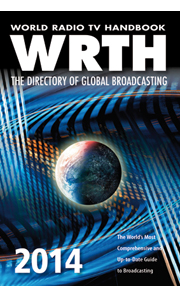
wrth-2014I received my copy of the 2014 World Radio and TV Handbook (WRTH) directly from the publisher a few days ago, just prior to a 24 hour power outage.

As many SWLing Post readers know, I always look forward to receiving this staple radio reference guide each year. While other reference guides have dropped out of the scene, WRTH has remained strong, somehow resistant to the economy’s negative influence upon radio–and the publication’s quality has been wonderfully consistent. It’s no wonder that WRTH has a loyal readership–not only among hobbyists, but also among commercial broadcasters, thus giving it a much broader reader base.

WRTH’s team of noted DXers from around the world curate frequencies and broadcaster information by region; while I’m not sure how they orchestrate all of this, the end result is truly a symphony of radio information. In addition to broadcaster listings, WRTH’s radio reviews, feature articles, and annual HF report make for excellent reading.

But the WRTH isn’t just a frequency guide: the publication always devotes the first fifty or so pages to articles relating to the hobby. Following, I offer a quick overview of these.

The first article always features a WRTH contributor (indeed, it’s this very network of contributors that make WRTH and its listings such a success):  this year, writer Max van Arnhem tells us how he got interested in the hobby and what being a contributor means to him.

FunCubeDongleProPlusThe second set of articles is always my favorite: WRTH receiver reviews. And the review in this issue is no exception. This year, WRTH reviewed the CommRadio CR-1 (which won their Best New Receiver award, and, I was pleased to see, received many of the same good marks I gave it).  They also review the FunCube Dongle Pro+ (above), the new AOR AR6000, the WinRadio Excalibur Ultra (spoiler: the reviewers say it’s the best they’ve ever tested!), the AOR AR8200D handheld receiver, and the YouKits FG-01 Mk II Antenna Analyzer. As I’ve come to expect from this publication, these are all great comprehensive reviews.

The following article is “The History of Shortwave Broadcasting in a Nutshell,” written by noted radio historian and author, Jerry Berg. In just a few pages, Berg takes you through the remarkable history of shortwave radio broadcasting.

SriLankaMap-SM

Following this, noted DXer and WRTH contributor, Victor Goonetilleke, offers a fascinating article focusing on broadcasting on his home island country of Sri Lanka. It’s a enlightening overview of some of the changes that have occurred within the Sri Lankan broadcasting scene (DXers and SWLers will likely recognize many of the stations Goonetilleke mentions).

Voice-Of-VietnamWRTH always highlights a radio broadcaster as well, and this year, it’s the Voice of Vietnam. Despite my many years of hearing VoV on the air, I did not realize how deeply involved they were during the Vietnam War (which took place when I was a kid). The station today prides itself on responding to QSL requests and listener comments.

The final sections of articles are dedicated to the WRTH digital update–this year’s subject is “Digital Future“–and their HF propagation report/forecast.

In summary, this is another great edition of the World Radio TV Handbook. As I’ve said many times, though I use online frequency databases fairly regularly, there is just no replacement for a good printed frequency guide. For DXers who collect QSL cards, you’ll find that broadcaster contact information in WRTH is often more up-to-date than a broadcaster’s own website.

Not only does WRTH contain more in-depth information on broadcasters and schedules, but it makes for quick reference, and doesn’t require a computer or Internet connection–much like, well, your shortwave radio.

Purchase your copy of WRTH 2014 directly from WRTH’s publishers, or from a distributor like Universal Radio (US) or Radio HF (Canada). Happy reading–and listening–in 2014!