Category Archives: Shortwave Radio

The Sony ICF-SW800: A Most Unusual Sony Radio

Many thanks to SWLing Post contributor, Bill Hemphill (WD9EQD), who shares the following guest post:


A Most Unusual Sony Radio

By Bill Hemphill WD9EQD

Over the years, I have owned many of the various Sony shortwave radios.  From analog to digital, I would buy the latest and sell my current radio.  For the past few years, I have been using mainly Tecsun radios and didn’t own any Sony radios anymore.   This changed last year.  I got the urge to acquire a few of the Sony’s that I remember so fondly.  Over several months I bought off eBay four ICF-2010 (one of which works), two ICF-SW100 (one of which works), four ICF-SW1 (none of which works).  After spending way too much money just to acquire two working Sony radios, I started realizing that any Sony radio was probably going to need re-capping – a chore which I am not skilled at.  I could have saved money by just paying the high price for a radio that had already been completely re-capped and working.

During the many hours spent watching eBay, I would occasionally come across a Sony radio that I was not familiar with – the Sony ICF-SW800.  This is a very unusual radio in that it has only two bands – FM and SW.  And the SW band only covers 3.7 to 17.9 MHz  It also has these small credit card size pre-programmed memory cards.  I ended up buying a couple of the radios just to learn what was going on with the memory cards.

The radio is very plain and simple.  Dull black plastic, telescoping antenna, nice flip out tilt stand on the back, very small LCD display that shows time when off or in stand-by and band (FM or SW), frequency and card Preset memory number when card is inserted.  Following are photos of front of radio, without and with card inserted:

Removing the battery cover reveals a storage area for the cards when not in use:

The cards are slid into the slot on the right of the radio.  There is a plastic cover over the keyboard.  This cover is touch sensitive. The plastic has imbedded in it small dots which can detect which part of the screen is being touched.  Without a card inserted, you can select the band (SW EXEC or FM EXEC) and directly enter a frequency using the 0-9 keypad.  Or you can use the manual +/- tune keys.

I had originally thought that the memory cards must be storing the memories in circuitry within the cards.  When I got the first radio and looked at the cards I was really surprised to see that they were just cardboard cards – no circuity.  So how was the radio knowing which card was inserted and what was stored in the memory.

The radio comes with four double side cards. Three of the cards are for the memories while the fourth is a card used to set the clock.  Following are photos of the “L” series cards:

As you can see some cards are pre-programmed for Radio Stations and some are Free Memories for you to program your own station.  But since the memories are NOT stored on the cards, how does the radio know which card is inserted and which memory on the card is selected?

Each card has one or two white tabs on the left of the card.  There are three possible tab locations.  A review of the service manual and the wiring diagram shows that the locations of these tabs make up a binary code for 1 to 7.  (only 7 is needed since the clock card is single sided while the other three cards are double sided)  The clock card has all three white tabs and is thus seven (Tab 1 = 1, Tab 2 = 2 and tab 3 =4 for 1+2+4 = 7).  Then each of the other cards are 1 thru 6 depending on the tab locations.  The radio has infrared leds along with sensors.  By shining a LED light onto the card, the radio can sense which card is inserted and then reference the correct ten memory locations in the storage..

The memories are stored in an EEPROM chip soldered into the radio.  Depending on where the radio was purchased, a different set of memories would be pre-programmed into the chip in the radio.  An associated set of memory cards would be provided with the radio.  There were at least the following different set of memories manufactured with associated card sets as follows:

Area 5/AE7 Austria:

  • (Card Series “I”)
    • Card 1:  Austrian Radio 1/Austrian Radio 2
    • Card 2:  Omnibus 1/Omnibus 2
    • Card 3:  Free Memories 1/Free Memories 2

Area 3/AE7 Swiss:

  • Card 1:  Omnibus 1/Omnibus 2
  • Card 2:  Omnibus 3/Free Memories 1
  • Card 3:  Free Memories 2/Free Memories 3

Area AE6 Germany:

  • (Card Series “A”)
    • Card 1:  Deutsche Welle/Omnibus 1
    • Card 2:  Omnibus 2/Free Memories 1
    • Card 3:  Free Memories 2/Free Memories 3

Area 2/AE7: Scandinavia:

  • Card 1:  Danmarks Radio/Norsk Rikskringkasting
  • Card 2:  Sveriges Radio/ Yleis Radio
  • Card 3:  BBC/Free Memories

Area 6/AE7 Portugal:

Area 7/AE7 Europe:

  • (Card Series “N”)
    • Card 1:  BBC/VOA
    • Card 2:  Free Memories 1/Free Memories 2
    • Card 3:  Free Memories 3/Free Memories 4

Area 7/AE7 International Sales Division in Europe:

  • Card 1:  BBC/Omnibus FM
  • Card 2:  Free Memories
  • Card 3:  BBC/Omnibus SW

Area US United States:

  • (Card Series “L”)
    • Card 1:  Deutsche Welle/Radio Moscow
    • Card 2:  Voice of America 1/Voice of America 2
    • Card 3:  BBC/Free Memories

Area UK United Knigdom:

  • (Card Series “B”)
    • Card 1:  BBC (FM)/Omnibus (FM)
    • Card 2:  BBC World Service/Omnibus (SW)
    • Card 3:  Free Memories 1/Free Memories 2

It should be noted that even though a memory is preprogrammed (in the chip), you could re-program the memory using the “WRITE” feature on the card.  Most of the cards just show memory location 0-9 with no indication of the frequency.  Some cards do indicate the radio station but not the frequency.  For example, Card Series “A”, Deutsche Welle has DW 0 thru DW 9 on the card:

In the packing material that came with my US version, there is a small fold out piece of paper that lists the Memory Presets for each card along with the preset frequency, broadcast time and coverage area:

There is no way to know from the outside of the radio which memory chip was pre-programmed at the factory.  The model number does not differentiate between the regions.   If the back cover of the radio is removed, then there is a printed sticker on the circuit board denoting which region the radio is for.

For example, one of my radios has a sticker with “E” on it to denote that it for the Europe market:

At this point, Sony was trying to market to people who just wanted to listen to their favorite station, be it FM or SW.  Thus a simple to use. pre-programed radio.  Never mind the fact that radio stations may change frequencies, or even disappear entirely.   At least the ICF-SW800 allowed the user to re-program all the memories.

Sony also made two other radios that used the cards for memory.

The first was the ICR-SW700.  This was a two band receiver covering MW and SW.

The second radio was the ICF-M500 which was made for the Japanese market.  This radio was FM/AM two band radio:

Shortwave stations are ACE and so are buses

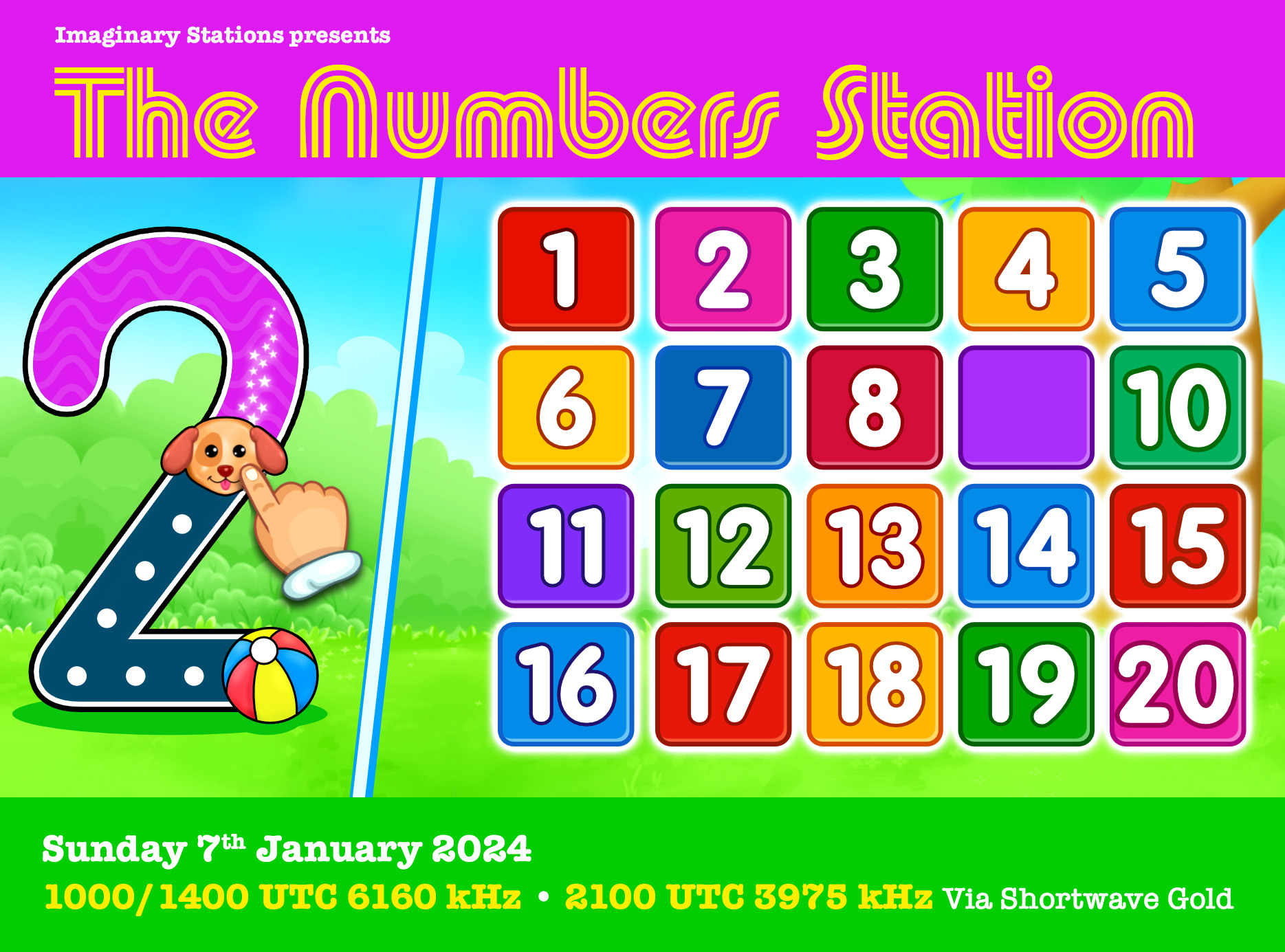
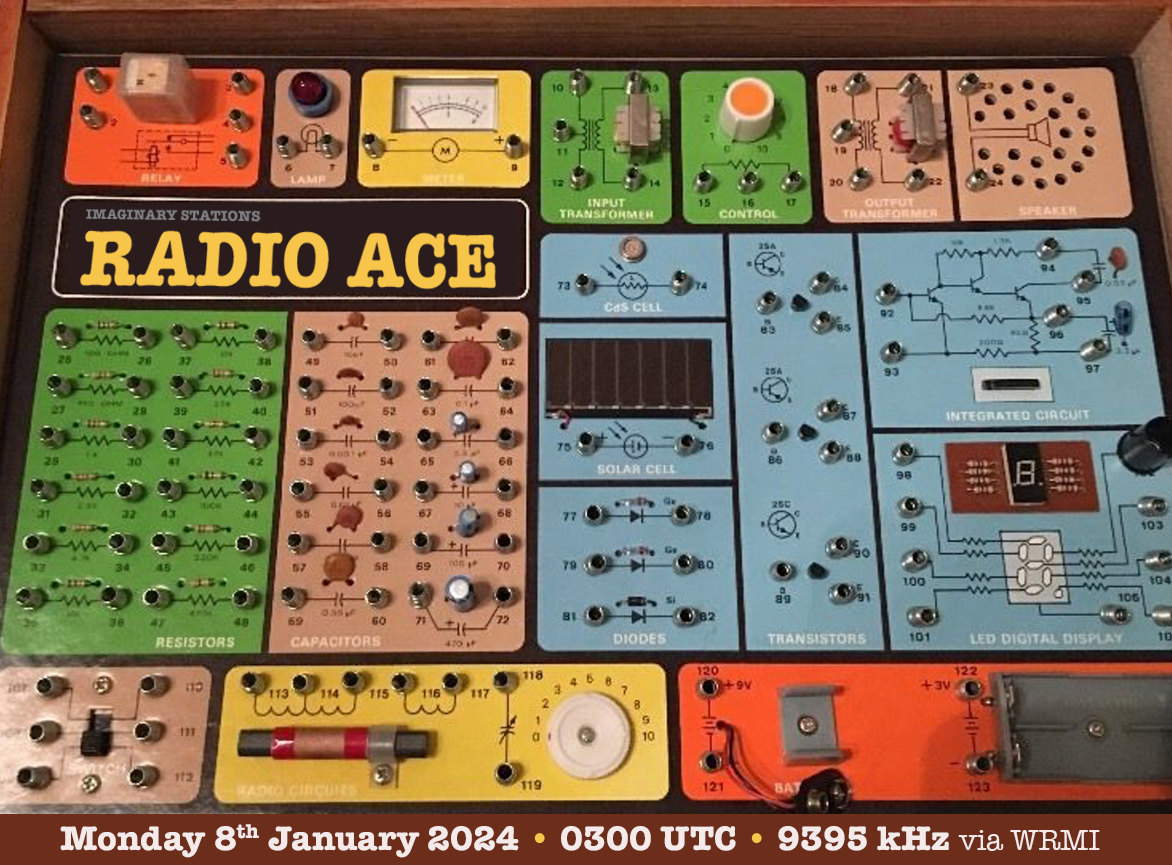
A big hi to all the SWLing Post Community, FastRadioBurst 23 here bringing you news of this week’s Imaginary Stations transmissions. Beamed to Europe via Shortwave Gold on Sunday 22nd October 2023 at 2000 hrs UTC on 3975 & 6160 kHz, we have Radio Ace featuring the Adventures of Flash Frisbone. If you love radio, you’ll love Radio Ace!

A few hours later via the transmitters of WRMI on Monday 16th October we have KBUS. The broadcast is at 0200 UTC on 9395 kHz and then repeated at 0300 UTC on 9455 kHz. Expect some Bus Driver’s classics, Conductor’s sing-a-longs and a collection of sound effects from various ticket machines. Step aboard and enjoy the trip!

For more information on the shows please email [email protected] and check out our old shows here.

Carlos’ Shortwave Art and recording of Radio Havana Cuba (October 14, 2023)

Many thanks to SWLing Post contributor and noted political cartoonist, Carlos Latuff, who shares his radio log art of a recent RHC broadcast.

Carlos’ goal is to vividly illustrate the broadcaster’s message in his own unique artistic style and is not a reflection of his own beliefs or those of the SWLing Post. His objective is for his artwork to add historical context and put a visual with the news, reporting, and broadcast content:


Carlos notes:

Extract from the news bulletin of Radio Havana, Cuba, with the position of the Cuban government regarding the Palestine and Israel conflict. Heard in Porto Alegre, Brazil.

Click here to view on YouTube.

Special Program: Woofferton Transmitting Station’s 80th Anniversary on October 17, 2023

Many thanks to SWLing Post contributor, Dave Porter, who shares the following announcement:

Woofferton Transmitting Station UK – 80th Anniversary – October 17, 2023

To mark this anniversary Encompass Digital Media at WOF will be running a special programme on HF :

Tuesday 17th October 2023 from 1330 – 1430 UTC/GMT

Sender 95 Marconi (BD272 from 1963) 250 kW AM 15245 kHz Array 928 294* for North America

Sender 96 Riz 250 kW AMC 17785 kHz Array 904A 114* for Europe and beyond.

Sender 92 Riz 110 kW DRM 11725 kHz Array 909A 114* for Europe and beyond.

There will be an opening interval signal on all three frequencies.

The programme content will be historical facts of WOF in BBC, VoA, Radio Free Europe, R Liberty ,CBC etc and the later privatised times, DW and VoV for example as well as up-to-date information on DRM as well as personal recollections from many former WOF staff. There will be station idents of services over the years.

There will be a special e-QSL card and the chance to enter a competition to win a historic station artifact and an Woofferton 80th mug.

There may be more details to follow…

Watch this space

73

Dave Porter G4OYX

Broadcast coverage plots

Imagine the sound of international radio

Hi all SWLing Post Community, FastRadioBurst 23 here bringing you news of this week’s Imaginary Stations transmissions. Beamed to Europe via Shortwave Gold on Sunday 15th October 2023 at 2000 hrs UTC on 3975 & 6160 kHz, we have the third episode of Skybird Radio International bringing you music and culture from all over the world. Tune in and enjoy some great jazz, electronica, pop and dub.

A few hours later via the transmitters of WRMI on Monday 16th October we have a different episode of Skybird Radio International. The broadcast is at 0200 UTC on 9395 kHz and then repeated at 0300 UTC on 9455 kHz. No genres or no agendas, just some cool sounds from around planet earth featuring a collection of international platters that really do matter. Enjoy!

For more information on the shows please email [email protected] and check out our old shows here.

Announcing DXtreme Monitor Log 14!

Many thanks to SWLing Post contributor and supporter, Bob Raymond with  DXtreme who shares the following product announcement:


Product Announcement 

DXtreme Monitor Log 14™ 

DXtreme Software™ has released a new version of its popular logging program for radio and TV monitoring  enthusiasts: DXtreme Monitor Log 14. Its familiar, uncluttered, industry-standard Windows® interface lets  listeners and DXers log the stations they’ve heard using features that enhance their monitoring enjoyment.

New Features in Version 14 

Signal Modes, Transmission Modes, Grid Square Tracking 

  • We added a Signal Modes field to let users specify the signal mode their receiver is tuned to (for example,  AM, CW, FM, LSB, USB, RTTY, etc.) plus a Transmission Modes field to let users specify the transmission mode  the station is transmitting (for example, CW, FAX, FT8, HFDL, MIL-STD-188-141A, SSB, STANAG 4285, etc.). And we added Signal and Transmission Mode modules to let users maintain tables of signal and transmission  modes.
  • We added a Transmission Mode Details box to allow users to type free-form information about the  transmission mode received, such as baud rate, bandwidth, etc. (for example, 1200bps/L). New Log Variables enable users to share Signal, Transmission, and Detail mode information so readers (and users) can  reproduce the monitoring environment and log (or relog) the stations. Here are two  examples: “1200bps/L STANAG 4285 crypto tfc on USB” and “MIL-188-110A/B continuous mode idle on LSB.” 
  • We added support for tracking Maidenhead grid squares, which is useful when monitoring/logging stations  not located in traditional countries, like aircraft and ships operating in international airspace and waters. Grid  squares are calculated from specified latitudes and longitudes. Both Performance and Stations reports let you  track grids. Search functions let you find log entries for viewing or editing based on their grid squares.

Verification By Improv Imaging 

Similar to the legacy Verification By Audio feature, where the presence of an audio file in a log entry designates  the station as “Verified By Audio,” we added a Verification By Improv Imaging feature which counts the station as  “Verified By Improv Image” if the Shows ID check box on the Improv Imaging tab is selected, indicating the  presence of an ID on the window of a captured digital software application (such as PC-HFDL).  Performance, Stations, and Log Entries reports let you track verifications by traditional QSLs, presence of Audio  files, and presence of Improv Images for which the Shows ID check box is selected.

Schedule Checker Monitoring Advice and Tuning 

  • When Schedule Checker advises users to monitor a station for a new or verified Country, it does so now for  the Class (SWBC, Ute, Ham, etc.) and QSL Type (Verified By QSL, Audio, or Improv Image) selected in Properties. The foreground and background colors that indicate the Schedule Checker’s monitoring advice can be defined by users in Properties. The colors appear in an upgraded legend on the Schedule Checker.
  • Users can now tune their radios to the schedule item’s signal mode and frequency by selecting the desired  signal mode in the Signal Mode list box and double-clicking the schedule item.

Solar Indices Enhancements 

  • Acquisition of current solar indices has been improved on the Monitor Log and Schedule Checker windows. • Editing of solar indices has been added to the Monitor Log window for when NOAA is down.
  • We restored historic solar indices adjustments based on date and time changes made on the Monitor  Log window provided users have downloaded historic solar indices from the NOAA FTP site into the Solar subfolder. An interface is provided on the Edit menu of the Monitor Log window for this FTP activity.

For more information about New Features, click https://www.dxtreme.com/monitorlog_whatsnew.htm.

Standard Features 

Logging Stations 

Monitor Log 14 lets users log all kinds of stations: radio, television, broadcast, utility, Amateur Radio, military,  etc. across the radio spectrum.

Finding Stations to Monitor 

The Schedule Checker lets users import schedules from Aoki, EiBi, and FCC AM web sites and display broadcast  schedule data according to the filter criteria they specify. Users can filter schedule information by band,  frequency, station, country, time of day, language, and more. EiBi schedules also include utility stations.

For each schedule item, Schedule Checker queries the Monitor Log 14 database to let users know – through user-defined, foreground and background display colors – whether they need to monitor a station for a brand new or verified country. The colors appear in a legend on the Schedule Checker window. When Schedule  Checker advises users to monitor a station for a new or verified Country, it does so for the Class (SWBC, UteHam, etc.) and QSL Type (Verified By QSL, Audio, or Improv Image) selected in Properties.

Reporting Reception 

Users can create customized paper and e-mail reception reports for sending to stations plus log entry data  shares for reporting catches to clubs and magazines. Using the Script Editor window, users can create and edit  scripts that format reception reports, eReports, and shares to their liking. The software prompts users to select  the script they want to use. Dozens of scripts come with Monitor Log 14. Users can also send eQSL requests to  hams automatically via the popular https://www.eqsl.cc site and update their databases with downloaded  eQSL.cc Inbox records.

Imaging 

Improv Imaging lets users associate ad hoc images with log entries using Capture, Scan, and Clipboard  functions. Captures of stations received on digital applications, waterfall displays, facsimile and Amateur TV  pictures are popular. The Improv Imaging tab and Application let users view images anytime, and an Improv  Image Explorer lets them peruse their entire collection and display associated log entries. A QSL Imaging facility  functions the same as Improv Imaging for associating QSLs.

Other Features 

  • Rig Control — Retrieves the frequency and mode from supported radios and permits tuning from the  Schedule Checker and Direct Tune. Rig control is provided through integration with Afreet Omni-Rig  (http://www.dxatlas.com) and CAT for SDR applications like SDR Console (https://www.sdr-radio.com) and SDRuno (https://www.sdrplay.com).
  • Audio Archiving — Lets users maintain an audio archive of stations heard.
  • Reporting and Searching — Produces Performance, Stations, and Log Entry reports that track the  performance and progress of the user’s monitoring station and provides criteria-based log entry searches.
  • Documentation — Context-sensitive Procedural Help, Field Help, and Microhelp are accessible on every  window to provide instructions quickly. Installation Instructions and a Getting Started Guide also included.

Supported Operating Systems, Pricing, Contact Information 

DXtreme Monitor Log 14 runs in 32- and 64-bit versions of Microsoft® Windows® 11, 10, 8.1, 8, 7, Vista® XP.  Retails for $94.99 USD for Internet distribution (discounted pricing for upgrades available). Product support by  Internet e-mail. For more info, visit (https://www.dxtreme.com) or write [email protected].

SWLing Post readers should note that DXtreme was one of our first company supporters. Their ad revenue helps bring the SWLing Post to you daily. Thanks, DXtreme!

Click here to check out DXtreme Monitor Log 11.

Radio Waves: Eclipses and Radio Waves, Radio World’s Letters, Eifel Radio Days Special, and AM Radio for Every Vehicle Act

Radio Waves:  Stories Making Waves in the World of Radio

Welcome to the SWLing Post’s Radio Waves, a collection of links to interesting stories making waves in the world of radio. Enjoy!

Many thanks to SWLing Post contributors Andrea Borgnino, Dennis Dura, ______ for the following tips:


Eclipses do odd things to radio waves. An army of amateur broadcasters wants to find out why (BBC Future)

It’s the huge tower in his back yard that gives Todd Baker’s hobby away. Bristling with antennae, the 30m (100ft) structure is taller than many of the mature trees nearby. Baker, an industrial conveyor belt salesman from Indiana, goes not just by his name, but also his call-sign, the short sequence of letters and numbers that he uses to identify himself over the air: W1TOD. He is a member of the amateur radio, or ham radio, community.

“You name it, I’ve been in it,” he says, referring to different radio systems, including citizens band, or CB radio, that he has dabbled with over the years. “Communications were just plain-o cool to me.”

Now, he dabbles in celestial citizen science, too. On 14 October, he and hundreds of other amateur radio enthusiasts will deliberately fill the airwaves during an annular solar eclipse, as it crosses the Americas. They’ll do it again next April, when a full solar eclipse becomes visible from Newfoundland to Mexico.

Why? Solar eclipses are known to affect radio transmissions, and Baker is planning to take part in a giant experiment designed to monitor how cosmic events affect radio broadcasts. [Continue reading…]

Letters: AM’s Future, Shortwave’s Past and More (Radio World)

[…]Shortwave radios don’t tell tales
Several points of interest regarding shortwave broadcasting. Although I have been retired from Voice of America as a Foreign Service Officer and field engineer for over a decade, several points are still worth noting.

In my experience of living and working around the world for 20 years, most radios sold overseas are a combination AM/FM and shortwave. So there are radios available to the general public.

Second is the beauty of shortwave. Broadcast can be sent over large distances and be highly effective at reaching the desired audience. AM broadcasting can only reach a smaller listener area and without extremely high power must be in rather close proximity to the intended audience. FM broadcasting has even greater limitations in respect to closeness to the intended listener.

As we have adopted new technology such as the global internet, we don’t seem to have a grasp of its inherent limitations. I witnessed this firsthand in the Middle East where websites or information deemed inappropriate are easily blocked or deleted from a country’s internet stream. Proxy servers and other VPN methods do little for the individuals striving for freedom of information. Information regarding using and searching for these services is easily gathered by internet service providers and can be used to intimidate or prosecute.

Shortwave radios don’t tell tales. Frequency memories can be deleted easily, and there is no way to tell what broadcast were being listened to, especially on analog scale radios.

We need to reevaluate our strategic thinking and remember that shortwave works effectively and has for many years. People around the world have relied on SW broadcast for years as a source of reliable news and information that their host countries did not want them to hear.

— Walter Konetsco

[Click here to read the entire article with other reader letters to the editor…]

Eifel Radio Days Anniversary Broadcast

Many thanks to SWLing Post contributor, Gérard Koopal, who shares the following announcement: 

On October 29, 1923, the first “entertainment broadcast” broadcast went on air in the Vox House in Berlin. The first regular radio broadcasts began.

The Eifel Radio Days will celebrate this unique anniversary from October 27th to 30th, 2023.
Of course again live and in mono from the studio in the former alternative headquarters of the NRW state government.

facebook.com/EifelerRadiotage
twitter.com/EifelerRadioTag

https://www.eifeler-radiotage.de/[email protected]

Gérard Koopal

S. 1669, AM Radio for Every Vehicle Act of 2023 (Congressional Budget Office)

S. 1669 would direct the Department of Transportation (DOT) to issue a rule requiring that AM broadcast stations be accessible in all passenger motor vehicles manufactured in, imported into, or shipped within the United States. (Passenger motor vehicles are those designed to primarily carry their operator and up to 12 passengers; the definition does not include motorcycles.) The bill would require DOT to issue the rule within one year of enactment and to report to the Congress at least every five years on the rule’s effects.

Additionally, S. 1669 would require the Government Accountability Office (GAO) to study the role AM broadcasts in passenger vehicles play in disseminating emergency alerts through the Integrated Public Alert and Warning System. That study would need to be completed within 18 months of enactment.

Using information on the cost of issuing similar rules and studies, CBO estimates that implementing the bill would cost DOT and GAO a total of $1 million over the 2024-2028 period. Any spending would be subject to the availability of appropriated funds.

Additionally, S. 1669 would authorize DOT to assess civil penalties on manufacturers that fail to comply with the new rule; such penalties are recorded as revenues. CBO estimates that any additional revenues collected would total less than $500,000 over the 2024-2033 period because the number of violations would probably be small.

Click here to download the full report.


Do you enjoy the SWLing Post?

Please consider supporting us via Patreon or our Coffee Fund!

Your support makes articles like this one possible. Thank you!