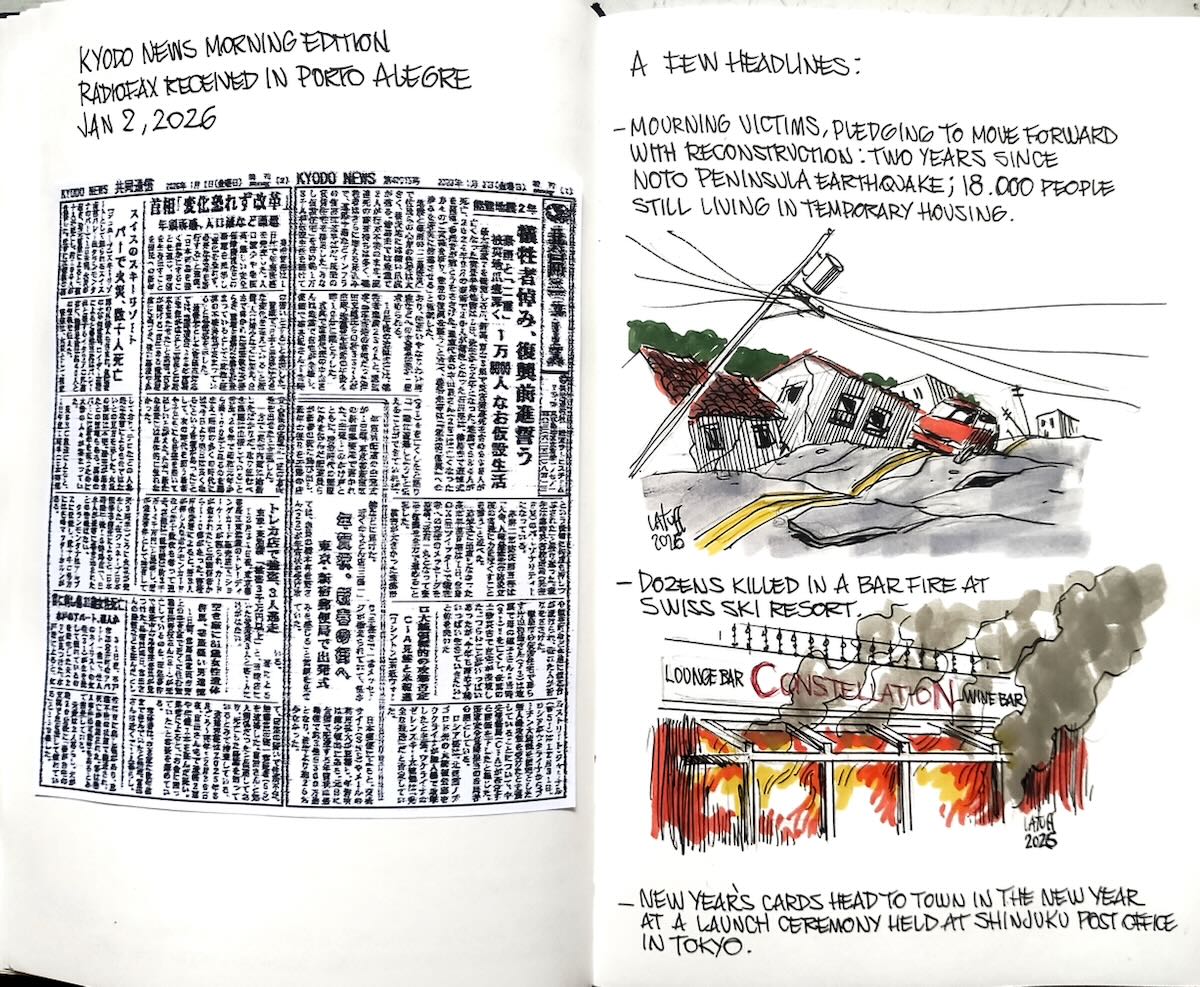
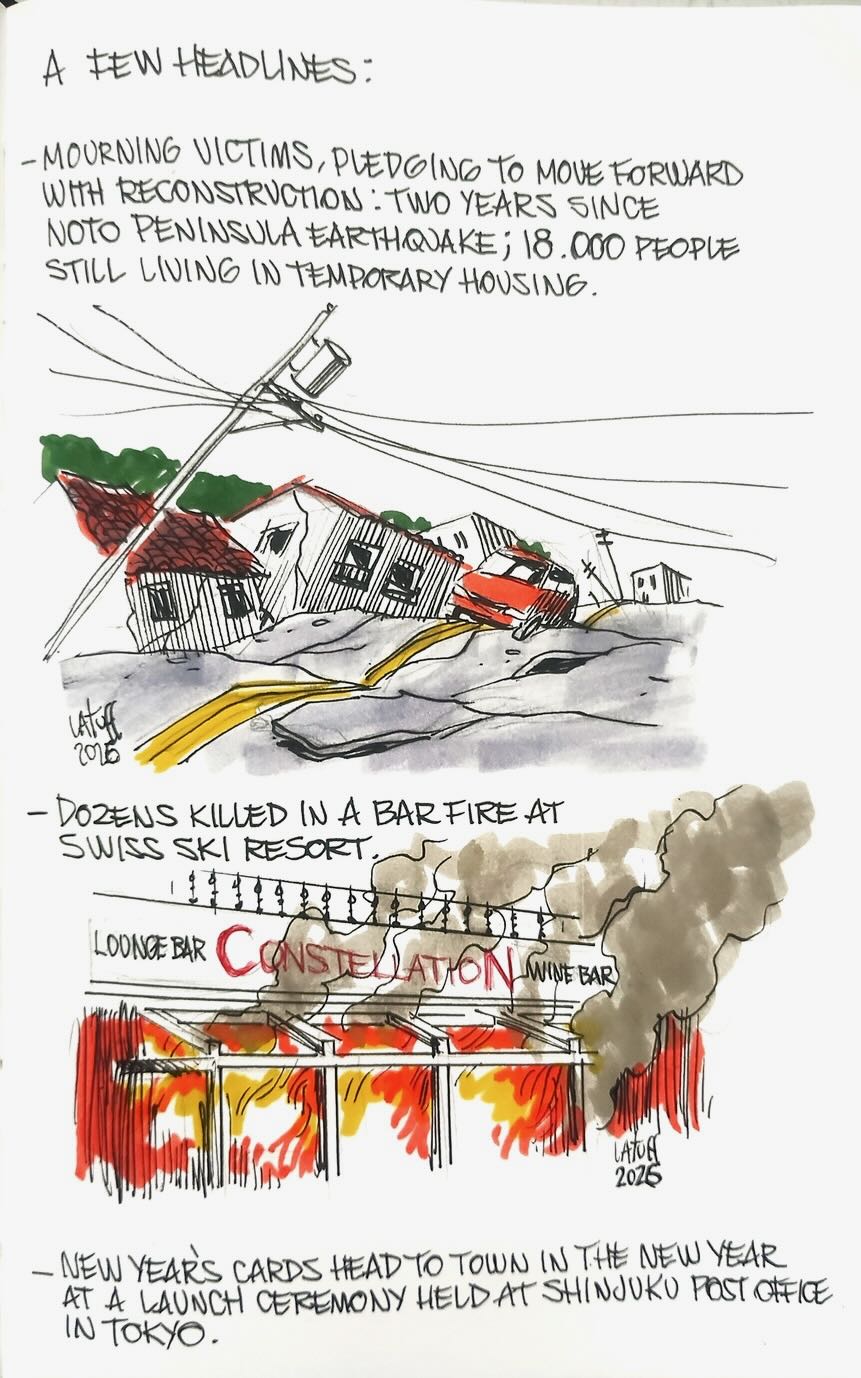
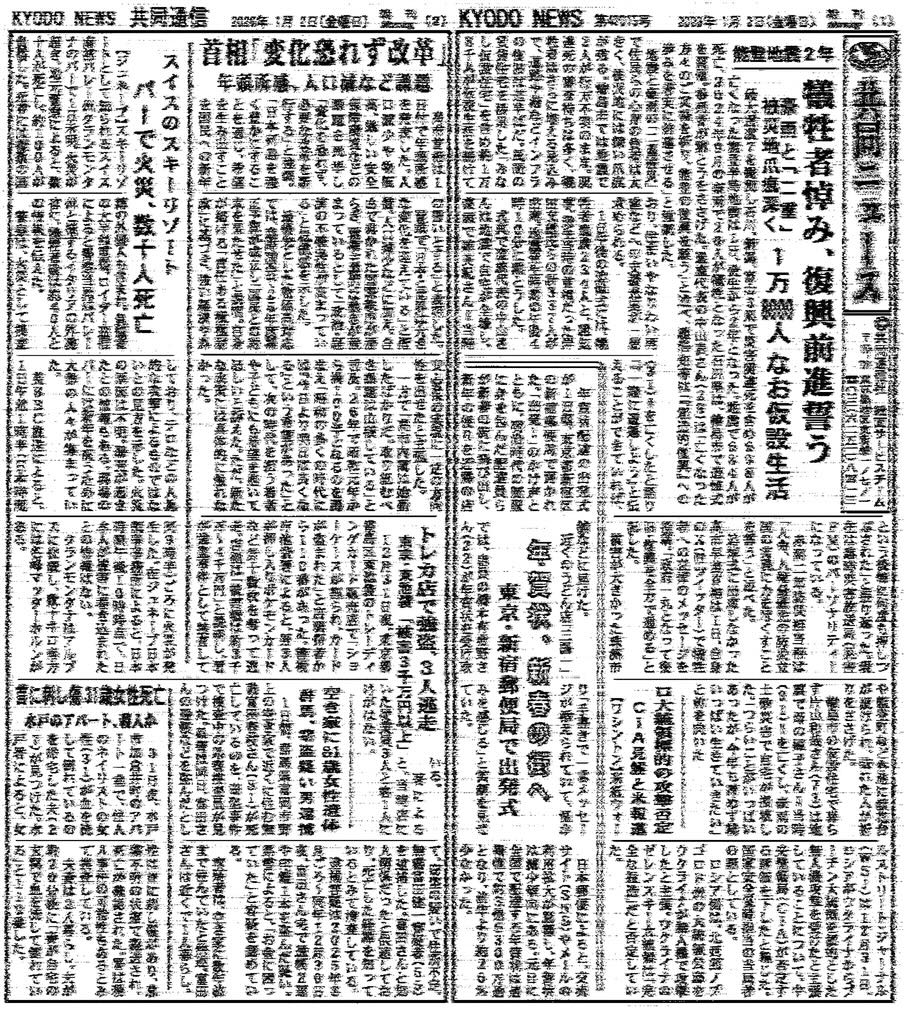
Category Archives: Shortwave Radio

Carlos’ Illustrated Radio Listening Report and Recording of CGTN (October 13, 2025)

Many thanks to SWLing Post contributor and noted political cartoonist, Carlos Latuff, who shares the following illustrated radio listening report of a recent CGTN broadcast.


Carlos notes:

Hamas hands over all remaining hostages to Israel, CGTN Radio, 13800 kHz

Click here to view on YouTube.

Some really inexpensive ways to perhaps improve your shortwave listening


By Jock Elliott, KB2GOM

Just yesterday morning, I was reminded that sometimes really small things can make a significant difference SWLing. So here are some things that I found can make an improvement, particularly if you are using one of the modern shortwave portables with its whip antenna.

  1. Turn off as many electronics as possible in the room where you are listening. Computers, scanners, LED lights and all sorts of other electronics can introduce digital “hash” into the airwave near your radio. Turning them off may reduce the noise floor. Remember, we are all about improving signal-to-noise: we want more signal, less noise. Yesterday, I was trying to chase some English language broadcasts and found that turning off a nearby police scanner made a significant difference. If weather permits, moving outside can make a huge difference.
  2. Feel free to move the whip antenna of your radio to different orientations such as horizontal and various points of the compass. Again, yesterday I was unable to hear one particular station with the whip antenna vertical, but when I lowered it to nearly horizontal and pointed toward the south, the station was audible.

OLYMPUS DIGITAL CAMERA

  1. If you are just getting started, try using the search/scan/seek function of your radio to see what broadcasts it detects. Remember, though, that the seek function will reveal only what it can detect, so you might also try it with your antenna in different orientations. (See number 2 above.)

OLYMPUS DIGITAL CAMERA

  1. Try using a bigger antenna. If you radio came with an auxiliary roll-up antenna, try deploying it. One of my auxiliary antennas is designed so that the far end can be clipped to a curtain. Try different configurations and see which works best. If you radio didn’t come with one, it is easy to improvise: get yourself 20 feet of insulated wire and an alligator clip. Attach the clip to the wire, then clamp the jaws of the alligator clip to the whip antenna on your radio. Try different configurations. The only hard and fast rule is: never, EVER, deploy an antenna where it can fall on a power line or a power line can fall on it. And, if you deploy your antenna outside be sure to haul it in when lightning threatens. Don’t go nuts with the length of the wire . . . 20 feet will do. Carlos Latuff, whose radiofax and weatherfax interceptions often grace this blog, often uses a wire antenna that is just 3 meters long!

  1. It is very useful to have a list of target frequencies, particularly since so many modern portables have a keypad that makes punching in a frequency as easy as using a calculator. I can highly recommend the charts produced by Harold Sellers of the Ontario DX Association. These include the World English Survey (a listing of English language broadcasts by time and frequency), Target Listening by Country, and Target Listening by Time. Just because a station is listed at a particular time on a particular frequency doesn’t mean that you will be able to hear it, but I find it fun to punch in the numbers and discover what I can You can be notified when each month’s charts can be downloaded. They are posted to the ODXA Facebook Group files section and also on three IO Group files section: ODXA, World of Radio and CIDX.

I hope these small suggestions will be of some help in making your listening better.

The 90 metre band – Then and Now

Many thanks to SWLing Post contributor Dan Greenall, who shares the following guest post:


The 90 metre band – Then and Now

by Dan Greenall

A few decades ago, the 90 metre shortwave broadcast band used to be full of interesting and challenging-to-hear DX signals. In the 1974 edition of The Complete Shortwave Listener’s Handbook, author Hank Bennett reports on what you might expect to hear on these frequencies. There is a copy of this book on the Internet Archive.  Here is a link to that specific page.

Also, this sample page from White’s Radio Log in the 1972 Communications World magazine shows a number of stations that could be logged in 90 metre band.

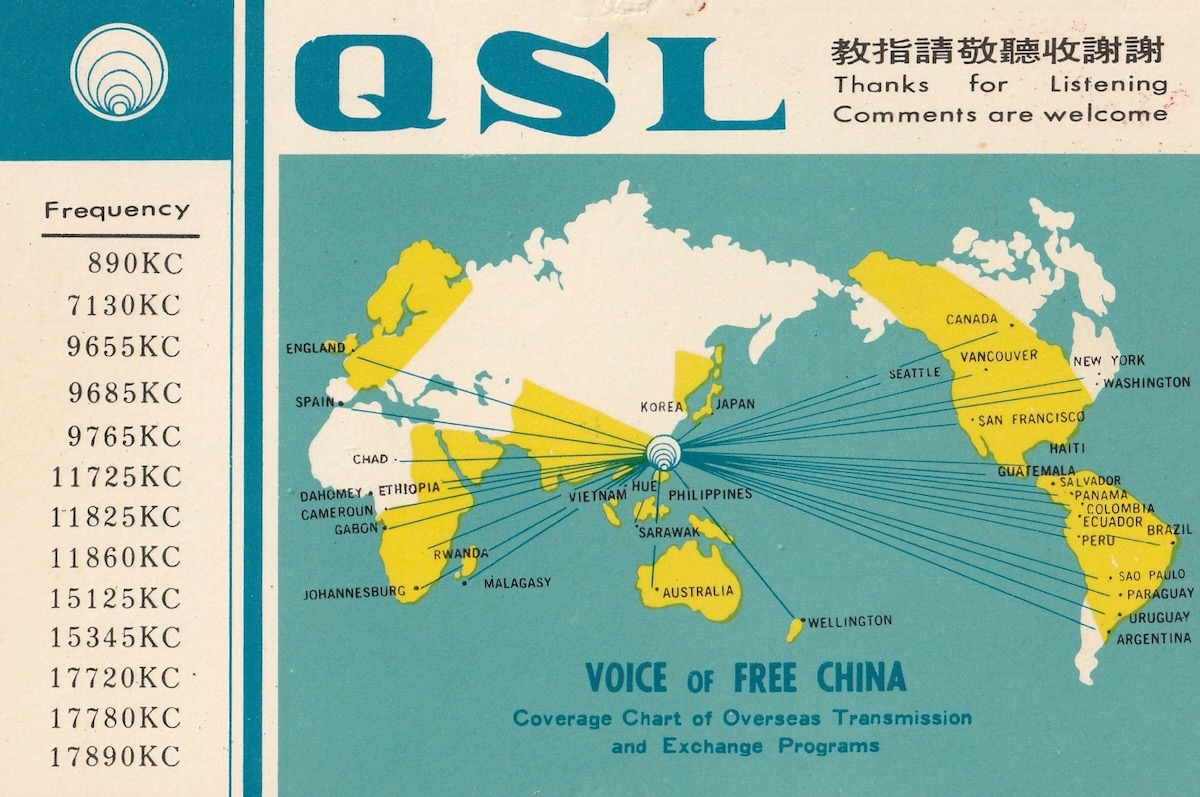
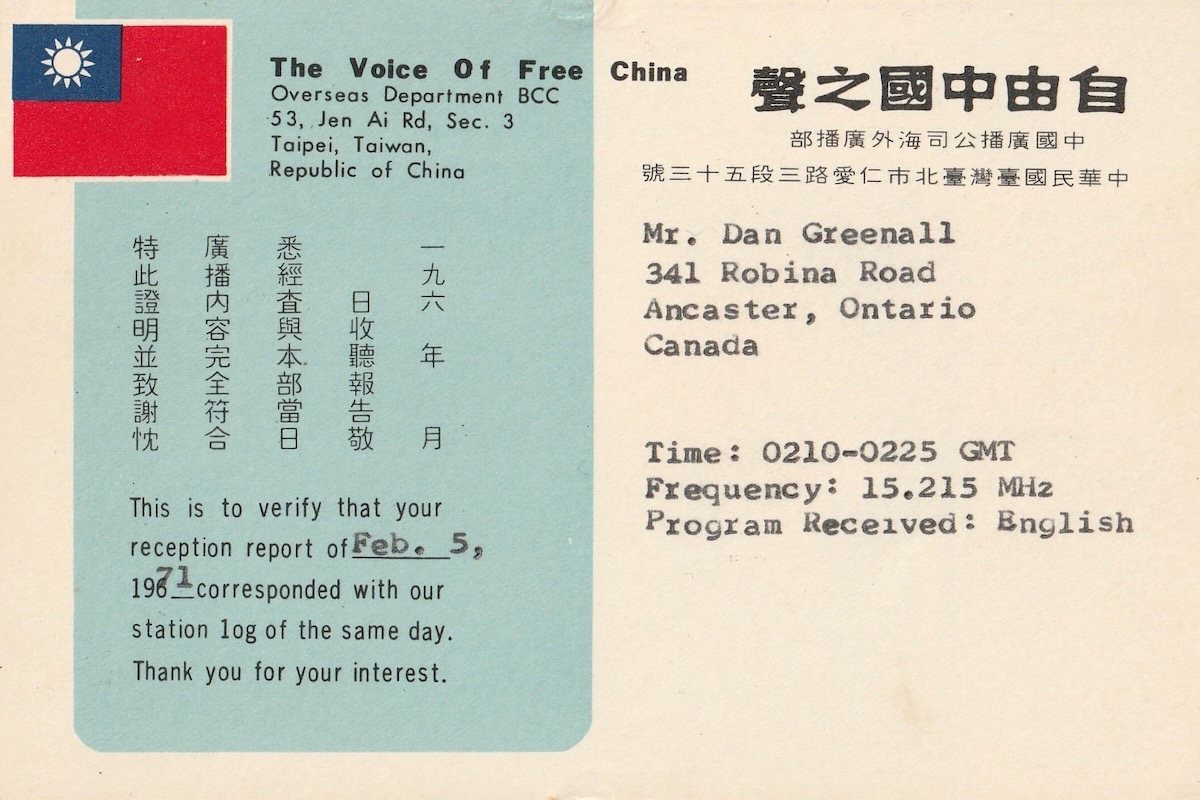
Here are a few links to recordings from my personal collection that have survived through the many years.  These were all made between 3200 and 3400 kHz from my listening post in southern Ontario, Canada.

[Note: Click on each broadcast link to open the associated Internet Archive page with more info.]

Radio Bougainville, PNG 1971

Radio Rabaul, PNG  1971

Radio Santiago, Dominican Republic 1971

Radio Libertad, Santiago, Dominican Republic  1971

Action Radio, Guyana Broadcasting Service  1972

Radio Christian Voice, Zambia  1996

Malawi Broadcasting Corporation (MBC)  1997

Radio Maya TGBA, Guatemala  early 1970’s

Radio Exitos, Dominican Republic  1971

Today, it seems that only a handful of stations can be found broadcasting in the 90 metre band.  These would include WWCR in Nashville, the Voice of Indonesia, KCBS Pyongyang and Radio Mosoj Chaski in Cochabamba, Bolivia.  As well, the Canadian time signal station CHU still continues to use 3330 kHz.

A recent recording of Mosoj Chaski Radio, a Christian broadcaster logged using a remote SDR in Lima, Peru, is presented here.

Although not in English, listen carefully and you can hear them give their frequency of 3310 kHz in the 90 metre band as well as their location of Cochabamba, Bolivia.

Carlos Uncovers the Mystery Behind a Strange Radiofax from the Japan Meteorological Agency

Many thanks to SWLing Post contributor Carlos Latuff, who writes:

This is the image I received today, October 12th, at 7:10 UTC, in Rio de Janeiro, Brazil, from the Japan Meteorological Agency, via radiofax (13988 kHz). It was supposed to be a satellite image, showing Tropical Storm Nakri (which will become a typhoon in the next few hours). Instead, I received this truncated image. This isn’t a radio transmission/reception error, but rather a problem with the image generation from the Japanese Himawari satellite, something I hadn’t seen before.

This is the information provided by the Japanese TV NHK website.

Australia Solved Remote Learning Seventy Years Ago—with Shortwave Radio!

Many thanks to SWLing Post contributor David Iurescia for sharing the following article about one of my favorite topics, which we’ve covered in the past.

Long before Zoom classrooms or remote-learning platforms existed, Australia was already teaching across the outback via radio. This article from Education Daily explores how the School of the Air began in 1951 using shortwave radio and evolved into one of the world’s most advanced distance education systems—connecting students across half a million square miles.

It’s a brilliant look at how necessity inspired real innovation in broadcasting and education.

Click here to read the full article at Education Daily.

Korea Meteorological Administration Radiofax with Nakri Path

Many thanks to SWLing Post contributor Carlos Latuff, who writes:

The path of tropical storm “Nakri,” forecast to become a typhoon on Sunday, is shown on this weather chart from the Korea Meteorological Administration, broadcasted via radiofax and received this morning in Rio de Janeiro, Brazil, 0800 UTC, frequency 13570 kHz (UTC).