Shortwave listening and everything radio including reviews, broadcasting, ham radio, field operation, DXing, maker kits, travel, emergency gear, events, and more
Hi to all SWLing Post community. Here’s what Imaginary Stations will be bringing to the shortwaves this week.
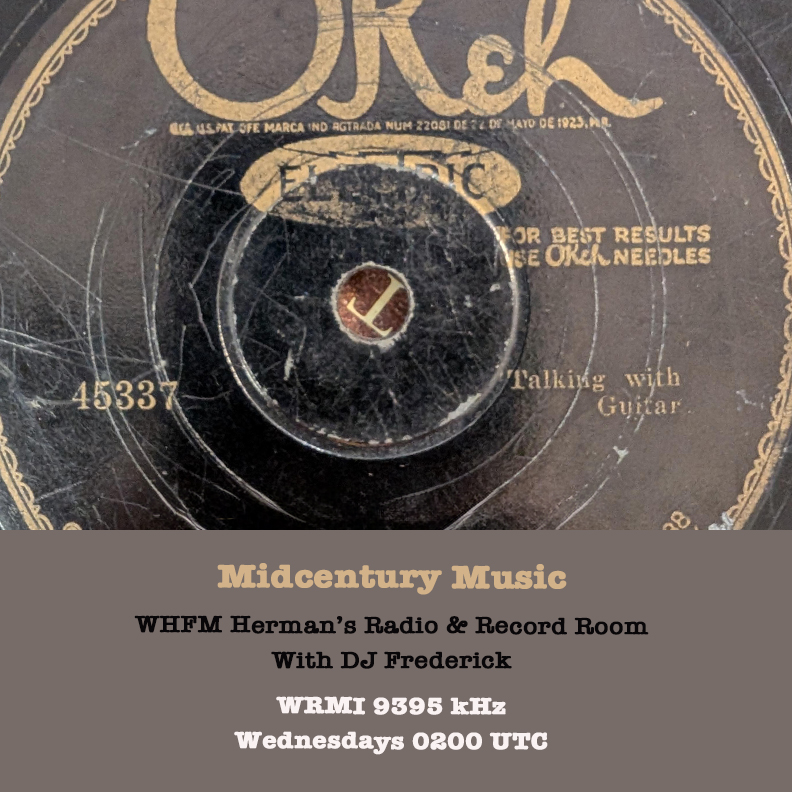
On Wednesday 1st July 2026, at 0200 hrs UTC on 9395 kHz on WRMI we have WHFM – Herman’s Radio and Record Room. This is a further show in a series of programmes recorded by DJ Frederick Moe in memory of his father Herman (1919-2001) and features mid-century sounds including country, jazz, folk and easy listening.
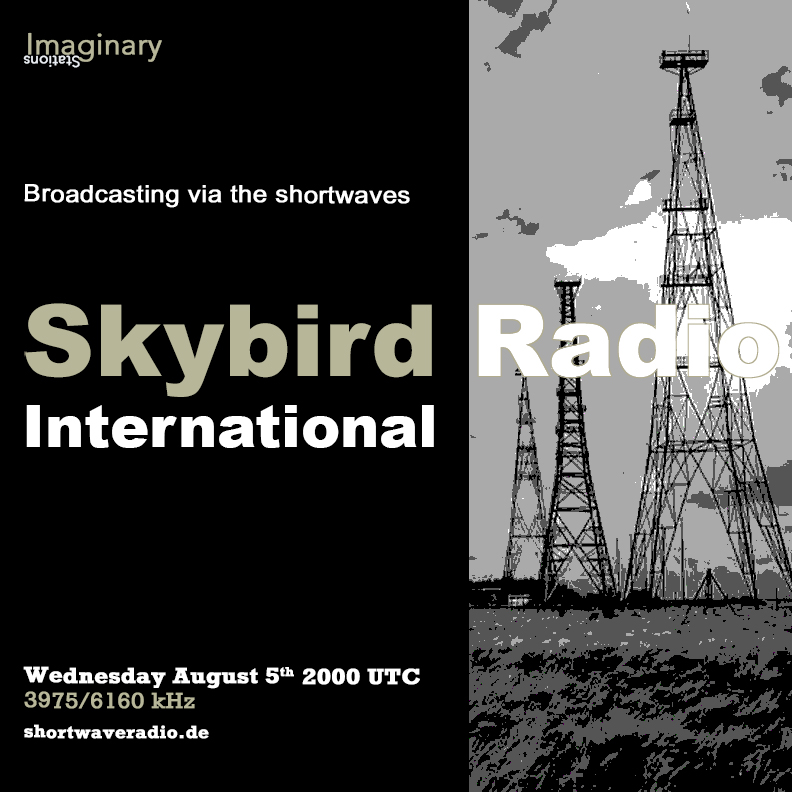
Later on that day at at 2000 hrs UTC on 3975 kHz/6160 kHz via Shortwave Gold, we bring you the repeat of Skybird Jams. The show is entitled “Music to increase your attention span” with DJ Frederick, in other words, extended tunes and ‘jam bands’ on your shortwave dial. Tune in and enjoy the sound of Skybird Jams.
While on Saturday 4th July at 1100 hrs UTC on 6160 kHz and then again on Sunday 5th July at 1300 hrs UTC on 6160 kHz and 2000 hrs UTC on 3975 kHz/6160 kHz, we have the first episode of the show called Wave. Think beach, think sea, think surf and all things summery! And think of those shortwaves too.
For more information on all our shows, please write to us at [email protected] and check out our old shows at our Mixcloud page here.
Many thanks to SWLing Post contributor Carlos Latuff, who shares the following article. Carlos writes:
Panasonic Microcassette Recorder
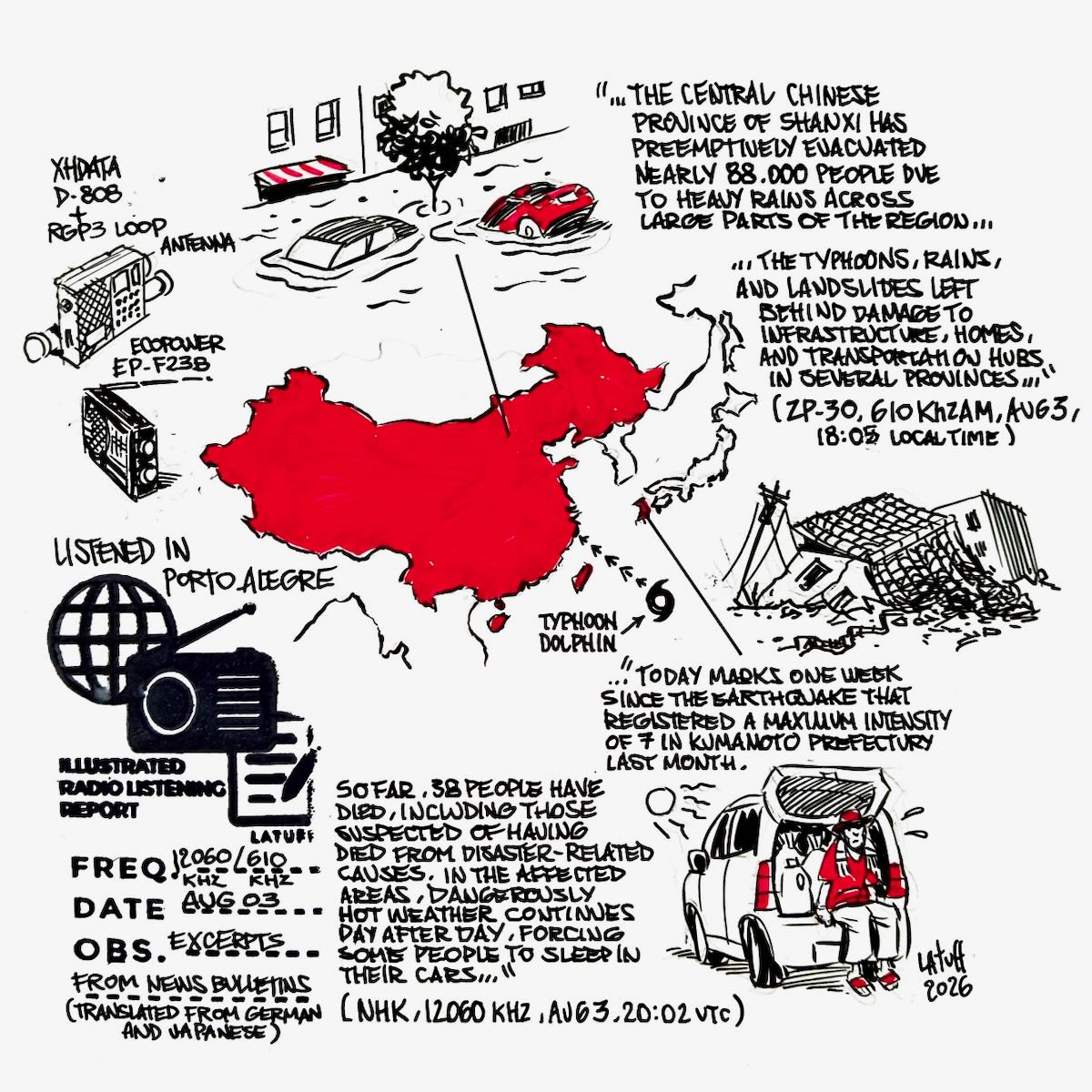
To record my radio listening sessions, I usually use a Sony digital recorder, model ICD-PX240. However, last week I purchased another beauty—this time a Panasonic microcassette recorder, model RN-305, manufactured in Japan in 2000.
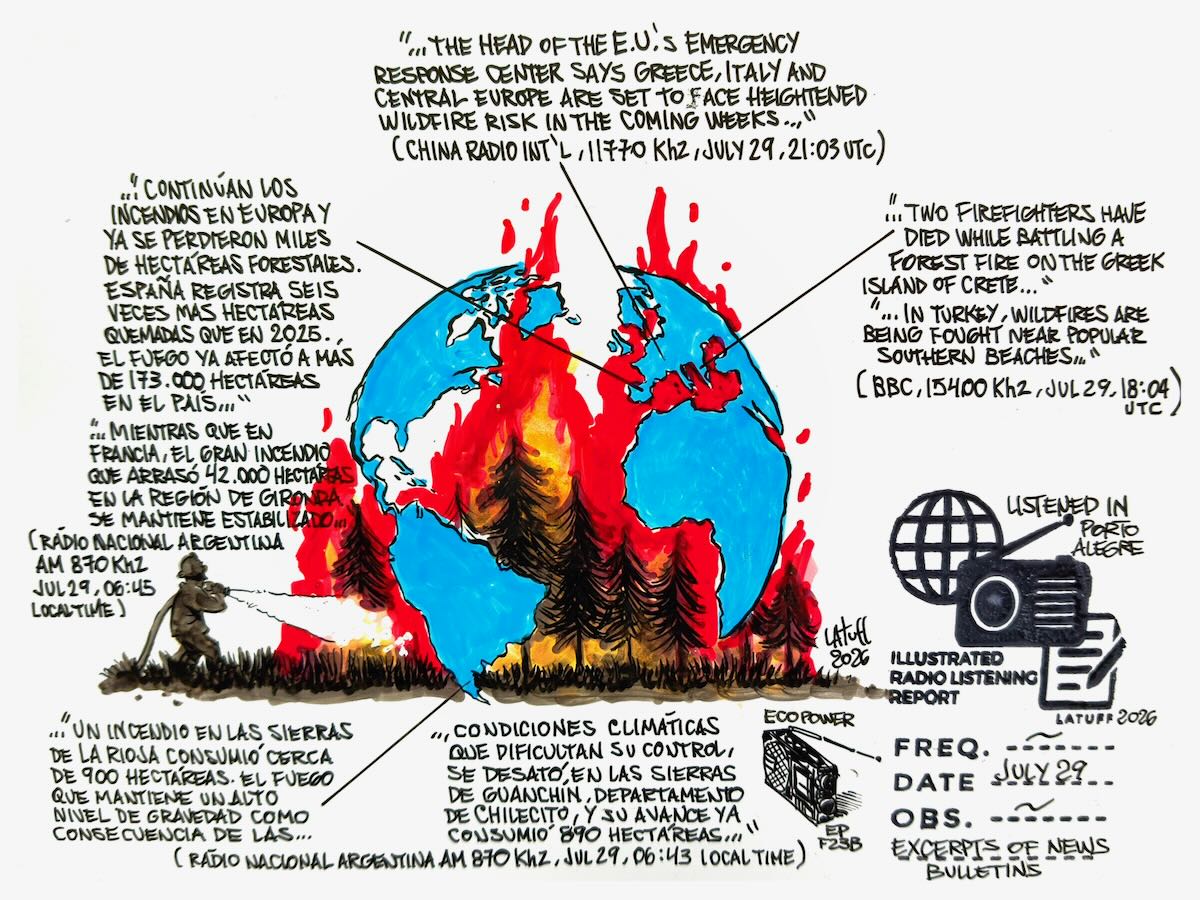
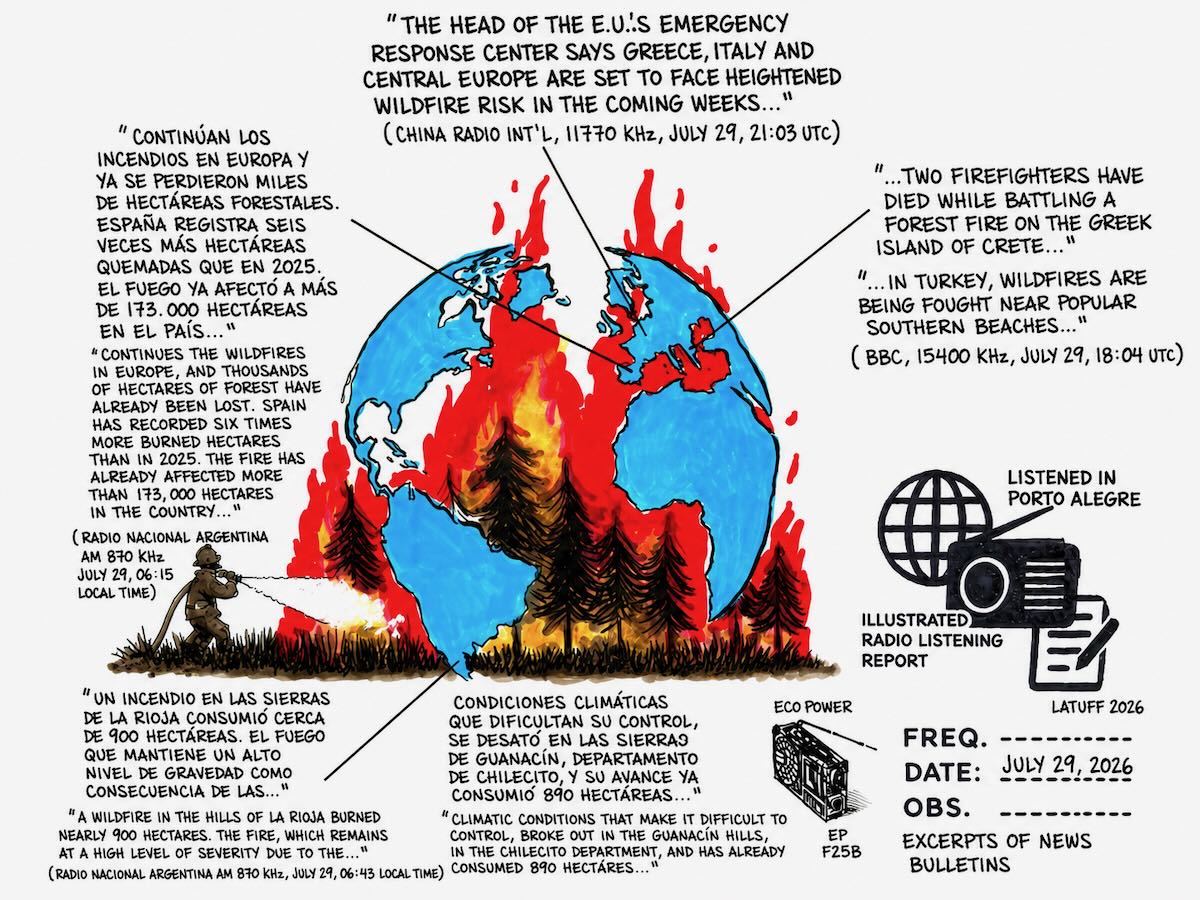
I decided to test it out, and here are the results. The listening sessions were conducted in Porto Alegre using XHDATA D808 and Ecopower EP-F23B receivers.
Earthquake in Venezuela, Spain and France offering rescue workers.
US Secretary of State assured Gulf allies the Strait of Hormuz will stay open as Iran threatens transit fees.
Former Israeli leaders threatened legal action over alleged Jewish terrorism in the occupied West Bank.
June 26, 2026
BBC, 15400 kHz (in English)
Earthquake in Venezuela, more than 900 people are now known to have died in two earthquakes. The U. N. says 50,000 people are missing.
The U.S. announced a framework to end fighting between Israel and Hezbollah in Lebanon.
John Bolton pleaded guilty to one charge of mishandling information.
A state of emergency was declared in Crimea.
Extreme heatwave in Europe, Germany recorded temperatures above 41°C on Friday, in France, festivals, street parties and Paris Pride were canceled, while alcohol sales were restricted in Paris, in the Netherlands, electric bus charging failures disrupted public transport.
Paris suspended flights to and from Kinshasa, D.R. Congo, after a passenger tested positive for Ebola.
Civil unrest in Tanzania.
D.R. Congo sued Rwanda at the International Court of Justice over alleged atrocities.
Earthquake in Venezuela: Full coverage.
Lebanon and Israel reached a U.S.-brokered deal for Israel’s withdrawal from southern Lebanon.
Radio Exterior de España, 17715 kHz (in Arabic)
Venezuela was struck by two earthquakes of magnitude 7.2 and 7.3 according to the U.S. Geological Survey on Wednesday. Collapsed buildings and several damaged structures were observed in the capital, Caracas. Acting President Delcy Rodriguez reported in an initial tally that the two earthquakes resulted in 32 deaths and 700 injuries. State of emergency was declared after the two earthquakes, which were followed by approximately 20 aftershocks. The earthquakes caused further damage, including building collapses and the closure of Simón Bolívar International Airport. The state of La Guaira was the most affected and was declared a disaster area, as explained by Acting President Delcy Rodriguez.
Vatican Radio, 11870 kHz (in English)
Africa News Panorama: Ebola outbreak in D.R. Congo, more that 1100 cases with 300 deaths.
Anti-immigrant rallies in South Africa.
Rescue workers are working in the rubble of a three-story building that collapsed in Nigeria.
Radio 2, 1230 kHz AM (in Spanish)
Venezuela increased to 920 the dead and there are at least 3360 injured in the latest reports of the Ministry of Health after the earthquakes of Wednesday. In addition to 50.000 people who remain missing.
Hi to all SWLing Post community. Here’s what Imaginary Stations will be bringing to the ionosphere this week.
On Wednesday June 24th at 2000 hrs UTC on 3975 kHz/6160 kHz via Shortwave Gold, we bring you Skybird Jams. The show is entitled “Music to increase your attention span” with DJ Frederick, in other words, extended tunes and ‘jam bands’ on your shortwave dial. Tune in and enjoy the sound of Skybird Jams.
While on Saturday 27th June at 1100 hrs UTC on 6160 kHz and then again on Sunday 28th June at 1300 hrs UTC on 6160 kHz and 2000 hrs UTC on 3975 kHz/6160 kHz we have WMMR (Mystery Mix Radio) where we have a theme that you, the listener tries to guess what it is from the tunes played. There will be no clues apart from the music.
On Wednesday 1st July 2026, at 0200 hrs UTC on 9395 kHz on WRMI we have WHFM – Herman’s Radio and Record Room. This is another show in a series of programmes recorded by DJ Frederick Moe in memory of his father Herman (1919-2001) and features mid-century sounds including country, jazz, folk and easy listening.
For more information on all our shows, please write to us at [email protected] and check out our old shows at our Mixcloud page here.
Many thanks to SWLing Post contributor, Dan Greenall, who writes:
The Voice of America is currently using its Tinang, Philippines site for a broadcast in Chinese beginning at 2100 UTC on 9535 kHz.
Here are 2 recordings of their sign-on with English ID and Yankee Doodle, one using a Kiwi SDR in Athens, Greece, and another using a Kiwi SDR in Taiwan (closer to the target area).
Athens, Greece
Taiwan
The signal starts out OK around 2157 with a test tone prior to Yankee Doodle, but seems to suffer from QRM from a co-channel station signing on after a minute or so. CRI is listed as using 9535 at other times, but perhaps this is a deliberate attempt to make the reception of VOA “uncomfortable”?
Many thanks to SWLing Post contributor, Bill Tilford, who shares the following update:
From the Isle of Music, July 2026
This month, some new releases of Cuban jazz
Friday, July 10, 2026, 9670 kHz, 1800 CEST (1600 UTC), repeat on 3955kHz at 2400 CEST (2200 UTC)
Uncle Bill’s Melting Pot, July 2026
Friday, July 17, 2016: 9670 kHz at 1600 UTC, repeats on 3955 kHz at 2200 UTC
To recognize the 250th anniversary of the US Declaration of Independence, we will feature “Stan Freberg Presents the United States of America Part 1”, a comedic version of US history.
In addition to direct terrestrial reception, we do honor reception reports using remote SDRs, provided that both the physical location of the listener and the location of the remote SDR are given. EQSLs only
First, a huge thank you to everyone who has submitted recordings of this year’s BBC Midwinter Broadcast to Antarctica on our recording-sharing post. It’s been a real pleasure browsing reception reports and recordings from around the globe.
(Please post your recording there rather than in the comments of this post so we can keep all of the recordings together in one place.)
I thought I’d share my own recording of the broadcast because this year’s reception was especially memorable. Unlike previous years when I’ve listened from the United States or Canada, I’m in the UK this year—and the results were brilliant. Both frequencies transmitted from the Woofferton site delivered excellent audio quality.
Recording notes:
This is the BBC Midwinter Broadcast to Antarctica recorded on June 21, 2026 at 09:30 UTC in Foulden, Scotland, UK. The radio was an Elecraft KX2 connected to a 31-foot 9:1 random wire antenna in the back garden. The broadcast starts on 9460 kHz, but I then move to 12070 kHz because it had slightly less local noise.
Thank you again to everyone who has contributed recordings and reception reports.
The BBC Midwinter Broadcast remains one of my favorite SWLing events of the year. I simply love the idea that the BBC would broadcast from two different sites on three different frequencies via shortwave to a relatively small audience of British Antarctic Survey scientists wintering over in Antarctica.
It’s always a joy to listen live, knowing that they’re celebrating midwinter with parties at their stations and hearing the voices, messages, laughter, and well-wishes of loved ones carried to them over the air by shortwave radio.
In an age of instant communications, there’s still something magical about that.
In the comments section of this post, I’d like you to share your recording of the 2026 BBC Antarctic Midwinter Broadcast!
Time and frequencies
Thanks to Dave Porter, who has confirmed these three shortwave frequencies for the annual BBC Antarctic Midwinter Broadcast (2130–2200 UTC Sunday, June 21, 2026):
9460 kHz from Woofferton
9510 kHz from Ascension
12070 kHz from Woofferton
Also on DAB in the UK at 2130 UTC (2230 BST).
Please comment with your recording on this post!
Listening to the 2017 BBC Antarctic Midwinter Broadcast from the back of my vehicle in Saint-Anne-de-Beaupré, Québec, Canada.
I’ve created this dedicated post where you can comment and include links to audio and video of your 2026 Midwinter Broadcast recordings. This will allow you to post your logs and recordings at your convenience without my availability becoming the bottleneck.
Here’s the format I’d like you to leave in your comment on this post:
Name:
Listening location:
Notes:(Include frequencies and any details about your receiver and antenna.)
Link to audio or video:(YouTube, Vimeo, Internet Archive, SoundCloud, etc.)
Video and Audio Recordings
There is no way to directly upload audio in your comments; however, you can link to your recordings if you upload them to the Internet Archive (which I’d highly recommend) or any of the video streaming services like YouTube and Vimeo—or audio services like SoundCloud.
To be clear: I will not have the ability to upload your videos for you—so please don’t email me your video files. Simply upload them to one of the services above and share the link here in the comments. ?
As with each year, I’ll make sure the BAS team and the BBC receive a link with all of your recordings!