Category Archives: Shortwave Radio

Guest Post: Monitoring Digital Selective Calling (DCS) with YADD

Many thanks to SWLing Post contributor, Don Moore–noted author, traveler, and DXer–for the following guest post:


Photo by Borderpolar Photographer

Monitoring DSC with YADD

By Don Moore

(The following article was originally published in the April/May 2022 edition of the Great Lakes Monitor, bulletin of the Michigan Association of Radio Enthusiasts. An all-band listening club, MARE publishes a bi-monthly print bulletin and a weekly e-mail loggings tip-sheet. The club also holds regular get-togethers, picnics, and DXpeditions, generally in southeastern Michigan.)

There are dozens if not hundreds of different digital modes used for communication on the MF and HF bands. These aren’t broadcasts you want to listen to unless you like to hear weird tones, beeps, warbles, and grinding noises interspersed with static. Digital modes are for monitoring, not listening. And monitoring them requires having software that does the listening for you and converts the noises into something meaningful – like the ID of the station you’re tuned to. The learning curve to DXing digital utilities can be steep. There are lots of modes to identify and the software can be complicated to learn. Some broadcasts are encrypted so you can’t decode them no matter how hard you try. But the reward is lots of new stations and even new countries that you wouldn’t be able to add to your logbook otherwise.

One of the easiest digital modes to DX is DSC, or Digital Selective Calling. DSC is a defined as “a standard for transmitting pre-defined digital messages.” Look online if you want to understand the technical specifications that specify the values, placement, and spacing of the tones. The result of those specifications is a string of three-digit numbers like this:

125 107 125 106 120 105 120 104 000 120 022 120 041 000 002 022 020 041 108 002 053 020 080 108 006 053 021 080 070 006 118 021 126 070 126 118 126 126 126 126 126 126 126 126 126 126 117 126 112 126 117 117 117 112 109 125 108 125

Each three-digit value represents either a digit or a key word and the positions of the values map to the various fields contained in the message. This message, which was received on 8414.5 kHz, is a test call from the tanker Brook Trout to the coastal station Coruña Radio in Spain. The sender and destination are not identified by name but rather by their nine-digit MMSI (Maritime Mobile Service Identity) numbers – 538006217 for the vessel and 002241022 for the coastal station.

GETTING STARTED WITH DSC

Logging DSC stations requires three pieces of software. First you need a decoder program that turns the noises into numbers and the numbers into meaning. There are several free and commercial options but the most popular one for beginners is YADD – Yet Another DSC Decoder. YADD is free and easy to set up and while YADD can be used by feeding the audio from a traditional radio into your computer, the most common use is with an SDR. That’s what I use and what I will describe here.

Second you need an SDR application and an SDR. I prefer HDSDR for most of my SDR use but I like SDR-Console for digital work. But any SDR program will work if you can feed the audio to a virtual audio cable. And that’s the final thing you need – a virtual audio cable to create a direct audio connection between your SDR application and YADD. There are several different ones available but I recommend VB-Cable. Your first VB-Cable is free and that is all you need to run a single instance of YADD. If you want to expand you can buy up to four more cables from them later. Continue reading

High-Frequency Trading Service: FCC posts two lobbying documents by DPA Mac

Many thanks to SWLing Post contributor, Benn Kobb (AK4AV), who notes that the FCC has posted for public inspection two lobbying documents by DPA Mac, applicant for a new DRM HF broadcast station with 2 kW of transmitter output power.

Benn notes:

“Regardless of DPA’s claims that its broadcasts will be free of charge and not encrypted, its non-broadcast high-frequency trading service will be for paying customers only.

“That is the purpose of this station and is why its target areas, as seen in a world map slide, are limited to the location of certain foreign exchanges. This despite its claim to be a worldwide service.

“There is little profit in SW broadcasting today, and what business there is available is accommodated by those existing US HF stations that can hang on through economic shifts. No, the DPA Mac station is not devoted to global information as a business venture. It wants a license to provide private telecommunications. The broadcasts to the public are just so it can get licensed, because there is no other radio service in the HF spectrum for private international data links.

“At this time no one knows what the FCC will do with this license application and two other similar applications. What is clear is that the applicants want to get on the air ASAP before any possible changes that may affect the HF broadcasting service.”

The FCC posted the following documents in an accessible place on their website yesterday morning:

https://www.fcc.gov/ecfs/document/1110171119378/1

https://www.fcc.gov/ecfs/document/1110171119378/2

Thank you for the update, Benn.

Has WTWW left shortwave?

I recently learned from a few reports on Twitter that WTWW left shortwave for good on November 9, 2022 and will now only broadcast over the internet. I missed this announcement on the air and WTWW’s website doesn’t seem to reflect this information yet.

The WTWW wikipedia page has already been updated, however, with WTWW’s services noted in the past tense and the following addition was made this week:

On November 9, 2022, WTWW announced it would discontinue all shortwave operations, with intent to continue streaming the programming as long as it was feasible. Ted Randall cited a massive increase in transmitter usage fees (the majority of that being from electricity cost) that the station could not realistically pay. The station signed off for the last time that night, with its final programming including a farewell message from Randall encouraging listeners to continue listening to the Web stream, a string of listener requests from WTWW’s automated system, and the final song being a rendition of “America the Beautiful” by one of Randall’s favorite recording artists, Ronnie Milsap.

Can anyone confirm if WTWW has indeed stopped all shortwave transmitting? Please comment.


Shortwave goes all chirpy chirpy, cheep cheep again

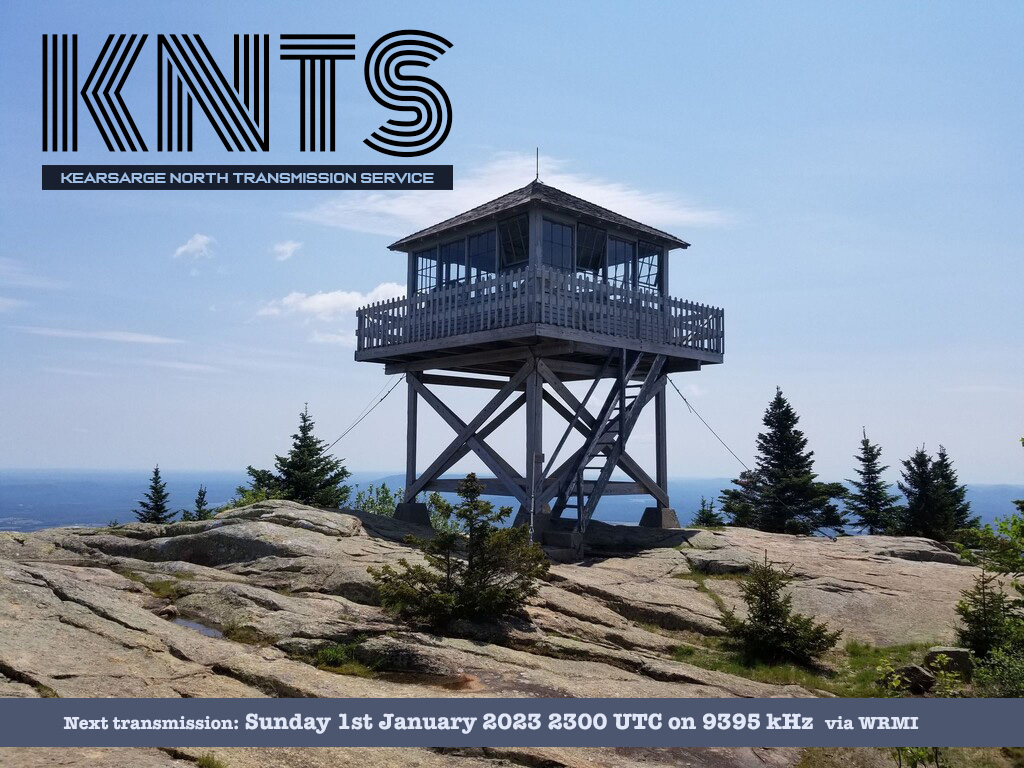
Hi SWLing post community and birdwatchers everywhere Fastradioburst23 here. Just to let you know if WRMI is on the air this Sunday (fingers crossed) after an encounter with yet another hurricame expect an additional programme of  WREN.

This week’s Imaginary Stations show on Sunday 13th November 2022 features our feathered friends again with lots of bird related classics and bird watching tips. Tune into 9395 kHz from 2300 utc onwards.

A review of the Tecsun H-501x portable shortwave radio receiver

I was recently searching for my review of the Tecsun H-501x on the SWLing Post to send to a reader when I realized I had not yet published it here! Let’s fix that…

The following review of the Tecsun H-501x was originally published in the November 2021 issue of The Spectrum Monitor magazine. Enjoy:


A review of the Tecsun H-501x

by Thomas (K4SWL)

Last year [2020], we were treated to a group of new shortwave portables from Tecsun:  the PL-990, PL-330, and the H-501.

Although all of these models garnered attention from shortwave listeners, one model in particular seemed to draw the most interest, the Tecsun H-501.

No doubt, much had to do with the H-501’s size––a large format portable––and especially the twin stereo speakers, that no doubt sparked the interest of those of us who owned (or wished we owned) the venerable Grundig Satellit 500 or 700 with its reputation for robust audio.

Tecsun was also very clear during their product announcement in 2019 that the H-501x is the flagship portable for the Tecsun line.

H-501 versus H-501x

Note that the product being evaluated in this review is the H-501x; the latest “export” version of the H-501.

The differences between these two models is fairly modest. The “x” model gives the user a slightly lower frequency floor in longwave and shortwave, and finer FM tuning (50 kHz as opposed to 100 kHz) when the AM tuning steps are set to 9 kHz as opposed to 10 kHz.

The differences are so modest between the H-501 and H-501x, I wouldn’t be worried if you already have the H-501. I would simply encourage you to only purchase from a reputable Tecsun distributor so you can be confident you’re not receiving one of the very early production runs of the H-501 that was only distributed domestically within China. Some of these early domestic models didn’t have all the refinements of the latest H-501 versions. I would encourage you to only purchase the H-501 or H-501x from a reputable distributors like Anon-Co, Waters and Stanton, Tecsun Radios Australia, and Bonito.

Unique features

Besides the large dual speakers of the H-501x, there are a number of other unique features and design choices that truly set the H-501 series apart from other Tecsun models.


Firstly, the H-501x uses two 18650 Lithium Ion batteries housed in two separate battery compartments. Both batteries can be internally charged, but here’s the interesting part: each battery seems to be somewhat independent of the other. When you engage battery charging, you must select, via a mechanical switch on the back of the radio, “Battery A” or “Battery B.” Only one battery can be charged at a time, and thus only one will power the radio at a time.

More than once, I’ve been listening to the H-501x and the battery indicator started flashing, signifying a low battery. I simply switched the battery switch to Battery B, and, voliá:  I have a full battery again! This reminds me of a college friend’s VW Beetle that had a spare fuel tank…with this unique feature, when you were running low on fuel, you’d kick in the spare fuel tank and then make plans to refuel the main tank soon. Of course, with the H-501x, both these “fuel tanks” are also generous ones, in that the batteries last for a good while.

I find that the play time of each battery impressive given the size and audio amplification used in the H-501x. I had worries that the unit’s need for two batteries could suggest a short battery life, but fortunately this hasn’t been the case, no matter what mode I’ve used (FM, AM, shortwave, or Bluetooth).

However I will note here that the supplied switching power supply will inject noise if you try listening to AM or shortwave while charging. This hasn’t affected FM reception, though.

The fold-out metal bail on the H-501x is very large. This shouldn’t have surprised me, but it did. The H-501x is tall and wide, but not very deep––only marginally deeper than, say, the PL-880. The bail needed to be low-profile, but also support this mini “wall” of the radio while in use. The metal wire bail is handy and certainly does the trick, although there’s only one tilt position, and when it’s deployed, the radio effectively has a large footprint. This might limit where you can set it if the surface––say, a bedside table––is small. Not a problem for me, but worth noting. Continue reading

Carlos’ Shortwave Art and recording of the Voice of Korea (November 4, 2022)

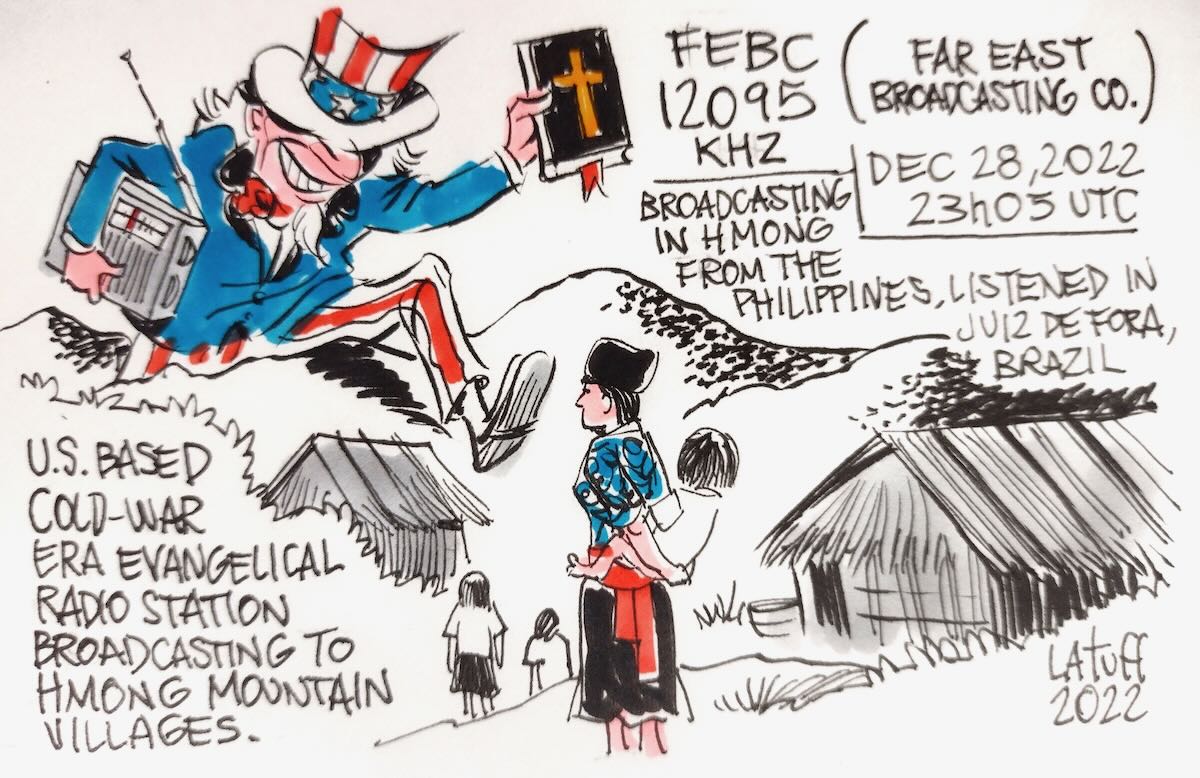
Many thanks to SWLing Post contributor and noted political cartoonist, Carlos Latuff, who shares his radio log art of a recent Voice of Korea broadcast.


Carlos notes:

Part of news bulletin from Voice of Korea Radio, 12015 kHz, broadcasting in English from Kujang, North Korea, and listened in Porto Alegre, Brazil, November 4, 2022, 21h (UTC).

“Press Statement of Pak Jong Chon, Secretary of the Central Committee of the Workers’ Party of Korea

It is reported that the United States and south Korea have decided to prolong the “Vigilant Storm” joint air drill.

It is a very dangerous and wrong option.

The irresponsible decision of the United States and south Korea drives the present situation created by the provocative military action of the allied forces to an uncontrollable situation.

The United States and south Korea will come to know that they made irretrievable terrible mistake.

Pyongyang
November 3, Juche 111(2022)”

Click here to view on YouTube.

More Wrenaissance on shortwave

Hi all SWLing post community, Fastradioburst23 here letting you know of our next episode of renaissance music radio across the shortwaves this weekend thanks to WRMI.

This Sunday 6th November 2022 from 2300 utc on 9395 kHz there will be another transmission of WREN and in keeping with last week’s show they’ll be much more modal music and to quote Wikipedia, more “Harmony that places a greater concern on the smooth flow of the music and its progression of chords.” Tune in and enjoy another journey way back into time.

Most of the Imaginary Stations shows that have been broadcast are now archived here.

STOP PRESS • Last night’s show now archived online here.