Shortwave listening and everything radio including reviews, broadcasting, ham radio, field operation, DXing, maker kits, travel, emergency gear, events, and more
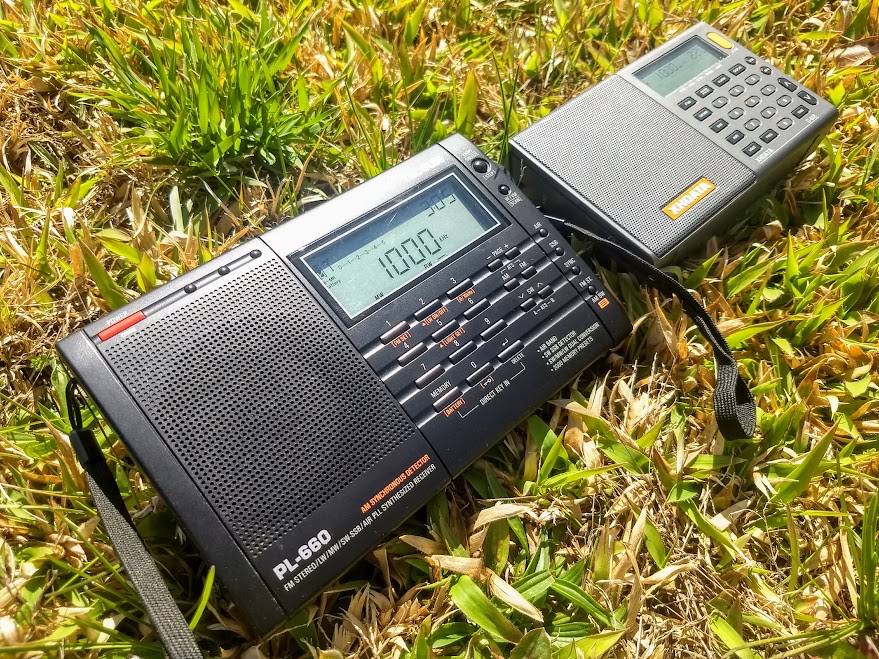
The Tecsun PL-660 (left) next to the XHDATA D-808 (right)
Many thanks to SWLing Post contributor, Andy, who writes:
Hi Tom,
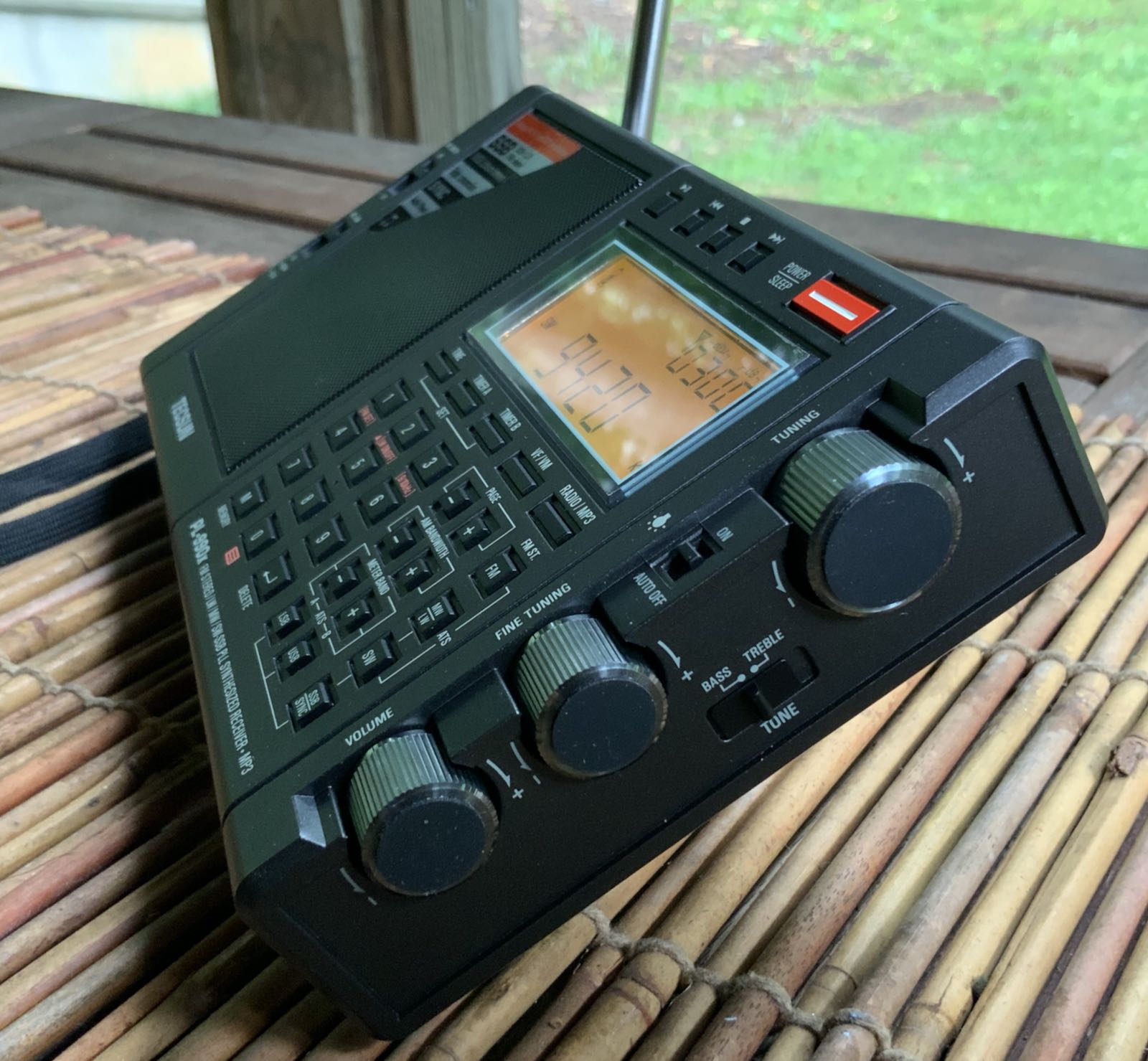
I wonder if any of your readers has noticed anything with later model PL-660s.
My old PL-660 met with an accident recently (purchased about 2015?).
I bought a new one and was disappointed by what appears to be
a difference with the narrow and wide filter.
My old version seemed to work well, with 3kHz and about 6kHz
widths as one would expect.
The new one is a disaster, you seem to get 3kHz and 18kHz widths roughly
resulting in poor performance, especially on local AM stations.
It’s like the same station appears twice.
Also the filter is not symmetrical.
It’s all on the HF side of the signal and it’s awful.
The older model centred the correct bandwidths properly.
I’ve tried to do a bit of research, not much really but the little info that I have found appears to show that others have the same problem.
It makes the use of the wide filter in any mode useless.
I’m gonna send mine back.
73 de Andy G0FTD
Thanks for sharing this, Andy. I haven’t purchased a PL-660 in ages–in fact, I gave mine to a friend interested in shortwave a few years ago. I still use my PL-680 regularly. I suppose it’s possible you might have received a lemon; this isn’t uncommon as quality control varies with production batches.
SWLing Post readers: If you have noticed these symptoms–especially an abnormally wide filter width–with your late model PL-660, please comment.
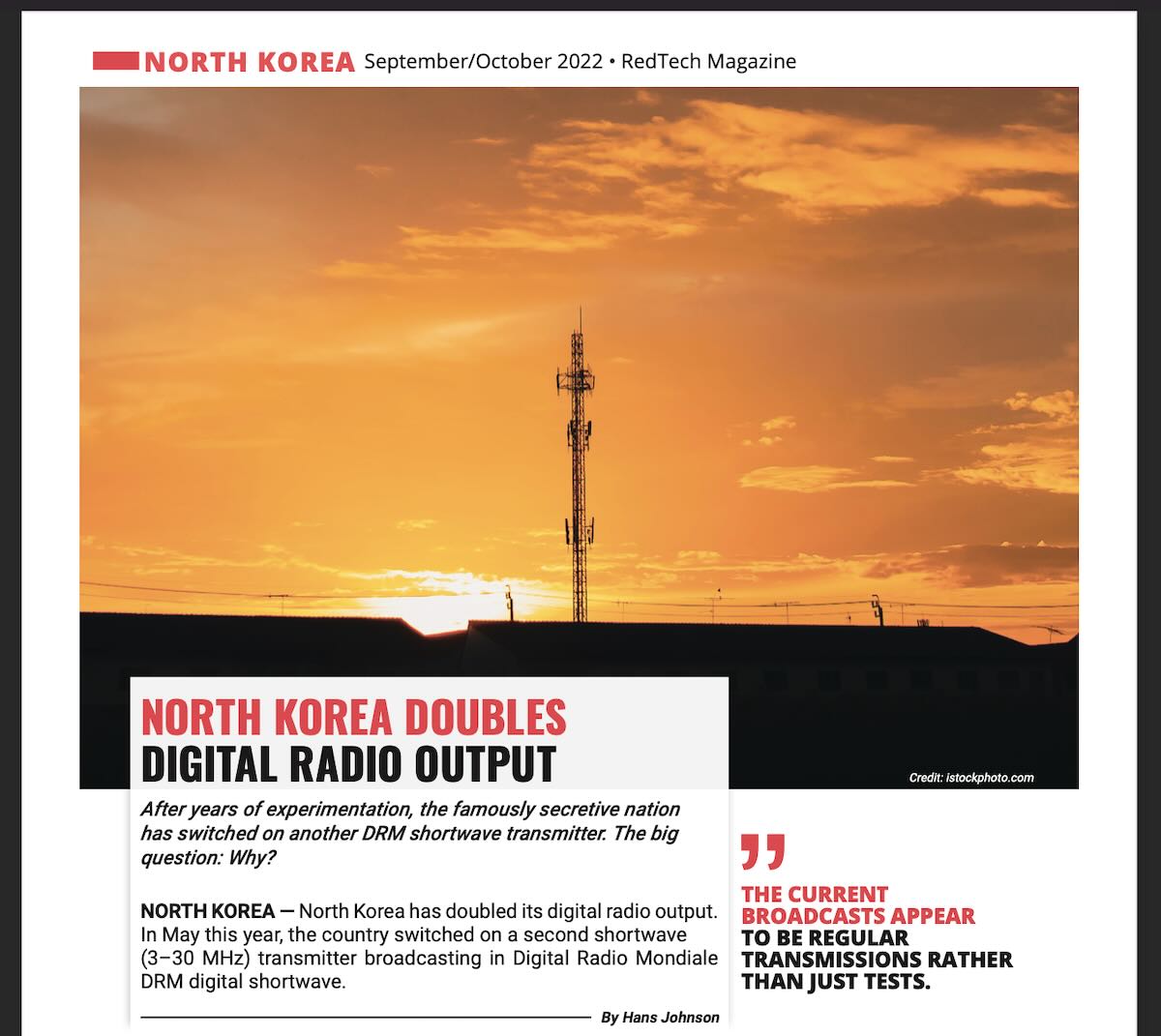
Of course, who really knows? North Korea isn’t public about any of their activities, so we rely on information from enthusiasts who have taken it upon themselves to investigate and confirm. Johnson assumed, “The most likely use [of DRM] would be as an audio feed to other stations and sites.” He used Radio New Zealand’s DRM service as an example, but I felt this to be unlikely with North Korea who doesn’t seem to use FM, MW, or shortwave relay sites in other parts of the world.
Fortunately, our friend Mark Fahey is an expert on North Korean media, broadcasts, and propaganda. Mark is the author and curator of the dynamic Behind The Curtain project.
I reached out to Mark via text message regarding North Korea’s use of DRM. Here’s what Mark shared with me earlier this week. This roughly follows the string of messages we exchanged.
Mark writes:
[October 3, 2022] I have been turning into the North Korean DRM today on the new reported frequency in the [Red Tech] magazine: 6140kHz, though it’s not VOK, it’s a relay of 819kHz Pyongyang.
This service is called KCBS – Korean Central Broadcasting Service – it’s the main domestic service that is available on MW (a few FM outlets) and domestic SW across North Korea.
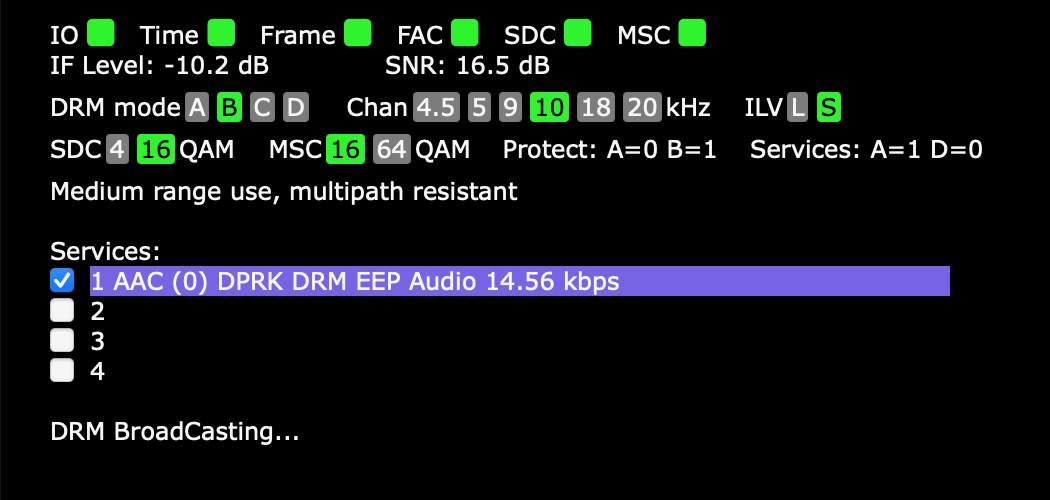
I will grab an audio ID off DRM for you at the top of the next hour – 0100 UTC. The DRM broadcast is only running one audio stream. It’s ACC audio 14.56kbps. As for purpose, maybe to feed the national AM relays, but also could be for North Korean ships, etc.
The other DRM frequency of 3205kHz is not on the air at the moment. I will check for it over the next 24hrs etc.
I just recorded the top of the hour. It was going in and out of DRM sync – I will send it now. I will grab a better sample tonight when there is a darkness path. The sun is well up in Pyongyang & Sydney at the moment (Noon Sydney – 10AM North Korea). Here is the Top Of The Hour ID from 10 minutes ago…
KCBS 6140 kHz (October 3, 2022)
I will record the station opening as well tomorrow morning – this domestic service also has an interval signal (the same tune as VOK–the first bars of “The Song (Hymn) of Kim Il Sung”). The opening is at 2000 UTC.
[October 4, 2022] OK here you go: both audio files (one from 6140kHz and the other from 3205kHz) are just from minutes ago as KCBS Pyongyang signed on. The signals go in and out of DRM lock here and this morning 3205kHz was the better–displayed at SNR at 13dB but still the DRM signal was breaking up.
Both DRM transmitters are running the same program: the main MW national service as heard on 819kHz in Pyongyang.
So I’m sure this DRM has nothing to do with the Voice Of Korea and is for domestic purposes.
I actually do not think it has anything to do with feeding remote transmitters as the DPRK has fibre and microwave links already in place for that purpose. I myself think it’s more likely intended for North Korean fishing vessels, navy, merchant shipping etc. But of course, nobody truly knows!
KCBS 3205 kHz (October 4, 2022)
KCBS 6140 kHz (October 4, 2022)
Thank you so much for your recordings and insight, Mark!
As I mentioned, Mark has a massive DPRK audio repository on his website Behind The Curtain. These are recordings you simply can’t find anywhere else, including hours of pristine Pyongyang FM recorded on a CC-Crane Witness Mark personally smuggled into Pyongyang.
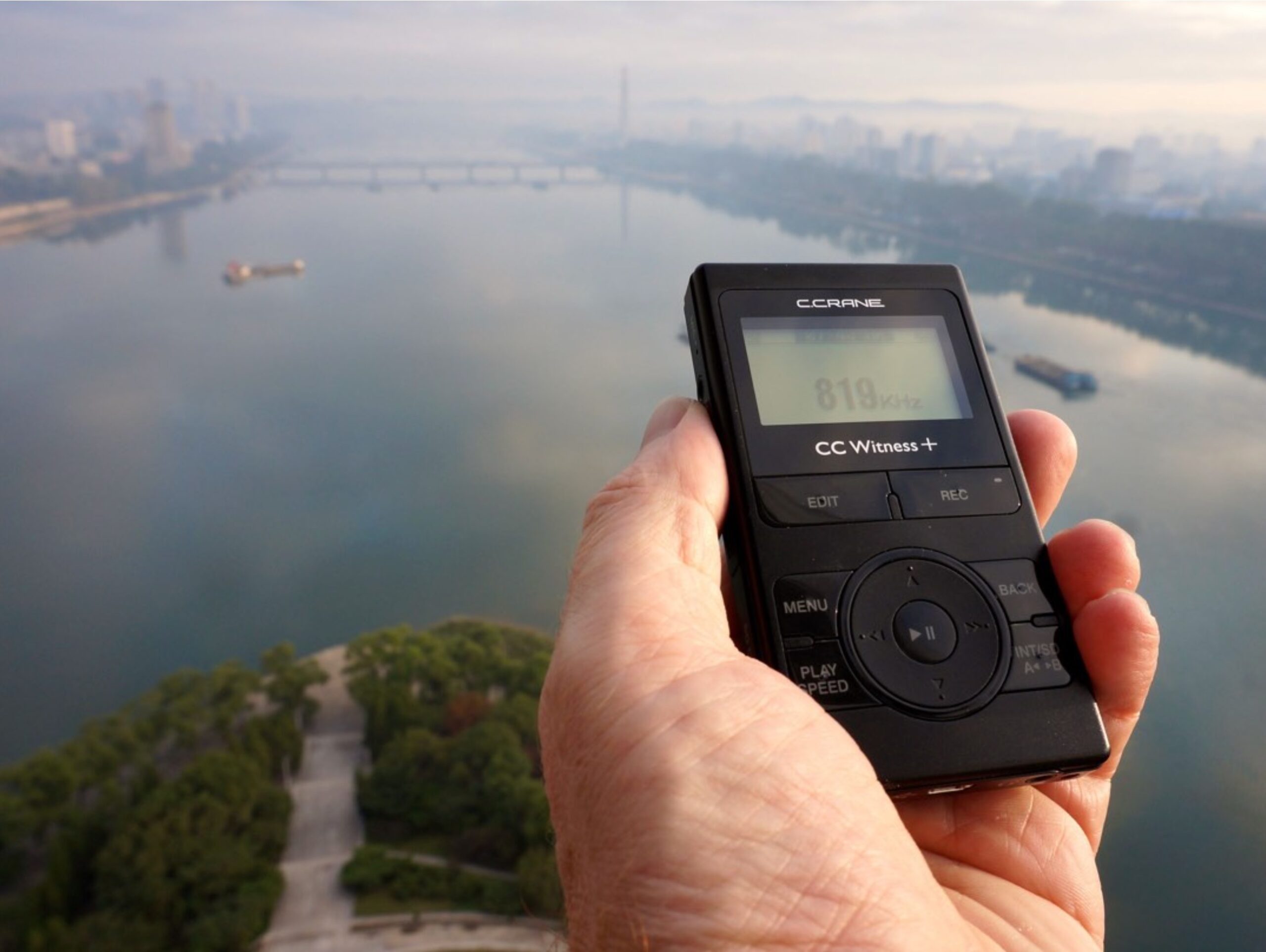
In fact, the above photo is the CC Witness in Mark’s hand overlooking central Pyongyang.
Mark told me that the CC Witness was ideal–he used it on a number of content gathering trips to North Korea as it resembled an MP3 player or dictation recorder rather than a radio. Since it wasn’t suspected as being a radio recording device, it passed through the North Korean border each time without incident.
It’s an understatement to say that Mark took a number of risks to gather North Korean media from “Behind the Curtain.” Thank you, again, Mark, for sharing this info about DPRK DRM broadcasts.
The vast Okeechobee, Fla., antenna farm of privately-owned WRMI, which transmits programming to the world via shortwave radio, was hit hard by Hurricane Ian.
WRMI has 14 transmitters and 23 antenna systems. “We had winds up around 100 miles per hour, and that did a real number on our antenna field,” said Jeff White, general manager of WRMI.
“So far we have three antennas that are probably destroyed beyond repair: one to Europe, one to Africa and one to Central America and the South Pacific.”
As pressing as rebuilding these three antennas is for WRMI, “The biggest job we have at the moment is putting back up dozens of telephone poles that carry the transmission lines from the transmitter building to the antennas,” said White. [Continue read at Radio World…]
Many thanks to SWLing Post contributor, Alex, who notes that some of VOK’s language services are now available in podcast form. If you wish to hear some old school propaganda in high fidelity, this is a good way to do so: check it out on Castbox.
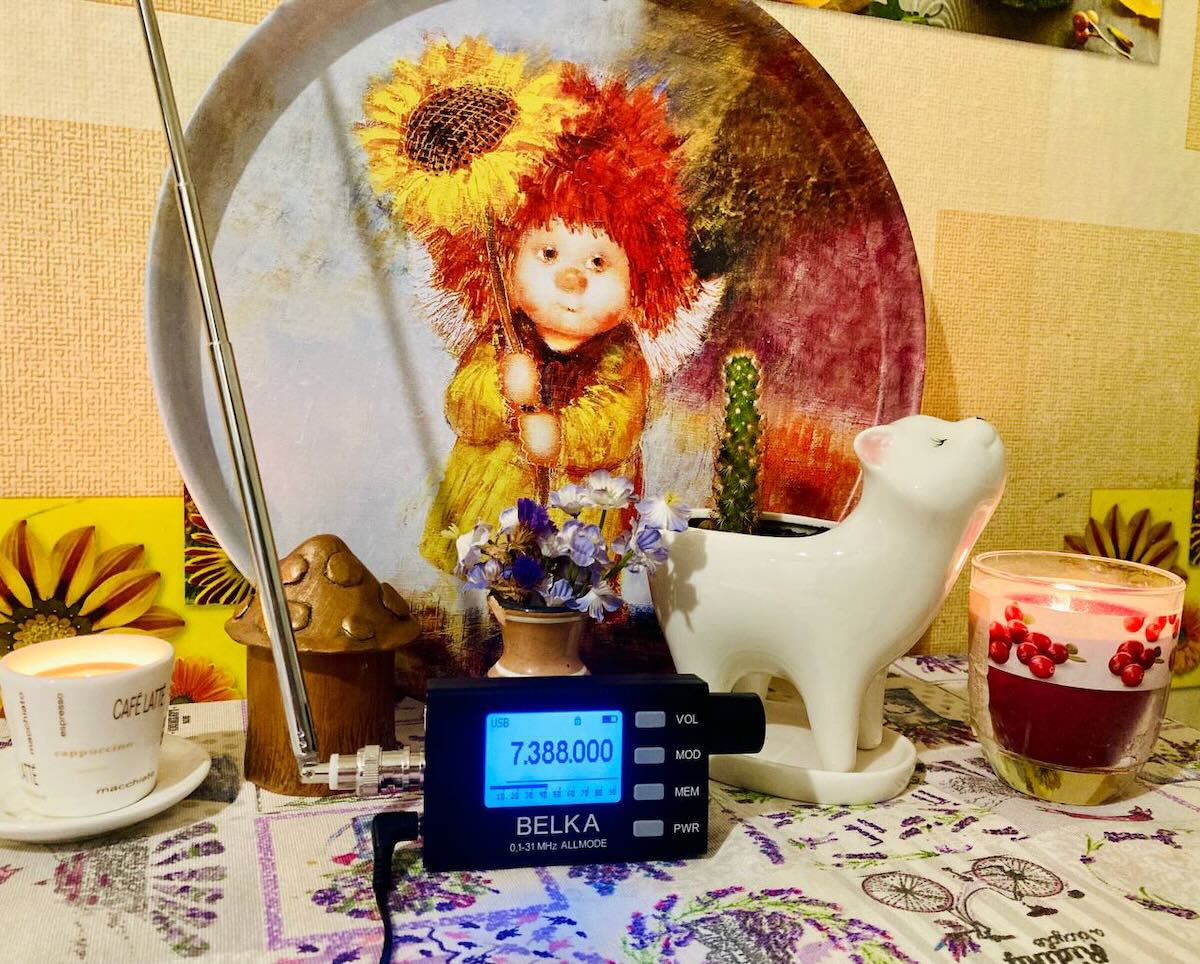
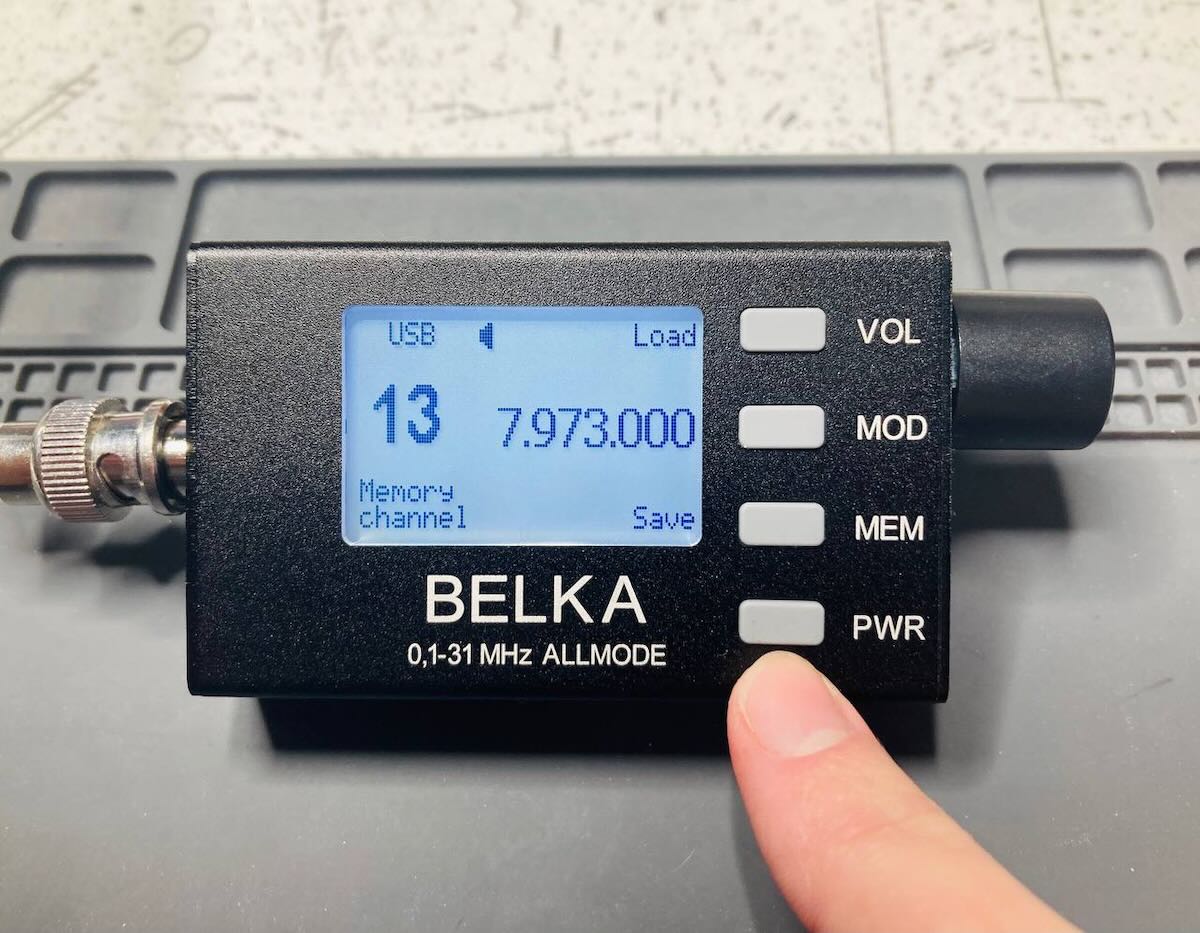
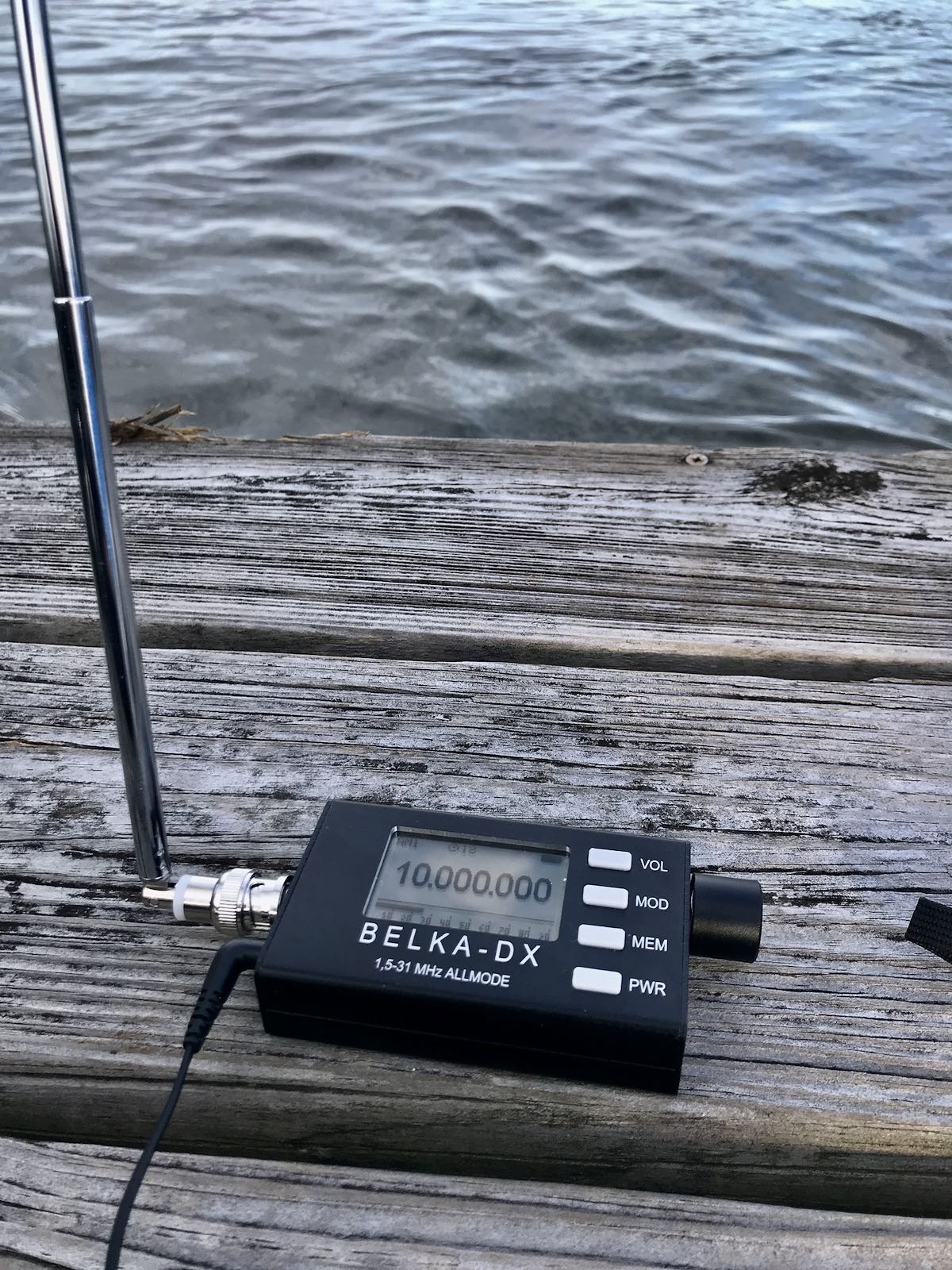
After posting information about the new Belka upgrades yesterday, Belka designer, Aleksandr Buevskiy, reached out to me and shared the following details and clarification about the latest design:
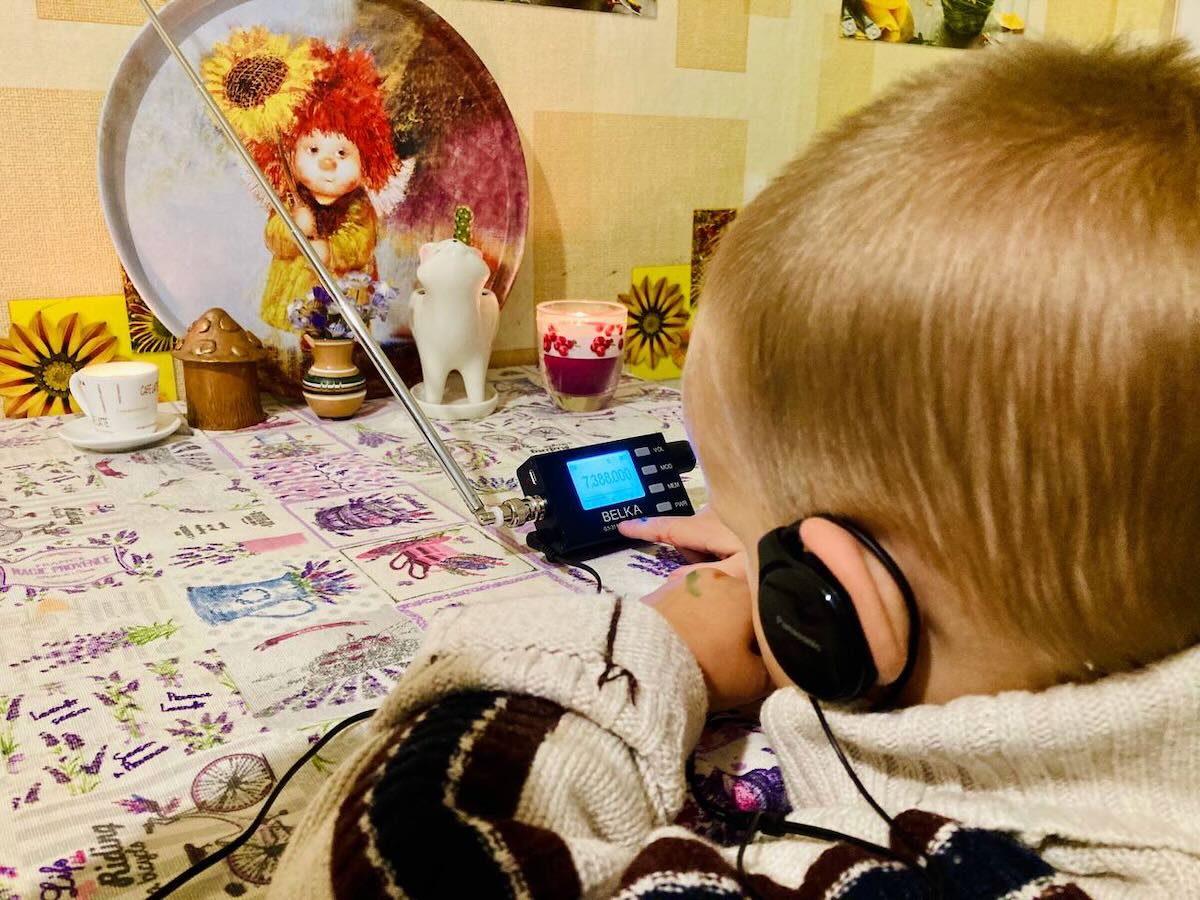
I would like to share some more details/photos about Belka so that there is clear understanding of what features the new version has.
First, regarding its name. Now there’s no “DX”, “DSP” or something else. Belka is just named “Belka”. As simple as that 🙂
Second, frequency range was extended with the same parameters and performance. It’s now 0,1-31 MHz.
In previous versions there were 32 memory cells, we’ve now added a few more – 36 is exact number now to be precise.
One more thing about memory cells is that now there is a possibility to listen to memory cells before loading. See attached how it looks like (I’ve added video illustrating memory cells listening just because there were questions).
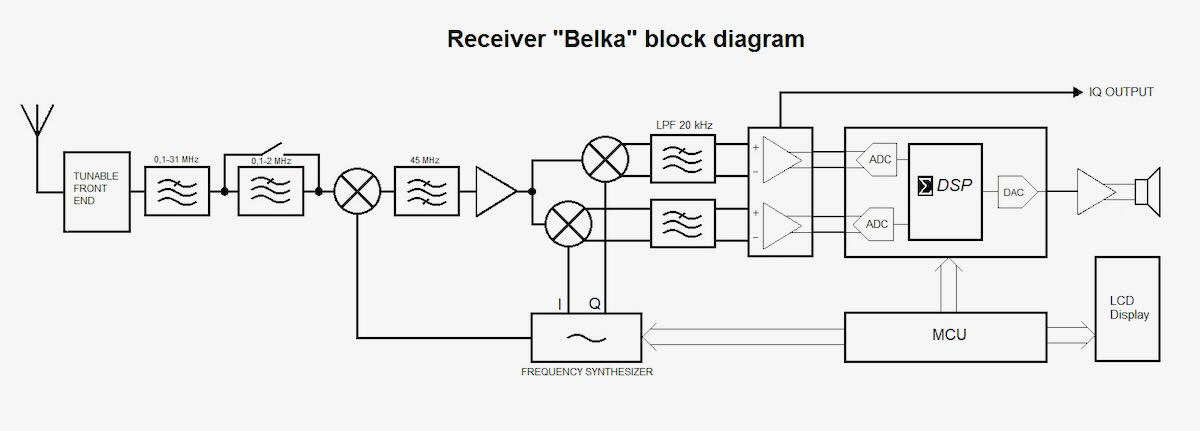
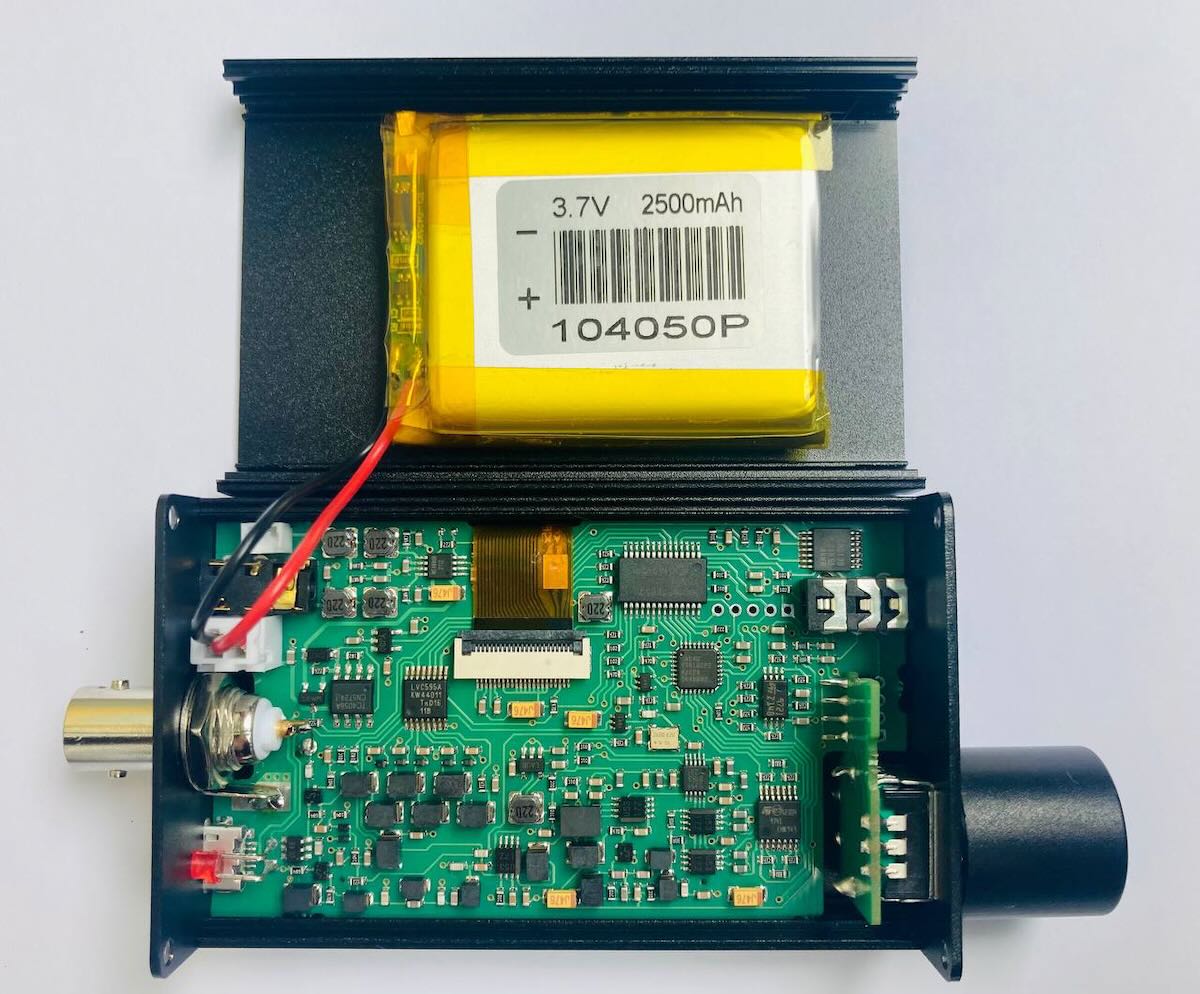
I also attach several photos of new version and add block diagram. You’ll find attached also PCB photo of new version:
Cheers,
Alex
EU1ME
Thank you for sharing all of this detail, Alex. I believe your new Belka will be a hit! I’m sure readers reach out with their reviews and we will share them here on the SWLing Post!
Many thanks to SWLing Post contributor, Dave Garr, who writes:
I have some interesting news for all of those Belka DX fans, Alex the guy behind this magnificent receiver has just announced the introduction of a new model. Ok so it is still called the Belka DX but it has now got a total frequency coverage of 100KHz to 31MHz so those that have put off buying because of lack of Long wave and Medium wave have now had their prayers answered. There has been no fanfare announcement about this but they have just updated their website with the new added frequency range. I am just waiting for the first review to appear before committing my hard earned cash.
Regards
Dave Gurr
Excellent news. I’m sure this will make the Belka DX even more popular than it already is. I have to assume a ferrite bar hasn’t been added (there isn’t much room for one in the Belka series) so you would need to pair a proper MW/LM antenna antenna in order to fully take advantage of the new bands.
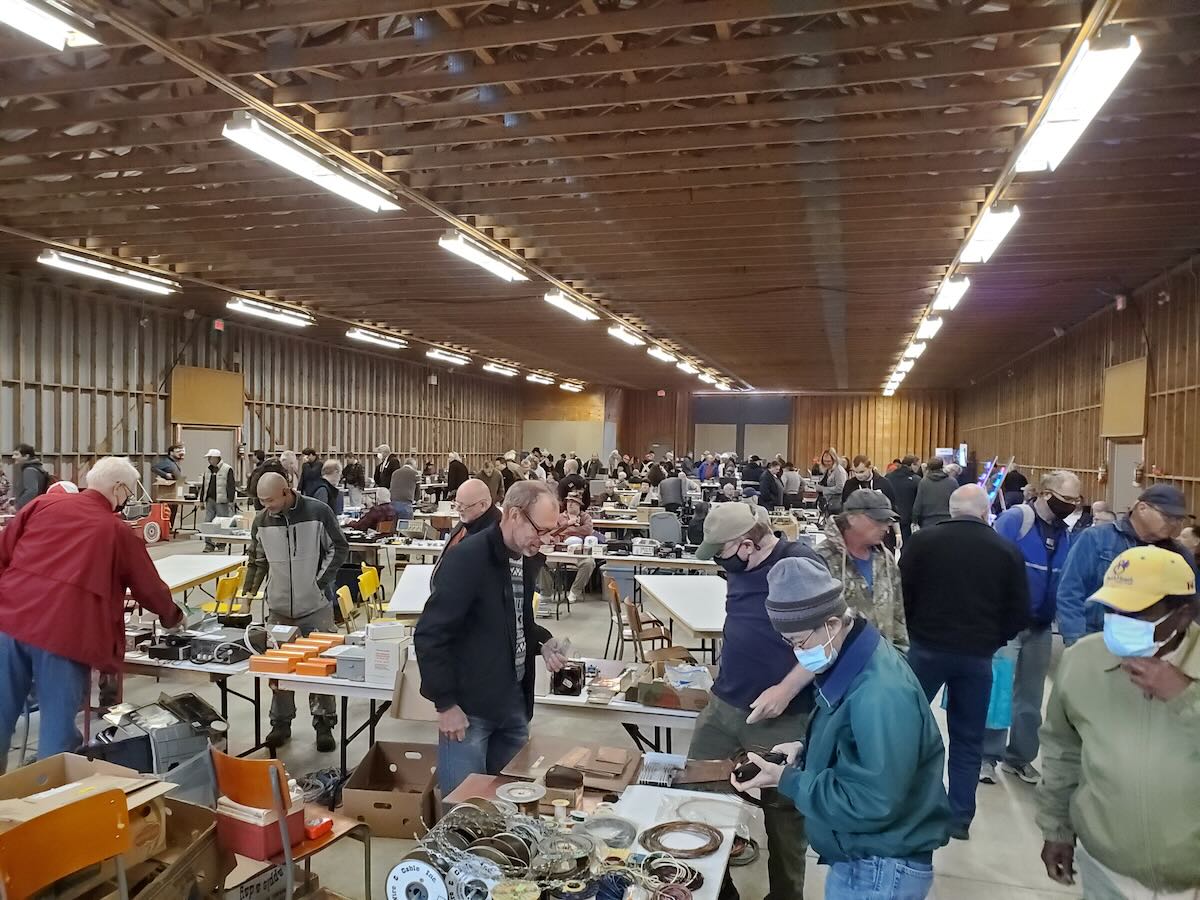
Many thanks to SWLing Post contributor, Mike (VE3MKX), who shares photos taken during the Hamilton, Ontario hamfest which took place on October 1, 2022.
Readers: This is a large gallery of 40 photos courtesy of Mike (VE3MKX). If you would like to view the entire image gallery click on the link to see more.
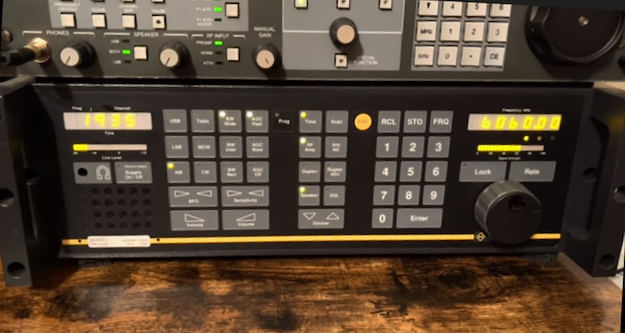
Excellent Nick! Thank you so much for sharing this and for demonstrating some weak signal work. You were certainly pitting the Skanti against some benchmark performers!
Please support this website by adding us to your whitelist in your ad blocker. Ads are what helps us bring you premium content! Thank you!