Category Archives: Shortwave Radio

Former KGEI transmitter building sports callsign once more

1941: KGEI’s reinforced concrete transmitter building near Belmont. Built to withstand bomb or earthquake. (Source: TheRadioHistorian.org)

Many thanks to SWLing Post contributor, Tracy Wood (K7UO), for sharing the following article from The Daily Journal. Tracy’s notes follow this excerpt:

KGEI, a shortwave radio station in Redwood Shores that was the only voice from home for GIs in the Pacific during World War II, has its call letters back.

The letters on the front of the building located off Radio Road were covered up decades ago by a church that took over the station’s transmitter building, now part of Silicon Valley Clean Water.

“I am happy to report that we have uncovered the letters on the building,” said Teresa Herrera, manager of the wastewater treatment facility. “I think it looks great!”

Herrera said she had no idea of the building’s history until the Rear View Mirror brought it to SVCW’s attention. No extra money was needed for the restoration because the building was due to be painted.

“The letters were just as they were when the concrete forms had been originally removed in the 1930s,” said construction manager William Tanner.

Still, there is no plaque to remind the few visitors to the area that KGEI, the GEI standing for General Electric International, played an important role in World War II. Among other accomplishments, the station broadcast Gen. Douglas MacArthur’s “I have returned” speech that fulfilled his promise to return with victorious American troops to the Philippines, occupied by Japanese forces since 1942.

“The First 24 Hours of War in the Pacific,” a book written by Donald Young, underlines the importance of KGEI. It also reminds readers how successful Japanese forces were during those 24 hours in attacking Malaysia, Hong Kong, the Philippines, Wake Island and Guam, as well as Hawaii.[…]

Read the full article at The Daily Journal.

Tracy also shared the following notes:

During my youth I often listened to KGEI, both in Oregon and Bolivia. I got to visit the station in the 80s. I remember their teletype spewing paper for the long-form newscasts… The old 50kw GE hummed away.

The parasitic oscillations would actually form audio that you could hear in the studio/transmitter room. The 250 kw unit was tucked away… kind of hard to see.

KGEI was an important part of LATAM radio history.. the Cuban Missile Crisis, earthquake outreach to Nicaragua, etc.

Cheap clock radios could receive KGEI in Oregon when the 250kw unit was blasting to Asia.

“Mission Engineering” 250kw beamed to Asia on 5980 could often be heard with Chinese and Russian slow-dictation programming… trying to overcome the Cold War ban of Bibles in the Communist countries.

If you can find a copy of the book “Sky Waves” that has a complete history of FEBC and some more details about “La Voz de la Amistad,” the Voice of Friendship KGEI.

Thank you so much, Tracy, for your notes and insights!

I just found a copy of the 1963 book Sky Waves by Gleason H. Ledyard as a free download via the American Radio History website. Click here to download the PDF.

I imagine other SWLing Post readers remember KGEI as well. If so, please comment!
Radio Waves: BBC lifeline, NZ Concert FM, Band Planning Group, and SETI VLA search

Radio Waves:  Stories Making Waves in the World of Radio

Because I keep my ear to the waves, as well as receive many tips from others who do the same, I find myself privy to radio-related stories that might interest SWLing Post readers.  To that end: Welcome to the SWLing Post’sRadio Waves, a collection of links to interesting stories making waves in the world of radio. Enjoy!

Many thanks to SWLing Post contributors Howard, Mark Hirst, Micheal Bird, Pete Eaton, andTroy Riedel for the following tips:


The BBC gave me a lifeline as a child. It must be kept public (The Guardian)

Those who lobby against the corporation’s service remit fail to understand its unique relationship with its audience

ou’re mistaken if you think you can hand Margaret Thatcher a pearl-handled revolver and expect her to do the right thing. She’d shoot you with it.” As memory serves me, those were the words of a member of parliament being interviewed on the BBC World Service in November 1990. The programme was Newshour, and the presenter was Owen Bennett-Jones. I recall these details because the ousting of Thatcher was the first political event I tuned into properly as a child with an interest in politics living in a sub-Saharan African country with no access to media that covered current events.

Satellite dishes were prohibitively expensive, and apart from a short news bulletin on state-controlled TV there was no other source of news, let alone analysis – until I found the BBC World Service on shortwave radio. I started to haul the only portable radio in the house, a large battery-powered contraption with a long-bent aerial, everywhere I went, becoming aware of the dead zones in the house where the signal was weak, and making note of the times when the signal was strongest. Night-times were the worst. I would heave the radio into the bed and painstakingly tease the dial to find the crackling transmission from Bush House, able only to fall asleep when I managed to find the faint voices fading in and out of the crackle of white noise.[]

NZ’s Concert FM may be safe (RadioInfo)

The future of New Zealand’s Concert FM seems to have been assured after NZ Prime Minister, Jacinda Ardern said her Cabinet was looking at an unused FM frequency as a solution to keeping the station on air.

There has been public outcry since the announcement of Concert FM’s proposed closure late last week with ex PM, Helen Clark going public to condemn the move.

RNZ’s breakfast king, Mike Hosking, says that the government is out of touch replacing it with a youth station, “The fact they’re calling it “youth” immediately shows how out of touch they already are, and hopefully they can hire someone who’s pants aren’t pulled up quite as high who can put them straight.”

Under the proposed changes, the classical station would lose its FM frequency, presenters, interviews and live programmes, become fully automated and move to the AM band.[]

New HF Band Planning Discussion Group (Southgate ARC)

The ARRL has created a new HF Band Planning Discussion Group which is open to both members and non-members

The ARRL say:

HF Band Planning Committee Chair Mike Raisbeck, K1TWF, will moderate the group, which will focus on the ARRL HF Band Planning Committee’s recommendations and other band-planning activities.

Earlier this month, the ARRL HF Band Planning Committee invited comments and suggestions from the Amateur Radio community on its report to the ARRL Board. At the Board’s January meeting, the committee presented its specific recommendations in graphical form for each HF band and each US license class, with the goal of increasing harmony on the HF bands, particularly between CW and digital users. Those responding to the initial call for comments and suggestions are encouraged to cross-post their remarks to the new HF Band Planning Discussion Group.

The discussion group is at
https://groups.arrl.org/g/ARRL-HF-Band-Planning/

Other discussion groups are at
https://groups.arrl.org/g/ARRL-Groups/subgroups

Source ARRL
http://www.arrl.org/news/arrl-creates-new-hf-band-planning-discussion-group

Astronomers to sweep entire sky for signs of extraterrestrial life (The Guardian)

Project is collaboration between privately-funded firm and New Mexico observatory

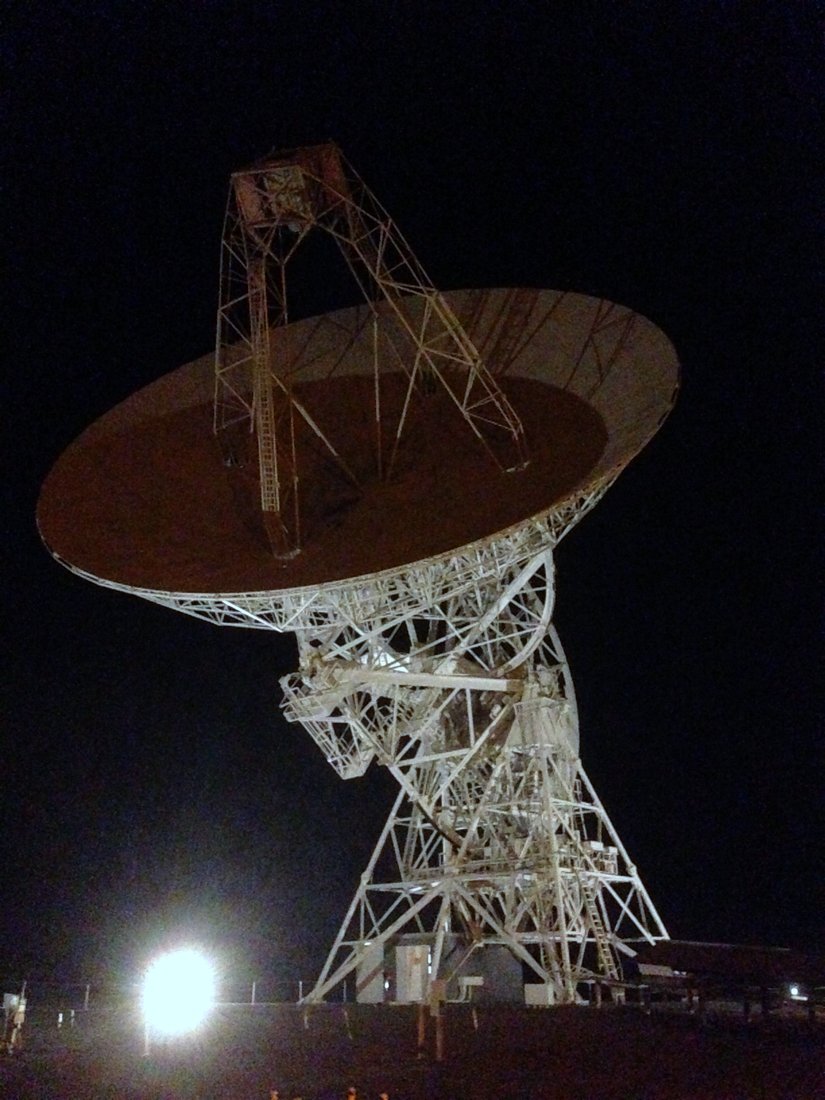
Astronomers will sweep the entire sky for signs of extraterrestrial life for the first time, using 28 giant radio telescopes in an unprecedented hunt for alien civilisations.

The project is a collaboration between the privately-funded Seti Institute and the Very Large Array observatory in New Mexico, one of the world’s most powerful radio observatories. Gaining real-time access to all the data gathered by VLA is considered a major coup for scientists hunting extraterrestrial lifeforms and an indication that the field has “gone mainstream”.

Normal astronomy operations will continue at the VLA, which was featured in the 1997 film Contact, but under the new arrangement all data will be duplicated and fed through a dedicated supercomputer that will search for beeps, squawks or other signatures of distant technology.

“The VLA is being used for an all-sky survey and we kind of go along for the ride,” said Andrew Siemion, director of the Berkeley Seti centre. “It allows us to in parallel conduct a Seti survey.

“Determining whether we are alone in the universe as technologically capable life is among the most compelling questions in science, and [our] telescopes can play a major role in answering it,” said Tony Beasley, director of The National Radio Astronomy Observatory, which runs the VLA.[]


Do you enjoy the SWLing Post?

Please consider supporting us via Patreon or our Coffee Fund!

Your support makes articles like this one possible. Thank you!

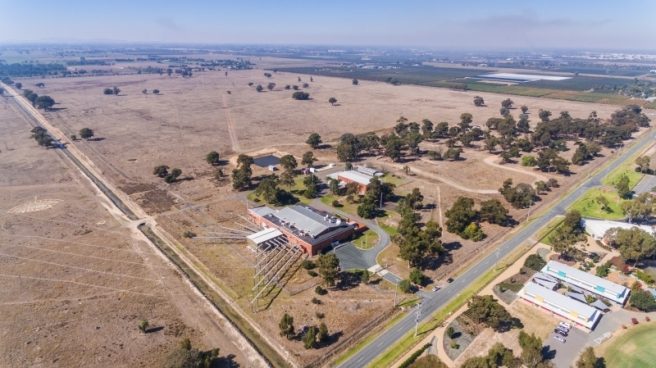
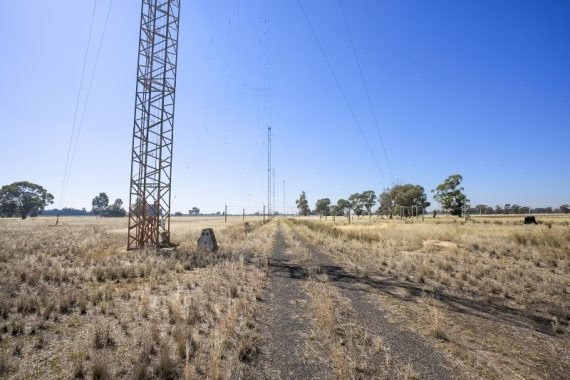
VI3RA: Last RF emanations from RA Shepparton before demolition (March 14-15, 2020)

Many thanks to SWLing Post contributor, Nigel Holmes, who writes:

Those of you who hold amateur (VK) licenses – form an orderly queue to book a spot.

Those of you who listen – make space on your shack wall for the last QSL card from Shepparton IHFTS.

A special callsign has been issued by ACMA for the event: VI3RA (Victor India…)

Amongst other experimental transmissions, will be an attempt will to reflect radio signals from the Moon using the high gain HF aerials at Shepparton. Frequencies in the 18 & 21 MHz amateur bands would be employed. This would emulate the ground-breaking work done by CSIR Radiophysics Laboratory in the 1940s from the Shepparton station which initiated Australia’s entry into radio astronomy.

Click here for more information about VI3RA at QRZ.com and SADARC.org.

Note that the event with take place March 14-15, 2020 (GMT +11:00).

Thank you for the tip, Nigel!  I’ll certainly attempt to put Shepparton in the logs! If I lived in anywhere near Shepparton, I’d make the pilgrimage to be in that long line of people hoping to light up one of those massive antennas!

I hope if any SWLing Post readers attend the event or operate as VI3RA, they’ll perhaps snap a few photos to share here with the community!

Coronavirus delaying product development, production, and shipping

Photo by chuttersnap

Earlier this week, I mentioned in a Patreon post that if you’re plotting to buy a radio or other consumer electronics currently in development or production in China, expect delays.

Due to the spread of the Coronavirus, a number of factories have been shut down and production effectively frozen since the beginning of the Chinese New Year. Some companies are attempting to slowly bring operations back to normal levels, but progress is unstable to say the least.

I’ve spoken with a couple of friends who work in the radio and consumer electronics industry in China and both have expressed serious concerns regarding new product timelines this year. Both noted that there’s no need for alarm or panic at this point, but consumer expectations should simply be in-check as the situation unfolds.

In the meantime, expect recently announced products to take longer to hit the market.

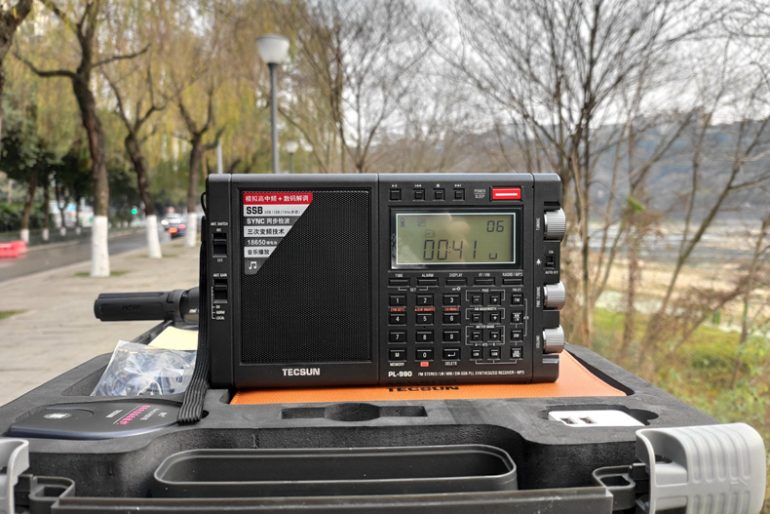
The Tecsun PL-990

I would not be surprised, for example, if the Tecsun PL-990, Tecsun H-501, Eton Satellit Elite, and Icom IC-705 are all delayed a few weeks or even months. Much depends on where each product was in the design, development, or production process when factories were closed.

It’s also possible if your regional retailers and distributors run out of product inventory, it could take an an extended time to replenish stock.

Again, there’s no need to panic about product availability at this point, just anticipate delays!

Post readers: Has this situation already had a direct impact on you?  Please comment.


Do you enjoy the SWLing Post?

Please consider supporting us via Patreon or our Coffee Fund!

Your support makes articles like this one possible. Thank you!

Radio Northern Europe International on shortwave

Many thanks to SWLing Post contributor, Roseanna, who shares the following announcement posted on her blog:

(Source: The Girl With The Radio)

I would like to share something very exciting that I’ve been working on since May 2019:
Radio Northern Europe International

RNEI will be the station for pop and dance music from Northern Europe on shortwave playing music from Norway, Sweden, Denmark, Iceland, Finland, the UK and Ireland!

I aim to play music you haven’t heard before and the first show features a very exciting experiment: Embedded MFSK64! This means, hidden in the final song, there will be the song list sent in MFSK64 in such a way it won’t be off-putting for those of you not decoding!
My shows will mainly consist of lesser known music with a small amount of speaking and jingles. Without spoiling too much of the show I can hint that you’ll hear some Swedish, Norwegian, Finnish, English and Icelandic language music if you tune in!

The first pilot show will go out on 6070 kHz Channel292 from Germany (decent reception all over Europe) at the following times:
February Saturdays 19:00-19:30 UTC (Starting Saturday 15th)

I’m also in talks with shortwaveradio.de so there is a possibility of using 3975KHz & 6160KHz as well (increased reception in the Benelux/UK/Ireland regions!)
After the broadcast, shows will be published on Mixcloud and my reception on YouTube in case you’ve missed the show!

I will respond to all reception reports sent in and, if I get enough, I’ll try and get postcards made to send out (I’ve designed one I want to get printed!)

I would like to take this space to thank RPC Audio (Jono) for the cheap jingles and Daz from HFZone for helping me with making my mic sound good!

I really hope you all get a chance to listen in and that you get decent reception!
until next time,
tgwtr

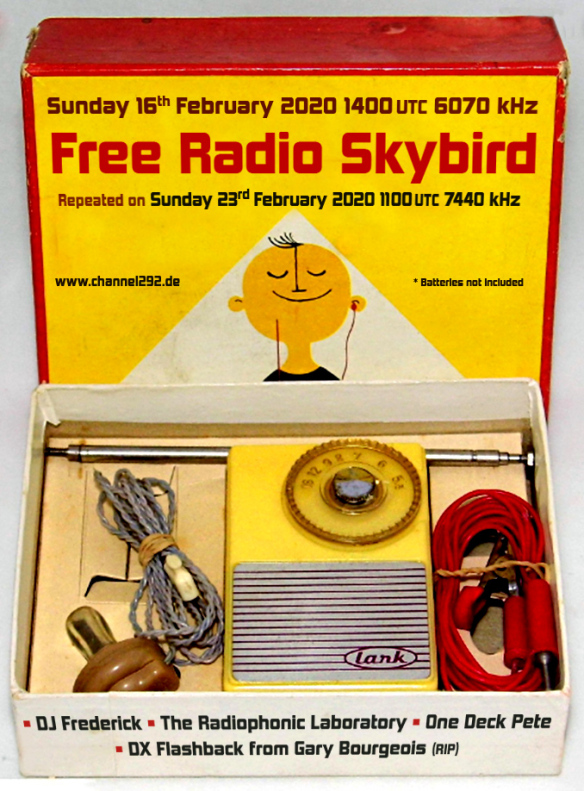
Free Radio Skybird returns February 16th and 23rd

(Source: Pete Madtone)

It seems like it’s been a while since DJ Frederick’s Free Radio Skybird was last on the shortwaves. Don’t worry, it won’t be long until the next one on Sunday 16th February at 1400 UTC/UK on 6070 kHz via Channel 292. The show will be rebroadcast on Sunday 23rd February at 1100 UTC/UK on 7440 kHz. If you haven’t got a shortwave radio it can also be heard on the SDR link on Channel 292’s site here.

The programme will feature Justin Patrick Moore’s Radiophonic Laboratory and One Deck Pete (from Weeds up to me knees) presenting the Skybird Mailbag. There’ll also be an airing of Pete’s “Less is more” that has new tunes from MaiMohammad-Reza  Shajarian & Seventh Soul and Blanco.

Mixes from previous shows are available at our audio podcast page here. The programme will be available on DJ Frederick’s Soundcloud page a day or so before transmission date if you want to hear it in true stereo but we here prefer the show with added noises from the ionosphere. Tune in and turn on! #shortwavesnotdead #madtone #freeradioskybird

Loss of BBC Hindi shortwave service and listener reactions

(Photo by Elle via Unsplash)

Many thanks to SWLing Post contributor, David Iurescia (LW4DAF), who shares the following story from The Print:

Emotional emails & offers to crowdfund — how fans tried to keep BBC Hindi radio on air

The service fell silent last month with its last transmission on 31 January. The BBC management now plans to boost its digital and TV presence.

New Delhi: It was the BBC’s Hindi radio on shortwave that slowly carved an identity for the British broadcaster in India after its launch 80 years ago. With an estimated audience of 40 lakh across India, the radio service was the first choice for consumers of serious news and entertainment alike, particularly in the remote and far-flung parts of the country.

But the service fell silent last month, on 31 January, with the BBC management citing a dwindling audience and plans to boost digital and TV presence as reasons to call time on this chapter of history.

It came as a rude shock for its loyal audience and the dismay was evident, according to BBC insiders.

“It was heartbreaking to see the kind of emotional emails and letters we received on the days preceding the shutdown and after that,” an insider told ThePrint. “They (the audience) pleaded to keep the service afloat. Some even said they were willing to crowdfund it. But it seems the management was interested in the numbers and the BBC Hindi radio service on shortwave was not giving them adequate numbers.”

Another insider in the BBC said audience numbers for the radio service had come down from 1 crore a few years ago to about 40 lakh now, even as its presence on platforms such as YouTube thrived. The service has also established its presence on television with a tie-up with news channel NDTV.

“But in our experience the quality of news consumers is poor in digital as compared to the loyal audience that BBC Hindi radio service in shortwave enjoyed,” the second insider said, basing the assessment on feedback received from both sets of audiences.

“I would say the management was insensitive to the millions of listeners in the remote corners of India who banked on the service as their daily source of news,” the insider added.

The decision to switch off BBC Hindi radio is part of the British broadcaster’s global cost-cutting efforts. It had planned to end the BBC Hindi radio service in 2011, but changed plans owing to massive outrage and a high-profile campaign supported by eminent journalist and author Sir Mark Tully, a former bureau chief of the BBC.

It’s not just the BBC Hindi radio service that has suffered on account of this twin push to cut costs and go digital. Even BBC Urdu announced in December last year that it will end the radio broadcast of its popular news and current affairs programme, Sairbeen.

In India, BBC also has internet broadcasts in other Indian regional languages, but no associated radio services. […]

Continue reading the full article at The Print.