Category Archives: Shortwave Radio

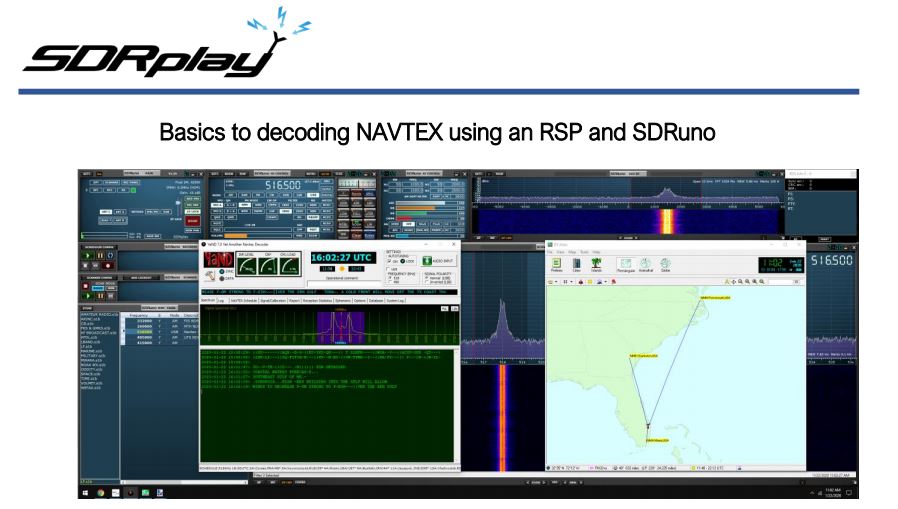
Mike Ladd’s primer on decoding NAVTEX using an SDRplay SDR with SDRuno

Many thanks to SWLing Post contributor, Mike Ladd with SDRplay, who shares the following PDF primer on decoding NAVTEX with an RSP series SDR.

Click here to download “Basics to decoding NAVTEX using an RSP and SDRuno” (PDF).

Thanks for sharing this excellent guide, Mike.  Without a doubt, SDRplay has some of the best documentation and primers in the world of radio. Click here to check out more.

Also, check out Mario’s post, from our archives, which discusses decoding NAVTEX, RTTY, and Sitor B.

Radio Waves: New BBC Ham, Russian Propaganda, Rotators, USB Continuity, and a Moment of Silence

Radio Waves:  Stories Making Waves in the World of Radio 

Because I keep my ear to the waves, as well as receive many tips from others who do the same, I find myself privy to radio-related stories that might interest SWLing Post readers.  To that end: Welcome to the SWLing Post’sRadio Waves, a collection of links to interesting stories making waves in the world of radio. Enjoy!

Many thanks to SWLing Post contributors, Marty, Mike Terry, and Tracy Wood for the following tips:


BBC World Service presenter is a radio amateur (Southgate ARC)

Gareth Mitchell M7GJM is well known as presenter of the BBC World Service show Digital Planet. He got his amateur licence in 2019 thanks to help from members of Essex Ham

Since getting his licence, Gareth M7GJM has been mentioning amateur radio in his BBC World Service show, most recently, featuring how radio hams in Australia have been helping with emergency comms.

Read the Essex Ham story at
https://www.essexham.co.uk/news/online-learning-and-exam.html

Information on the free Foundation Online course that Gareth took is at
https://www.essexham.co.uk/train/foundation-online/


Russian ‘Propaganda Machine’ Selects Kansas City As Its Second Radio Broadcast Site (KCUR)

Commuters interested in conspiracy theories about George Soros, Hillary Clinton and the Republican National Committee have a new option, courtesy of the Russian government.

Early this month, a radio station based in Liberty, Missouri, signed a three-year deal to broadcast Radio Sputnik across Kansas City.

The English-language programming airs for three hours each morning and again in the evening on three frequencies controlled by KCXL: 1140 AM, 102.9 FM and 104.7 FM.

It’s produced by the U.S.-based branch of an organization created in 2013 by Russian President Vladimir Putin to promote Russian interests abroad.

The organization, Rossiya Segodnya, hopes to restore a “fair attitude to Russia in every country in the world,” according to court records.

For now, Radio Sputnik only broadcasts in two American cities: Kansas City and Washington D.C., where its programming has aired since 2017.

“We’d love to broadcast in all major U.S. markets,” a Radio Sputnik spokesperson told KCUR via email. “But unfortunately, U.S. authorities are working really hard to prevent us from doing so.”[…]


Rotators – How do you turn that thing? (Nuts and Volts)

We’ve had a few columns on antennas and propagation, and there sure is a lot of variation in the types of antennas! All the different ways signals propagate require different antenna directions and types. Hams use dinky finger-sized “rubber ducks” on handheld radios but also some ridiculously big antennas it seems. Hams can’t use as much power as some of the other communication services, so they use antennas to get through by focusing radiated power.

If the antennas can focus a signal, then they need to be able to focus it in the desired direction, right? A few antennas can do that electrically by controlling the signal’s phase or switching antenna elements on and off. Most of the “pointable” ham antennas, though, need to be pointed mechanically and held in place during a contact or to keep a communications link working. The thing that hams use to point their antennas — large and small — is called a rotator.

There are a wide range of rotators, just like antennas. You may have used a TV antenna rotator with its “chunk-chunk-chunk” stepping. At the other end of the scale, whole towers turn! We’ll cover some of the most common types and give you an idea of how they work. (If you want detailed information, including guidelines and illustrations for how to work with these unsung heroes of the antenna farm, see the sidebar, “Rotator and Tower Know-How.”)


Build a USB continuity jig (Nuts and Volts)

If you’re like me, you likely have a drawer or shoebox stuffed with assorted USB cables that are used to either charge or program a USB device. The problem often is that some cables may only be useful for charging, and which only have the +Vcc and ground wires intact with one or both data wires either broken or not connected in the first place.


Every Radio Station in Los Angeles Holds Moment of Silence for Kobe Bryant (Billboard)

Los Angeles has been rendered speechless by the shocking death of NBA legend Kobe Bryant, his 13-year-old daughter Gianna “Gigi” Bryant, and seven others in a helicopter crash in Calabasas, Calif., on Sunday morning. And for one minute and eight seconds — the extra time nodding to Bryant’s original No. 8 Lakers jersey — radio stations across the city held a moment of silence Monday (Jan. 27) at noon.

The Southern California Broadcasters Association asked its members to synchronize their moment of silence, as well as continuously airing reminders about the upcoming tribute.

Before noon, the SCBA requested all local area radio stations to repeat this core introductory message for grieving Angelenos listening in: “Right now All LA radio stations are now broadcasting 1:08 minute silence for LA Sports Legend Kobe Bryant,” according to an announcement posted on the association’s website.[…]


Do you enjoy the SWLing Post?

Please consider supporting us via Patreon or our Coffee Fund!

Your support makes articles like this one possible. Thank you!

LRA36: A new email address for reception reports

Source: Base Esperanza – Antártida

Many thanks to SWLing Post contributor, Harald Kuhl, who notes that LRA36 (Radio Nacional Arcángel San Gabriel) has published the following new email address to be used for reception reports: [email protected]

Thanks for sharing this Harald as I have not had luck with the former email address. I’ll re-submit my last report!

WRMI’s origins in Scituate, MA

(Source: The Patriot Ledger)

WHAT IS IT?

Located off Hatherly Road, the Scituate Proving Grounds was used as an ammunition dump and a testing facility for artillery during World War I. During World War II, it served a different purpose, beaming radio broadcasts to occupied Europe as the transmitter site for shortwave station WRUL. The station’s signal also had strong coverage in Africa, South America and at sea.

LAST WE HEARD

The station traces its origin back to the first shortwave radio license granted in the United States in 1926. In 1936, the station built its transmitters and antennas on the Scituate site, broadcasting university lectures, cultural and news programs from studios on Boston’s Commonwealth Avenue. The call letters stood for World Radio University Listeners.

At the start of World War II, its broadcasts were credited with keeping more than 900 Norwegian ships from being captured by Nazi Germany. The station was used by the U.S. Government during the war, and broadcast the Voice of America service from 1947 to 1953. The station went through some ownership changes and in 1960 its studios moved to New York. The call letters were changed to WNYW in 1966, and the station was knocked off the air by a fire at the Scituate facility in 1967.

When it returned to the air, it was bought by Family Radio in 1973 and was one of only a handful of privately-owned shortwave stations in the United States. Family Radio gradually moved the transmitter site to Okeechobee, Florida. The Scituate transmitters were turned off in 1979.

WHAT’S HAPPENING NOW?

After being vacant for many years, the Hatherly Road property became the site of the Seaside at Scituate Condominiums. As for the station, WYFR went off the air in 2013. Its facilities were taken over by WRMI “Radio Miami,” which is still on the air.

Click here to read the full article at The Patriot Ledger.

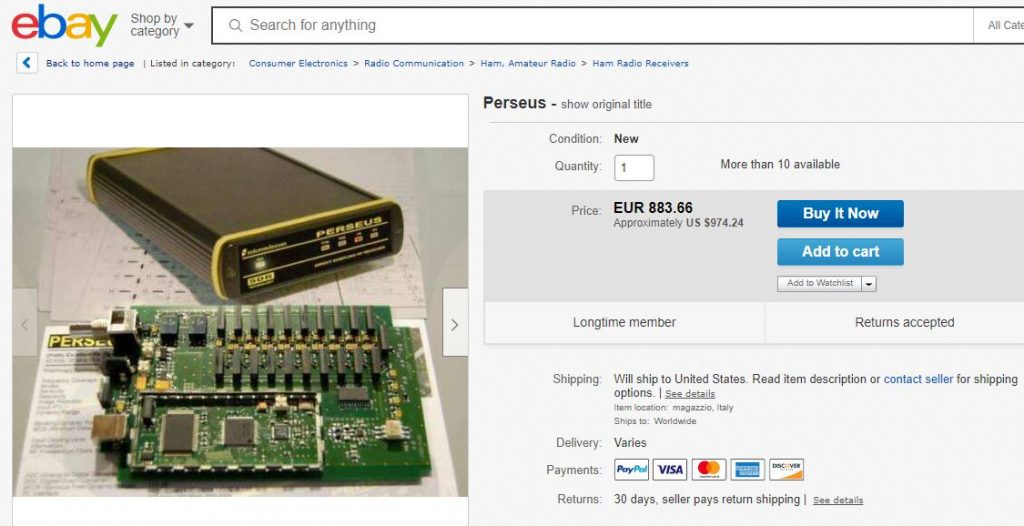
New Microtelecom Perseus SDRs on eBay

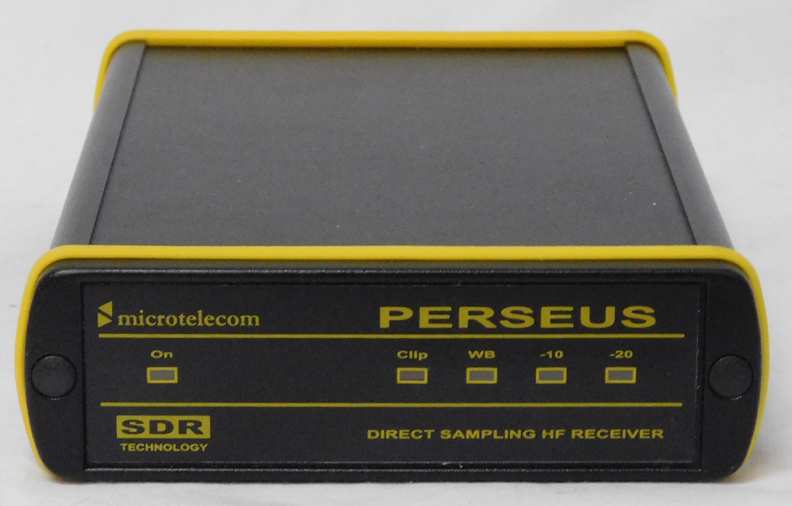
Many thanks to SWLing Post contributor, Dan Robinson, who notes that an eBay vendor in Italy is selling new inventory of the benchmark Microtelecom Perseus SDR. The price is 883.66 Euro or roughly $975 US. 

I have gotten a lot of inquiries about the Perseus over the past few years since it’s more difficult to find ones new-in-box. It appears this vendor has at least ten units and a 99.3% rating with almost 800 eBay reviews. The seller allows for a thirty day return period and they also pay return shipping. If you’ve been looking for a new Perseus, this may be worth considering.

Click here to view on eBay.

Washington Post features WWV and WWVB

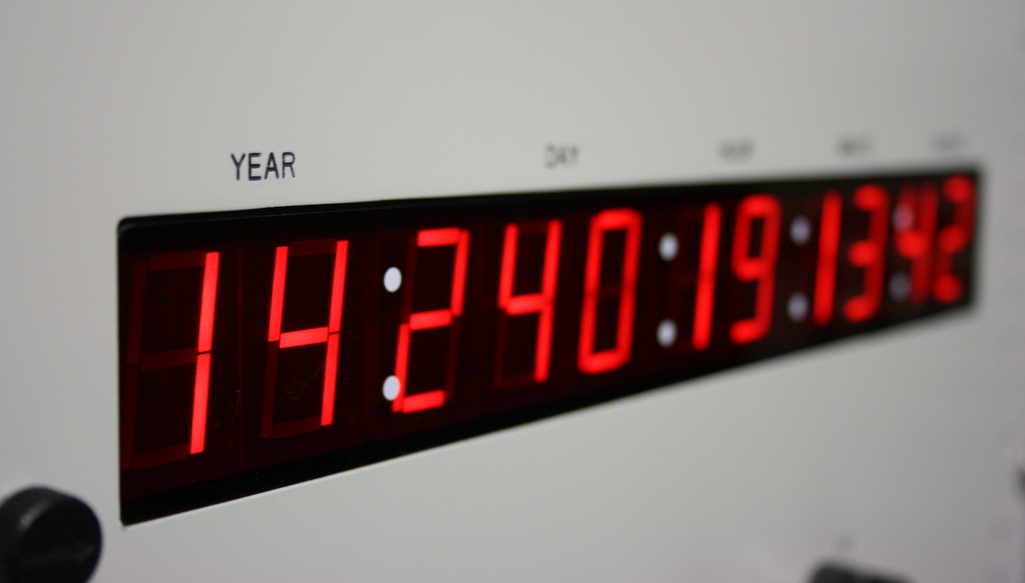
A WWV Time Code Generator

(Source: Washington Post via Ulis K3LU)

If you tune a shortwave radio to 2.5, 5, 10 or 15 MHz, you can hear a little part of radio history — and the output of some of the most accurate time devices on Earth.

Depending on where you are in the United States, those frequencies will bring you to WWV and WWVH, two extremely accurate time signal stations.

Developed before commercial radio existed, WWV recently celebrated its 100th anniversary. It’s the oldest continually operating radio station in the United States.

Both stations are overseen by the National Institute of Standards and Technology, the federal agency that governs standards for weights and measures and helps define the world’s official time.

That time can be heard on shortwave radio 24/7.[…]

Click here to read the full article.

If you’d like to hear why I believe WWV/WWVH and WWVB are important services, check out this interview I did with Scott Simon for NPR Weekend Edition.

Thirty Years of Radio New Zealand’s International Service

RNZI QSL

Yesterday, Radio New Zealand celebrated 30 years of service to the Pacific. Many thanks to SWLing Post contributors Jason Walker and Peter Marks for sharing the following story and audio from Radio New Zealand:

On 24 January 1990, Radio New Zealand International beamed into the Pacific, on a new 100 kilowatt transmitter.

New Zealand has had a short-wave service to the Pacific since 1948. The station broadcast on two 7.5kw transmitters from Titahi Bay, which had been left behind by the US military after the Second World War.

In the late 1980s, following growing political pressure to take a more active role in the Pacific area, the New Zealand government upgraded the service.

A new 100kw transmitter was installed and, on the same day the Commonwealth Games opened in Auckland, the service was re-launched as Radio New Zealand International.

“What we were able to understand was how important radio was and still is in the Pacific, where as here radio had become a second cousin to television… different thing in most of the countries we worked with,” said RNZ International’s first manager was Ian Johnstone, from 1990 to ’93.

Mr Johnstone said news of a dedicated Pacific service into the region was welcomed by Pacific communities.

He also said it was important for New Zealanders to remember that New Zealand is part of the Pacific.[…]

Continue reading the full article and listen to embedded audio at Radio New Zealand.

Audio:

Click here for the audio links.