1939 RCA Broadcast Equipment Catalog

RCA-AR-60Now that I’ve read this scanned 1939 RCA Broadcast Equipment Catalog, I realize that I really do need an RCA AR-60 Communications Receiver. It would make a lovely addition to my antique radio collection!

Click here to download your copy of the 1939 RCA Broadcast Equipment Catalog.

RCACatalog

Thanks to David for spotting this!

VOA reducing shortwave radio broadcasts

VOAFollowing the BBC World Service’s lead, the VOA will reduce broadcasts to Iran, Albania, Georgia and Latin America, along with English language broadcasts to the Middle East and Afghanistan.

Full details below:

(Source: Inside VOA)

WASHINGTON, D.C. — Voice of America is reducing some of its radio transmissions this weekend and ending shortwave broadcasts to regions where audiences have alternative ways of receiving VOA news and information programs.

The transmission reductions allow VOA to comply with budget cuts required by sequestration and to avoid furloughs of staff members.

When the new broadcast schedule goes into effect on March 31st, cross-border shortwave and medium wave broadcasts to Albania, Georgia, Iran and Latin America will be curtailed, along with English language broadcasts to the Middle East and Afghanistan.

VOA will continue to provide audiences in these regions with up-to-date news and information through a host of other platforms, including radio and TV affiliate stations, direct-to-home satellite, web streaming, mobile sites and social media.

The new broadcast schedule calls for reductions in some  shortwave and medium wave radio broadcasts in Cantonese, Dari/Pashto, English to Africa, Khmer, Kurdish, Mandarin, Portuguese, Urdu and Vietnamese. Direct radio broadcasts to all of these regions will continue.

The transmission reductions are expected to have minimal impact on audience numbers since primary modes of delivery will remain.  Shortwave and medium wave broadcasts will continue to regions where they draw substantial audiences, and to countries where other signal delivery is difficult or impossible.

For more information contact Kyle King at the VOA Public Relations office in Washington at (202) 203-4959, or write [email protected].  For more information about VOA visit our Public Relations website atwww.insidevoa.com, or the main VOA news site at www.voanews.com.

Shortwave Radio Recordings: Radio New Zealand International

The New Zealand Bellbird (Anthornis melanura) provides the interval signal for RNZI (Photo: Wikimedia Commons)

The New Zealand Bellbird (Anthornis melanura) provides the interval signal for RNZI (Photo: Wikimedia Commons)

One of my favorite shortwave radio broadcasters is Radio New Zealand International. RNZI has authoritative news–with a focus on NZ and the Pacific islands–music, sports and their own unique character, though they operate on a very modest budget by international broadcasting standards.

The RNZI interval signal is charming and unmistakable: the call of the New Zealand Bellbird.

Fortunately, in the 3 hour recording of RNZI below, I caught not only the interval signal as the broadcast began, but also as it went off the air. This recording was made on March 14th 2013 starting around 8:00 UTC on 9,765 kHz. (You’ll note news of the Pope.)

Click here to download the full broadcast as an MP3, or simply listen via the embedded player below:

Note to SWLing Post reader, Mike:
I hope you enjoy these sounds from home!

Shortwave Radio Recordings: Alcaravan Radio

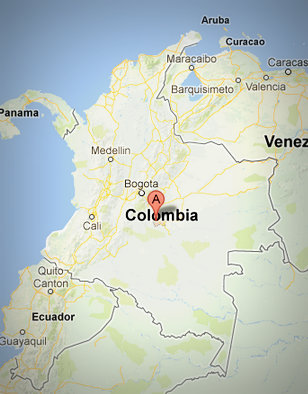
The Alcaravan Radio transmitter site is located south of Bogata.

The Alcaravan Radio transmitter site is located SSW of Bogata in Puerto Lleras.

On March 19th, I was able to record a particularly strong signal from Alcaravan Radio out of Puerto Lleras, Columbia. Alcaravan Radio broadcasts domestically on medium wave and also on 5.91 MHZ shortwave, from 23:30-12:00 UTC.

I have seen their output power listed anywhere from 1,000 – 5,000 watts; a puny amount by international standards, but more than enough to cover their target area of Columbia.

There are very few details about Alcaravan Radio on the Internet. If anyone can add more details about this station, feel free to comment below.

This is a four hour recording and contains about three hours of music.

Click here to download the recording as an MP3, or simply listen via the embedded player below:

BBC World Service program discusses Chinese jamming

BBCSWOverToYouIn the latest episode of Over To You, host Rajan Datar discusses how the BBC World Service’s shortwave transmissions are being affected by jamming in parts of Asia. It’s a short but informative episode.

Even Datar and his guest, Nigel Fry (Head of Distribution for BBC Global News), could appreciate the irony that while China is investing a substantial number of resources in jamming BBC WS English broadcasts, the BBC World Service is voluntarily trimming their English offerings anyway. What a gift to those in China trying to control access to the global press!

Thanks to the Southgate ARC for the tip.

(Source: Over To You)

Over To You explores the way that the World Service’s shortwave transmissions are being affected by jamming in parts of Asia, following up from an email from a listener in West Bengal who was having problems listening to the service. With the help of the World Service’s head of business development, we find out how jamming of the World Service shortwave transmissions inside China is spilling over into neighbouring countries, and explore what the BBC can do to redress the situation through international organisations.

Click here to listen to the full interview.

BBC World Service to “simplify” English and cut Arabic on shortwave

BBC-WorldServiceSadly, the BBC World Service is going forward with cuts that had been announced in 2012.

Global English service is being reduced, but Arabic services are being cut altogether. The BBC expect to lose 1.5 million listeners to Global English cuts, 800,000 listeners to Arabic cuts.

Fortunately, they will maintain all shortwave service into Sudan.

Here is the full press release:

(Source: BBC Media Centre)

25 March 2013

The World Service English global schedule will be simplified with fewer regional variations from Sunday 31 March 2013 and shortwave Arabic broadcasts will cease.

The reductions to shortwave services were announced in October 2012 as part of the UK government’s 2010 spending review. BBC World Service on FM and online and on television will not be affected and no language services are closing.

Shortwave and medium wave transmissions in English will be reduced to a minimum of 6 hours in total each day. This will generally be two periods of between 2 and 4 hours each, usually at peak listening times in the morning and evening to help minimise disruption. The changes will have less impact in regions where World Service is increasingly accessed via partner stations or online and in countries where FM is widely available.

Steve Titherington, Senior Commissioning Editor for BBC World Service, said: “We know that increasing numbers of people are accessing World Service on FM, online, and television. For those who can’t access these platforms, we’ve tried to ensure that they will continue to hear to the best the World Service has to offer at times of the day when they are most likely to tune in.”

“As part of the new schedule we will endeavour to have a mixture of news, current affairs and a mix of programmes covering the arts, science and human interest stories.” says Titherington.

A new programme, The Newsroom, will replace World Briefing. Outlook will be extended to an hour-long format and offer a new approach to covering arts, music and humanities following the closure of The Strand. Every Friday, The 5th Floor will run in the prominent Outlook time slot offering a review of the pick of the BBC’s 27 language services programing – in English.

The estimated loss of listeners to Global English on shortwave will be around 1.5m listeners, equivalent to 1.3% of the total Global News English audience on any platform.

BBC Arabic audiences are estimated to reduce by 800,000 as a result of the closure of shortwave broadcasts.

In the Arabic speaking world, the World Service broadcasts on a network of FM relays, a 24-hour television channel and thebbcarabic.com website.

Shortwave services to Sudan are not affected as the shortwave service is currently the most viable method of broadcasting to this large region.


CommRadio CR-1 training videos

Don Moore, founder of CommRadio, has uploaded training videos for the CommRadio CR-1. These offer a pretty comprehensive overview of the CR-1, especially in terms of functions and menu structure.

Training Video 1 – Overview

Training Video 2 – Tuning

Training Video 3 – Menus and Functions