India To Go DRM

In the broadcasting world, All India Radio has been an early adopter of DRM technology. I was pleased to find this article from the DRM Consortium via Andy Sennitt at RNW Media Network:

The Digital Radio Mondiale (DRM) Consortium has welcomed the Indian government‘s approval of All India Radio (AIR)’s ambitious plan of converting its vast broadcasting network to digital using the DRM standard. India is one of the first countries in the world to implement such an extensive and well-researched plan to upgrade its radio infrastructure using the global open DRM radio technology and thereby ensuring that it can maintain significant reach to its 1.2 billion strong population whilst delivering enhanced radio services.

India’s Cabinet Committee on Infrastructure on Thursday 8 April gave its approval to the proposal from the Ministry of Information and Broadcasting regarding 11th Plan of Digitalisation where Rs 9.20 billion (approx US$200 million) have been earmarked for AIR to convert to digital which will cover approx 70 per cent of the country. By converting to digital, AIR will deliver enhanced radio services that offer crystal clear sound, increase user experience with additional functionality such as automatic tuning by station name, interactive user interface through digital screens that offer slide-shows and many other services like EPG, Journaline.

The digitisation scheme involves the installation of over 40 digital (DRM capable) transmitters as well as other digital enhancements and networks for both state radio and television.

All India Radio (AIR) began moving towards digitisation with the adoption of the DRM standard after extensive field trials and tests since 2007 that was offering in their opinion the most ‘robust, reliable’ technology. Last year, it started a regular DRM broadcast from one of its high-power shortwave transmitters located at Khampur near Delhi and this year it acquired two high powered mediumwave DRM transmitters.

Source: DRM Consortium via RNW Media Network

3rd Edition of “Radio Monitoring – A How To Guide” Available As Free Download

Author Skip Arey is now offering his third edition of the popular “Radio Monitoring – A How To Guide” as a free download via the NASWA website. This guide was originally published by Index Publishing Group and later released by Paladin Press–it had two very successful editions that sold for many years.

The guide recently went out of print but Skip has released it on line (for FREE) via Creative Commons license.

You can download a copy thanks to the North American Shortwave Association (NASWA) who have consented to be the primary online source for distribution. The direct link is .

On Skip’s Facebook page, he said, “The hobby has been good to me over the years. I am happy to give this book back to
the radio community. Enjoy.”

Thanks Skip! We will enjoy your fine publication.

I would strongly encourage you to use this as an opportunity to become a member of the NASWA.

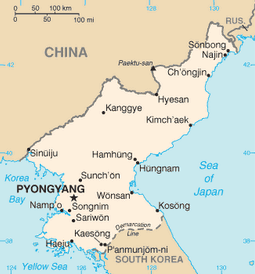
Irish Times Reports On Shortwave Broadcaster Targeting North Korea

Free North Korea Radio is giving voice to a growing opposition to the dictatorship, writes David McNeill in Seoul.

Building up a new network of stringers took time. Today, 10 freelance journalists provide reports from behind the bamboo curtain on a retainer of about $100 (€73) a month. They include a university professor, a teacher, at least two soldiers and a North Korean security agent…

…FNKR provides them with small digital recorders, which are used to record interviews, and mobile phones with signals that work across the Chinese border – Pyongyang’s fledgling mobile- phone system was bought from Egypt and is incompatible with the South Korean network.

The recordings are smuggled across the Chinese border and transported back to Seoul via a network of spies.

The results detonate on air during Voices of the People , where the raw views of the North’s citizens – electronically distorted – are broadcast back into their own country. Brainwashed automatons in so much reporting, the people heard here emerge as thrillingly human, alive and angry.

Read full article in the Irish Times.

Other reports of Free North Korea Radio:

Radio World: Whatever Happened to Shortwave Radio?

For all its transmission expense and audio problems, analog shortwave radio has one clear advantage over the Internet and domestic radio/TV: It cannot be easily blocked — even when states try to disrupt its signals using jamming transmitters.

This is one of the best articles I’ve read recently about the state of shortwave broadcasting. It features authorities on the subject like Andy Sennitt, Larry Magne and Kim Elliott. Moreover, it highlights the historical appeal and the challenges shortwave broadcasts face in the internet age. Click here to read the full article on Radio World’s website.

forth magazine: Clandestine, not confidential

Jason Walsh, of Ireland’s forth magazine, attempts to separate the news from the propaganda on the international airwaves – and finds it impossible

IMAGINE THERE was a communications medium that spanned virtually the entire globe and was virtually impossible to censor. Now imagine that, unlike the internet, it couldn’t be switched-off by the powers that be and didn’t require expensive equipment or monthly subscription fees to access. That would be a powerful voice for democracy, wouldn’t it?

Read the full article here.

SWL Fest 2010 – March 5–6, 2010

For those of you readers who often feel you’re alone in your enthusiasm for radio, I highly encourage you to attend the NASWA-sponsored SWL Fest in Kulpsville, Pennsylvania this year. This will be my second year attending, and I have eagerly awaited the arrival of the ‘Fest.  It is jam-packed with radio-related information and attended by many radio kindred spirits.  From their website :

The Winter SWL Fest is a conference of radio hobbyists of all stripes, from DC to daylight. Every year scores of hobbyists descend on Kulpsville, Pennsylvania, just outside Philadelphia, for a weekend of camaraderie. The Fest is sponsored by NASWA, the North American Shortwave Association, but it covers much more than just shortwave; mediumwave (AM), scanning, satellite TV, and pirate broadcasting are among the other topics that the Fest covers. Whether you’ve been to every Fest (all 23, starting with the first year at the fabled Pink & Purple Room of the Fiesta Motor Inn) or this year’s will be your first, you’re sure to find a welcome from your fellow hobbyists.

The Winter SWL Fest has two days of sessions where you can learn about the latest developments in the radio listening hobbies, but there’s so much more going on. There’s a silent auction that takes place over the two days of the Fest, where you’re bound to find something of interest. There’s the Hospitality Suite, where attendees partake of tuning oil and other treats and engage in spirited conversations. There is the closing Banquet, with after-dinner remarks by a luminary from the field, often one of the many broadcasters who attend the Fest, followed by the raffle, where you could win one or more of the dozens of prizes, ranging from pens from stations up to top-notch communications receivers. And of course, the infamous midnight ride of Pancho Villa that closes things out every year.

Your hosts, Richard Cuff and John Figliozzi, work throughout the year to ensure that attendees have a great time over the weekend, and by all accounts, they succeed stunningly. How else could this event have lasted for 23 years and draw people from around the world to this small town in Pennsylvania? Won’t you join us?

Sure, I will!

If you’re interested in attending the SWL Fest, too, go to the official website and register!