Open Radio for North Korea hopes to contribute to gradual change in North Korea

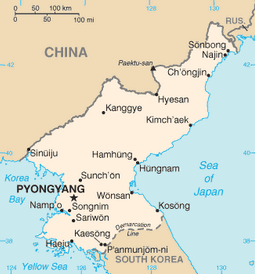
North Korea

Without a doubt, North Korea is one part of the world that is information starved. Open Radio for North Korea uses the shortwaves to get their messages across the border:

(Source: Deutsche Welle)

The North Korean regime suppresses all forms of free information within the country. “Open Radio for North Korea” broadcasts international news via shortwave and FM from neighboring South Korea for the North. World in Progress talked to the radio station’s founder, Tae Keung Ha, about the role of outside broadcasters for the people of North Korea.

Tae Keung Ha: I find the human rights situation and the media control in North Korea, I think, the most severe, the most serious in the world. Radio is very special for the North Korean people to get outside news, because in North Korea they don’t have any Internet connections. Social network services, Facebook, Twitter are impossible inside of North Korea.

Also, all the calls in North Korea are monitored, strictly wired by the North Korean regime. And their TV system is different from the South Korean system – they cannot watch South Korean TV.
Domestic phonecalls in North Korea are controlled by the government

Internal information is strictly blocked by the regime, so a person in the northern part of North Korea doesn’t know what’s happening in the southern part of North Korea. The North Korean media only broadcast their own propaganda, so we have underground correspondents inside North Korea, 10 to 20, it varies. They offer us news about what’s happening inside North Korea.

Read full transcript/interview at DW-Welle.de

This isn’t the first time we’ve mentioned stations targeting North Korea, click here to read our previous–yet still totally relevant–article. Also, check out this 2009 article from the LA Times.

Public Diplomacy Magazine features array of articles on the state of international broadcasting

It is a rare occurrence when so much attention is given to the topic of international broadcasting. Financial hardship combined with a rapidly changing media landscape set a stage where broadcasters are being forced to a precipice of change. How well they quickly evaluate restructuring their message and the medium they use to deliver it could very well determine the future of broadcasting on the shortwaves.

This issue of Public Diplomacy Magazine covers the scope.

(From: RNW Media Network)

PD Magazine, Summer 2011 of the University of Southern California Center on Public Diplomacy, is devoted to international broadcasting. Its contents include:

Also available is the pdf version.

Thanks to RNW Media Network, Kim Andrew Elliot and Richard Cuff for the tip.

BBC strikes in light of Murdoch

(Source: The Guardian)

Sometimes it’s easy to figure out which side people are on – the strikers and their union, the National Union of Journalists (NUJ) are on one side – as are the other unions in the BBC and outside. At the rallies at the BBC’s Bush House and Television Centre, NUJ General Secretary Michelle Stanistreet read out a strong solidarity statement from her Public and Commercial Services union equivalent Mark Serwotka – one of many messages from other unions. Also on the side of the BBC are Labour MP and chair of the NUJ parliamentary group, John McDonnell, and former MP and NUJ Member of Honour, Tony Benn, who joined NUJ members on the picket line.

On the other side, for quite a long time, has been the Murdoch empire, chipping away at support for the BBC, particularly in parliament. However, the events of the last few days have shown the irony of the closing line of James Murdoch’s 2009 MacTaggart lecture: “The only reliable, durable, and perpetual guarantor of independence is profit.” The craven pursuit of profit by the company of which he’s boss led to the phone hacking scandal that has shocked and disgusted so many and so damaged his family’s empire.

…[T]he NUJ, on the eve of the strike, called for the licence fee deal to be re-examined in the light of revelations surrounding the influence of Rupert Murdoch and his News International executives on David Cameron and senior government ministers.

Read the full article in The Guardian.

WNYC features Leeds Radio

(Source: WNYC)

Now it’s 1952 all over again,” Richard Matthews said with satisfaction, after buffing a small black radio knob to a shiny gleam. “It’s beautiful.”

For those who tinker like it’s 1959, Leed’s Radio is Candyland. This 2,500 square foot warehouse is literally jam packed with an inventory of between three to five million parts, including vacuum tubes, transformers, coils, knobs, switches, light bulbs and just about anything requisite for a radio made before 1965. Some of the stock dates back to 1919, a few years before the original Leeds opened on Manhattan’s Radio Row in 1923.

But with the exception of the hulking 1940s-era Radio Free Europe machine in Matthews’ office, you won’t find a completely assembled radio here. Leeds is a store for people who like to build and tinker with antique technology, not for those who want to purchase pristine relics.

Listen to the full show at the WNYC website and browse Leeds Radio’s website.

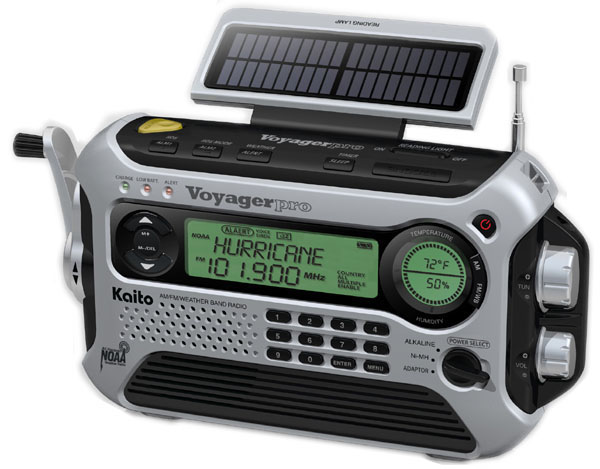
The Kaito KA600 Voyager Pro self-powered emergency radio

The Kaito KA600 self-powered radio has direct keypad entry of frequencies--a unique feature in this product niche.

Universal Radio has started selling the new Kaito KA600 Voyager Pro self-powered shortwave radio.  Two features really set this radio apart in the self-powered market: RDS and the ability to enter a frequency via direct keypad entry. I know of no other mass-produced unit that can do this.

We have made an entry for the KA600 in the Shortwave Radio Index where we will post updates and reviews of this model as they are available.

Jonathan Marks re-publishes “The Hitch-Hikers Guide to DXing”

Jonathan Marks has re-released The Hitch-Hikers Guide to DXing. In his own words:

It is thirty years ago since I wrote a rather silly parody on both international radio broadcasting based on my favorite radio series at the time, the Hitch-Hikers Guide to the Galaxy. There seemed to be so much to make fun of at the time…the boring propaganda at the height of the Cold War, jamming, the waste of energy shouting from one country to another, and the variable quality of reaction from listeners. I don’t think it was the listeners’s fault that most of the feedback was very technical, to do with signal strength and QSL cards rather than comments on the programme. May be people were being too polite.

[…]There wasn’t much time to write radio drama on the second floor of the Radio Netherlands building. And there was no budget to hire actors. So I just rattled it off on a typewriter and asked colleagues to come and read their parts in a lunchtime recording session. This was all two track material, sliced together with a chinagraph pencil and a razor blade. In total we made 5 in 1981 to fit the 5th Thursday in the month, and then one more in 1982 as a Christmas special.

To listen to all five episodes, simply cruise to the Media Network Vintage Vault and start with Episode 1. It’s well worth a listen and a nice little piece of 1981 RNW ingenuity.

ETOW featured on PRI’s The World Technology Podcast

Shortwave radio charity, ETOW (Ears To Our World) has been featured in this week’s PRI’s The World Technology Podcast. If you’ve never heard of ETOW, check out our previous posts or simply visit ETOW’s website. Self-powered shortwave radios are an integral part of their mission to provide “appropriate” technologies to schools and children in the third world.

Click here to go to PRI’s webpage for The World Technology Podcast.