Shortwave Australia: On the air from Central Victoria

(Image Source: Shortwave Australia on Facebook)

Many thanks to SWLing Post contributor, Jack Dully, who shares a Tecsun Australia article highlighting several shortwave stations including Shortwave Australia.

Shortwave Australia is a non-profit station transmitting from Central Victoria in the 120-meter and 60-meter bands on 2,310 kHz and 4,835 kHz. Late afternoon and nighttime coverage typically reaches much of southeast Australia under normal conditions. Of course, Shortwave Australia would be a brilliant weak signal DX catch from outside the region.

Their programming is varied and intentionally distinct from mainstream broadcasters — a reminder that shortwave radio still provides space for independent voices and creative content!

Read the full post on Tecsun Australia’s site.

Listeners can reach the Shortwave Australia directly at [email protected] or via their Facebook page.

Get a (vertical and horizontal) hold of yourself

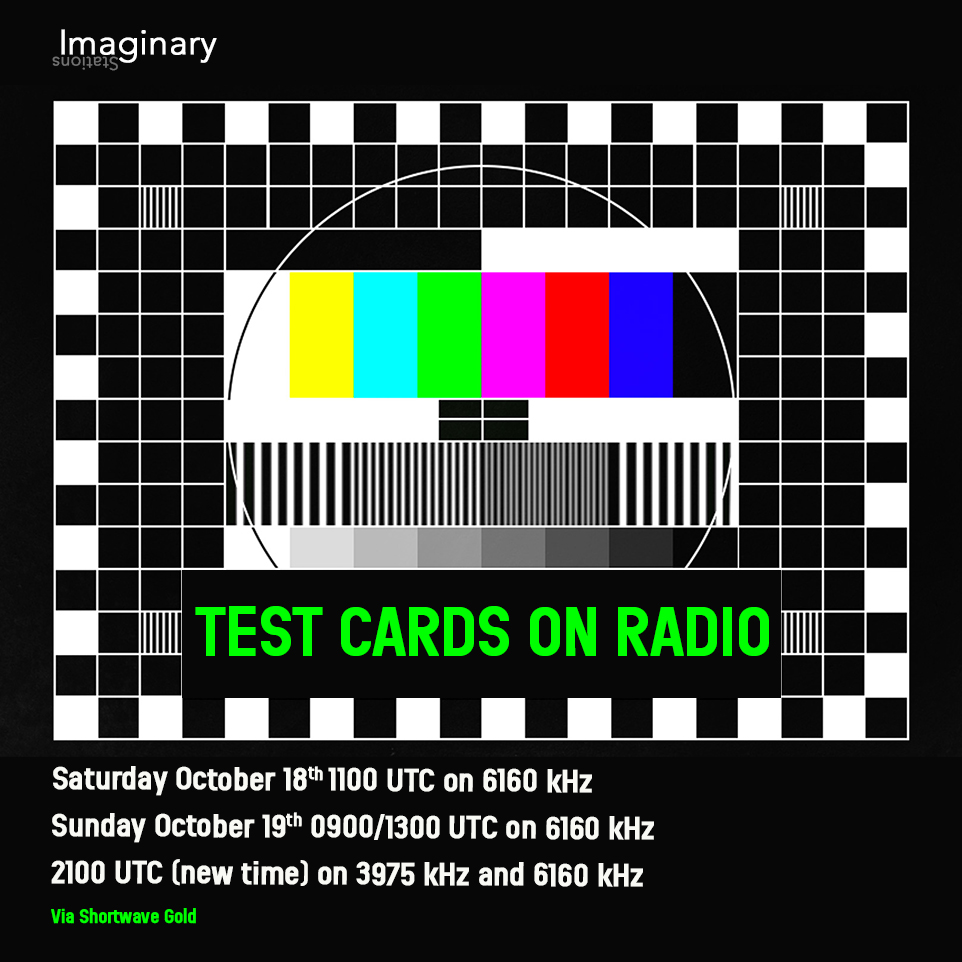
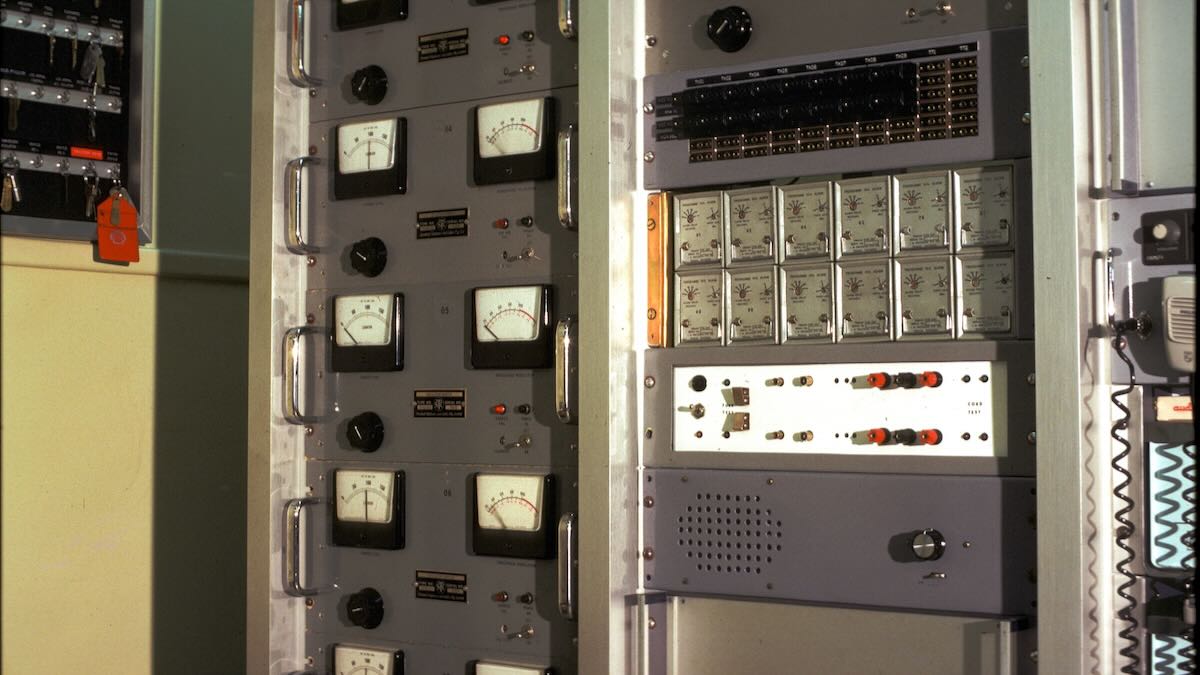
Greetings all SWLing Post community, here’s more about what the Imaginary Stations crew will be broadcasting via those airwaves this week. On Saturday 18th October 2025 at 1100 hrs UTC on 6160 kHz and then again on Sunday 19th October 2025 at 0900/1300 hrs UTC on 6160 kHz and at 2100 UTC on 3975 kHz and 6160 kHz. We will be bringing you a visual shortwave special called Test Cards on Radio.

This show is a must for fans of test cards and TV trade test transmissions alike and will feature all kinds of frequency tones for screen calibration purposes and test card related music from around the world. If you love those test cards, you’ll love this show.

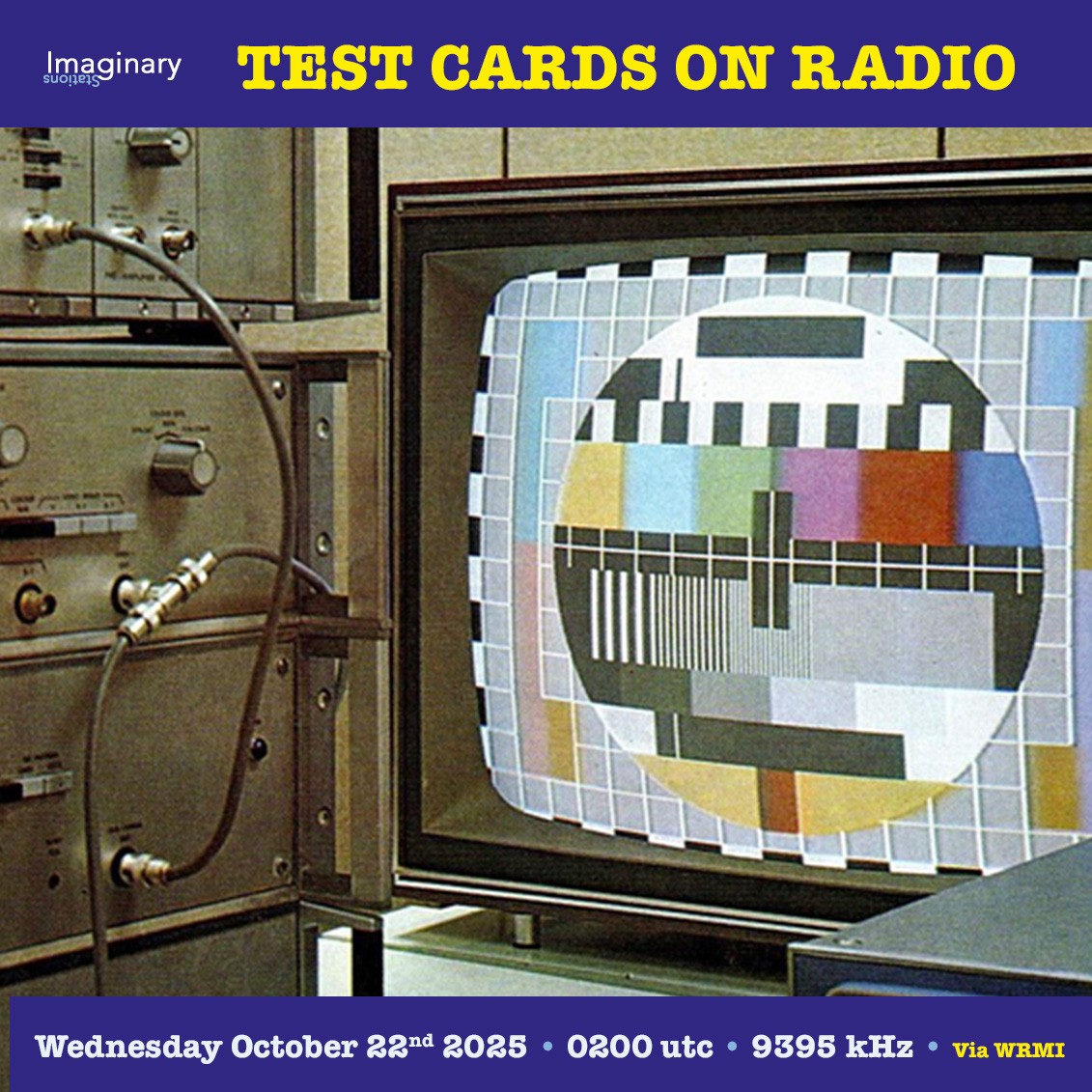
On Wednesday 22nd October 2025 at 0200 UTC via WRMI  we have a different episode of Testcards on Radio. We’re talking more test card musical classics and test tones for screen calibration fans and rooftop antenna adjusters. Tune in and enjoy. More on the theme below.

For more information on all our shows, please write to us at [email protected] and check out our old shows at our Mixcloud page here.

FastRadioBurst23

A HUGE difference . . .

By Jock Elliott, KB2GOM

It was a remark from Sebastian Schlüter in response to this post – https://swling.com/blog/2025/10/some-really-inexpensive-ways-to-perhaps-improve-your-shortwave-listening — that sparked today’s post.

He said:

If your RFI is really high, your best weapon is a magnetic loop antenna aka small receive loop. At home, my RFI is so high that I don’t benefit from a larger/longer antenna. For example: Using the telescopic antenna (75 cm) vs using 3m of wire. Reason is that the signal-to-noise ratio is roughly the same in both cases and that all of those very weak signals are below the noise floor anyway, and the ones that make it through the noise are already strong enough to be received with the telescopic only. Conclusion: In a high RFI environment, it’s not about maximising the signal strength but maximising the SNR. You need to find an antenna type that will pick up less of that RFI. A cheap and simple antenna for this is the small receive loop. For a start, you can use a cheap wire terminal with 3.5mm mono jack. Using a 1:1 balun further improves the result.

What really struck my eye was this:

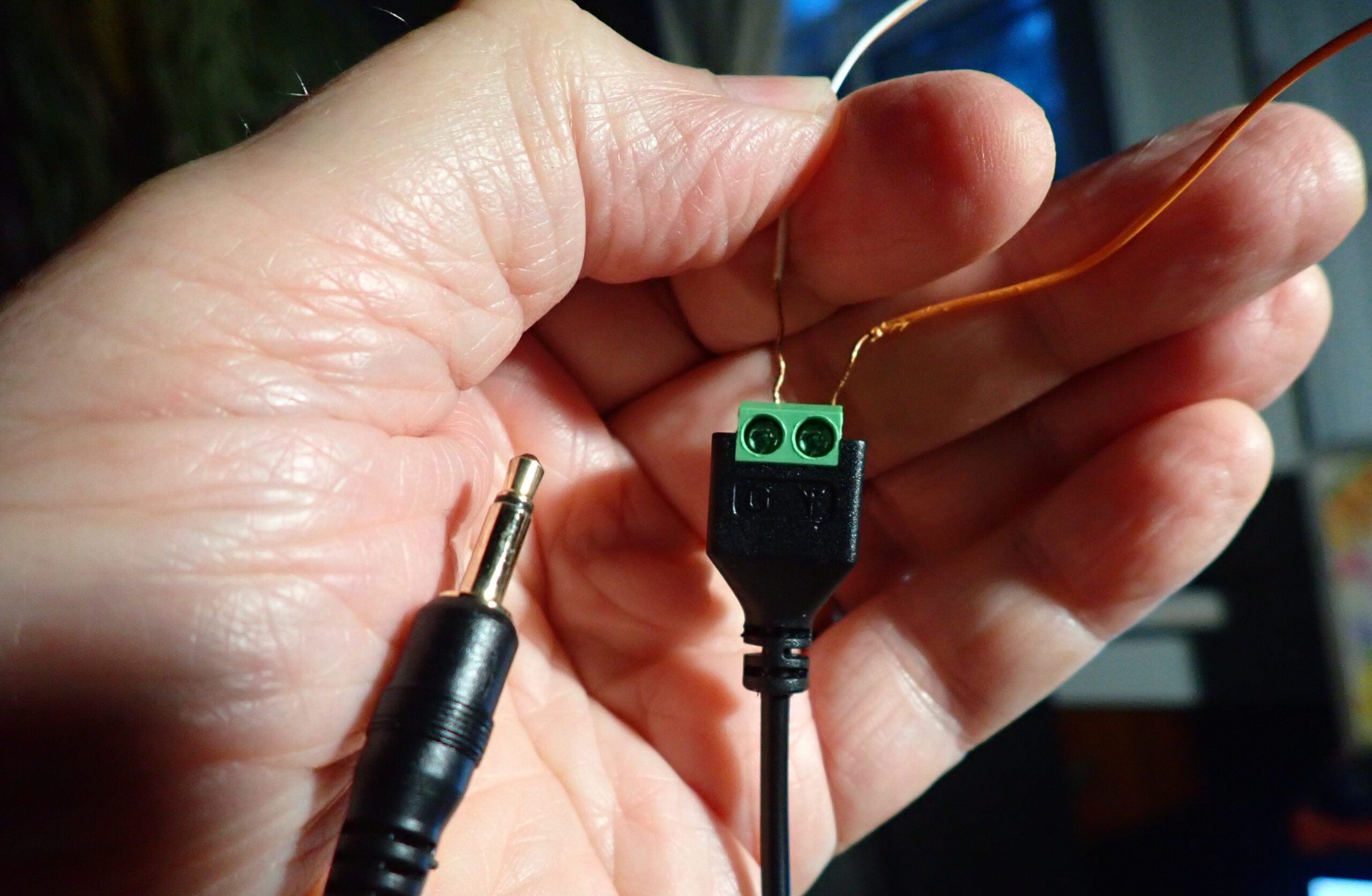
A cheap and simple antenna for this is the small receive loop. For a start, you can use a cheap wire terminal with 3.5mm mono jack.

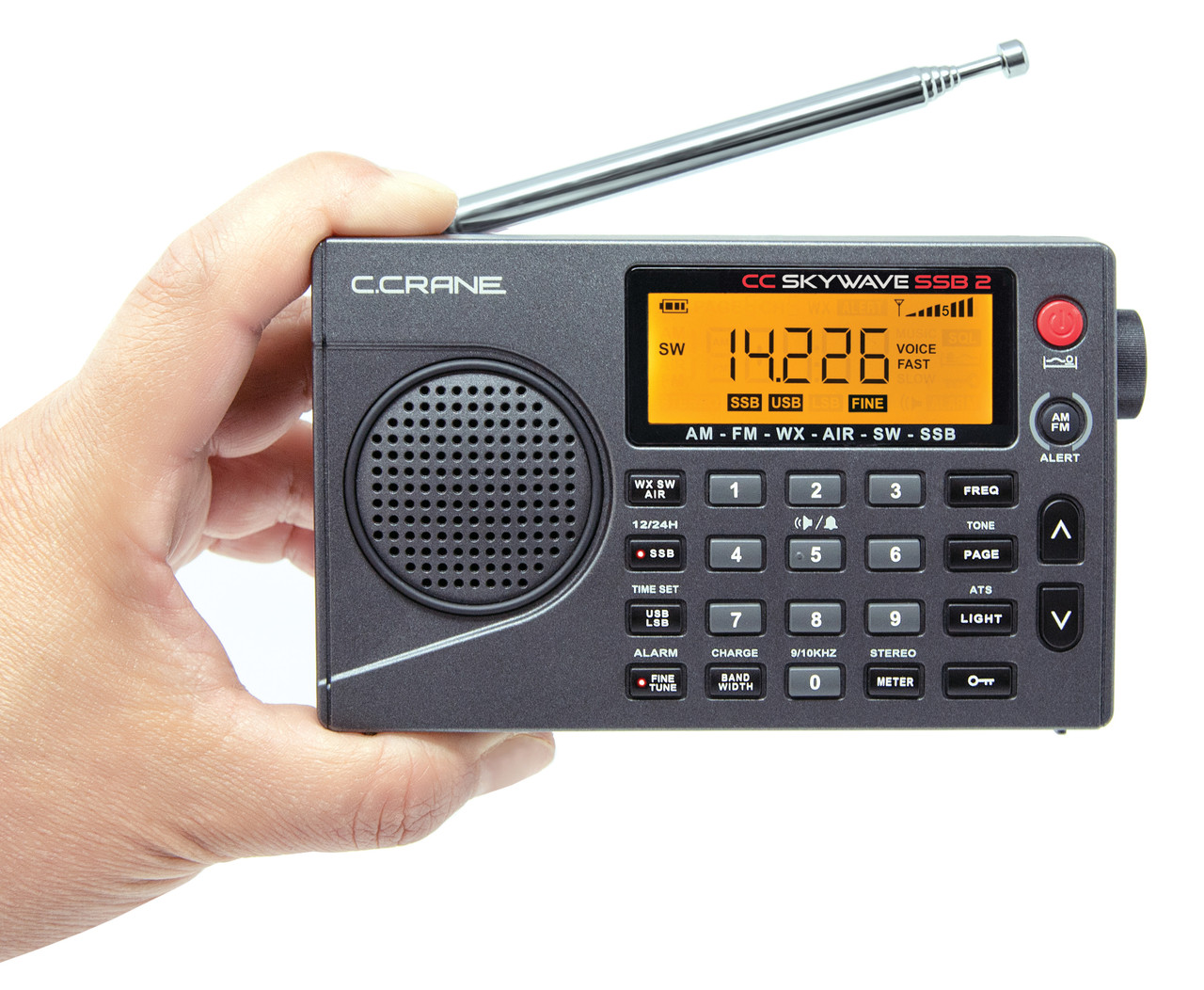
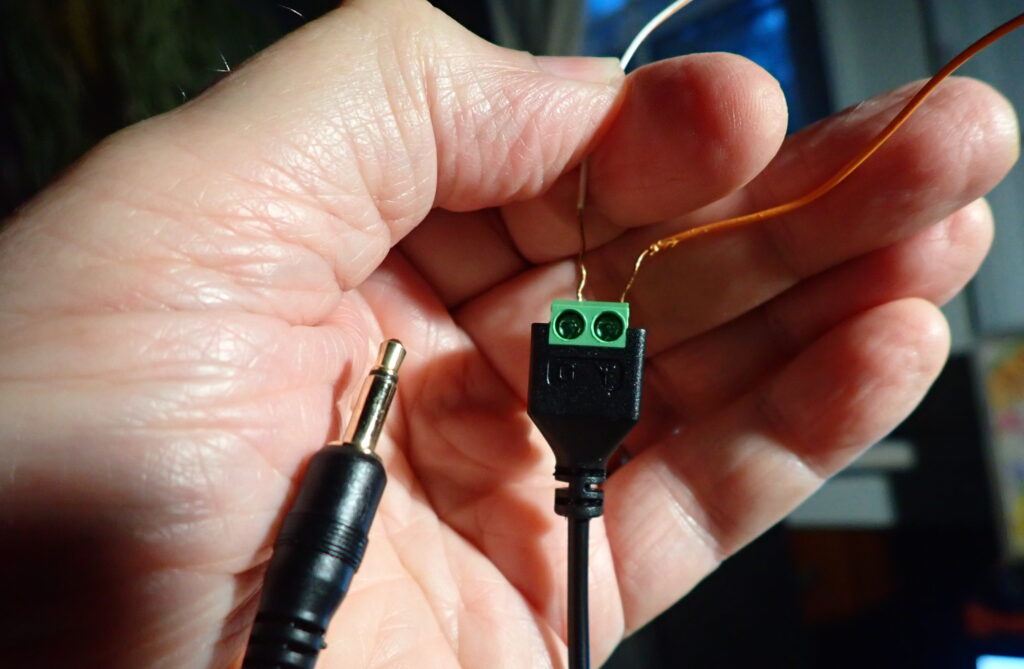
My CCrane Skywave SSB 2 came with a wire terminal with a 3.5 mono jack, I realized. I hooked it up to my 45-foot horizontal room loop (a single strand of insulated wire run around the top of window frames and bookcases in my radio shack), and then ran the following experiment.

Using the scan function on the Skywave SSB 2, I scanned the shortwave bands using the whip antenna, and then I did it with the loop plugged into the external antenna socket.

The results:

CCrane Skywave SSB 2

Whip antenna: 4 stations detected.                             Loop antenna: 13 stations detected.

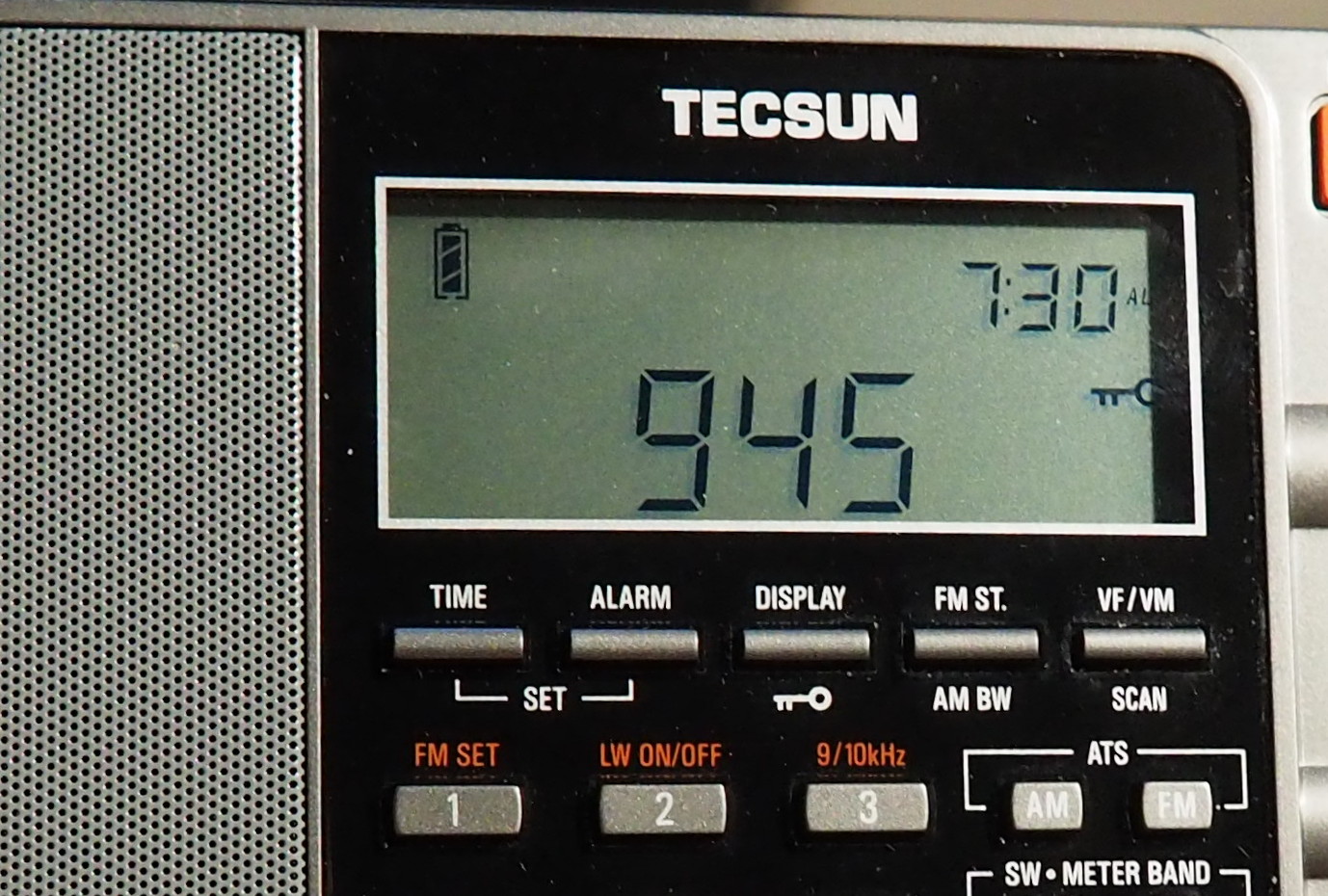
Then I tried the same experiment with a Tecsun PL-880.

The results:

Tecsun PL-880

Whip antenna: 8 stations detected                              Loop antenna: 15 stations detected.

Clearly, Sebastian’s suggestion of plugging in a simple wire loop makes a huge difference. And, I should note, I didn’t play fair. I did the test while 3 scanners, an LED light, and two UHF/VHF ham transceivers were operating in the vicinity and probably generating RFI.

So now the question: I ran the experiment with a 45-foot simple loop. What do you suppose would be the minimum wire length for an effective simple wire loop? I look forward to your input.

A Deep Dive Into the NATO Phonetic Alphabet

Many thanks to SWLing Post contributor Fred Waterer, who writes:

I’ve subscribed to this channel for some time. This video, which dropped the other day, will be of relevance to both SWLs and HAMS:

Rob does some deep dives into language. Including the surprising origins of many words in English and the lingering influence of both Anglo Saxon and Norman French.

Cheers

Fred

This is a brilliant video. Thank you, Fred!

Carlos’ Illustrated Radio Listening Report and Recording of Radio ELWA (October 13, 2025)

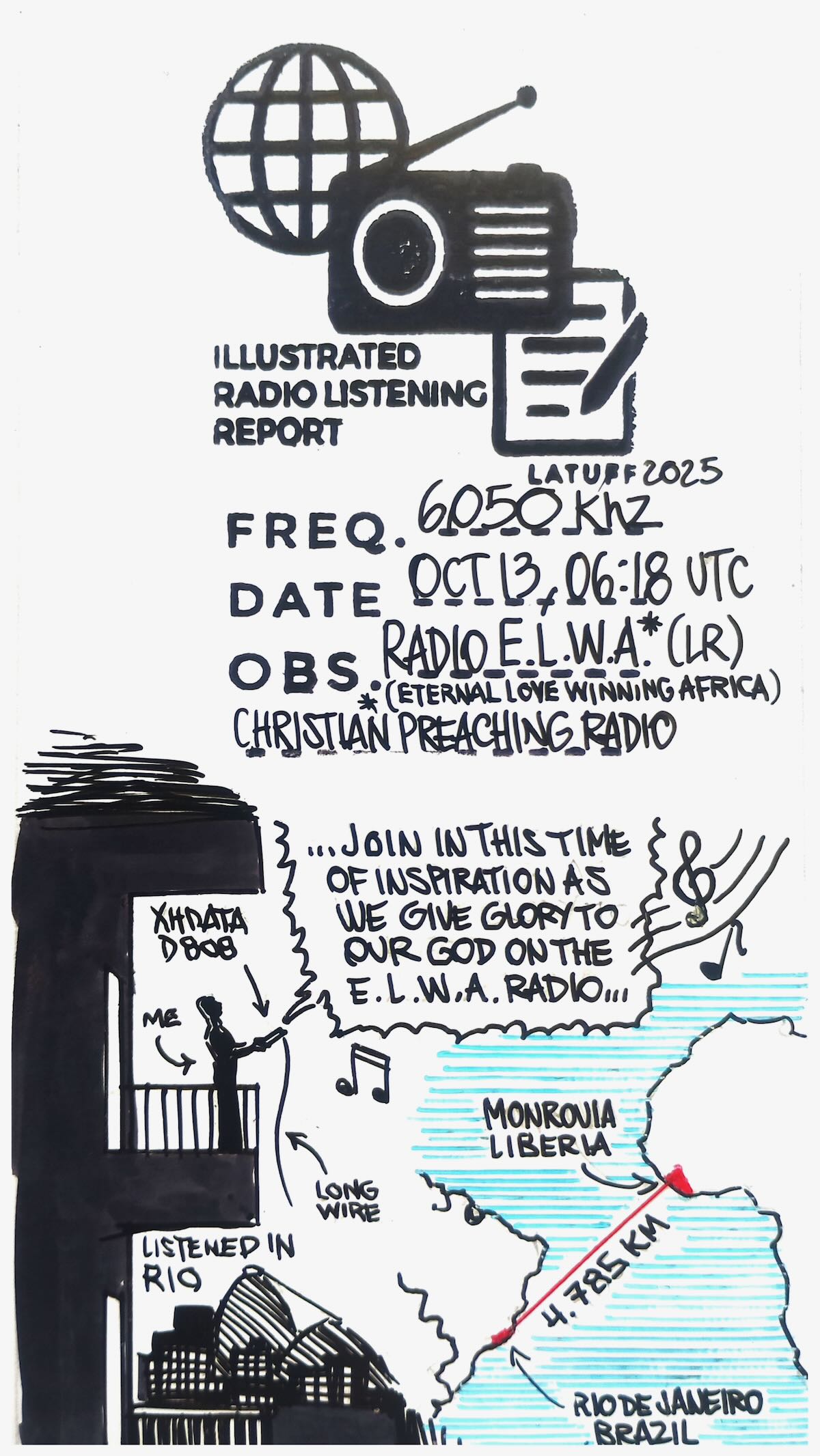
Many thanks to SWLing Post contributor and noted political cartoonist, Carlos Latuff, who shares the following illustrated radio listening report of a recent Radio ELWA broadcast.


Carlos notes:

It’s never been easy for me to pick up the ELWA (Eternal Love Winning Africa) radio signal on 6050 kHz in Brazil. The signal was always weak, propagation was poor, and conditions were never particularly favorable for listening to the historic evangelical radio station from Monrovia, the capital of Liberia. Until then, I had only listened ELWA, with great difficulty, in Porto Alegre and Guaíba, both cities in Rio Grande do Sul, and in Juiz de Fora, Minas Gerais. Recently, while scanning shortwave frequencies during the early morning hours in Rio de Janeiro, I received the ELWA radio signal and decided to try recording the broadcast. I noticed a sort of propagation window between 6:30 and 6:50 (UTC). Even though, it took at least six days of failed attempts, the same weak signal and poor propagation, until finally today, October 13th, I got clear audio.

Click here to view on YouTube.

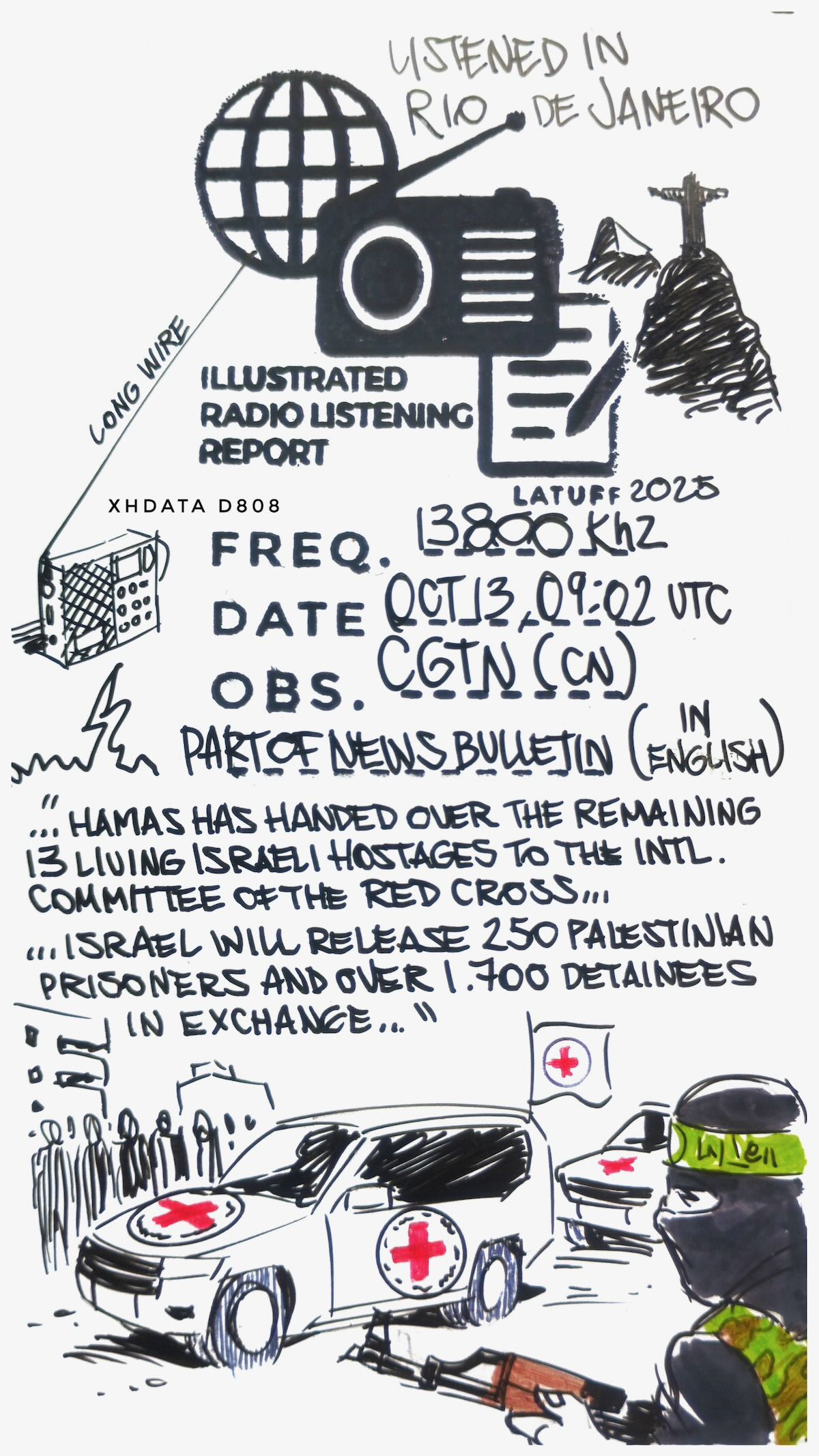
Carlos’ Illustrated Radio Listening Report and Recording of CGTN (October 13, 2025)

Many thanks to SWLing Post contributor and noted political cartoonist, Carlos Latuff, who shares the following illustrated radio listening report of a recent CGTN broadcast.


Carlos notes:

Hamas hands over all remaining hostages to Israel, CGTN Radio, 13800 kHz

Click here to view on YouTube.

Some really inexpensive ways to perhaps improve your shortwave listening


By Jock Elliott, KB2GOM

Just yesterday morning, I was reminded that sometimes really small things can make a significant difference SWLing. So here are some things that I found can make an improvement, particularly if you are using one of the modern shortwave portables with its whip antenna.

  1. Turn off as many electronics as possible in the room where you are listening. Computers, scanners, LED lights and all sorts of other electronics can introduce digital “hash” into the airwave near your radio. Turning them off may reduce the noise floor. Remember, we are all about improving signal-to-noise: we want more signal, less noise. Yesterday, I was trying to chase some English language broadcasts and found that turning off a nearby police scanner made a significant difference. If weather permits, moving outside can make a huge difference.
  2. Feel free to move the whip antenna of your radio to different orientations such as horizontal and various points of the compass. Again, yesterday I was unable to hear one particular station with the whip antenna vertical, but when I lowered it to nearly horizontal and pointed toward the south, the station was audible.

OLYMPUS DIGITAL CAMERA

  1. If you are just getting started, try using the search/scan/seek function of your radio to see what broadcasts it detects. Remember, though, that the seek function will reveal only what it can detect, so you might also try it with your antenna in different orientations. (See number 2 above.)

OLYMPUS DIGITAL CAMERA

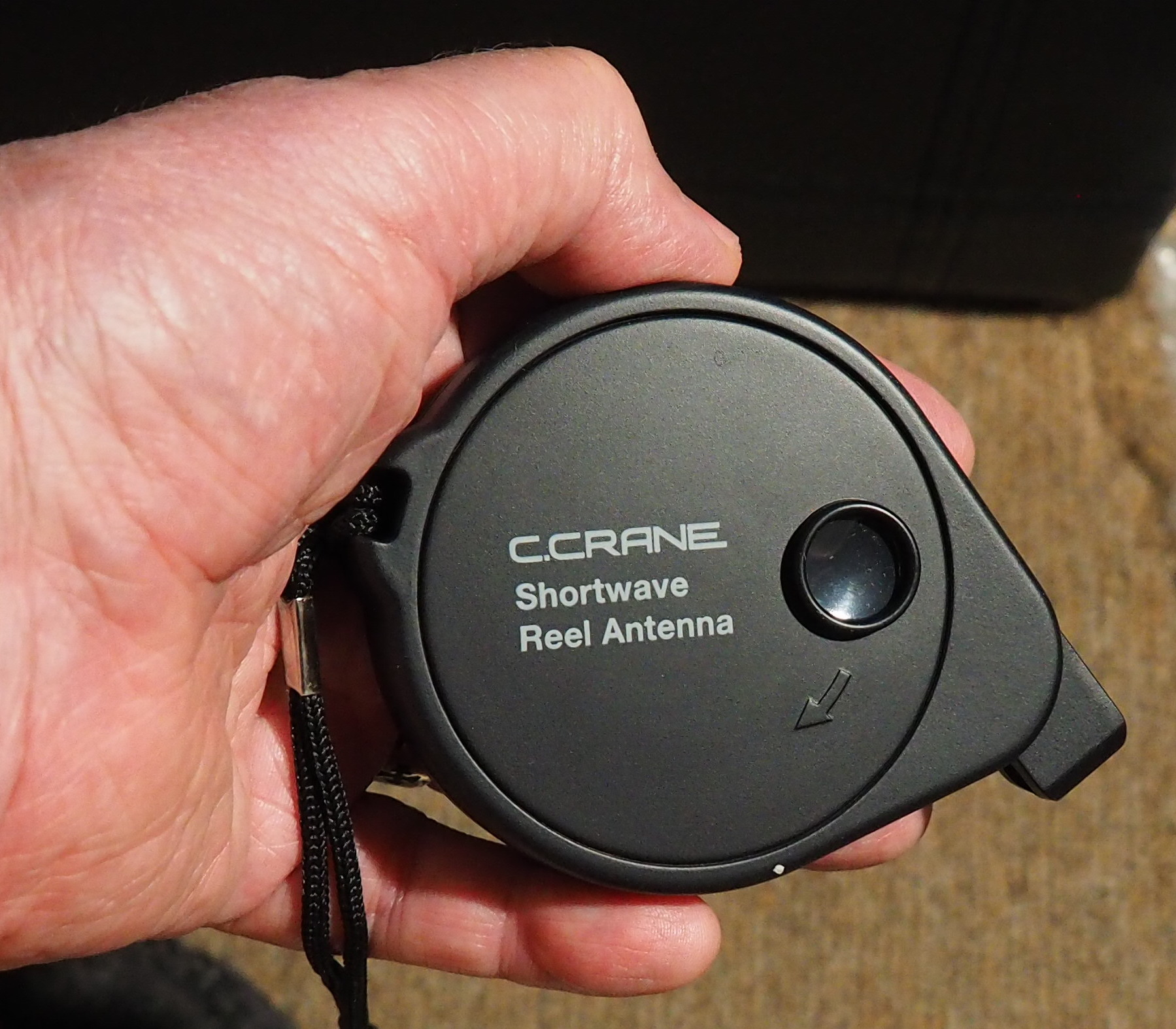
  1. Try using a bigger antenna. If you radio came with an auxiliary roll-up antenna, try deploying it. One of my auxiliary antennas is designed so that the far end can be clipped to a curtain. Try different configurations and see which works best. If you radio didn’t come with one, it is easy to improvise: get yourself 20 feet of insulated wire and an alligator clip. Attach the clip to the wire, then clamp the jaws of the alligator clip to the whip antenna on your radio. Try different configurations. The only hard and fast rule is: never, EVER, deploy an antenna where it can fall on a power line or a power line can fall on it. And, if you deploy your antenna outside be sure to haul it in when lightning threatens. Don’t go nuts with the length of the wire . . . 20 feet will do. Carlos Latuff, whose radiofax and weatherfax interceptions often grace this blog, often uses a wire antenna that is just 3 meters long!

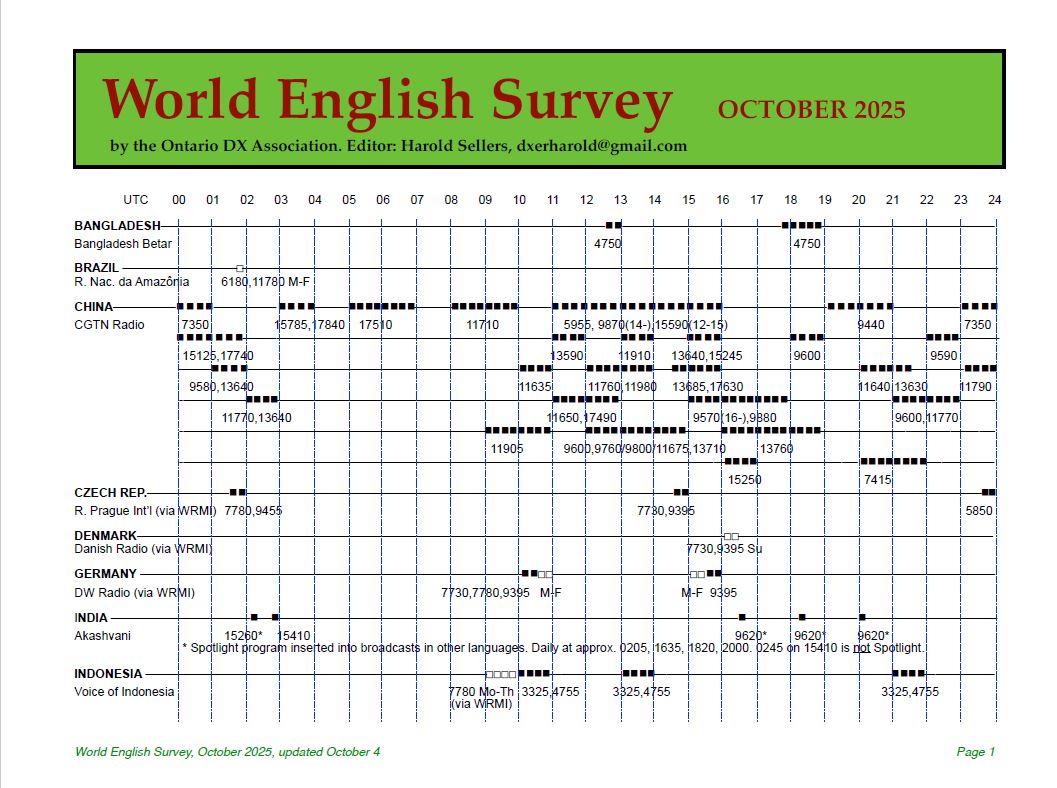
  1. It is very useful to have a list of target frequencies, particularly since so many modern portables have a keypad that makes punching in a frequency as easy as using a calculator. I can highly recommend the charts produced by Harold Sellers of the Ontario DX Association. These include the World English Survey (a listing of English language broadcasts by time and frequency), Target Listening by Country, and Target Listening by Time. Just because a station is listed at a particular time on a particular frequency doesn’t mean that you will be able to hear it, but I find it fun to punch in the numbers and discover what I can You can be notified when each month’s charts can be downloaded. They are posted to the ODXA Facebook Group files section and also on three IO Group files section: ODXA, World of Radio and CIDX.

I hope these small suggestions will be of some help in making your listening better.