Radio Waves: Stories Making Waves in the World of Radio
Because I keep my ear to the waves, as well as receive many tips from others who do the same, I find myself privy to radio-related stories that might interest SWLing Post readers. To that end: Welcome to the SWLing Post’s Radio Waves, a collection of links to interesting stories making waves in the world of radio. Enjoy!
Many thanks to SWLing Post contributors Andrea, Kim Andrew Elliott, Dave Porter, and Phillip Novak for the following tips:
New quantum receiver the first to detect entire radio frequency spectrum (Phys.org)
A new quantum sensor can analyze the full spectrum of radio frequency and real-world signals, unleashing new potentials for soldier communications, spectrum awareness and electronic warfare.
Army researchers built the quantum sensor, which can sample the radio-frequency spectrum—from zero frequency up to 20 GHz—and detect AM and FM radio, Bluetooth, Wi-Fi and other communication signals.
The Rydberg sensor uses laser beams to create highly-excited Rydberg atoms directly above a microwave circuit, to boost and hone in on the portion of the spectrum being measured. The Rydberg atoms are sensitive to the circuit’s voltage, enabling the device to be used as a sensitive probe for the wide range of signals in the RF spectrum.
“All previous demonstrations of Rydberg atomic sensors have only been able to sense small and specific regions of the RF spectrum, but our sensor now operates continuously over a wide frequency range for the first time,” said Dr. Kevin Cox, a researcher at the U.S. Army Combat Capabilities Development Command, now known as DEVCOM, Army Research Laboratory. “This is a really important step toward proving that quantum sensors can provide a new, and dominant, set of capabilities for our Soldiers, who are operating in an increasingly complex electro-magnetic battlespace.”
The Rydberg spectrum analyzer has the potential to surpass fundamental limitations of traditional electronics in sensitivity, bandwidth and frequency range. Because of this, the lab’s Rydberg spectrum analyzer and other quantum sensors have the potential to unlock a new frontier of Army sensors for spectrum awareness, electronic warfare, sensing and communications—part of the Army’s modernization strategy.
“Devices that are based on quantum constituents are one of the Army’s top priorities to enable technical surprise in the competitive future battlespace,” said Army researcher Dr. David Meyer. “Quantum sensors in general, including the one demonstrated here, offer unparalleled sensitivity and accuracy to detect a wide range of mission-critical signals.”
The peer-reviewed journal Physical Review Applied published the researchers’ findings, Waveguide-coupled Rydberg spectrum analyzer from 0 to 20 GigaHerz, co-authored by Army researchers Drs. David Meyer, Paul Kunz, and Kevin Cox[…]
Virus and distance learning by radio (1937, 1946) (AE5X Blog)
Six to eight decades ago polio was one of the most feared diseases in the US. In 1952 alone, 60,000 children were infected, 3000 died and many more were paralyzed.
The most severe outbreaks were in 1937 and 1946. My father was a victim of the 1946 epidemic, suffering minor paralysis in one leg as a child.In 1937, many schools around the country closed, as did public pools, movie theaters and parks. But the Chicago public school system took an innovative approach.
During that period, 80% of US households contained a radio. This allowed 325,000 children in grades 3-8 to continue their education at home via radio lessons aired by six Chicago radio stations (WENR, WLS, WIND, WJJD, WCFL, WGN) that donated time for the purpose.
Program schedules for each day were printed in the morning paper. Home with more than one radio & more than one child often set up radios in different rooms so that each child could hear the appropriate grade’s lesson.
This continued for one month…until schools reopened in late September of that year.
Curriculum was developed by teachers and monitored over the air by school officials. After each episode, a limited number of teachers were available for phone calls. A large number of the calls were from parents distressed that they could not clearly receive the broadcasts.[Continue reading…]
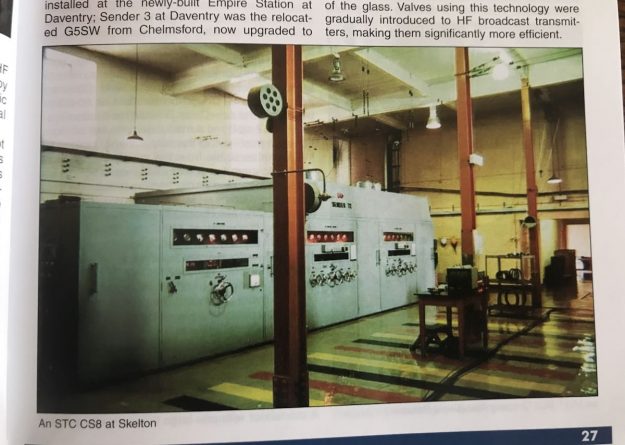
BBC Woofferton Early Days (Ludlow Heritage News) [PDF]
Very few structures are left in the Ludlow area which can be traced back to the Second World War. However, look five miles south of the town towards the rise of the hills and a tracery of masts can be seen. Go closer, and a large building can be found by the road to Orleton, surrounded now by a flock of satellite dishes, pointing upwards. The dishes are a sign of the recent past, but the large low building was made for the war-time radio station aimed at Germany.
This little history attempts to tell the story of the British Broadcasting Corporation’s transmitting station at Woofferton near Ludlow in Shropshire during the first years of its existence. When and why did the BBC appear in the Welsh border landscape with a vast array of masts and wires strung up in the air? The story begins in 1932, when the BBC Empire Service opened from the first station at Daventry in Northamptonshire. Originally, the service, to link the Empire by wireless, was intended to be transmitted on long-wave or low frequency. But, following the discovery by radio amateurs that long distance communication was possible by using high frequency or short waves, the plan was changed. Later in the decade, the BBC expanded the service by also broadcasting in foreign languages. Although Daventry had a distinguished name in the broadcasting world, it was never technically the best place for a short-wave site, being on a hill and close to a growing town.
This article can be found in the Ludlow Heritage News: click here to download the full PDF.
Hello Morse: A collection of AI and Chrome experiments inspired by Morse code on Android Gboard (Google)
Developer Tania Finlayson found her voice through Morse code. Now she’s partnering with Google to bring Morse code to Gboard, so others can try it for accessible communication.
Morse code for Gboard includes settings that allow users to customize the keyboard to their unique usage needs. It works in tandem with Android Accessibility features like Switch Access and Point Scan.
This provides access to Gboard’s AI driven predictions and suggestions, as well as an entry point to AI-powered products, like the Google Assistant.[…]
Do you enjoy the SWLing Post?
Please consider supporting us via Patreon or our Coffee Fund!
Your support makes articles like this one possible. Thank you!