The new Icom IC-705 QRP portable, backpackable transceiver

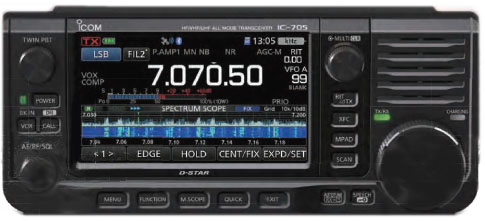
This weekend at Tokyo’s Ham Fair 2019, Icom announced an innovative transceiver to their line-up: the Icom IC-705 QRP transceiver.

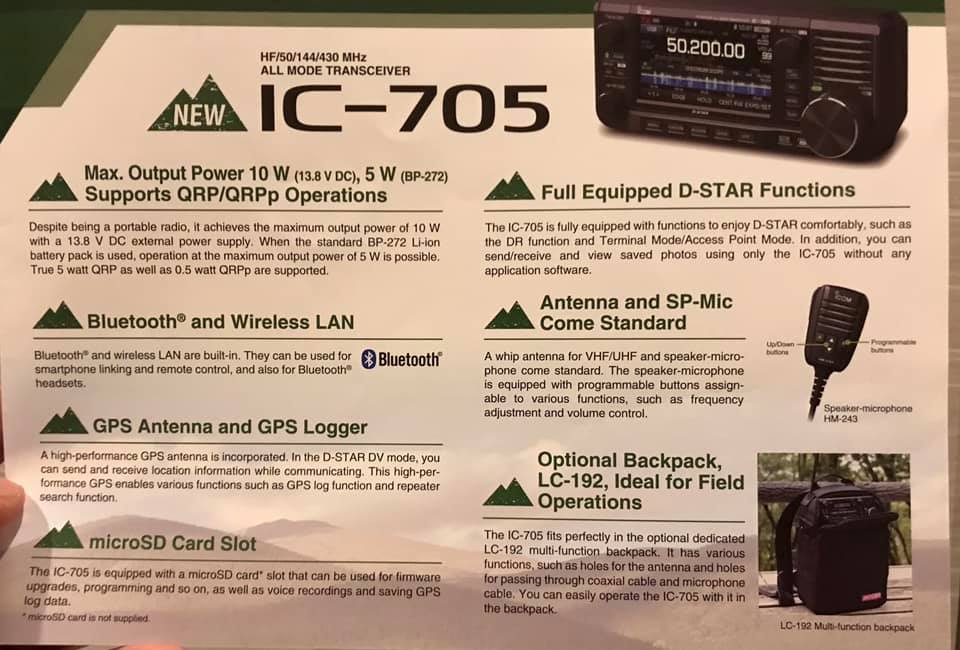
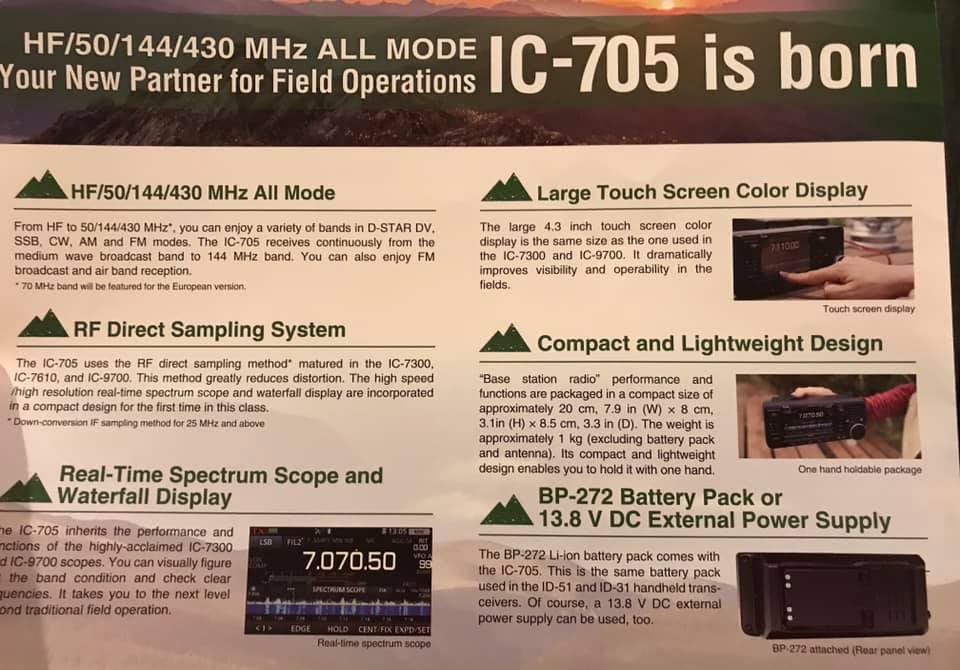
The IC-705 introduces several industry firsts for a backpack portable radio:

  • It uses the same BP-272 Li-ion Battery pack as the ID-51 and ID-31 series D-Star handy talkies. To my knowledge, this is the only HF transceiver that uses battery packs that can be swapped so easily in the field–like one would swap an HT battery pack
  • It has a general coverage receiver that spans a whopping 0.5 to 148 MHz
  • It sports a full color, touch screen with spectrum and waterfall displays
  • It includes the D-Star digital voice mode
  • A GPS receiver
  • Bluetooth connectivity
  • A MicroSD card slot for memory storage, screen captures and recordings

All of this appears to be included, not add-on options.
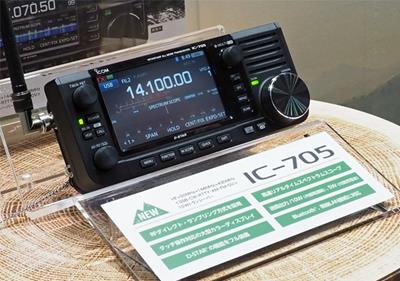
The only IC-705 omission, in my opinion, is an internal ATU (antenna tuner). Something I would have expected, but not a deal-breaker for those of us who could really benefit from the amount of features this radio offers.

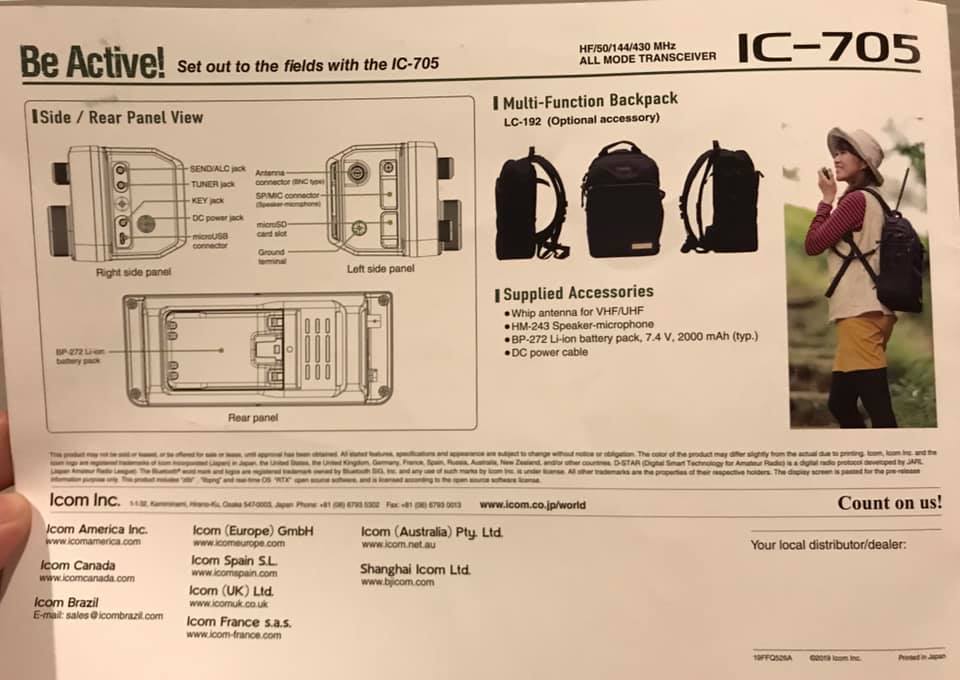
Side and back panel view noting ports and connections.

There is no word yet on pricing or availability, but you can count on us to post these details once they’re available. If you would like to follow updates, bookmark the tag: IC-705

We will also review on the Icom IC-705 as soon as it’s available.

Video from Amateur Logic/Ham College

Ray Novak (N9JA) with Icom America did a live video interview with Amateur Logic/Ham College TV yesterday. The video includes a full announcement in English from the Icom Booth:

Click here to view on YouTube.

IC-705 Pre-Release brochure

Many thanks to Ray Novak for snapping a few photos of the pre-release brochure:

Update: click here to download the full IC-705 brochure. Hat tip to Dave Zantow!

A surprise from one of the “Big Three”

The “Big Three” transceiver manufactures–Icom, Yaesu and Kenwood–have not shown a lot of interest in backpackable QRP radios over the past two decades.

By “backpackable” I mean QRP transceivers specifically designed for portable use in the field–radios that typically have built-in battery options, internal ATUs, and designed to be lightweight shack-in-a-box units.

Yaesu introduced the FT-817 almost twenty years ago and it lives on today (with modest upgrades) as the FT-818. Kenwood has no portable/backpackable HF QRP radio at this point.

I bet the IC-705 is being introduced today because Icom sees a strong market among field-portable operators who enjoy travel and outdoor radio activities like SOTA (Summits On The Air) and POTA (Parks On The Air).  In addition, many ham radio operators live in neighborhoods that are either plagued with radio interference (RFI) or don’t allow antennas to be installed outdoors. Portable radios liberate ham radio ops from their shacks and allow them to set up a station far away from noise or home owner’s associations.

Looking forward…

Again, I’ll be in touch with Icom about the IC-705 and will share updates here when they’re available. I’m looking forward to evaluation this rig when it hits the market!


Do you enjoy the SWLing Post?

Please consider supporting us via Patreon or our Coffee Fund!

Your support makes articles like this one possible. Thank you!

Encore – Classical Music on Shortwave Sunday and Friday

Encore – Classical Music on Shortwave – Broadcast on Sunday afternoon in Europe and USA

Encore – Classical Music this weekend is being broadcast as usual by Channel 292 (Europe) on 6070 kHz at 15:00 UTC Sunday 1st September.
And by WBCQ on 7490 kHz at 00:00 – 01:00 UTC Monday 2nd September
There is a repeat on 6070 kHz on Friday 6th September at 19:00 UTC.
This week’s programme starts with a Bach ‘cello suite followed by another of Paul Mealor’s wonderful madrigal settings of Tennyson’s Now Sleeps the Crimson Petal. Then we have Purcell’s overture to his King Arthur. Contemporary next – Triangle by Canadian composer Ana Sokolovic. Then Hamish MacCunn’s The Land of the Mountain and the Flood followed by some Janá?ek quartet – exquisite. Then something almost medieval for flute and pipes leading into a couple of wild cards – a secret. The hour ends with some of Bruckner’s 4th.
I hope you can join me to listen.
Both Channel 292 and WBCQ do live streams if the reception is poor in your location. Easy to find their sites with a google search.
Thank you for spreading the word about Encore – Classical Music on Shortwave. And thank you to everyone for letting us know how well/badly the signal is received where you live.
Brice Avery – Encore – Radio Tumbril.
Regular Broadcast times are:
15:00 – 16:00 UTC Sunday, and repeated 19:00 – 20:00 UTC Friday on 6070 kHz (Channel 292 Germany).
00:00 – 01:00 UTC Monday on 7490 kHz 9WBCQ – Maine).

September 1, 2019: Free Radio Skybird returns to channel292

Many thanks to SWLing Post contributor, “One Deck” Pete, who shares the following announcement:


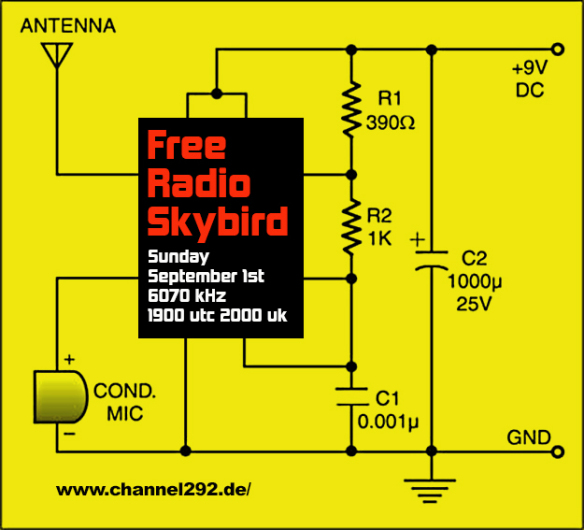
DJ Frederick’s Free Radio Skybird returns to the shortwaves on Sunday September 1st 2019 via http://www.channel292.de/ on 6070 kHz at 1900 UTC (8pm UK time).

With a mixture of features and music, the hour transmission will include One Deck Pete’s “Soothing sound of shortwave”, Steve with Mini indie radio and Justin Patrick Moore from Sothismedias with another episode of the Radiophonic Laboratory.

Last month we had listeners in New Zealand, Northern Canada and Italy (QSL and soundclip here) to name but a few places. Come on, what’s better than listening to a radio broadcast with audio that has fading, co-channel interference and sounds like it had a journey via the ionosphere rather than something that’s been streamed in crisp dolby stereo? Who said shortwave radio is dead? #freeradioskybird #shortwavesnotdead #madtone

Jack’s Tailgate DXpedition

Many thanks to SWLing Post contributor, Jack Blanke (WB5LVP), who shares the following:

Really enjoyed your article yesterday, and felt compelled to respond with a similar DX’ing jaunt of mine two days ago.

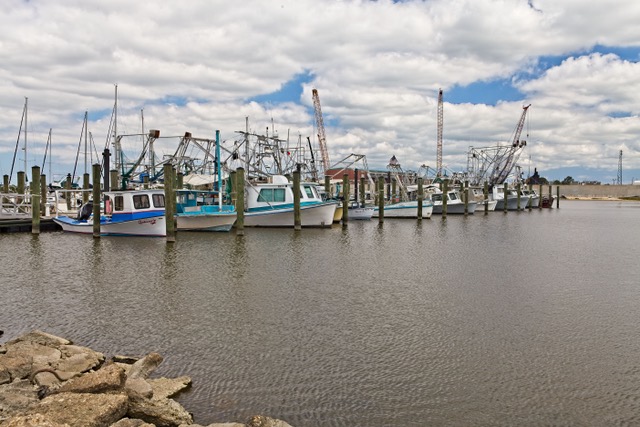
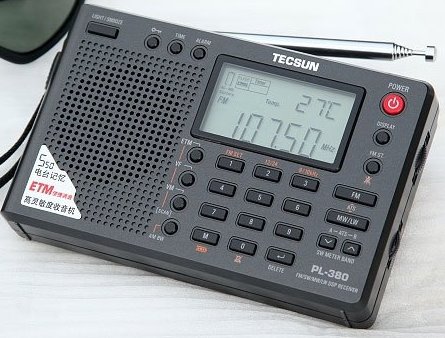
I found myself in the same mindset and ventured out to a nearby peaceful fishing and yacht harbor to try out my new Tecsun PL-380. I have had it about 10 days and I have figured out that I have about all the urban power line and electrical noise I can stand at my home location, so I was headed out to give the 380 a chance to exercise its ears.

I found the most deserted corner of the parking lot at the harbor, positioned my pick-up for maximum shade, dropped the tail gate to provide a work surface, strung out about 75 feet of stranded #14 insulated copper wire and positioned my portable chair for DX action.

I did not have a copy of the WRTH, but I do use an iPhone app called Shortwave Broadcast Schedules by Black Cat that has really worked well for me and I highly recommend. With great anticipation, I flipped the power switch and enjoyed the most beautiful silence from man made electrical noise that I have ever experienced!! I could not believe how much quieter the receiver was in a more more pristine environment.

Jack’s ultralight Tailgate DXpedition kit

I opened the app to search for some DX’ing frequency possibilities, began tuning the bands and I was amazed at the number of short wave broadcast stations, the strength of their signals and the pure listening quality coming out of my 380, which is little larger than a pack of cigarettes!! I have been a licensed ham since 1970 and at one point back in the early 1970’s, I had a complete R. L. Drake HF station which might be called “Boat Anchors” by today’s standards. I was now listening to stations from around the globe on a receiver that comfortably fit in my pocket and a long wire strung out to a nearby “NO PARKING” sign post.

The Tecsun PL-380

Within a matter of a couple of relaxing hours, I had logged and enjoyed listening to Radio Habana, Voice of Vietnam, China Radio Int., Voice of Nigeria, Radio Romania Int., KBS World Radio and several other stateside shortwave broadcasts from Miami, Nashville & Lebanon Tennessee. I was totally thrilled at the performance of the radio/antenna combo and I anxiously await the opportunity to visit the area again for another Tailgate DXpedition!! I am particularly looking forward to fall days and cooler temps to go lose myself in the reverie of the shortwave bands, this time with a few brewskies in the ice chest, along with lunch.

It was a thoroughly enjoyable day and I could not help but relate to your article when I read it!! Next time, I plan to photograph my Tailgate DXpedition, simple though it may be to share with others. I have been away from radio for some time, but have maintained my amateur license for nearly 50 years. Now that I am retired and have more time, I plan to enjoy my long lost love of radio once again.

Thanks for your web sight. I look forward to the newsletters and enjoy its resources.

Take care.

’73’s
Jack Blanke

Thanks so much for sharing your story, Jack!

Isn’t it amazing how the shortwave bands simply open up when you remove all of the urban noise that plagues our receivers? That’s the brilliance behind impromptu DXpeditions. Plus, I’ve always believed that radio is best enjoyed outdoors.

We look forward to seeing some photos and a report of your next Tailgate DXpedition, Jack!


Do you enjoy the SWLing Post?

Please consider supporting us via Patreon or our Coffee Fund!

Your support makes articles like this one possible. Thank you!

Time for a little Radio Therapy…

Yesterday, my calendar was pretty full. Not an uncommon thing these days. I needed a break from all of the running around town, so I set aside the better part of an hour to play radio.

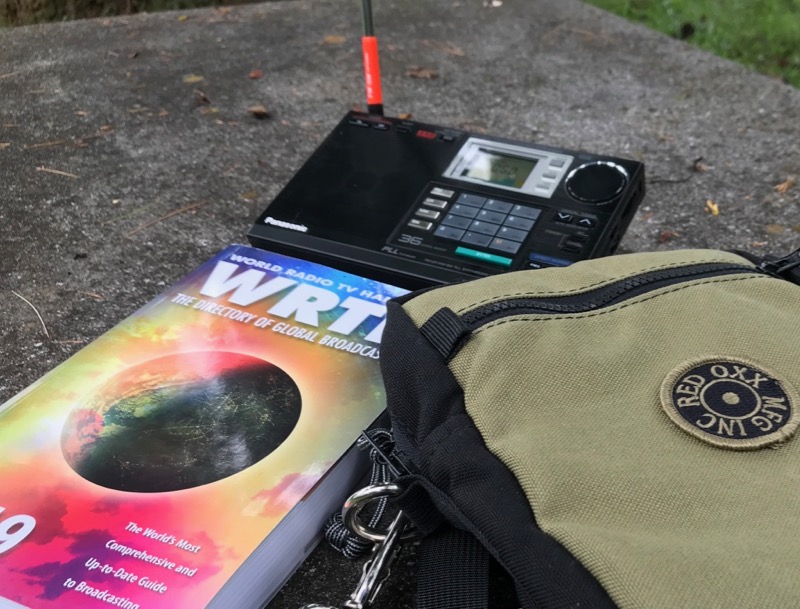
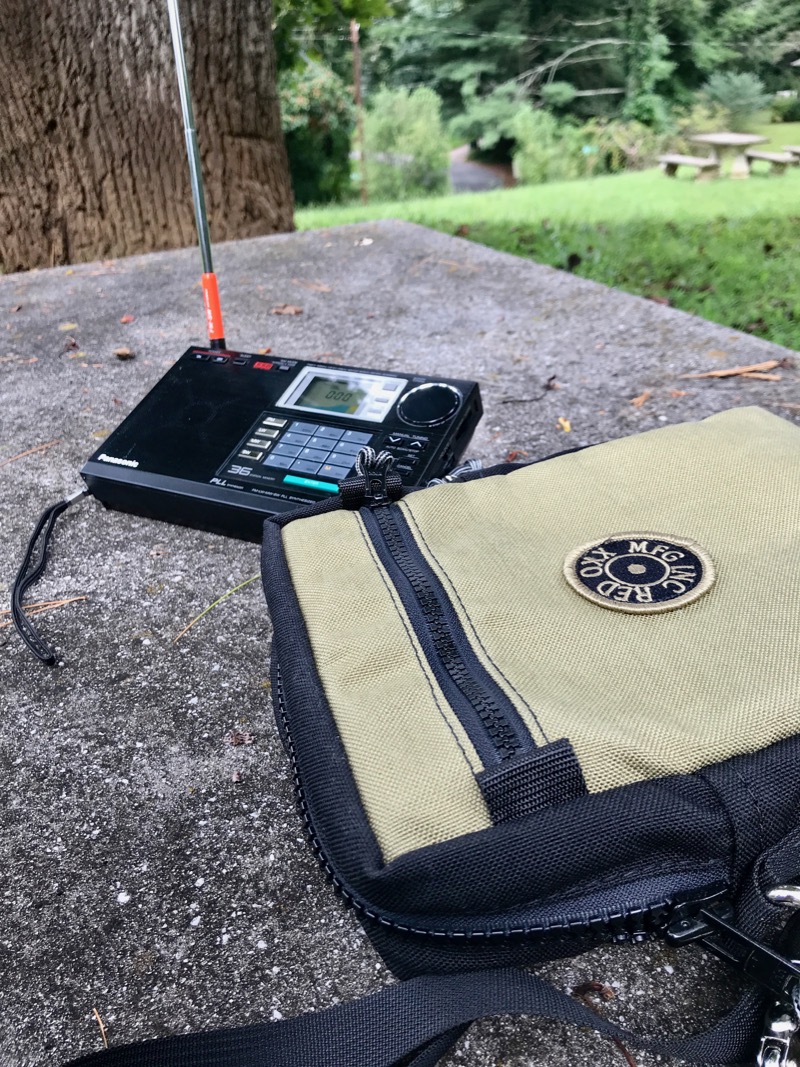
I packed up my Panasonic RF-B65 and the latest copy of the WRTH. (I didn’t plan to actually reference the WRTH’s schedules for this outing, but I do enjoy reading through the station listings while I tune around.)

I found a local park en route to my next appointment and set up my kit on a picnic table only moments after light rain had moved through the area.

I didn’t know what propagation would be like, and frankly I didn’t care. Sometimes, it’s just nice to tune through the bands and see what’s there.

I call this a “radio therapy” session because, for a small portion of the day, the ritual takes my mind off of everything else around me.  I get some of the same benefit from mountain biking and reading a good book (although, not at the same time).

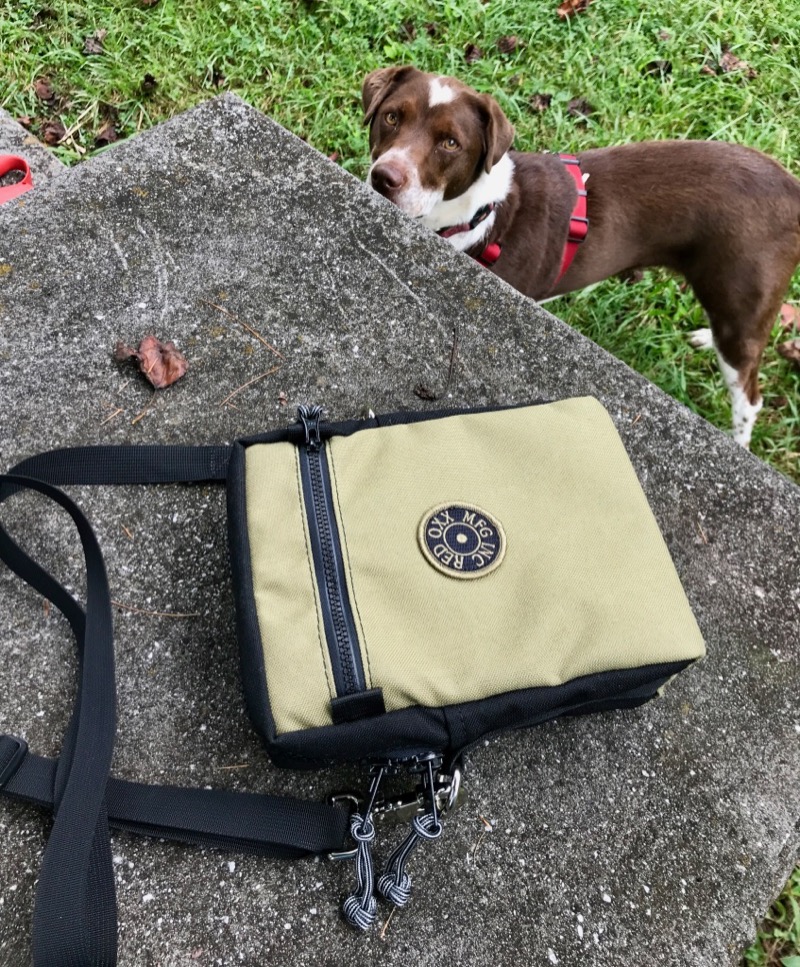
Everything was going according to plan: the weather was pleasant, I had the whole park to myself, and Hazel (my canine companion) noted each and every squirrel within a 50 meter radius of our picnic table.

My bliss was cut short by two things.

First of all, the batteries in my Panasonic were running low. I had forgotten to charge them. (Doh!) Oh well. That didn’t really matter because secondly, a landscaping company brought their crew by to mow the grass…starting at my side of the park!

That’s okay–I still managed to get a good twenty minutes of radio therapy and Hazel counted at least 47 squirrels to harass on a future visit.

Hazel thinking, “Seriously? Another pack?”

I’ve also been evaluating a soon-to-be-released pack manufactured in Montana by Red Oxx. Turns out, it’s the perfect size to protect my RF-B65 and still have room for a copy of the WRTH, a wire antenna and–had I thought about it in advance–four spare AA batteries. Since I’m also a certified pack geek, expect to see a review of this mystery bag soon!

Anyone else planning a little radio therapy soon?  Please comment!

Swiss Army Knife FM antenna

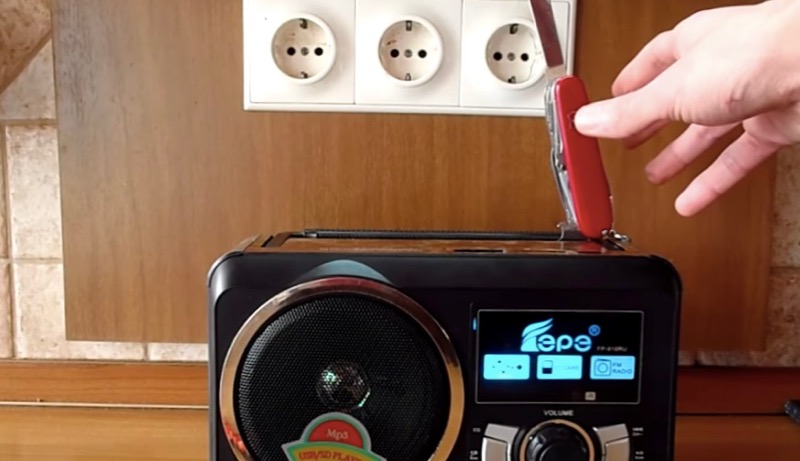
Many thanks to SWLing Post contributor, Balázs Kovács, who shares the following video of a Swiss Army knife and tweezers being used as FM antennas:

Click here to view on YouTube.

Thanks for sharing this, Balázs. The video actually makes a good point: it takes so little to make an effective FM antenna to receive local stations. I’ve been with repair technicians when working on radios They’ll often use their precision screwdriver as an antenna to test the receiver before reassembly.

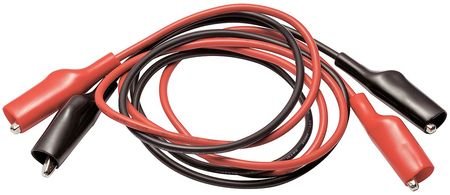
I also carry a couple cheap instrumentation patch cord with alligator clips on both ends to act as a short antenna or antenna extension when needed. Honestly, It’s amazing how often I reach for them!

AE5X notes: Beware of counterfeit Elecraft K3S transceivers

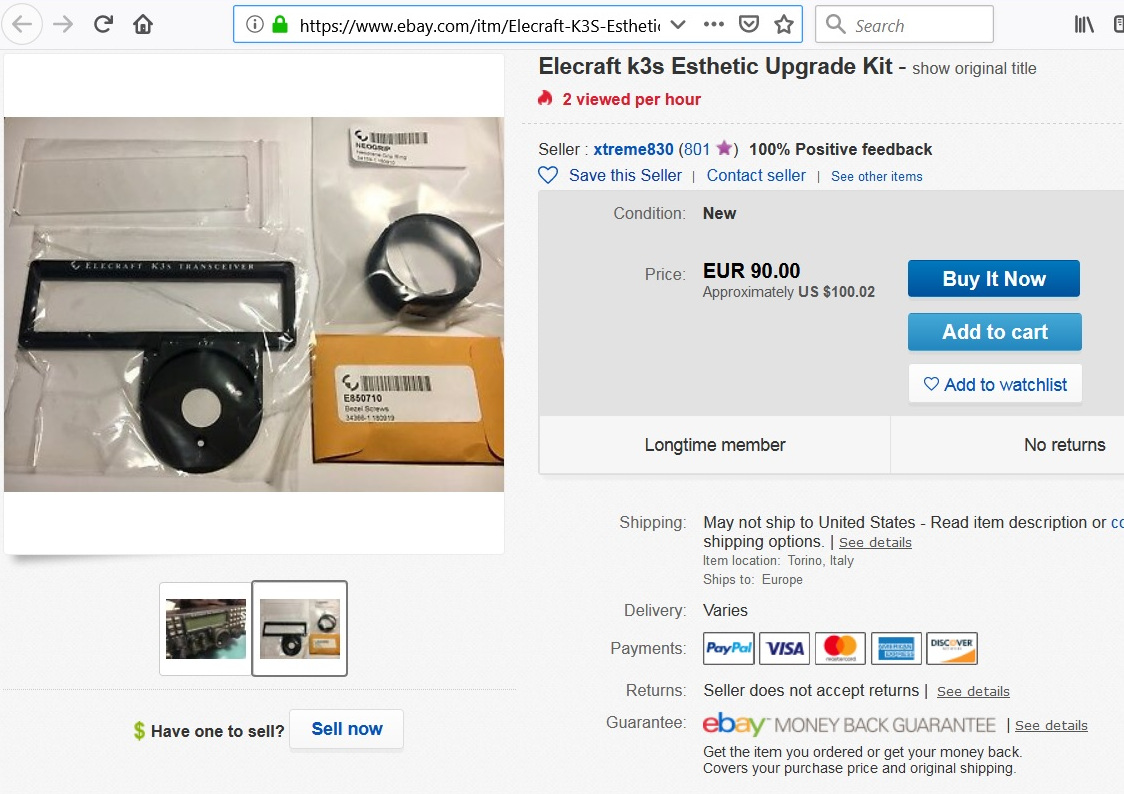
Many thanks to SWLing Post friend John (AE5X) who posted the following warning on his blog regarding “Esthetic upgrade kits” to make an Elecraft K3 look like a K3S.

From the AE5X blog:

If you’re in the market for a used K3S you might want to pay extra diligence to what you’re actually buying.

An eBay seller “xtreme830” is selling Esthetic upgrade kits that can be added to a K3 to make it look like a K3S. As always, buyer beware.

K3S serial numbers begin with #10,000.

Thank you for the warning, John! That’s a little crazy, in fact. I would be most concerned about people buying esthetically altered K3 transceivers at hamfests where one often forgets to check serial numbers. Buyer beware!