Shortwave listening and everything radio including reviews, broadcasting, ham radio, field operation, DXing, maker kits, travel, emergency gear, events, and more
FM: World FM 88.2MHz 3h30-4UTC Thursdays (Tawa, New Zealand) Soundwave FM 107.7MHz & 87.8MHz Sundays (Napier, New Zealand)
If you’ve not heard our shortwave community service before due to time differences or interference this weekend is your weekend! You can send reception reports for eQSL verification to: [email protected]
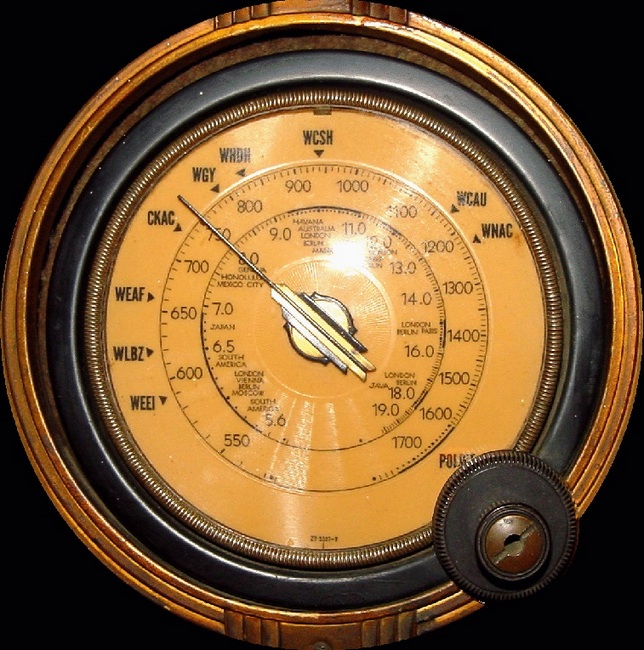
I’m very curious what it must have been like to tune the Bush S.W.45. Seems the big selling feature was its ability to reliably tune closely-spaced stations. The ad claims:
“[T]he Teleflic comes to your assistance by giving you the equivalent of a dial 12 feet long, every station with its own number!”
I’m sure this was a brilliant innovation at the time.
It has to be away from home as I have 2 FM and 1 TV transmitter above my head plus an ungodly amount of electrical noise and RF overload. The banks of the Yukon River are 500 feet from my office and apartment, so that’s a good location.. just need a way to secure a long wire or box loop. I am also in the process of finding an FM Low pass filter to filter out the FM stations real nearby that overload certain parts of the SW dial.
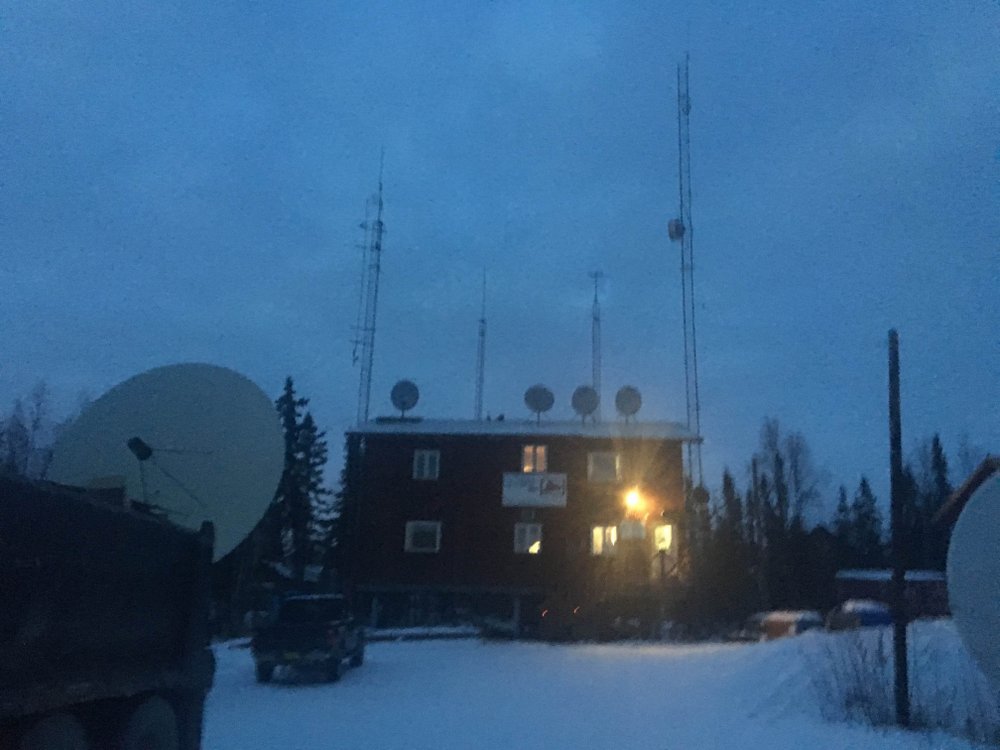
I am in Galena, Alaska. It is a village of about 500 people in the central part of Alaska, we are 300 miles west of Fairbanks and 300 miles east of Nome. Off the road system, everything is flown in 8 months or so out of the year and when the river is flowing, it’s barged in.
Radio Australia and Radio New Zealand are weak here, some days barely listenable, other days passable, but not very strong here. I’ve not heard anything from Radio Taiwan International here, yet I could get them weakly in California and in Arkansas.
I can hear CRI daily, the stuff that comes from their Beijing area SW transmitters is quite listenable.
What I can hear with regularity and strangely, a very good signal depending on the frequency, is The Voice Of North Korea. I’ve logged The Voice Of Korea on about A DOZEN different frequencies! What I can’t figure out is why? Some of the Voice of Korea broadcasts are near local AM radio station like strength many nights. I could hear them fairly well in northern California, but not always so strong.
Why I can’t figure out is the Voice Of Korea broadcasts that I’m hearing, what is their target area? It would sure seem I am not in the direct beam for any of their target areas, being so far north.
The strongest Voice Of Korea broadcasts for me are generally, not always, 15180 kHz and 11735 kHz. I’ve heard them on several 6 and 7 MHz frequencies which are listenable, but never very strong. I’ve also heard them in a few places in the 9mhz band and those are generally pretty listenable.
I did hear Voice Of Korea on 3250 kHz about a week ago. The signal was weak but steady and it was very clearly them.
I’ve heard them in the 13 MHz band one night and that signal was pretty strong. I did get them a few days ago smack in the middle of the day at 11910 kHz which was a bit surprising.
I expect when I construct a massive(and very directional box loop) or put up a longwire, My DX will greatly improve beyond the average stuff I’m getting now.
I’ve also logged Radyo Pilipinas on 17700 and 17820 kHz, several instances of the Firedrake Jammer on different frequencies, CRI and NHK (CRI & NHK are to be expected here).
I did have a surprising reception of All India Radio on 7550 kHz.
Also logged recently was RFI on 15300 kHz, BBC WS on 15400 kHz, Voice of America on 15580 kHz, Radio Exterior De Espana 15390/15500 kHz, RN de Brasilia 11780 kHz among others.
Some of my clips range from merely 30 seconds long to 20 minutes. The longer clips are usually when I had much better. Some clips are video, held up to the radio showing the dial, others are audio onlly.
As always, comments and discussion always welcome.
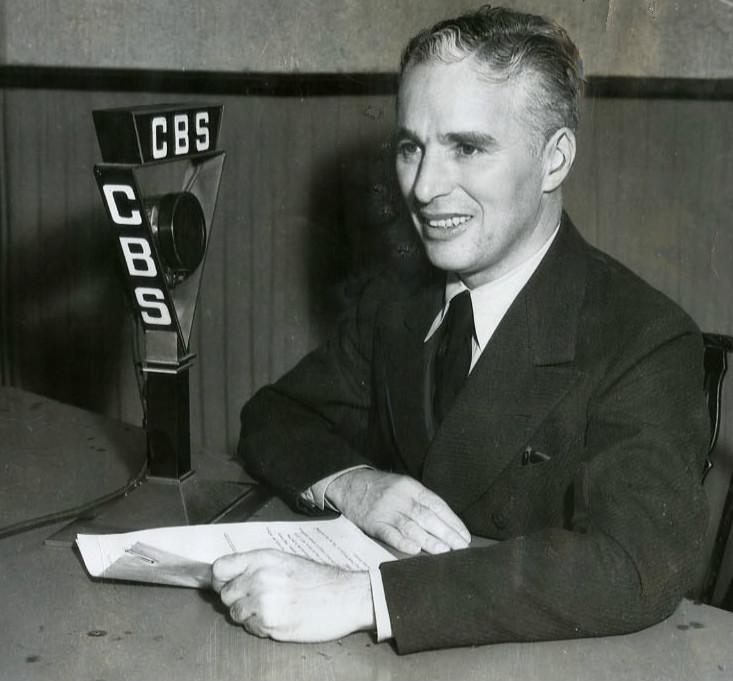
CBS Corp. is poised to exit the radio business that it helped create.
Eighty-eight years ago, the company’s founder, William S. Paley, bought the nascent Columbia Broadcasting System, and those radio stations became the nucleus of a budding broadcast empire.
But on Tuesday, CBS Chairman and Chief Executive Leslie Moonves said the company was exploring strategic options, including a sale or spinoff, of its entire radio division.
“The aim here is to unlock value for our shareholders,” said Moonves, who made the announcement during an investor day in New York.
The decision marks the end of an era and highlights the waning influence of commercial radio, which is no longer considered a growth industry. Young adults spend more time listening to digital music files, podcasts and subscription Internet radio services such as Spotify and Pandora. The shift has prompted major advertisers, including car dealerships, wireless phone companies and financial services firms, to steer more of their marketing dollars to digital platforms.
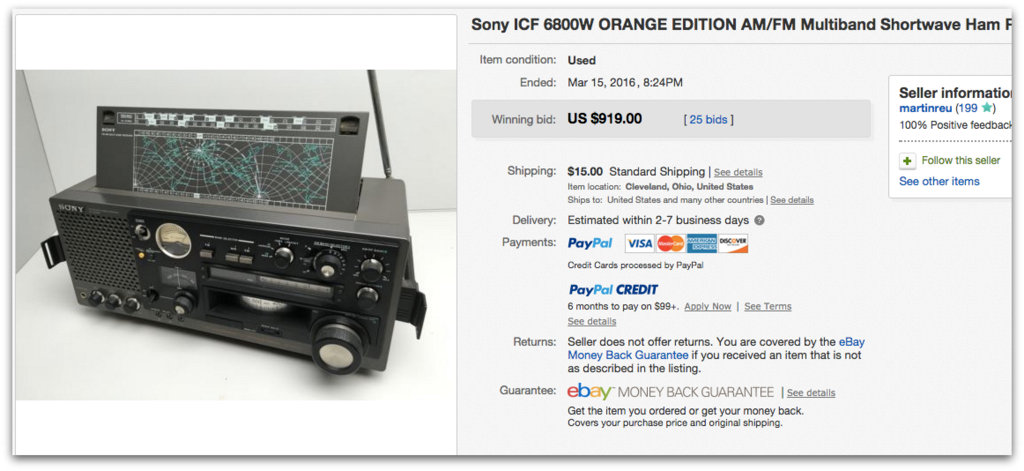
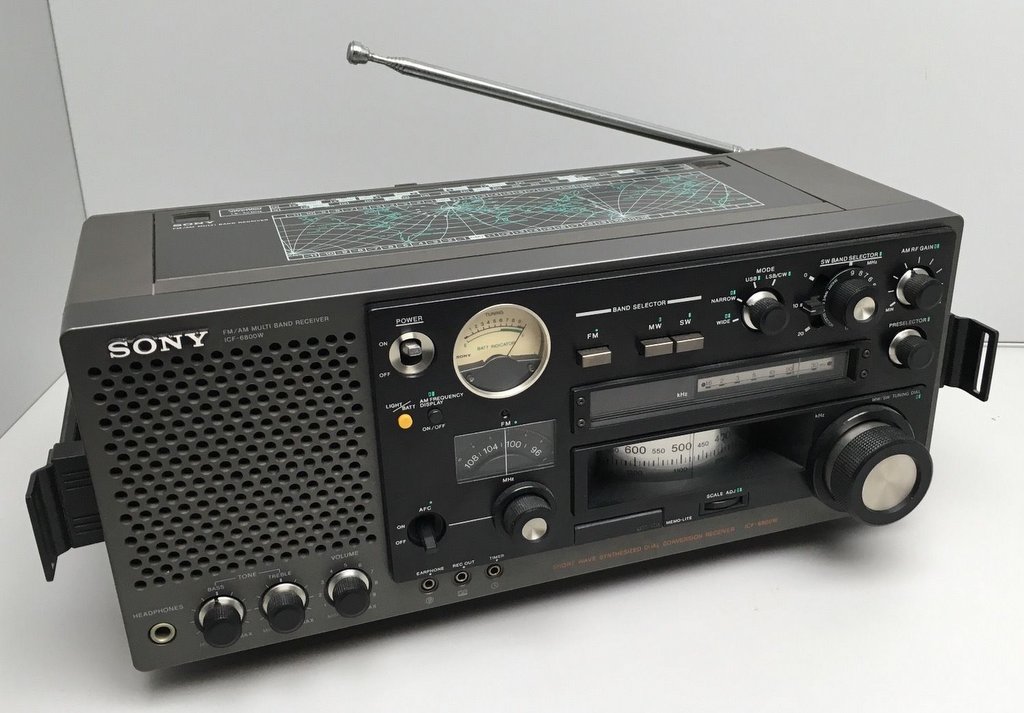
This is the thing about sites like eBay: the market price of any given item is the price it eventually fetches in auction. This Sony appears to be in superb shape and was being sold by a seasoned seller with a high approval rating. The collector behind the winning bid paid top dollar, but he felt it was a fair price to snag this rig.
Note of caution about eBay BuyItNow pricing
The ICF-6800W above was sold in an auction listing. There are times, however, when eBay sellers don’t have an item up for auction, rather they ask for fixed “BuyItNow” prices which are sometimes outrageous. For example, I see a lot of shortwave portables that are still in production being offered at three times the retail price. These sellers are hoping you didn’t do your homework prior to purchasing at a fixed price. We actually addressed this issue last year–check out our previous post:
The General Electric Co. was truly among America’s premier broadcasting companies.
In addition to developing much of early broadcast technology and building a trio of high-power AM stations in the early 1920s — WGY Schenectady, N.Y.; KOA Denver; and KGO Oakland, Calif. — GE was also the country’s pioneer shortwave broadcaster.
GE’s initial shortwave station, 2XI, first broadcast in 1923, and in 1924 it was used to relay WGY’s programs for to KOA and KGO for rebroadcast in the western U.S.
By 1925, there were two experimentally licensed shortwave stations in Schenectady: W2XAD and W2XAF. A third GE station in San Francisco, W6XBE, was added in 1939.
That was the year that the Federal Communications Commission allowed the country’s experimental shortwave stations to relicense as commercial operations, and these three GE stations received the call signs WGEA, WGEO and KGEI, respectively.
Many thanks to SWLing Post reader, Mark Hirst, who writes:
Thomas,
I have been very impressed by the shacks featured on SWLing !
I don’t really have the room to accommodate such large collections, or to dedicate a special area to just radio.
I tend to perch a radio on a spare surface in the front bedroom, and then cycle through my small collection on a weekly or bi-weekly basis, returning the previous radio to storage to await its turn in a month’s time.
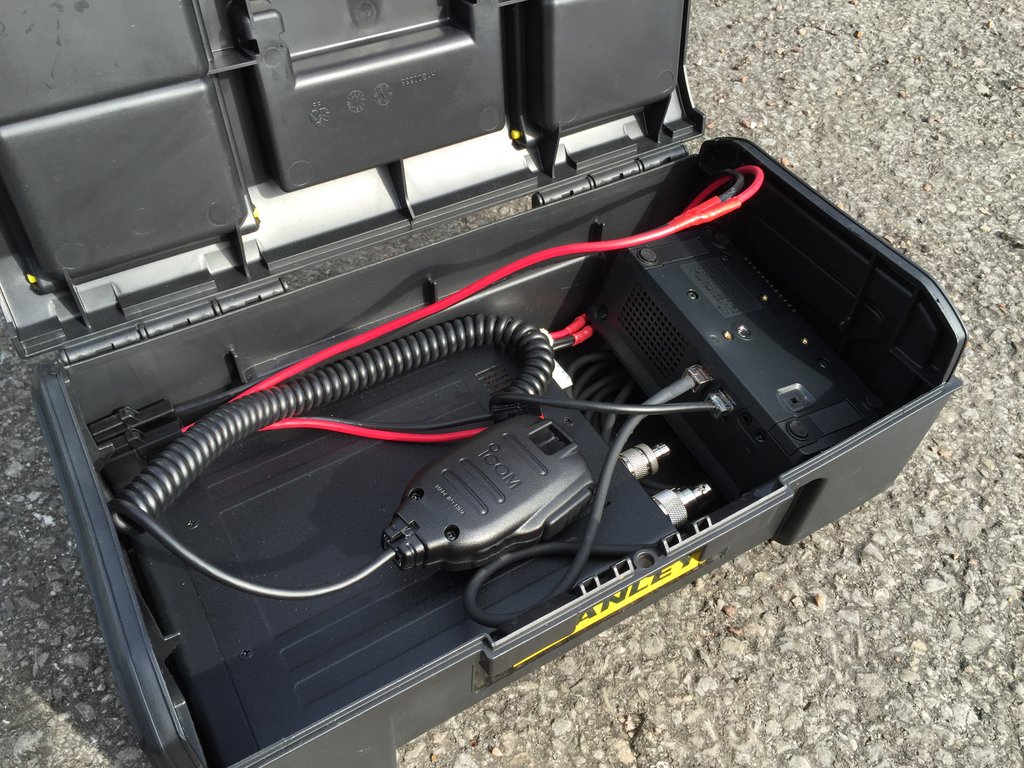
Since newer houses and gardens are typically quite small in the UK, I’ve always been thinking in terms of radio on safari, so with the weather starting to improve, I present to you my ‘shack’ consisting of a recently acquired IC-7100 inside a fortuitously sized toolbox. The radio runs in the bedroom like this too, usually connected to a Wellbrook loop when not transmitting.
The picture [above is of the] head unit in stowed configuration, as the lid of the box doesn’t quite clear the unit when sitting on the base. The space on top of the radio is then filled by the SOTA Beams antenna bag and other sundries. The battery travels separately in the backpack.
My plan was to never have to connect/disconnect the ethernet style cable between the two halves, looks like the plan worked !
This is a brilliant kit, Mark–a great way to escape urban radio interference! The Icom IC-7100 is uniquely qualified for the deep case, too, since the control head can sit on top of the body while in use. The angle of operation is also ideal. Very cool–thanks for sharing!