Tag Archives: Radio Waves

Radio Waves: Waves Around Earth’s Core, New Australian Communications Minister, Shipping Forecast Future, and Hams Accused of Being Spies

Radio Waves:  Stories Making Waves in the World of Radio

Welcome to the SWLing Post’s Radio Waves, a collection of links to interesting stories making waves in the world of radio. Enjoy!


Giant Magnetic Waves Have Been Discovered Oscillating Around Earth’s Core (Science Alert)

Earth’s interior is a far from quiet place. Deep below our surface activities, the planet rumbles with activity, from plate tectonics to convection currents that circulate through the hot magmatic fluids far underneath the crust.

Now scientists studying satellite data of Earth have identified something inside Earth we’ve never seen before: a new type of magnetic wave that sweeps around the surface of our planet’s core, every seven years.

This discovery could offer insight into how Earth’s magnetic field is generated, and provide clues of our planet’s thermal history and evolution – that is, the gradual cooling of the planetary interior.

“Geophysicists have long theorized over the existence of such waves, but they were thought to take place over much longer time scales than our research has shown,” says geophysicist Nicolas Gillet of the Université Grenoble Alpes in France.

“Measurements of the magnetic field from instruments based on the surface of Earth suggested that there was some kind of wave action, but we needed the global coverage offered by measurements from space to reveal what is actually going on.

“We combined satellite measurements from Swarm, and also from the earlier German Champ mission and Danish Ørsted mission, with a computer model of the geodynamo to explain what the ground-based data had thrown up – and this led to our discovery.”

Earth’s magnetic field is the subject of much fascination for scientists. Research to date suggests that the invisible structure forms a protective ‘bubble’ around our planet, keeping harmful radiation out and the atmosphere in, thus allowing life to thrive. [Continue reading…]

Michelle Rowland sworn in as new Communications Minister (TV Tonight)

Michelle Rowland sworn in as new Communications Minister

Australia has a new minister leading regulation in the screen sector.

Michelle Rowland M.P. has been sworn in as the new Communications Minister under PM Anthoyn Albanese.

Replacing Paul Fletcher, she has previously been shadow communications minister in opposition.

“It is an honour to be sworn in as Minister for Communications and to serve the Australian people under an Albanese Labor Government,” she said.

“This portfolio has the potential to further enable an Australia where connectivity and content enriches our quality of life, informs us, drives productivity and empowers us to fulfil our potential. I am dedicated to ensuring Australians, in our cities and regions, are united and connected. Now, let’s get to work” [Continue reading…]

‘A link across time’: how shipping forecast will outlast Radio 4 long wave (The Guardian)

Boats have not needed the broadcast for decades but radio bosses know nostalgia for it runs deep

Radio 4’s shipping forecast is a national institution, with millions of listeners reassured by the thought that, somewhere out at sea, British fishers are patiently waiting by their radios to find out whether there is a gale warning in Rockall or Cromarty.

Yet the announcement that Radio 4’s long wave signal will be shut down as part of the BBC’s latest cuts has left many wondering how the country’s fishing fleet will cope without access to the four-times-a-day updates.

The slightly less romantic reality, according to Mike Cohen of the National Federation of Fishermen’s Organisations, is that his members have not needed Radio 4 for decades. Modern fishers have far more accurate devices to warn them about the wind and rain: “Even the small 15-metre boats in Bridlington have satellite internet these days. I’ve had video calls from people in the middle of the sea.”

Yet that does not mean they are immune to the charms of Sailing By, the music that heralds the forecasts and was designed to help captains adjust their radios: “That theme tune is a link to other times, other people, other places. There’s as much a fondness among fishermen for that as there is for the rest of us.”

When the fishers’ trade body asked its members how they felt about the shipping forecast one said it “acted as a link across communities, a link across time”. Another added: “For us it is a bygone age but for many older folk it is a reassuring connection to the past.”

The BBC plans to end dedicated programming on its Radio 4 long wave frequency next year, which could mean the loss of two of the current four shipping broadcast updates. The early morning and late night forecasts will remain on FM, DAB and online broadcasts. But the loss of the long wave signal – accessible far from the British mainland – confirms they will essentially be nostalgia pieces, more about waking the nation up or lulling listeners to sleep. [Continue reading…]

Two Brits arrested in Albania as police accuse them of spying after seizing radio gear (Southgate ARC)

Two Britons were quizzed on allegations of espionage by officers at Tirana International Airport in Albania after police discovered sophisticated Kenwood radios in their luggage

Two Britons have been arrested by Albanian spooks and accused of spying after border police found radio transmitters in their luggage.

The pair were quizzed on allegations of espionage by officers at Tirana International Airport after they discovered sophisticated Kenwood radios in their luggage.

They told the officials they were IT engineers who were carrying the amateur gear to indulge their hobby while on holiday in Albania.

One suspect was registered as using a “ham radio” in the Tirana region on online profiles, which also say he specialises in “electronic warfare”.

Albanian police confirmed that they have opened a probe over allegations of “spy activities” and “espionage”.

A source said: “It’s highly unusual to be carrying this sort of equipment and even more strange for someone to be stopped and accused of being a covert agent.”

The two Britons were held on May 30 and then allowed to return to the UK. However they remain under investigation, police say. The electronic kit by Kenwood – which makes a range of cutting edge communication devices – was sent to the Albanian Criminal Laboratory for further examination.

You can read the full Daily Mirror article at
https://www.mirror.co.uk/news/world-news/two-brits-arrested-albania-police-27191861


Do you enjoy the SWLing Post?

Please consider supporting us via Patreon or our Coffee Fund!

Your support makes articles like this one possible. Thank you!

Radio Waves: Led Zeppelin Saved by Off-Air Recording, News on a Music Station, FFC Notice to Pirate Landlords, and Hamvention 2022

Radio Waves:  Stories Making Waves in the World of Radio

Welcome to the SWLing Post’s Radio Waves, a collection of links to interesting stories making waves in the world of radio. Enjoy!


The improvised Led Zeppelin song that was lost by the BBC for over 40 years (Far Out)

During Led Zeppelin’s 12 years together, the group released eight studio albums, each composed of tracks Jimmy Page and company believed to be the best representation of the group at that specific moment in time. When amassed, these albums trace the evolution of Zeppelin’s style, approach to production, individual musical skills, and songwriting habits. And while we might have assumed this rendering of Zeppelin’s musical life to be complete, it would seem that we’ve not been given the full picture. Indeed, there are certain Led Zeppelin songs that even some of the group’s most die-hard fans never knew existed.

Following the release of the Led Zeppelin compilation album BBC Sessions in 1997, Jimmy Page began hearing a bootleg version of a song he hadn’t heard in just under 30 years. The band had never attempted it during an album session, and it never appeared on any of their records. After a bit of digging, Page realised that the track had come from a BBC performance Led Zeppelin made in the first months of 1969. Unfortuantely, it transpired that the BBC had managed to lose the tape from that day, meaning that Page was forced to track down a copy of the song a fan had recorded off the radio back in ’69. [Continue reading…]

How One Music Station Covered The Buffalo Massacre (Radio Ink)

(By Tom Langmeyer) The unfortunate conventional wisdom that has prevailed in radio during the last 20 years is “We are a music station. We don’t do news.” Unfortunately, this sentiment represents many people who set the tone for the industry and make these proclamations proudly, as the radio business becomes more and more irrelevant.

There is some truth to the statement that a “music station should not be covering news” by those who think completely linearly. However that culturally process-driven approach that has zero to do with results.

A music-intensive radio station is not expected to do news in the traditional sense, nor should be competing with news stations. It’s not a music station’s role.

However, all radio stations must have a component of “news. Now, before folding your arms across your chest, think about it this way.

“News” is really what your listeners need and want in the radio experience. What does “news” mean for your station? What is it? How is it delivered? How much? How do we activate our listener? That’s where things are different and need to be defined.

Think about a great country station that’s talking about a concert that’s happening in town and building an experience around it. That’s NEWS.

No one is saying a music station should be WINS, WBBM, KNX or KCBS.

No matter the music format is, there needs to be a playbook for how and what information (relevant “news”) gets presented.

On the advising side of Great Lakes Media’s business, we create customized plans for stations committed to localism and winning on the revenue hill. Sure it’s different – and that’s why it works.

It’s called the “Great Lakes Media Way.” [Continue reading at Radio Ink…]

FCC Sends Pirate Radio Notices to Property Owners (Radio World)

Agents traced signals in Pennsylvania, Maryland and Oregon

The Federal Communications Commission has sent notices to several property owners of alleged pirate radio activities on their properties.

The letters from the Enforcement Bureau are headlined “Notice of Illegal Pirate Radio Broadcasting.” They remind the owners that federal law now provides for fines of up to $2 million “if we determine that you have continued to permit any individual or entity to engage in pirate radio broadcasting from the property that you own or manage.”

The bureau said its agents used direction finding techniques to source these FM signals. It mailed letters to Richard Manson for broadcasts on 103.5 MHz in Philadelphia in January; to Maria V. Hernandez of Kissimmee, Fla., for signals on 87.9 MHz in Hazleton, Pa., in January; to Edwin and Joyce Pitt of Baltimore, Md., for signals on 91.3 in February; and to Kent and Deanna Coppinger for signals on 100.5 MHz in La Grande, Ore., in March. [Continue reading…]

Hamvention to kick off this weekend in Xenia; Thousands expected to attend (Southgate ARC)

After nearly three years, Hamvention is back.

The convention is the world’s largest amateur radio gathering at Greene County Expo Center, according to the event’s website.

Around 30,000 visitors are expected to come to the event from all over the world.

Michael Kalter, the spokesperson for Hamvention, said that based on numbers from the Greene County Convention Visitors Bureau, Hamvention adds $30 million to the local economy.

He said amateur radio, also known as ham radio, is something people of all ages and backgrounds can be a part of, which is why he thinks the convention draws such a large crowd.

Kalter shared how it feels to bring so many people from around the world together. “That makes me feel really good,” Kalter told News Center 7?s Kayla McDermott. “I’m glad that the hobby seems to be really growing and flourishing,” he added.

There are no COVID-19 restrictions in place for this year’s convention. With thousands of people expected to attend, safety is a top priority. Before entering the convention center, people must have their bags checked. The Greene County Sheriff’s Department said they have prepared for the event.

Major Shawn Prall, with the sheriff’s office, said they have a plan in place to make sure traffic moves along smoothly as there are only two lanes to get to the grounds. Crews will also keep an eye on the weather, in case there is a chance for it to turn severe. Prall said this will be his fourth Hamvention and he has never had an incident. “We’re taking precautions, both that the public will see in uniform presence and also things that they can’t see. Just trying to keep everybody safe and be ready for any kind of incident, whether it be weather or manmade or anything like that,” Prall said.

The convention runs this weekend 9 a.m.-6 p.m. Friday, 9 a.m.- 5 p.m. Saturday and 9 a.m.-1 p.m. Saturday.

Source: https://www.whio.com/news/local/hamvention-kick-off-this-weekend-xenia-thousands-expected-attend/RUMUJLOHEJCUXOOSMEZJL6S22I/


Do you enjoy the SWLing Post?

Please consider supporting us via Patreon or our Coffee Fund!

Your support makes articles like this one possible. Thank you!
Radio Waves: Holme Moss Transmitter, Sherwood Tools, World of LPFMs, Shortwave Revival Response, and Russia “Thrown Back 40 Years”

Radio Waves:  Stories Making Waves in the World of Radio

Welcome to the SWLing Post’s Radio Waves, a collection of links to interesting stories making waves in the world of radio. Enjoy!


Holme Moss transmitter (BBC Archives)

A look at how the BBC’s third television transmitter in West Yorkshire was built.

These original masts broadcast to the surrounding population until 1985, when they were replaced by a new generation of transmitters.

Originally broadcast 12 October 1951

Click here to watch the video at the BBC Archives.

Sherwood Tools Available (K4FMH Blog)

The work that Rob Sherwood NC0B has contributed to the public over the past decade is unique and an amazing service to hams worldwide. I’m talking about, of course, his summary Table of receive bench tests published at this Sherwood Engineering website. He is independent so no one can think that advertising dollars could skew his assessments or how he presents them. As a CW contest operator, he is very clear that he sorts his table on the basis of what his experience and training has shown him to be the single most important measurement in his table: the narrow dynamic range.

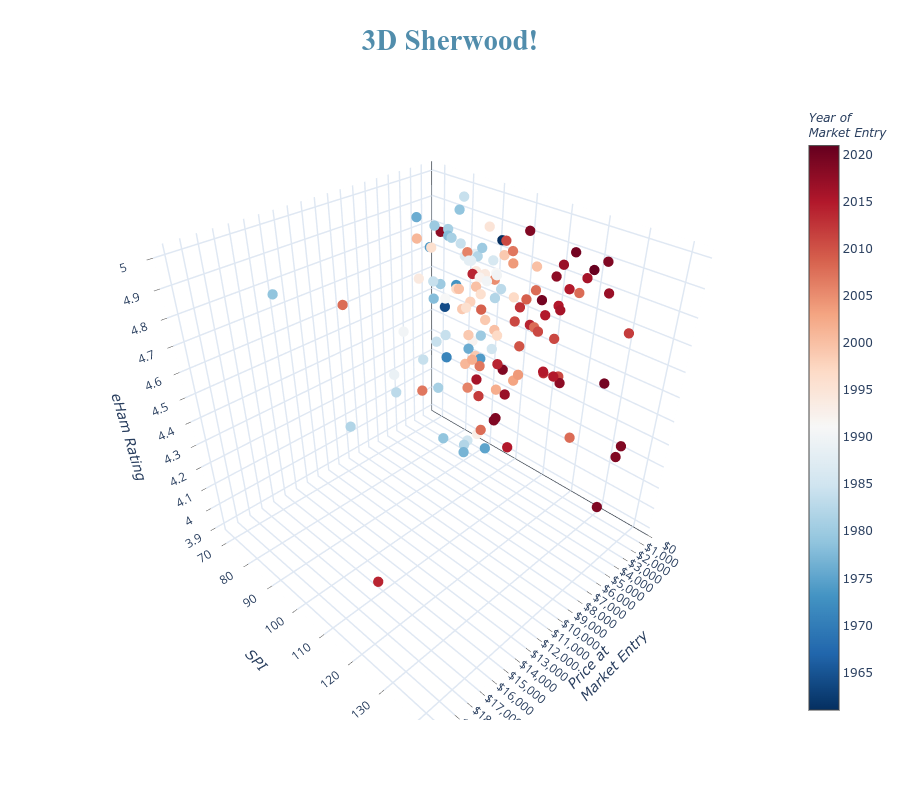
I am not a CW operator or accomplished contester (lol) but enjoy the latter with my small team of fellow hams. But I am a statistician who likes to focus on problems where analytic tools can help foster a wider understanding of the data surrounding the problem area. So, working with Rob NC0B, I’ve created a set of “Sherwood Tools” to visualize his data as well as link them to a couple of other critical aspects of a rig purchase: market-entry price, consumer satisfaction, and the year the radio entered the market. These four vectors of data drive all of these tools, now available over at foxmikehotel.com.

The tools include a sortable Sherwood list where you can sort on any of the nine tests he publishes as well as the composite index of them that I created and included in my two-part NCJ articles in 2021. A set of 3D data visualizations are available to simultaneously view radios on four data elements (that does make it 4D, technically). Several graphs illustrate key aspects of the data, including how to not get tripped-up in the “ranking” of radios where the bench measurements are just not appreciably different. Seeing how the past 50 years of radios appearing in Rob’s Table have made a remarkable and clear progression toward the best receiver performance that modern test equipment can detect is in another tool. In addition, how the trend in getting a receive bang-for-the-buck has progressed over this 50 year period is there, too. Finally, I’ve used the industry-standard tool by Gartner, the Magic Quadrant, to help isolate radios in Rob’s Table that perform and are rated above average at various price points. I call these the Golden Quadrant Lists. Continue reading

Radio Waves: DRM Part of BBC Story, Antennas and Smith Charts, Shortwave “Hot Debate,” Carrington Event, and “Deep Freeze”

Radio Waves:  Stories Making Waves in the World of Radio

Welcome to the SWLing Post’s Radio Waves, a collection of links to interesting stories making waves in the world of radio. Enjoy!


DRM Is Part of the BBC World Service Story (Radio World)

The iconic broadcaster has been supportive of the standard for over 20 years

The author is chairman of the DRM Consortium. Her commentaries appear regularly at radioworld.com.

Our old friend James Careless studiously ignores DRM once more in his well-researched, but to our minds incomplete article “BBC World Service Turns 90” in the March 30 issue.

As an ex-BBC senior manager, I would like to complete the story now that the hectic NAB Show is over.

Having lived through and experienced at close quarters the decision to reduce the BBC shortwave about 20 years ago, I can confirm that the BBC World Service decision to cut back on its shortwave footprint — especially in North America, where reliable, easy-to-receive daily broadcasts ceased — has generated much listener unhappiness over the years.

In hindsight, the decision was probably right, especially in view of the many rebroadcasting deals with public FM and medium-wave stations in the U.S. (and later other parts of the world like Africa and Europe) that would carry news and programs of interest to the wide public.

But BBC World Service in its long history never underestimated the great advantages of shortwave: wide coverage, excellent audio in some important and populous key BBC markets (like Nigeria) and the anonymity of shortwave, an essential attribute in countries with undemocratic regimes.

BBC World Service still enjoys today about 40 million listeners worldwide nowadays. [Continue reading…]

The Magic of Antennas (Nuts & Volts)

If you really want to know what makes any wireless application work, it is the antenna. Most people working with wireless — radio to those of you who prefer that term — tend to take antennas for granted. It is just something you have to add on to a wireless application at the last minute. Well, boy, do I have news for you. Without a good antenna, radio just doesn’t work too well. In this age of store/online-bought shortwave receivers, scanners, and amateur radio transceivers, your main job in getting your money’s worth out of these high-ticket purchases is to invest a little bit more and put up a really good antenna. In this article, I want to summarize some of the most common types and make you aware of what an antenna really is and how it works.

TRANSDUCER TO THE ETHER
In every wireless application, there is a transmitter and a receiver. They communicate via free space or what is often called the ether. At the transmitter, a radio signal is developed and then amplified to a specific power level. Then it is connected to an antenna. The antenna is the physical “thing” that converts the voltage from the transmitter into a radio signal. The radio signal is launched from the antenna toward the receiver.

A radio signal is the combination of a magnetic field and an electric field. Recall that a magnetic field is generated any time a current flows in a conductor. It is that invisible force field that can attract metal objects and cause compass needles to move. An electric field is another type of invisible force field that appears between conductors across which a voltage is applied. You have experienced an electric field if you have ever built up a charge by shuffling your feet across a carpet then touching something metal … zaaapp. A charged capacitor encloses an electric field between its plates.

Anyway, a radio wave is just a combination of the electric and magnetic fields at a right angle to one another. We call this an electromagnetic wave. This is what the antenna produces. It translates the voltage of the signal to be transmitted into these fields. The pair of fields are launched into space by the antenna, at which time they propagate at the speed of light through space (300,000,000 meters per second or about 186,000 miles per second). The two fields hang together and in effect, support and regenerate one another along the way. [Continue reading…]

Smith Chart Fundamentals (Nuts & Volts)

The Smith Chart is one of the most useful tools in radio communications, but it is often misunderstood. The purpose of this article is to introduce you to the basics of the Smith Chart. After reading this, you will have a better understanding of impedance matching and VSWR — common parameters in a radio station.

THE INVENTOR
The Smith Chart was invented by Phillip Smith, who was born in Lexington, MA on April 29, 1905. Smith attended Tufts College and was an active amateur radio operator with the callsign 1ANB. In 1928, he joined Bell Labs, where he became involved in the design of antennas for commercial AM broadcasting. Although Smith did a great deal of work with antennas, his expertise and passion focused on transmission lines. He relished the problem of matching the transmission line to the antenna; a component he considered matched the line to space. Continue reading

Radio Waves: Radio Liberty Journalist Killed in Ukraine, Group Asks FCC to Revoke License, Labor & Shortwave Restoration, and “The Earth Is An Image”

Radio Waves:  Stories Making Waves in the World of Radio

Welcome to the SWLing Post’s Radio Waves, a collection of links to interesting stories making waves in the world of radio. Enjoy!


Ukraine war: Russian strike on Kyiv kills reporter Vira Hyrych (BBC News)

A journalist working for Radio Liberty in Ukraine was killed in Russian rocket strikes on Kyiv on Thursday evening, the station has confirmed.

Vira Hyrych was at home when a rocket hit the residential building where she lived in the capital, it says. Her body was pulled from the wreckage on Friday.

She “will be remembered for her professionalism and dedication to our mission”, the US-funded station says.

Kyiv was hit as UN Secretary General António Guterres was visiting the city.

The UN chief – who only a day earlier had held talks in Moscow with Russian President Vladimir Putin – said he was “shocked” by the Russian attack.

Ukrainian President Volodymyr Zelensky accused the Kremlin of trying to humiliate the UN, while Kyiv Mayor Vitaliy Klitschko said the Russian leader had shown “his middle finger” to Mr Guterres.

Moscow has confirmed it hit Ukrainian targets, but has not commented on the strike on the building.

“We are deeply saddened by the death of our Ukrainian Service staffer Vira Hyrych in Kyiv overnight,” Radio Liberty President Jamie Fly said in a statement.

“We are shocked and angered by the senseless nature of her death at home in a country and city she loved. Her memory will inspire our work in Ukraine and beyond for years to come.” [Continue reading…]

Group Wants to Shut Down Garziglia Station (Radio Ink)

A group calling itself the Ukrainian Congress Committee of America has filed a petition with the FCC asking the Commission to revoke the license of the translator owned by John Garziglia. FM translator W288BS in Reston, Virginia rebroadcasts WZHF-AM in the Washington DC metro which carries Radio Sputnik. Continue reading

Radio Waves: AMARC Africa, Discussing HD Radio Australia, Learning by Doing, and RadCom Seeking New Editor

Radio Waves:  Stories Making Waves in the World of Radio

Welcome to the SWLing Post’s Radio Waves, a collection of links to interesting stories making waves in the world of radio. Enjoy!


Study recommends revival of AMARC Africa (Red Tech)

HARARE, Zimbabwe — The unavailability of critical information about community radio in Africa has led the University of the Witwatersrand(Wits) journalism department and a consortium of media, civil rights and business NGOs — Fojo Media Institute, Civicus, Civil Rights Defenders, Defend Defenders and Hub Afrique — to carry out a study entitled “Mapping Community Radio in Sub-Saharan Africa.”

“Even basic information is hard to get, and it is often not even certain how many stations are on air. Operations collapse, and others start, with hardly anybody outside the immediate environment noticing. Even the licensing authorities sometimes struggle to keep accurate records,” revealed Prof. Franz Kruger, head of Wits Journalism.

Conducted by Jacob Ntshangase, the head of Wits Radio Academy, the study sought to gather information and better understand the community radio landscapes in different parts of Sub-Saharan Africa to identify needs, opportunities and potential partners for developing a program of support for community radio on the continent. [Continue reading…]

Can the HD Radio experience be of use in regional Australia. (RadioInfo)

The 2022 NAB Show is already underway in Las Vegas, and fresh from presenting some new research on HD radio in the US, Xperi SVP Broadcast Radio, Joe D’Angelo (pictured), sat down with radioinfo’s Wayne Stamm.

Joining the conversation was Commercial Radio Australia’s Head of Digital, Jamie Chaux, to add an Australian perspective and view on what might be gained from the HD experience in the States.

radioinfo: We’re talking about a couple of the presentations that are going to be made at NAB this year. Joe you’ve already done one of those presentations and taken a look at some very interesting studies that have been done recently about the penetration of HD radio, especially here in the US.

Joe D’Angelo: Yes, I finished a session today on actually UX guidelines (NABA Radio In-car User Experience) for in-car receiver design and that that went very well. And what’s really exciting about not only the work of the UX group, but the progress of HD radio, is we’re now at 85 million vehicles on the road.

And so we surveyed users of the technology and 91% of them came back and said that HD radio has significantly improved their radio listening experience.

74% of people said they would not buy another new car unless it had HD radio, which is very affirming.

Read more at: https://radioinfo.com.au/news/can-the-hd-radio-experience-be-of-use-in-regional-australia-nabshow/ © RadioInfo Australia

Learning Electronics By Just Doing It (Southgate ARC via Hackaday)

Learning anything new, especially so broad and far reaching as electronics, can be hard. [IMSAI Guy] knows this because he gets asked regularly ‘how do I learn electronics?’ Many of you reading this will have a few ideas to pass along (and we encourage you to share your take on it in the comments below) but there is an even greater number of people who are asking the same question, and [IMSAI Guy]’s take on it is one that this particular Hackaday writer can relate to.

According to [IMSAI Guy], an excellent place to start is the ARRL Handbook. The ARRL Handbook is an electronics and RF engineering guide published by the Amateur Radio Relay League in the US. It’s a wonderful reference, and past editions can be had very inexpensively and are every bit as handy. Many hams will have a copy they could be talked out of, and you can likely find one at your local library. Where to start in the Handbook, then?

[IMSAI Guy] recommend starting with whatever catches your fancy. As an example, he starts with Op Amps, and rather than diving straight into the math of how they work or even worrying to much about what they are- he just builds a circuit and then plays with it to intrinsically understand how it works, a “learn by doing” approach that he has found extremely helpful just as many of us have. We also appreciated is very straightforward approach to the math: Don’t bother with it unless you need to for some reason, and definitely don’t start by learning it first.

Read the full article and watch the video at:
https://hackaday.com/2022/04/25/learning-electronics-by-just-doing-it/

RadCom Managing Editor role (Southgate ARC via the RSGB)

As previously announced, RadCom Editor Elaine Richards, G4LFM is to retire in the summer and there will be a vacancy for a person to edit RadCom, the Society’s journal and one of the most respected amateur radio publications in the world.

The successful candidate will need to show demonstrable experience of producing professional and technical publications in both print and digital formats as they will need to take the entire co-ordinated portfolio forward and exploit new media opportunities.

The role also includes overseeing the publication of RadCom Basics and RadCom Plus with their editors, as well as being part of the team that puts together GB2RS news each week.

The role is being advertised by Redwood Publishing Recruitment and is also on the Guardian Jobs website and LinkedIn. If you’d like an informal chat about the role, please contact the General Manager via [email protected]

All applications must be made via the Redwood website: https://www.redwoodrecruitment.com


Do you enjoy the SWLing Post?

Please consider supporting us via Patreon or our Coffee Fund!

Your support makes articles like this one possible. Thank you!
Radio Waves: First BNR Overseas Broadcasts, Russian Milcomm Intercepts, Mount Merapi Community Radio, and Saskatchewan’s Oldest Station Turns 100

Radio Waves:  Stories Making Waves in the World of Radio

Welcome to the SWLing Post’s Radio Waves, a collection of links to interesting stories making waves in the world of radio. Enjoy!


The fascinating story of the first overseas broadcasts BNR (Radio Bulgaria)

In 1936 BNR, then under the name of Radio Sofia, started broadcasting on short waves via the ELZA transmitter (the abbreviation coming from the radio station’s international code – L-Z-A). The same year the radio started broadcasts to abroad.

In 1936, information about Bulgaria could only be heard in Bulgarian and in the artificially created language Esperanto. It was after 1 May 1937, when programs began to be broadcast in French, German, English and Italian.

In the spring of 1938, broadcasts for foreign audiences were further developed to include “Special Broadcasts for Some European Countries”.

What was special about these was the advance publicity which the radio made in the countries for which the broadcast is intended. Such publicity was carried out through the legations, business representatives, foreign radio stations and newspapers so as to attract the attention of listeners abroad in advance.

Authors and hosts of the first broadcasts abroad were free-lance collaborators, among whom were legendary Bulgarian journalists and intellectuals like Petar Ouvaliev, Georges Milchev, Bory Ganchev, Mikhail Hadzhimishev and others.

After 9 September 1944, when the communist regime seized power in Bulgaria, Radio Sofia’s foreign language broadcasts continued to air news bulletins and commentaries on events in Bulgaria and around the world. From 1945 to 1950, Bulgarian Radio Sofia broadcast 10-minute news bulletins in Romanian, Serbo-Croatian, Macedonian, Greek and Turkish.

The Bulgarian Radio began broadcasting in Turkish language in July 1945. The programme targets the Turkish population in this country as well as listeners from neighbouring Turkey. It was run by Chudomir Petrov, BNR Deputy Director and head of the Foreign Information Department.

There were two 10-minute broadcasts each day. Editor was Boris Pilosoff, who then also led the French-language broadcasts. The first hosts of the program in Turkish were Ulfet Sad?kova, R?za Mollov, Mustafa Bekirov, Sali Baklaciev among others.

The Greek-language emissions started in the first half of 1948. By then, democratic power had already been installed in Greece under US and Western European pressure. The Greek Communist Party’s resistance movement was destroyed and many Greek functionaries found refuge in Bulgaria. Curiously, it was with their help that the Greek editorial board was set up.

Similarly, after the political events in Yugoslavia and Albania in 1948, political immigrants seeking protection from the Bulgarian communist government created broadcasts in Serbo-Croatian and Albanian.

The first editors and speakers of Serbo-Croatian language had their quarters at 10 Danube Street in Sofia. There they prepared and translated the material for the Bulgarian radio broadcasts.

Based on historical accounts collected by Bozhidar Metodiev – founder and curator of the BNR Museum.

To be continued.

Compiled by: Krasimir Martinov

Editor: Darina Grigorova

English version: Elizabeth Radkova

Clcik here to follow this series on the BNR website.

How does Ukraine keep intercepting Russian military communications? (NPR)

Russia is regarded as one of the world’s most advanced countries when it comes to anything and everything related to spying, and that includes secretive, high-tech military communications.

For Russian leader Vladimir Putin, a former intelligence officer, this is a particular point of pride. Yet Russia’s reputation has taken a major blow with the often bumbling way the military has handled communications in Ukraine.

Here’s a look at how the Ukrainians have effectively countered the Russians on multiple fronts:

Q. Ukraine keeps publicly releasing what it says are intercepted Russian communications from the battlefield. Wouldn’t Ukraine want to keep this under wraps?

Ukraine feels there are huge public relations benefits in releasing intercepted material that’s either embarrassing to Russia or points to Russian wrongdoing, possibly even atrocities.

Ukraine’s military intelligence recently put out audio on social media, saying that as two Russian military members were speaking, one called for Ukrainian prisoners of war to be killed.

“Keep the most senior among them, and let the rest go forever. Let them go forever, damn it, so that no one will ever see them again, including relatives,” a voice says on the tape. [Continue reading at NPR…]

Hot rocks, smouldering ash: Community radio a vital source of information around Indonesia’s Mount Merapi (Channel News Asia)

YOGYAKARTA, Indonesia: With a soft, soothing voice, Mujianto greeted his listeners before reading out an important update from the volcanologists at Indonesia’s Center for Geological Disaster Research and Technology Development (BPPTKG).

Mount Merapi, located just 4km from Mujianto’s village in Boyolali Regency, Central Java province, continued to show signs of heightened activity, he warned.

Since 2019, the mountain has been hurling glowing hot rocks from deep inside its magma chamber. Occasionally, Merapi erupted, spewing a column of smouldering ash high into the air and blanketing nearby villages in black and grey soot.

“People are advised not to conduct any activity in potentially hazardous areas,” Mujianto, who like many Indonesians goes with one name, told his listeners, concluding his announcement.

A farmer by day and an amateur radio DJ by night, Mujianto and six others at MMC FM have been providing residents of Samiran village with information about the dangers posed by Merapi, Indonesia’s most active volcano, as well as educating them on disaster mitigation since 2002.

MMC stands for Merapi Merbabu Community, with Merbabu being another volcano north of Merapi. Mujianto’s MMC FM is one of eight community radios run by people living on the slopes of Merapi, which straddles along the border of the Central Java and Yogyakarta provinces. [Continue reading…]

Oldest radio station in Saskatchewan turns 100 (Discover Humboldt)

It is thought to be the fourth oldest radio station in Canada, and it is the oldest radio station in Saskatchewan. This weekend, Moose Jaw’s CHAB is celebrating 100 years on the air.

The story started in 1922 – April 23rd, 1922 when, after many meetings, planning and anticipation, 10-AB began broadcasting. According to Broadcasting-History.com, the Moose Jaw Amateur Radio Association “had planned originally to operate the station, but found they couldn’t afford to run it, so handed it over to the Kiwanis Club. 10-AB was licensed as a non-commercial station at 1200 kHz with 50 watts of power.”

One hundred years later in 2022 the signal at 800 on the AM radio dial booms across the province and into the northern United States with 10,000 watts of power with studios located atop Main Street in Moose Jaw, Saskatchewan, broadcasting through a transmitter located near Pasqua, just southeast of Canada’s “Most Notorious City”.

It was in the fall of 1922 that the Kiwanis Club turned 10-AB back to the re-organized Moose Jaw Radio Association and in 1924 the studio was moved from the old YMCA building to the top floor of the Bellamy Furniture Store, a building which still stands to this day, having been turned into an apartment block on Main Street, downtown.

In 1931 there was another move to new studios at The Grant Hall Hotel, a lovely, historic building that has been completely refurbished.

Financial struggles in 1933 would lead to 10-AB leaving the air on November 11th. The history books tell us that Rudy Vallee “provided the background to the sign-off singing I’m Heading for the Last Round-Up”. It was just a few weeks later when 10-AB returned to the air as CHAB after being issued a commercial broadcasting license by the federal government. Carson Buchanan, the secretary of the Amateur Radio Association, would own the radio station with partners and become the general manager at CHAB.

It was in 1937 that one of the first true radio stars to come out of Moose Jaw would begin his career. Elwood Glover got his start at CHAB, working for $5.00 a week. Glover would later move on to become CBC Radio’s Chief Announcer.

In fact, CHAB was an affiliate of the CBC from 1933 through 1962 when CBC’s Dominion Network folded and they became an independent station. [Continue reading…]


Do you enjoy the SWLing Post?

Please consider supporting us via Patreon or our Coffee Fund!

Your support makes articles like this one possible. Thank you!