Tag Archives: Recordings

AM sync lessens noise in this The Voice of Greece broadcast

TheParthenonAthensSometimes, the Voice of Greece plays very little Greek music; October 10th was one of those occasions.  Nonetheless, I recorded that evening’s broadcast.

Using AM sync for sideband noise

In the first hour of the 10/10 VOG broadcast, you’ll hear a pulsating noise from an unknown origin (possibly a jammer?). The noise was centered about 20 kHz above VOG.

Fortunately, most of the noise was in the upper side band of the VOG signal, so I was able to mitigate it by using an AM sync lock on the lower side band. Without AM sync, this VOG broadcast––and its music mix––was almost inaudible.

If you have a synchronous detector on your receiver and tune in a station with interference, always try turning on sync lock and locking it on either the upper or lower sideband. If most of the noise resides in one of the sidebands, the lock can help tremendously. I often use this method while listening to AM pirate radio stations in noisy conditions.

A confession…

I have no idea what she’s talking about–it could be something absolutely mundane–but I love this radio host’s voice as she speaks and Pink Floyd’s Comfortably Numb begins(Start listening around 26:00)

Click here to download more than two hours of the Voice of Greece, recorded on October 10, 2013, starting around 03:15 UTC on 9,420 kHz, or simply listen via the embedded player below. Most of the noise disappears around 00:21:

Pirate Radio Recordings: Radio Paisano

RadioListening

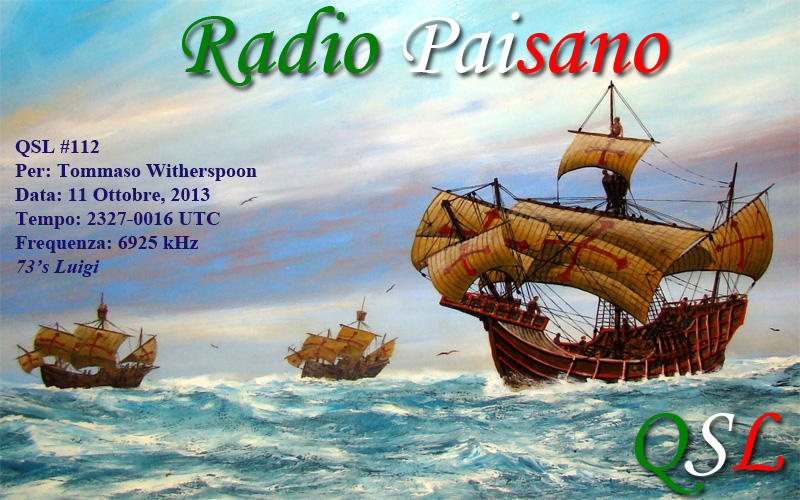
For your listening pleasure: fifty minutes of the pirate radio station, Radio Paisano.

I recorded this broadcast on Oct 11, 2013, starting around 23:30 UTC, on 6,925 kHz AM. This was the first time I had heard Radio Paisano on the air, though they do seem to broadcast around the same weekend every year.

Click here to download the recording as an MP3, or simply listen via the embedded player below:

2013PaisanoQSL-Witherspoon112

Pirate Radio Recordings: Wolverine Radio

I decoded this Wolverine Radio SSTV QSL on the SSTV iOS App

I decoded this Wolverine Radio SSTV QSL with the SSTV iOS App–you can also decode this eQSL at the end of the recording

For your listening pleasure: 1 hour and 44 minutes of pirate radio station, Wolverine Radio–recorded Saturday, October 12, 2013 starting around 1:15 UTC.

Wolverine was broadcasting on 6.945 MHz in the upper side band. Typical of Wolverine, lots of music variety which spans the decades–staring in the 30s and 40s, ending with present day tunes–and no commentary other than station ID throughout.

Wolverine Radio typically has a blowtorch signal which makes for great audio fidelity, especially for an upper side band broadcast. This broadcast was no exception.

Click here to download the recording as an MP3 or simply listen via the embedded player below:

Shortwave Radio Recordings: The Mighty KBC

"Dad, that's The Mighty KBC! Turn it up!"

“Dad, that’s The Mighty KBC! Turn it up!”

Sunday at 00:00-02:00 UTC, I tuned to 7,375 kHz to listen to The Mighty KBC. This was the first time I tuned to their winter frequency this season and wasn’t sure how strong their signal would be on a relatively noisy night on the bands.

KBC’s signal was blowtorch strength into North America. It could have been easily received on even the most simple of portable radios.

As we’ve come to expect, the Mighty KBC’s Giant Jukebox of music has a lot of rock-n-roll and Euro-pop variety, spanning the decades; DJ, “Uncle Eric” knows how to entertain and spin the tunes! Uncle Eric includes Kim Elliott’s digital text modes in this broadcast–if you missed the live broadcast, you can even decode the messages from the recording below.

Click here to download the recording as an MP3, or simply listen via the embedded player below. Enjoy:

Shortwave Radio Recordings: Radio Australia

CRI-bandwidthLike most Friday mornings, yesterday at 11:00 UTC, I tuned to 9,580 kHz to listen to Radio Australia news and ABC National’s technology program Download This Show.

While the signal out of Shepparton, Australia was as strong as ever, I heard adjacent interference from China Radio International.

Indeed, looking my WinRadio Excalibur‘s spectrum display (see image on right), you can see that CRI’s signal on 9,570 kHz was actually producing noise 15 kHz on either side of their AM carrier (for a total bandwidth of 30 kHz!). Radio Australia’s signal was much cleaner, sticking to their allotted 10 kHz bandwidth limit.

The recording of Radio Australia was still quite good, despite the interference, because I was able to run the Excalibur’s AM sync detector locked on the (less noisy) upper side band.

Click here to download the recording as an MP3, or simply listen via the embedded player below:

Shortwave Radio Recordings: Radio Exterior de España

Plaza de Cibeles--MAdrid, Spain (Photo: Wikimedia Commons)

Plaza de Cibeles–MAdrid, Spain (Photo: Wikimedia Commons)

For your listening pleasure: one hour, fifty minutes of Radio Exterior de España.

Recorded on September 16, 2013, starting at 00:00 UTC on 9,535 kHz.

Click here to download the recording as an MP3, or simply listen via the embedded player below:

Shortwave Radio Recordings: Worldwide All-Ireland GAA finals via RTÉ

22 September 2002; A general view of Croke Park at 3.29pm, a minute before the start of the game. Kerry v Armagh, All Ireland Football Final, Croke Park, Dublin. Picture credit; Brendan Moran / SPORTSFILE

22 September 2002; A general view of Croke Park at 3.29pm, a minute before the start of the game. Kerry v Armagh, All Ireland Football Final, Croke Park, Dublin. (Photo credit; Brendan Moran / SPORTSFILE)

Sunday afternoon, I was at home to catch a bit of the GAA finals via RTÉ on 17,725 kHz, starting around 15:00 UTC.

I enjoy hearing sporting events broadcast over shortwave–perhaps it’s my imagination filling in the gaps from the live coverage or the washy sound of the crowds roaring.  Regardless, RTÉ has a long-standing track record of broadcasting the GAA finals on every medium possible.

As I listened to the live broadcast, Sunday, I read Norman Freeman’s account of listening to the GAA finals from a ship in the Indian Ocean, back in 1956. He writes:

“Almost 50 years ago, listening to the All-Ireland by radio was uncertain and frustrating.

In 1956, RTÉ knew how much the All-Ireland meant to the Irish diaspora. Arrangements were made with the authorities in the then French Congo to have the match rebroadcast the following evening, on the powerful short-wave transmitter in Brazzaville.

The time and frequencies were published in the Irish newspapers. This information was sent by letter to the Irish on oil rigs off the coast of Borneo, to round-the-year painters on Brooklyn Bridge, and to missionaries within sight of Mount Kilimanjaro.

I had noted the time and frequencies before I was sent out to Mumbai to join my first ship, the Amra, as second radio officer. The hurling final was between two giants, Cork and Wexford.”
[Continue reading…]

While Freeman doesn’t miss the uncertainty and fickle nature of shortwave radio as the messenger of his favorite sporting event, his look back is certainly nostalgic. After all, Radio Brazzaville transported Freeman and his boss back to Ireland for the length of the game. And to RTÉ’s credit, they continue to broadcast to the Irish diaspora on shortwave radio, if only for this event. 

If you would like to hear my recording of the GAA Finals, click here to download the MP3 recording, or simply listen via the embedded player below: