Shortwave listening and everything radio including reviews, broadcasting, ham radio, field operation, DXing, maker kits, travel, emergency gear, events, and more
Many thanks to SWLing Post contributor, Carlos Latuff, who shares the following video/recording and notes:
Hey Thomas, [Check out] how well the USCG signal arrives from Chesapeak in Porto Alegre, Brazil. It’s a NOAA Pacific NE forecast.
I made this video at 06h36 (09h36 UTC):
[Here is an audio ifile so you can get an idea of the quality of the reception:
That is amazing reception in Brazil, Carlos! Thank you for sharing this! I must say, you really give your XHDATA D-808 a workout! It’s a proper little DX machine!
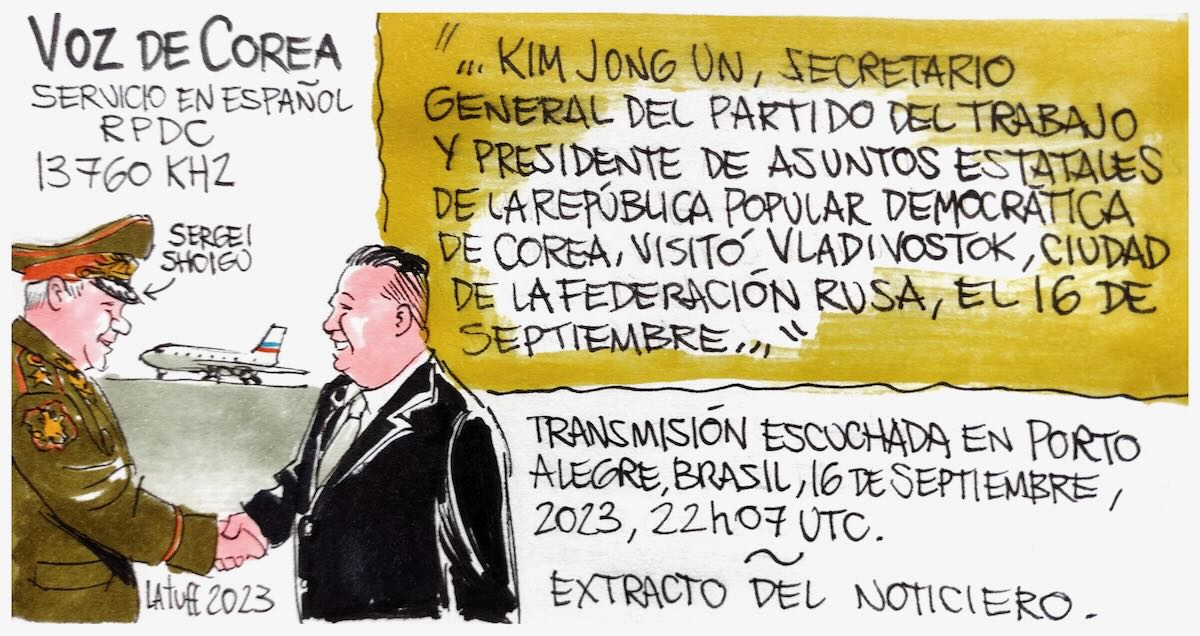
Many thanks to SWLing Post contributor and noted political cartoonist, Carlos Latuff, who shares his radio log art of a recent Voice of Korea broadcast.
Carlos notes:
Excerpt from the Spanish-language news broadcast by Voice of Korea (DPRK) on Kim Jong Un’s historic visit to Russia. Broadcast on 13760 kHz shortwave and listened in Porto Alegre, Brazil.
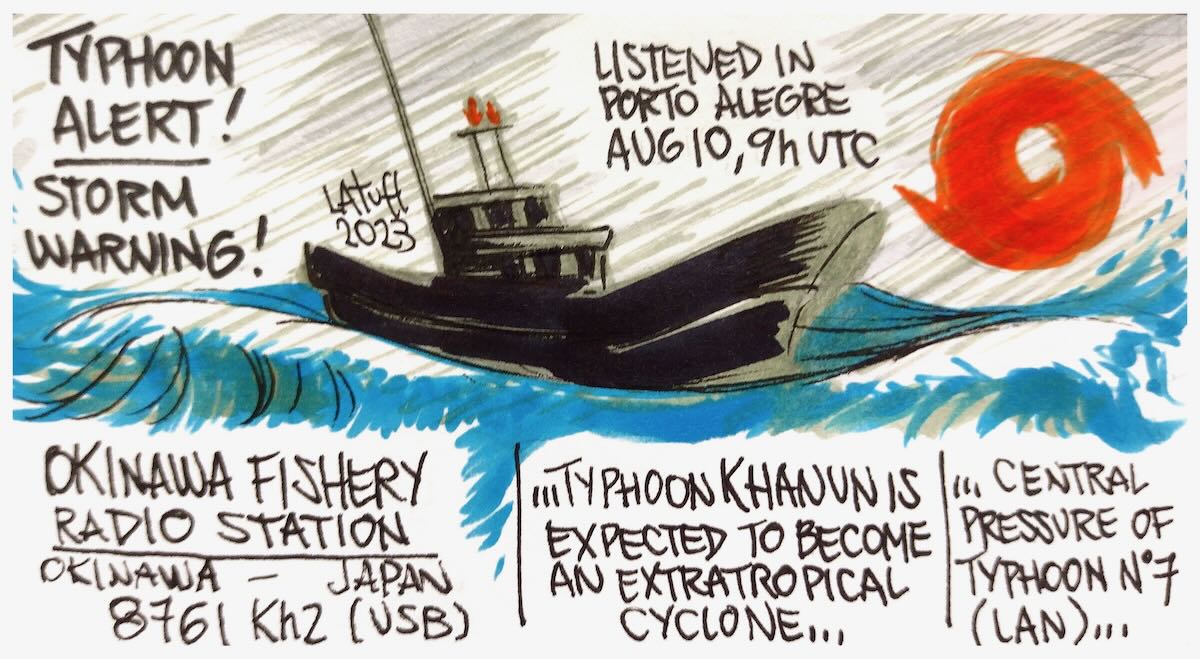
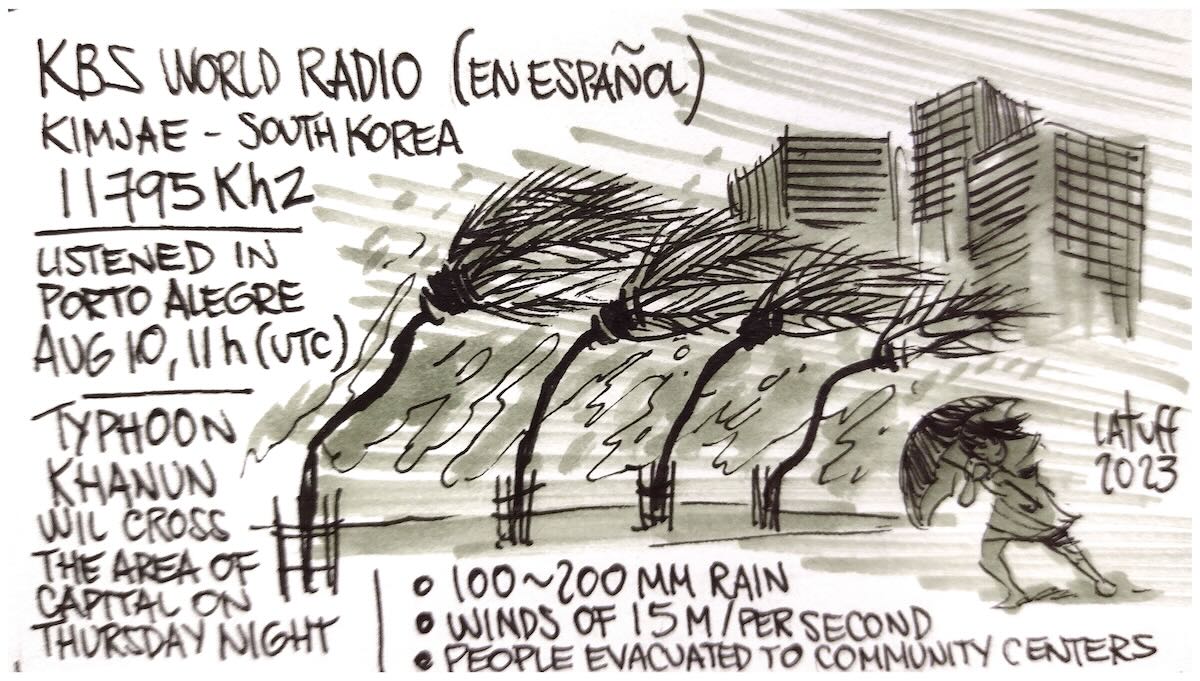
Many thanks to SWLing Post contributor and noted political cartoonist, Carlos Latuff, who shares his radio log art from two recent reports and a radiofax.
Good morning, Thomas.
My radio activity on August 10, 2023.
Attached are two illustrated listening reports about Typhoon Khanun: one from Okinawa Fishery radio station and the other from KBS World Radio.
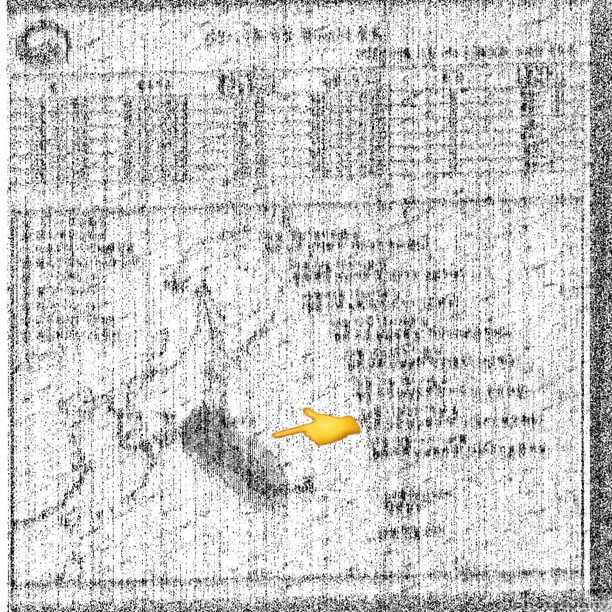
Also attached a typhoon warning issued yesterday by South Korean meteorology agency via radiofax at 05h00 UTC and received in Porto Alegre. Signal wasn’t good, therefore image arrived with poor quality. Even though, it’s possible to notice the map of Korea and the path of Typhoon Lan, now a tropical storm.
Thank you so much for documenting these broadcasts, Carlos, and sharing them with us in the SWLing Post community!
Many thanks to SWLing Post and SRAA contributor, Dan Greenall, who shares the following off-air shortwave radio recording and writes:
In all of the recordings of Radio Botswana’s famous barnyard interval signal I can find, the barnyard sounds are accompanied by the sound of cowbells. There is usually a rooster crowing and cows mooing too.
Today, while revisiting some raw tape from an old cassette dated 1973, I came across a short [off-air] recording of some similar barnyard sounds, chickens clucking and cows mooing. No sign of the cow bells here, but perhaps they started up farther into the interval signal?
If this recording is from Radio Botswana, perhaps they were only using the animal sounds in 1973? Maybe someone out there can help with this? Sorry but I have no other info. Many thanks!
Dan Greenall
London, Ontario Canada
Thanks for sharing this, Dan.
If you can shed some light on this recording and if Radio Botswana’s interval signal has changed over the years, please comment with details! Thank you!
Many thanks to SWLing Post contributor, Carlos Latuff, who shares the following FM radio recordings made while flying over northwest Africa. Carlos writes:
Flying over Northwest Africa towards Paris yesterday I managed to listen and record FM stations from countries like Senegal, Mauritania, Morocco and Spain, at an altitude of 10668 meters, using the native FM radio of my cell phone. Interesting thing is that it was only possible when I got close to the plane emergency exit. Back to my seat I wasn’t able to listen.
94.3 FM, Senegal, May 11, 2023:
95.0 FM, SNRT Amz Morocco, May 11, 2023:
101.7 FM, Spain, May 11, 2023:
91.0 FM, Mauritania, May 11, 2023:
Thank you for sharing this, Carlos. Impressive reception from your cell phone’s FM receiver!
Many thanks to SWLing Post contributor, Pete Jernakoff, who writes:
Last Saturday evening, I was cruising through the SW bands and came across music and talk on 2640 kHz, a rather odd (I would think) frequency on which to find such a broadcast format.
The music was of the soft pop variety (for example “Vou de Taxi” by Angelica; “A Time For Us – Love Theme from Romeo and Juliet” by Jack Jones; “A Lua E Eu” by Cassiano), and it sounded to my ears that the on-air talent (male) was speaking (between songs) either in Portuguese or in a Brazilian dialect of said language.
I have attached an audio clip of this broadcast [see below] which begins at 0158 UTC (on 26-March-2023). The recording is a little over 13-minutes long and ends when the signal abruptly leaves the air.
Note that there is a seeming mention in the recording of the words ‘Brazil’ and ‘Brasilia’ at the 4:40 and 5:03 time points, respectively. I have no clue where this signal originated, and I’m hoping that you or one of your many readers might be able to help ID this one. As far as I’m aware, there is no station that broadcasts on this frequency at least with this kind of programming. The signal seemed too strong to be a harmonic of a station broadcasting on, say, 1320 kHz. Perhaps a pirate? A mystery to me…
Thanks for sharing this recording, Pete!
If you can help Pete ID this mystery recording, please comment!