Tag Archives: Shortwave Radio

Reader Chris shares travel recordings: Voice of Mongolia, Korea

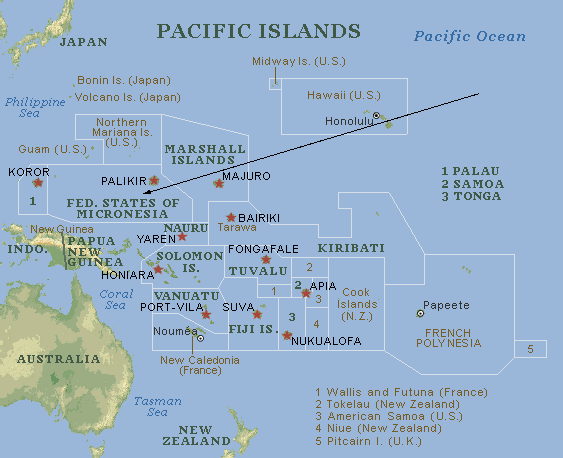
Map pointing to Truk Lagoon (Source: truk-lagoon.com)

Map pointing to Truk Lagoon (Source: truk-lagoon.com)

SWLing Post reader, Chris Johnson, recently sent me a message confessing his love of travel combined with shortwave radio listening. When he told me about his enviable plans to travel to the tiny islands of Truk Lagoon in the Federated States of Micronesia–and to record some of the broadcasts he heard–I asked if he would allow me to share his recordings on the Post. Fortunately for us, he agreed!

Below are two of his recordings, the first from the Voice of Mongolia, the second from the Voice of Korea. Both happen to be very difficult stations to catch here in eastern North America. His comments follow each recording:

Voice of Mongolia Shortwave Broadcast to Asia and Europe. Using a Sony ICF-SW7600G with a whip antenna. Recorded on 29 January 2013 at 1030z on 12085 khz from the Blue Lagoon Resort, Truk Lagoon, Federated States of Micronesia. The broadcast interval signal begins at 1:35

Voice of Korea; Recorded on a Sony ICF-SW7600G using a whip antenna. 7 February 2013 on 15100 khz at 0500z Location; Puka Beach, Boracay Island, Philippines. The program was scheduled for 60 minutes but due to the frequent power outages in the DPRK, the program ceased at approximately 52 minutes.

Thanks, Chris!

Media Institute of Southern Africa reacts to Zimbabwe shortwave receiver ban

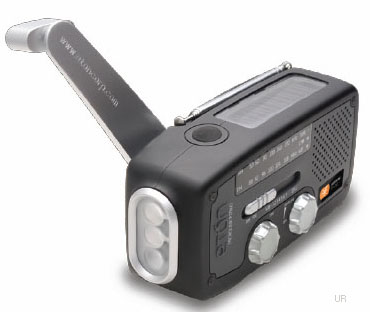
The shortwave version of the Eton Microlink FR160 is one of the noted "

The shortwave Eton Microlink FR160 is one of the noted “specially-designed radios” capable of receiving international broadcasts (like those from the Voice of America) which might compete with state-owned stations.

International broadcasters (and those cutting their budgets) should ask themselves the following question:

If shortwave radio is no longer relevant in today’s high-tech world, why are these radios suddenly being banned in a country controlled by a repressive regime?

The government of Zimbabwe apparently fears the little self-powered shortwave radio you see on the right.  —>

Read the Media Institute of Southern Africa’s reaction to the radio ban in the Huffington Post:

(Source: Huffington Post)

Media freedom campaigners said Friday police in Zimbabwe are breaking the law by seizing and banning small radio receivers that can tune in to stations not linked to the state broadcasting monopoly controlled by President Robert Mugabe’s party.

The Media Institute of Southern Africa said Friday no regulations outlaw the hand-cranked, solar powered radios that democracy and election support groups plan to use ahead of a referendum on a new constitution next month and crucial elections later in the year. Police insist the radios and cheap Chinese 3G smartphones with GPS capability are being supplied by “subversive organizations” and pose a security threat surrounding the polling.

[…]”The importance of a radio set cannot be overemphasized as it is a generally affordable legal gadget used for receiving information by the public,” the group said.

Police efforts to “criminalize the distribution and possession of the radio sets” infringed citizens constitutional rights to freedom of expression and basic civil liberties,” it said.

Such radios and other equipment were seized in recent police raids on the Zimbabwe Peace Project, a human rights group that monitors political violence, and the independent Zimbabwe Election Support Network.

Police allege those and other groups were planning to mobilize “recruits” with unauthorized communications devices in rural districts across the country, traditionally voting strongholds of Mugabe’s party.

The Elton [Eton, actually] Microlink radio, at a cost of about $30, has channels able to receive Voice of America broadcasts beamed in from neighboring Botswana and shortwave broadcasts on Zimbabwe from Europe.

The state Zimbabwe Broadcasting Corp. has four radio stations fiercely loyal to Mugabe. State and independent newspapers are not commonly found in impoverished rural districts where communities rely for information on radios only receiving state radio and powered by batteries that are often in short supply.

Police warned this week that the activities of some Western-backed non-governmental organizations and rights groups now verged on espionage. People found in remote areas with the cited devices could face arrest.

They said the “specially designed radios are not compatible with state-owned radio stations” and could inflame election tensions by promoting hate speech.[…]

Read the full article here…

Radio Australia’s Jazz Notes

Jazz Notes presenter, Ivan Lloyd (Photo: Radio Australia)

Jazz Notes presenter, Ivan Lloyd (Photo: Radio Australia)

One Radio Australia music program I make a point of listening to each week– besides Saturday Night Country–is a wonderful show called Jazz Notes.

Jazz Notes showcases the best in Australian jazz, often featuring new and original recordings made in ABC’s studios. The show is hosted by Ivan Lloyd and has been offered on Radio Australia for several years.  I listen to the show every Wednesday morning at 8:30 am EST.  If you’ve never heard of Jazz Notes, I can understand why, since it’s only a 30 minute show and begins at the half hour–but it’s certainly worth hearing.

Next week, make a point to tune your shortwave radio to 5940, 9580 or 11945 kHz on Wednesday at 13:30 UTC.  As you will hear in the following recording, listeners in North America will be most impressed by the strong signal out of Shepparton, Australia, on 9,580 kHz. Even an inexpensive portable receiver can pick up this robust broadcast.

Click here to download the full recording of Jazz Notes as an MP3, or simply listen via the embedded player below:

Steven Roberts cycled the US with a Sony ICF-2010

N4RVE working the world from BEHEMOTH, somewhere in Wisconsin. (Photo: Steven Roberts)

Steven (N4RVE) working the world from his bike BEHEMOTH, somewhere in Wisconsin. (Photo: S. Roberts)

One of the most fascinating responses I received after posting the story of my buddy Vlado’s incredible thrift store find (a Sony ICF-2010 for just $5) came from Steven Roberts, who told me that, in the 1980s, he cycled across the United States with the Sony ICF-2010 in tow.

Indeed, Steven carried much more than just the Sony on his memorable trip:  he had a custom designed computer (circa late 80s), a fully-functioning ham radio station, as well as all of his camping and living supplies, mounted on his custom-designed recumbent bike…Wow.

Talk about someone with vision!  I asked Steven if I could post this for SWLing Post readers, to which he replied:

Thanks! I have a pretty good summary of the whole crazy adventure at this link, and the bike is now in the Computer History Museum. Fast-Forward two decades, and I’m geeking-out a 44-foot steel sailboat (including a wrap-around rack console for audio, comms, and electronics lab). Here’s the bike: http://microship.com/resources/technomadic-tools.html

You’re most welcome, Steven–and many thanks, for the inspiring story! We look forward to hearing about your adventures on the water…

If you have a story you’d like to share, please contact me.

CommRadio is introducing the CR-1, a new tabletop shortwave receiver

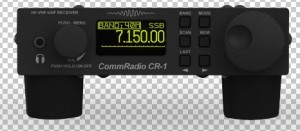
The CommRadio CR-1

The CommRadio CR-1

US-based CommRadio is introducing a new tabletop, SDR-based, shortwave receiver this year: the CR-1. Their website has a few specifications and the video I’ve embedded below.

The CR-1 receives the full medium wave and shortwave spectrum (.5-30 MHz), plus some portions of VHF and UHF (FM broadcast band, Aircraft, Marine, NOAA weather radio, GMRS and FRS services).

The receiver architecture is a dual conversion super-heterodyne design with low-IF , I-Q digital sampling, 16 bit DSP with digital audio CODEC.  Their website also mentions DSP algorithms for all demodulation: DSB-AM, SSB, CW, WBFM, NBFM and channel filtering.

Other impressive features:

  • Can be powered from USB or a 6-18 VDC power source (from a separate 2.1mm jack).  The CR-1 possibly has the most flexible power source I’ve ever seen in a shortwave receiver!
  • The knobs are black anodized machined aluminium and front panel is powder coated machined aluminium; case is 20 gauge powder coated steel
  • Three antenna inputs
    • BNC for HF/MW
    • 3.5 mm audio jack (rated at 1000 Ohm, for roll-up antennas or telescoping whip),
    • BNC for VHF and UHF
  • Very portable size!

Full specs are available on their website: commradio.com

We will also keep you posted with any future updates.

WRTH : B12 updates are now available for download

WRTH2013(Source: WRTH Editorial Team)

A few hours later than planned, the B12 broadcast schedules update file is now available from the WRTH Website: http://www.wrth.com (and follow the links) the file is in PDF format and requires Acrobat 6 or greater to open it. The file contains updates to the International and Clandestine/Target broadcast schedules published in WRTH2013. We hope you find this a useful accompaniment to the printed book.

Best wishes / 73 from WRTH Editorial team.