Tag Archives: Voice of America

Farewell, Firewall: Kim Elliott’s take on what the NDAA means for US international broadcasting

The Broadcasting Board of Governors (Photo BBG)

(Source: USC Center on Public Diplomacy)

Farewell, Firewall

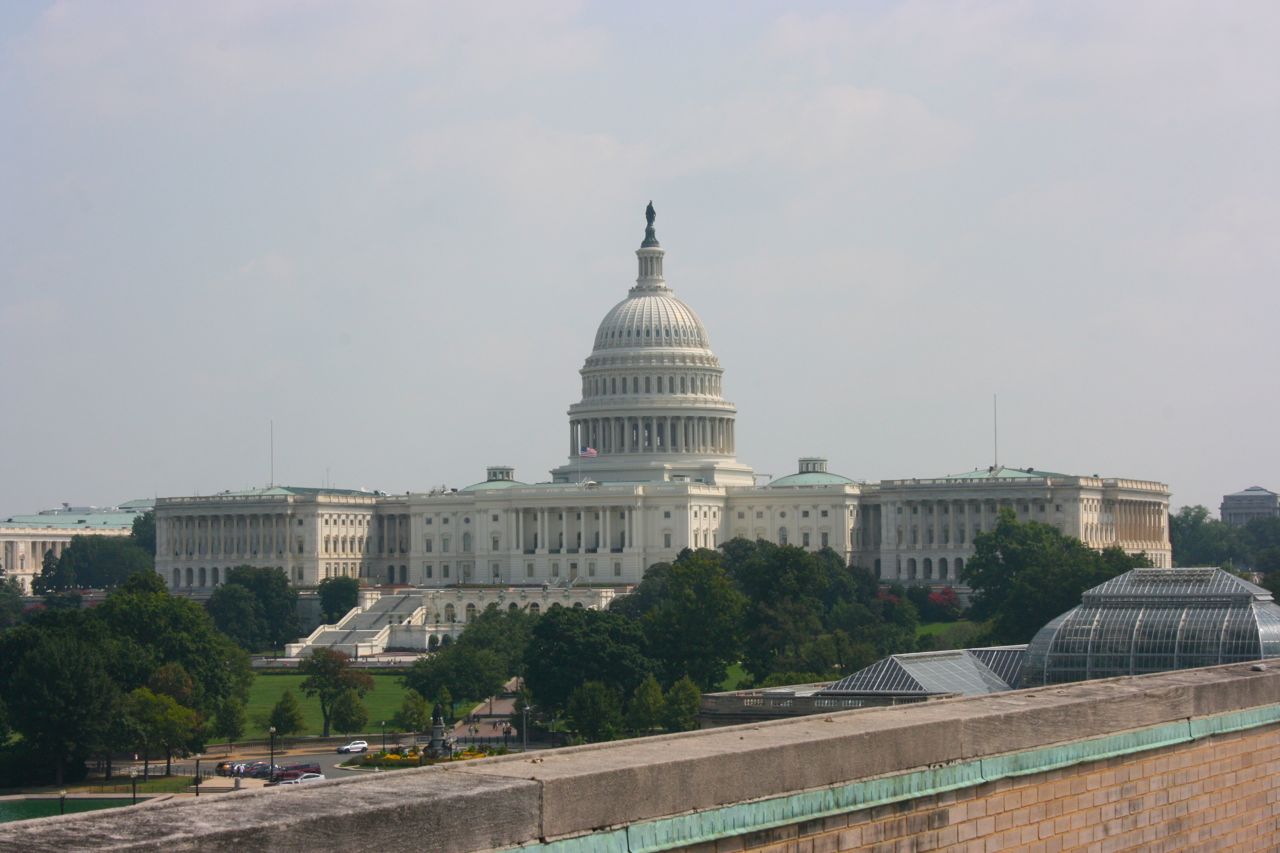
Deep in the massive FY2017 National Defense Authorization Act is a provision to eliminate, in its present form, the U.S. Broadcasting Board of Governors. The NDAA has been passed by the House and the Senate and is expected to be signed by President Obama. The BBG is the topmost authority of the elements of U.S. government-funded international broadcasting: Voice of America, Radio Free Europe/Radio Liberty, Radio Free Asia, Radio and TV Martí, and the Arabic-language Alhurra TV and Radio Sawa. Together they broadcast in 61 languages.

This BBG’s demise eliminates the “firewall” of a nine-person bipartisan board with fixed and staggered terms, and replaces it with one politically-appointed CEO. This change will have consequences.

Traditionally, people around the world huddled around a shortwave radio to get news from abroad. Increasingly, they watch an international news channel via cable or satellite television, or access a foreign website or social media outlet. Whatever the medium used, the need for a credible alternative to domestic state-controlled media is the main reason international broadcasting has had an audience since the 1930s.

Credibility is the essence of successful international broadcasting. The shortwave frequencies, satellite channels, and online media are full of propaganda, but serious news consumers seek out the news organizations that they trust.

International broadcasting in languages such as Burmese or Hausa has little commercial potential. National governments must step in to provide the funding. The foremost challenge is to ensure that the journalism is independent from the governments that hold the purse strings.

To achieve this, there is no substitute for a multipartisan governing board. Its main function is to appoint the senior managers of the broadcasting organization, so that politicians don’t. This is how “public service” broadcasting corporations throughout the world, e.g. BBC, Canadian Broadcasting Corporation, Australian Broadcasting Corporation, maintain their independence.

When a government is directly involved in the production of news, the results are generally deleterious. The outcome can be as extreme as the lies and distortions of German broadcasts before and during World War II. Or the output can be something like the stultifying commentaries that filled much of Radio Moscow’s schedule during the Cold War. And, as can be observed by watching Russia’s RT or China’s CCTV News on cable TV, propaganda can also be manifest by emphasizing some topics, while downplaying or ignoring others.[…]

Read Elliott’s full article on the USC Center on Public Diplomacy website…

Hurricane Matthew: VOA adds emergency shortwave coverage for Haiti

hurricanematthew

Many thanks to Mauno Ritola who notes the following news via the WRTH Facebook page:

VOA emergency shortwave coverage for Haiti in Creole & English has started as follows via Greenville [North Carolina]:

  • 2200-0200 7305 kHz
  • 0200-1200 7405 kHz
  • 1200-1630 9565 kHz

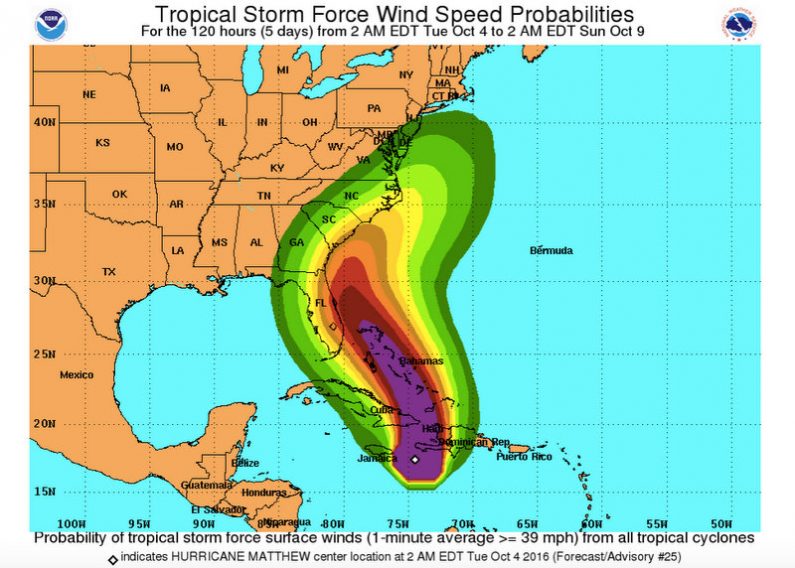
Last night, I looked at the projected path of Hurricane Matthew. Sadly, Haiti and parts of Cuba will receive the brunt of Matthew’s energy in the Caribbean.

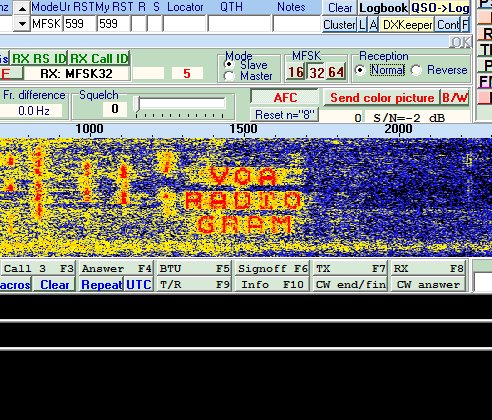
There’s a pattern in that noise!

Digital-Image-VOA-Radiogram

Many thanks to SWLing Post contributor, @K7al_L3afta, who just shared the image (above) and noted, on Twitter:

“I just discovered the noise at the start of [the VOA Radiogram has] a purpose!” 

That’s a brilliant discovery!

Click here to learn about the VOA Radiogram.

Click here to follow @K7al_L3afta on Twitter.

New Shortwave Station in South Sudan

Radio-TamazujThere’s a new shortwave station in South Sudan!
Kudos to Eye Media for their Shortwave Radio efforts in South Sudan to complement and extend their reach beyond local FM radio. And I must add, kudos to the United States for their part in helping to fund the venture. While I am quick to criticize my country for their cutbacks in SW funding, I have to be fair and say “well done” when something like this comes along. Here is the news report as posted April 26 (yesterday) on Radio Tamazuj and which was reported by Alokesh Gupta New Delhi on the Cumbre-DX  Yahoo Group:

Eye Media, the parent organization of Eye Radio, has announced that it has launched a new shortwave broadcast service to complement its existing FM broadcasts in South Sudan.

The broadcasts starting today will bring listeners news and information in Arabic, as well as Dinka, Nuer, Shilluk, Bari, Zande and Lutoho.

According to a press release today from Eye Media, “the Eye Radio Shortwave will cover the whole of South Sudan including remote areas in which communities are not able to access FM radio stations.”

Eye Radio is one of the fastest expanding media houses in South Sudan after launching FM repeaters in several state capitals last year, expanding the station’s reach beyond Juba where it is based.

In its press release, the station noted that the funding for this initiative came from USAID, the international development agency of the US government.

Shortwave radio is used for long distance communication by means of reflecting or refracting radio waves back to Earth from the ionosphere, allowing communication around the curve of the Earth. It was a popular means of long-distance news sharing before the advent of the Worldwide Web, and it is still used for reaching remote areas.

Only two other media houses broadcast on shortwave with content specifically for South Sudan: Radio Tamazuj, which operates two hours daily on the shortwave, and Voice of America, which produces the 30 minute program South Sudan in Focus.

Radio Tamazuj broadcasts from 6:30 to 7:30 each morning on 11650 kHz on the 25 meter band and 9600 kHz on the 31 meter band, and 15150 kHz and 15550 kHz on the 19 meter band each evening from 17:30 to 18:30.

Eye Radio’s new broadcasts will run from 7:00 to 8:00 each morning on 11730 kHz on the 25 meter band and 17730 kHz on the 17 meter band from 19:00 to 20:00.


Robert Gulley, AK3Q, is the author of this post and a regular contributor to the SWLing Post. Robert also blogs at All Things Radio.

Video: Demolition company’s view of VOA Site A towers falling

Fullscreen capture 472016 113932 AM

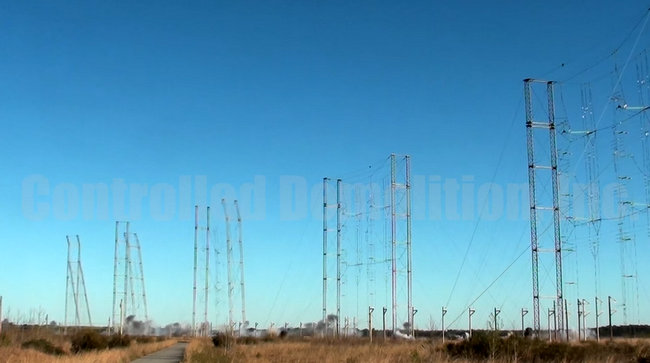
While it’s fascinating to watch the video footage of the VOA Site A towers falling, it’s also a little heartbreaking.

As I mentioned in a previous post, I spent time last week at the VOA Site A’s twin site: VOA Site B (now the Edward R. Murrow Transmitting Station).

While it’s a little tough for me to watch, imagine how difficult it is for the engineers who lovingly cared for these giant antennas for so many decades. Still, VOA Site A’s antennas needed to be demolished–they hadn’t been in operation since 2006 and would have soon become a hazard to anyone on the site.

It’s just tough to see these powerhouse curtain antennas collapse:

Click here to view on YouTube.

Post Readers: I’m hoping to have time this weekend to put together the photos I took last week and responses to your questions.

VOA Site A antennas and towers demolished

Fullscreen capture 442016 83022 PM

Helicopter view of the curtain antenna array falling.

On Friday, I spent the afternoon at the Edward R. Murrow Transmitting Station (a.k.a. VOA Site B) in Greenville, NC.

While there, I was told that the VOA Site A towers, which have long been abandoned, were slated to be demolished this morning. Here’s the report from local NBC TV station WITN:

(Source: WITN)

BEAUFORT COUNTY, NC (WITN) – A series of implosions is all it took to bring down 48 radio towers that have been a part of U.S. history for over 50 years.

It happened Monday morning at the old Voice of America Site A in Beaufort County.

Not used since 2006, the VOA site was sold to Beaufort County as surplus U.S. property.

Environmental Holdings Group of Morrisville teamed up with Controlled Demolition Incorporated to implode and haul off the 48 towers.

It took less than a minute for it all to come down.

Voice of America still broadcasts from Site B to Latin America, Cuba, the Caribbean, and Africa.

Click here to read the full article and watch the video at WITN.