Tag Archives: WRMI

VOA Radiogram “soft launch” this weekend

VOARadioGramKudos to VOA research analyst Dr. Kim Andrew Elliott for his remarkable innovation:  VOA Radiograms (i.e., digital text messages sent over shortwave broadcast radio), and for promoting this concept through the Voice of America. His persistance, with support from forward-thinking shortwave broadcasters like WBCQ, WRMI and The Mighty KBC, who have all broadcasted his digital messages, has paid off.  Classic technology meets current in this new communication mode which makes internet disruption absolutely irrelevant, and which is even impervious, to a great degree, to interference.

This weekend, the VOA Radiogram will become a reality:

(Source: VOA Radiogram)

VOA Radiogram will “soft launch” this weekend. Here is the transmission schedule (all days and times are UTC):

Saturday 1600-1630 17860 kHz

Sunday 0230-0300 5745 kHz (Saturday evening in North America)

Sunday 1300-1330 6095 kHz

Sunday 1930-2000 15670 kHz

All via the IBB Edward R Murrow Transmitting Station in North Carolina.

The digital text modes to be transmitted this weekend on VOA Radiogram are as follows. Each text transmission will be one minute, unless otherwise specified. Asterisk * denotes RSID: if your RxID is on, Fldigi will automatically switch to this mode and audio frequency. The other modes you can decode from your recording.

  1. BPSK31 on 2000 Hz*
  2. QPSK31 on 1000Hz, BPSK31* on 2000 Hz
  3. QPSK31 on 1000Hz*, PSK63F on 1500Hz, BPSK31 on 2000 Hz
  4. QPSK63 on 1000 Hz, PSKR125 on 1500 Hz*, BPSK63 on 2000 Hz
  5. QPSK125 on 1000Hz, PSKR250 on 1500 Hz*, BPSK63 on 2000 Hz
  6. QPSK250 on 800 Hz, PSKR500 on 1500Hz*, BPSK250 on 2200Hz
  7. QPSK500 on 800 Hz, PSKR1000 on 1500 Hz*, BPSK500 on 2200 Hz
  8. PSKR500 on 1000 Hz, PSK63F on 1500 Hz, PSKR125 on 2000 Hz, and PSKR250 on 2500 Hz* (5 min 40 secs).  The latter portions of the PSKR250 and 500 transmissions are formatted for Flmsg. (In Fldigi, Configure > Misc > NBEMS > under Reception of flmsg files, click Open with flmsg and Open in browser, and below that state the location of the flmsg.exe file.)
  9. MFSK32 image on 1500 Hz (54 seconds)

In future weeks, after the “hard launch” of VOA Radiogram, only one mode will be transmitted at one time. This will ensure the highest possible signal-to-noise ratio and the best possible chances for a successful decode.

See also how to decode the modes.

Send reports to radiogram(at)voanews.com

Follow @voaradiogram

Keep up-to-date with all future broadcasts, digital modes and methods for decoding on the VOA Radiogram website, and by following them on Twitter: @voaradiogram.

Wavescan focuses on Africa in 2013

AWRlogoFor those of you looking for an informative show on international broadcasting, shortwave radio and DXing, checkout Wavescan by AWR.

This year, I understand a lot of focus will be placed on radio and broadcasting to/in Africa. Wavescan’s full schedule follows Jeff White’s announcement below:

(Source: Jeff White, WRMI)

WAVESCAN this weekend:

The January 13 edition of Wavescan, which begins to air this weekend and throughout next week on WRMI, contains part 2 of the “100 Years of Wireless and Radio in Bulgaria” series, the Philippines DX Report with Henry Umadhay, and “Focus on Africa: Liberia.” Included is an interview with Allen Graham of HCJB in Ecuador, who is currently working in Liberia doing radio training and helping with a local university FM radio station. Allen talks about the importance of shortwave radio in West Africa.

Wavescan Scheduling: B12 Transmission Period

Radio Miami International

Radio Miami International

Sunday

0500 UTC via WRMI 9955 kHz – Radio Miami Int Miami Florida USA

1200 UTC via AWR 17535 kHz – Media Broadcast Wertachtal Germany

1500 UTC via WRMI 9955 kHz – Radio Miami Int Miami Florida USA

1530 UTC via AWR 15255 kHz – Sri Lanka Broad Corp Trincomalee Sri Lanka

1600 UTC via KSDA 11825 kHz – Adventist World Radio Agat Guam

1600 UTC via KSDA 15360 kHz – Adventist World Radio Agat Guam

1630 UTC via KSDA 11740 kHZ – Adventist World Radio Agat Guam

2230 UTC via KSDA 15320 kHZ – Adventist World Radio Agat Guam

Monday

1200 UTC via WRMI 9955 kHz – Radio Miami Int Miami Florida USA

Tuesday

0430 UTC via WRMI 9955 kHz – Radio Miami Int Miami Florida USA

Wednesday

0100 UTC via WRMI 9955 kHz – Radio Miami Int Miami Florida USA

1200 UTC via WRMI 9955 kHz – Radio Miami Int Miami Florida USA

2000 UTC via WINB 13570 kHz – World International Red Lion Pennsylvania USA

Thursday

400 UTC via WRMI 9955 kHz – Radio Miami Int Miami Florida USA

1430 UTC via WRMI 9955 kHz -Radio Miami Int Miami Florida USA

Friday

0415 UTC via WRMI 9955 kHz -Radio Miami Int Miami Florida USA

Saturday

0800 UTC via WRMI 9955 kHz -Radio Miami Int Miami Florida USA

1200 UTC via WRMI 9955  kHz -Radio Miami Int Miami Florida USA

1730 UTC via WWCR2 12160 kHz -Worldwide Christian Nashville Tennessee USA

2100 UTC via WRMI 9955 kHz -Radio Miami Int Miami Florida USA

2330 UTC via WRMI 9955 kHz -Radio Miami Int Miami Florida USA

…………..

iPod AWR

Internet Stream AWR.org WRMI.net WWCR.com WINB.com

Telephone Feed WINB at 1 415 655 0846

More shortwave digital text (and the reason behind it)

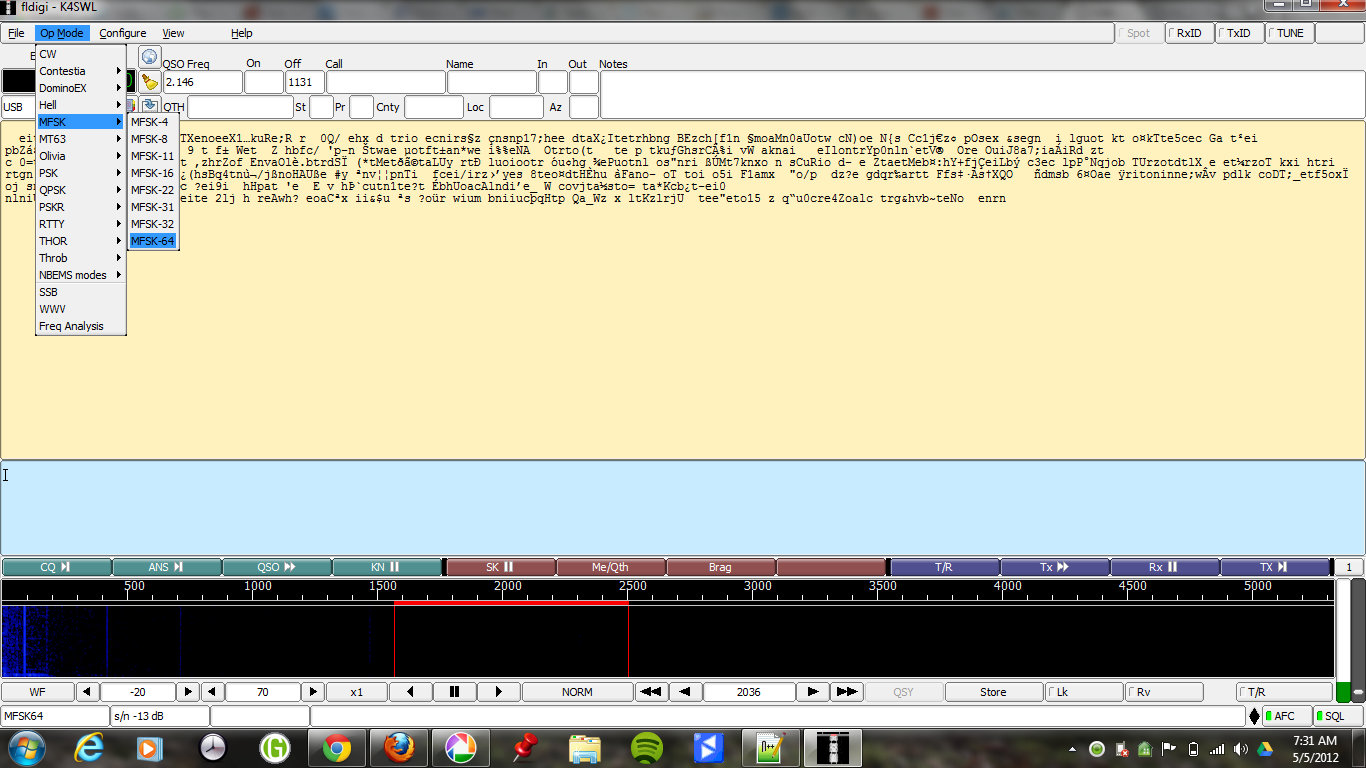
Screenshot of digital mode being selected in FLDIGI. Click image to enlarge.

SWLing Post readers have seen previous posts regarding text being broadcast via shortwave digital modes on WBCQ, WRMI and The Mighty KBC (which broadcasts again this weekend).

Recently, Kim Elliott explained his mission behind these digital tests. Not only do I agree, but I support him completely. Why? It’s proof that the shortwave spectrum is an excellent medium to transmit digital information across the globe. Decoding requires a very basic shortwave radio, some free software and a computer. I believe, in the near future, there will be a smart phone app that can handle this with ease–it simply needs a developer (hint, hint).

Here is Kim Elliott’s post on the topic–I have emphasized points in bold:

Radio amateurs use several modes to transmit text via shortwave. It occurred to me that text via shortwave might be a workaround whe[r]e the internet is not available because of disasters, dictators, or other causes.

I have not yet convinced any major international broadcasters to let me test this hypothesis on their (remaining) shortwave transmitters. However, the Netherlands-based Mighty KBC has kindly been allowing me two one-minute segments during their broadcast to North America at 0000 to 0200 UTC on 9450 kHz. This is via leased time on a transmitter in Bulgaria.

Reception of text via shortwave is possible on an inexpensive shortwave radio, even one without single sideband (SSB) capability. The audio is patched into a PC that does not have to be especially powerful. This involves a patch cord from the earphone jack of the radio to the microphone input of the PC. If there is no patch cord, placing the radio’s speaker near the built-in microphone of a laptop might work.

Software for decoding the text should be installed in the PC. There are several available to radio amateurs, including DM780, MixW, and MultiPSK. Especially popular these days is Fldigi. This is available from www.w1hkj.com. While you are there, please also download Flmsg, because it will be needed for this weekend’s test on KBC. [Note: This software is free and open source.]

This weekend’s test on KBC will feature the MT63 modes with long interleave. After Fldigi is installed, go to Configure > Modems > MT-63 > check 64-bit (long) interleave, 8-bit extended characters, and Allow manual tuning. Also, go to Configure > Misc > NBEMS > check Open with flmsg and Open in browser and, below that, indicate where your flmsg.exe file is located.

The first KBC text transmission will be around 0130 UTC Sunday (Saturday evening 8:30 pm EST). The MT63-1000 mode with long interleave will be centered at 1000 Hz on the waterfall visible on the software display. PSKR125 will be cenetered at 2200 Hz. Decode one while listening, and decode the other from your recording of the transmission.

The second text transmission will be just before 0200 UTC Sunday (9 pm Saturday EST). This will be MT63-2000 centered at 1500 Hz. This message will be formatted for Flmsg. If all goes well, the shortwave transmitter in Bulgaria will open a new window of Flmsg and then open a new window of your web browser with formatted content, in color no less.

One week after my first text transmissions (11 November) on KBC, Arnie Coro at Radio Havana Cuba began transmitting digital text modes on his Dxers Unlimited program (in English). He might do so again this weekend. The schedule for DXers Unlimited can be found at the World of Radio website (where all times and days are UTC, so those UT Monday transmissions are actually Sunday evening in North America).

More discussion of the concept of digital text via analog shortwave broadcast is in Kim’s December 2012 column (pdf) for the North American Shortwave Asociation.

Radio República: shortwave broadcasting 24/7 on a budget

In this Miami Herald Op Ed piece, Orlando Gutierrez-Boronat, the national secretary of the Cuban Democratic Directorate, defends his organization and their clandestine station, Radio Republica. It’s worth noting that in an effort to use their limited funds effectively, and to get their message into Cuba, they use shortwave radio as their medium of choice:

(Source: Miami Herald)

Radio República, the Directorate’s 24-hour, seven-day-a-week shortwave radio station, has provided a voice to Cuba’s resistance from the smallest provincial towns to the largest Havana neighborhoods. Its format has been strategically designed to enhance the natural self-defense mechanism of nonviolent struggle generated by Cuban society. Costing between $1.5 million to $2 million a year, Radio República’s budget accounts for over 50 percent of the Directorate’s annual funds from federal grants. These costs are far below the annual budgets of both public and commercial shortwave radio stations.

Likewise, it is undeniable that Directorio has made a vital contribution to the changing attitudes of the international community towards the Castro regime. The Cuban pro-democracy leadership has moved from international neglect to international recognition, winning prestigious awards like the European Parliament’s Sakharov Prize and nominations for the Nobel Peace Prize in the process.

[…]The truth is that the testimony of hundreds of civic resistance leaders throughout the island shows that Radio República has become an essential tool for social organization.

Read the full Op Ed article on the Miami Herald website.

Though they carry a different message, the choice in shortwave radio is the same for Charles Caudill and WCB.

WRMI/Radio Republica Special DX Test

Radio Miami International

(Source: Jeff White WRMI and Mike Terry, Cumbre DX)

Radio Miami International, in cooperation with our client Radio Republica, will be conducting a special DX test at 2000-2100 UTC January 7, 2300-2400 UTC January 7, and 0200-0300 UTC January 8, 2012 on the frequency of 5954 kHz from Cariari, Costa Rica. (These times are 3-4 pm, 6-7 pm and 9-10 pm Eastern Time Saturday, January 7 in North America.) The programming aired will be Radio Republica in Spanish. The power will be 10 kilowatts.

Shortwave listeners may be aware of the fact that Radio Republica has used this frequency in the past, but it has been off the air for several weeks now. Radio Miami International will verify all reception reports with a QSL card indicating the special tests. Reports may be sent to Radio Miami International, P.O. Box 526852,… Miami, Florida 33152 USA, or by e-mail to [email protected]. Thank you to the DXing community worldwide for monitoring these special tests and for letting us know if you are able to hear them in your area.

WRMI Radio Miami International
175 Fontainebleau Blvd., Suite 1N4
Miami, Florida 33172 USA
Tel +1-305-559-9764
Fax +1-305-559-8186

Radio Slovakia International to continue shortwave broadcasts to Caribbean and Latin America

(Source: Southgate Amateur Radio Club)

A last-minute agreement between Radio Slovakia International and Radio Miami International (WRMI) will permit the international radio station of Slovakia to continue its shortwave transmissions in English and Spanish to the Caribbean and Latin America.

Radio Slovakia International had announced that its shortwave broadcasts would end on 31 December 2010. However, WRMI will be broadcasting RSI’s programme in English at 0130-0200 UTC Tuesday-Saturday and RSI’s Spanish programme at 0330-0400 UTC seven days per week. Both of these transmissions will be on 9955 kHz with 50 kW of power from Miami using a beam of 160 degrees directed to the Caribbean and Latin America.

“We are glad to be able to help Radio Slovakia International continue its shortwave transmissions to this part of the world,” said WRMI General Manager Jeff White. He added that listener reports will be appreciated and will be verified with a special WRMI QSL card commemorating the Radio Slovakia International relay.

Reports may be sent to Radio Miami International, P.O. Box 526852, Miami, Florida 33152 USA, or by e-mail to [email protected].

War of the Worlds on your shortwave radio – October 30th

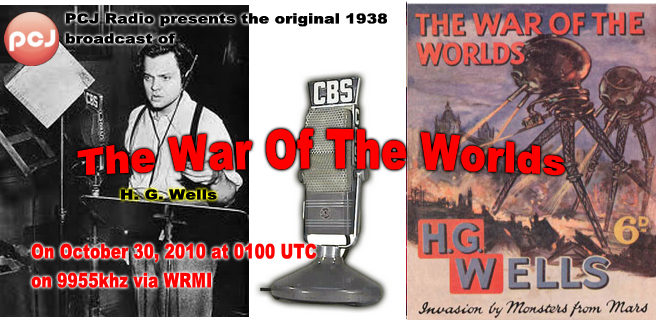
On October 30, 2010 at 0100UTC on 9955khz, PCJ Radio will present a special broadcast of HG Wells’ War Of The Worlds as it was originally broadcast on CBS Radio.

PCJ is also giving away 3 copies of this program. If you would like a chance to win one send them an email at: [email protected].

Links: