Tag Archives: WRMI

Radio World: International Broadcasters Reconsider Shortwave

Sackville-radio-towers-li

Check out this article from Radio World which addresses the state of shortwave radio broadcasting.

Jeff White of WRMI and Kim Elliott of the VOA are both interviewed. Elliott even speaks about the virtues of the VOA Radiogram experiments which have had success circumventing shortwave radio jamming (broadcasts which were completely omitted from the BBG Special Committee report on the efficacy of shortwave radio).

Click here to read the full article at Radio World.

Shortwave Shindig rebroadcast, April 18 and 19

ShindigLogoWhiteThis just in from David Goren at Shortwaveology:

Shortwave Shindig rebroadcast!

The show originally broadcast on 3/14 will be heard again on WRMI: Friday, April 18, at 6-7 pm ET (2200-2300 UTC) and Saturday, April 19 at 11 pm-12 midnight ET (0300-0400 UTC April 20) — both on 9955 kHz from Okeechobee.

Off air recording of the Shortwave Shindig?

ShindigLogoWhite

Are there any SWLing Post readers out there who could make an off air recording of the Shortwave Shindig broadcast tonight (22:00 EST, 02:00 UTC)? If so, please comment!  I would like to share your recordings on the Shortwave Radio Audio Archive.

Please note the type of radio used and what part of the world you live in. The more recordings, the merrier! Thank you!

The Shortwave Shindig goes live on shortwave Friday 3/14/14 from the 27th Annual Winter SWL Festival in Plymouth Meeting, PA. The Shindig signs on for one hour at 10 ET/0200 UTC on 7,570 khz via WRMI’s new Okeechobee facility. Please join us for a celebration of the art and culture of long distance listening.

Listen to the Shortwave Shindig live: Friday on WRMI 7,570 kHz

ShindigLogoWhite

If you can’t make it to the Winter SWL Fest this year, you can still listen to one hour of David Goren’s Shortwave Shindig via a live broadcast through WRMI. Here are the details:

The Shortwave Shindig goes live on shortwave Friday 3/14/14 from the 27th Annual Winter SWL Festival in Plymouth Meeting, PA. The Shindig signs on for one hour at 10 ET/0200 UTC on 7,570 khz via WRMI’s new Okeechobee facility. Please join us for a celebration of the art and culture of long distance listening.

Be sure to check out David Goren’s website: Shortwaveology.net

BBC News on the long-term survival of shortwave radio

BBC-World-Service-007Many thanks to SWLing Post reader, Alex, who shares this essential listening: an audio report aired at 17:45 GMT today by Lucy Burton of the BBC World Service.

In this report, Burton discusses the future (or lack thereof) of shortwave radio. Burton interviews staff at Radio Romania International and even Glenn Hauser. To listen, just click:

The report reminds me that shortwave radio is often viewed as only legacy technology, when, in fact, shortwave has many advantages over digital options and is as relevant as ever.

This photo was taken in South Sudan, after Ears To Our World distributed radios in this rural community for the fourth year running. This photo was taken prior to the outbreak of violence the country is currently enduring.  Can you imagine the power of information each radio can provide to its community?

This photo was taken in rural South Sudan, after Ears To Our World had distributed hundreds of radios via our partner Project Education South Sudan. This photo was taken prior to the recent outbreak of violence the country is currently enduring. Can you imagine the power of information just one radio can provide to a community during these turbulent times?

As I’ve mentioned before, Gareth Mitchell once interviewed me for the BBC World Service technology program Click. Mitchell’s interview focused specifically on my non-profit, Ears To Our World, which uses self-powered shortwave radios to further its mission. His description of our radios during his introduction was as insightful as it was humorous:BBC_Click

“…Portable battery powered devices that can stream audio in real time all via an intuitive touch interface.”

Aptly put.  Shortwave radio, after all, has several profound benefits over the Internet, the three most significant being: 1) radio has no regard for national borders, and crosses them effortlessly; 2) listeners retain anonymity (thus cannot be readily tracked nor penalized by repressive authorities); and 3) radio requires no apps nor subscriptions to work.  Nor even, for that matter, a power grid.  It’s “just” an inexpensive “battery powered device” that can bring listeners vital lifesaving information, and, well…the world.

In short, I continue to stand by what I reported to UNESCO last year:

This post joins our popular tag: Why Shortwave Radio?

Radio Slovakia International wishes to resume shortwave service

USA NASB logoMany thanks to SWLing Post reader, Dominik, who points us to the National Association of Shortwave Broadcasters’ latest newsletter, which mentions Radio Slovakia International’s intentions to, once again, broadcast on shortwave from Slovakia.

“The NASB organized the B13 Conference in cooperation with Radio and Television Slovakia (RTVS) and its international service, Radio Slovakia International (RSI). RSI stopped broadcasting on shortwave from Slovakia at the end of 2010, but NASB member WRMI in Miami has continued to relay the station’s English and Spanish broadcasts to the Americas since January of 2011. And RSI would like to resume shortwave broadcasts from Slovakia in the near future if funding can be restored.”

The NASB newsletter summarizes the full B13 HFCC Conference.  The following is an excerpt from the NASB Newsletter newsletter, featuring Maria Mikusova, Chief of Radio Slovakia International:

[…]Tuesday morning, August 27, the HFCC Conference began with some words of welcome from Maria Mikusova, Chief of Radio Slovakia International. “As the General Director of Radio and Television Slovakia pointed out yesterday,” she said, “the fact that this conference is taking place in Bratislava is a great inspiration and impulse for us. It broadens the horizons of us — journalists and professionals from the foreign broadcast of Radio Slovakia International, on behalf of whom I’d like to welcome you to Bratislava as well.”

Mrs. Mikusova noted that RSI has received feedback from listeners in 130 countries. “The core of this feedback,” she said, “comes from broadcasting our programs via short waves. We left shortwave broadcasting only recently, at the beginning of the year 2011, and not fully.” She noted that RSI remains on shortwave via WRMI in the Americas.

Mrs. Mikusova said that RSI is busy developing a new website. “In regards to the variety of languages we broadcast in, you can listen to RSI in six languages, which is the same number as Radio Prague, our Czech colleagues and closest partners, broadcast in. This says a lot about the power of tradition and our efforts and ability to preserve this kind of a broadcast at a time of such a vast choice of communication channels opening on the internet and social networks.”

Mikusova said that RSI still receives good listener feedback from areas such as Russia, and the station still sends QSL cards to listeners. “We consider this to be a very important form of communicating with our listeners, although we know that QSLs are traditionally a shortwave communication.”

“Let me wish all the best to this coordination meeting,” she continued. “Your conference allows us to get to know better your work, and makes us feel that we are still part of the world network of shortwavers. For us, this conference is a firsthand, live encounter with the shortwave network and its significance for broadcasting. But at the same time it unveils what strategies of radio broadcasting and shortwave transmission are out there in the modern world. After all, the outlook and future strategy of Radio and Television of Slovakia is to bring RSI back to shortwave broadcasting. Although this issue has not been resolved yet, it shows just how important the HFCC Conference in Bratislava is, and why we, RSI, are so very interested in it.”

Dominik also pointed to the HFCC schedule where RSI already has a slate of broadcasts listed from the RSI Rimavska Sobota transmitter site:
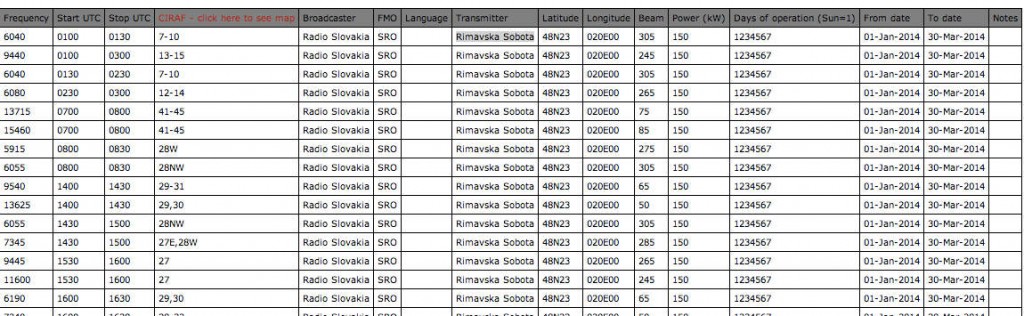
HFCC-Clip-RSI

Again, thanks to Dominik for sharing this hopeful news!

WRMI purchases WYFR transmission site and plans move to Okeechobee

Radio Miami International

Radio Miami International

Several of you wrote to share this great news from Jeff White at WRMI; many thanks to Michael, Pete, Bob and Keith for the tip:

(Source: Jeff White)

Legendary shortwave station WYFR in Okeechobee, Florida, which ceased transmissions on June 30, 2013, will resume broadcasting in December as a result of an agreement between Family Stations, Inc, and Radio Miami International, Inc.

According to the agreement, Family Radio will sell the WYFR facility to Radio Miami International. Family Radio programming for the Caribbean and South America will return to shortwave via the Okeechobee site, and Radio Miami’s programming currently aired on WRMI in Miami will switch over to the Okeechobee facility. The station will also carry programs for other international broadcasters, including Pan American Broadcasting’s Radio Africa network. A target date of December 1, 2013 has been set for the resumption of broadcasts. The current WRMI transmission site in Miami will be closed, and the WRMI call letters will be transferred to Okeechobee.

“We are very grateful to Family Radio for entrusting us with this magnificent station,” said Jeff White, WRMI General Manager. “WYFR is an important part of the heritage of shortwave broadcasting, and we are very happy that it will continue to serve shortwave listeners around the world.” The station first went on the air from Okeechobee in 1977, although the origins of the station and its predecessors go back to 1927. WYFR/WRMI is the largest shortwave station in the United States in number of transmitters and antennas. The facility is comprised of 13 transmitters — twelve 100-kilowatt and one 50-kilowatt — and 23 antennas beamed to all of the Americas, Europe and Africa.

White, who is also Secretary-Treasurer of the National Association of Shortwave Broadcasters (NASB), said that “many people made this transition a reality, not the least of whom was our former Secretary-Treasurer and current board member, Dan Elyea, who had been the WYFR Station Manager from the time it was built in the late 1970’s until his recent retirement. Dan presented us to Family Radio Vice President Tom Evans. Tom and the Family Radio Board have given us their confidence, and we will do our best to keep this station going for many years to come.”

(From Jeff White, WRMI, Nov 5 2013)