Yearly Archives: 2011

Heathkit is back in business

Great news for kit builders! Legendary company Heathkit has started manufacturing kits again. Though their first line-up of products do not include radios, they are planning to cater to the amateur radio community as soon as next year.

I would like to believe that the popularity of the Maker community has given Heathkit the ability to re-enter the growing kit building market (it has certainly given Radio Shack reason to continue carrying components).

Here is an announcement from Heathkit’s website:

Thank you for your overwhelming response to our announcement that Heathkit is back into the Do-it-Yourself kits business. We received many great suggestions for kits you would like to build.

We will be releasing Garage Parking Assistant kit (GPA-100) in late September and soon after the Wireless Swimming Pool Monitor kit will be available.

Based on your input, we are looking at developing amateur radio kits. Our goal is to have kits available by the end of year.

Please keep your suggestions coming so that we can continue to bring you interesting, unique Heathkit products.

Now is the time to let Heathkit know you that you want shortwave and amateur radio kits!

You can contact Heathkit at the following address:

Heathkit
2024 Hawthorne Avenue
St. Joseph, MI. 49085
(269) 925-6000 : Phone
(800) 253-0570 : Toll-free
(269) 925-2898 : Fax
[email protected]

Listen to asteroid echos November 8th-9th

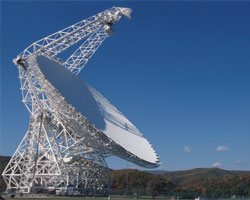
The massive Green Bank Telescope will be listening for CW tuned to put the asteroid's echo at a constant 2380 MHz (Photo Source: NRAO / AUI / NSF)

The excellent Southgate ARC has posted information on receiving signals that the Arecibo Observatory, the Deep Space Network Goldstone facility, the Green Bank Telescope and the Very Long Baseline Array will be bouncing off of the near-Earth asteroid 2005 YU55.

The asteroid will be making a 0.85 lunar distance flyby of Earth on November 8.

While the listening frequencies are well above the HF (shortwave) spectrum, many of you may have wide-band receivers or ham radio equipment that could tune in the signals. So, apologies for this slightly off-topic post. The amateur radio astronomer in me couldn’t help but promote this rather cool and unique opportunity.

From Southgate ARC:

Because YU55 will be so close to Earth, its radar echo will be detectable with even small antennas (~1 m^2). YU55’s echo will be a slowly drifting signal with a bandwidth of ~1 Hz within a few kHz of 2380 MHz or 8560 MHz.

[…]On November 8, 2011, 19:15 – 19:30 UTC, Arecibo will be transmitting a continuous wave tuned to put the asteroid’s echo at a constant 2380.000000 MHz at the Green Bank Telescope. Observers elsewhere on Earth will see the echo within 2 kHz of 2380 MHz, Doppler-shifted by the Earth’s rotation. It will be slowly drifting in frequency and have a bandwidth of ~0.6 Hz.

On November 9, 2011, 01:30 – 02:00 UTC, the Goldstone Deep Space Network facility will be be transmitting a continuous wave tuned to put the asteroid’s echo a constant 8560.000000 MHz at a second antenna at the Goldstone site. Other observers may see the echo shifted by as much as 6 kHz, and it will have a bandwidth of ~2 Hz.

Read the full article on the Southgate ARC website.

The Mighty KBC will begin broadcasts on shortwave 30 October 2011

(Source: Media Network)

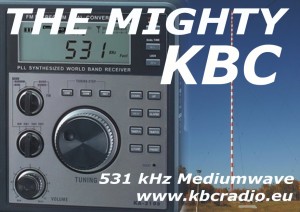
Dutch-based KBC Radio has published the following information: “The Mighty KBC will start broadcasting on shortwave on 30-10-2011 Saturday and Sunday between 11.00 – 16.00 UTC. There is a good chance that we will use our new frequency during weekdays as well in the future. Within a few weeks we will announce our new frequency.”

We will post the KBC schedule when it becomes available. KBC is currently testing on 513 MHz for all of you MW DXers.

QSL info:

[email protected]

or write to

The Mighty KBC
Argonstraat 6
6718 WT Ede
The Netherlands


BBC World Service launches new famine aid broadcasts

(Source: journalism.co.uk)

The BBC World Service has launched special radio broadcasts on its Somalia service aimed at helping those affected by the famine in the Horn of Africa.

According to a release, the daily 15 minute programmes, called Gurmad (Rescue), feature news bulletins offering practical information and expert advice “to help people to make informed decisions that may help them survive the famine”.

The editor of BBC Somali, Yusuf Garaad Omar, said while the broadcaster has been covering the humanitarian crisis its reporters have been “overwhelmed” with questions on relief aid.

“So we decided to devote a special programme to address these issues, and as a majority of those affected are Somali-speakers, it was also obvious that BBC Somali is the right channel to reach these people.

“We hope that timely, up-to-date information, provided by experts, about issues these people are facing every day, will help them survive this crisis. We will do our best to maintain the supply of such knowledge to all those who are in need of it.”

Click here to read the full article at Journalism.co.uk.

It pleases me to no end to know that someone at the BBC World Service acknowledges that shortwave radio is still the most effective way to reach those who live in the most rural and impoverished parts of our globe.

NPR: Voice Of America’s Role In Internet Age

(Source: NPR)

Host Scott Simon speaks with David Ensor, who took over directorship of Voice of America last month. A longtime journalist for NPR, CNN and ABC News, his most recent post was in Afghanistan, where he was director for communications and public diplomacy at the U.S. Embassy in Kabul.

Click here to listen to full story on NPR’s website.