Shortwave listening and everything radio including reviews, broadcasting, ham radio, field operation, DXing, maker kits, travel, emergency gear, events, and more
Many thanks to SWLing Post contributor, Dan Robinson, who writes:
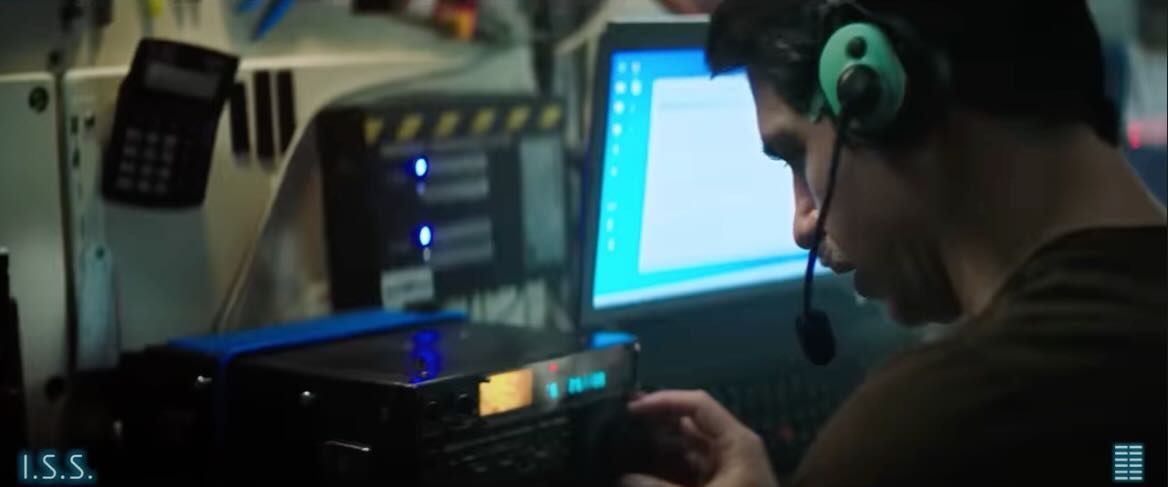
An ICOM transceiver features in the new movie I.S.S. A film from the space disaster genre about U.S. and Russian astronauts and cosmonauts on the space station when nuclear war breaks out down on Earth. See if you can ID the radio, which flashes by quite quickly in the trailer for the movie:
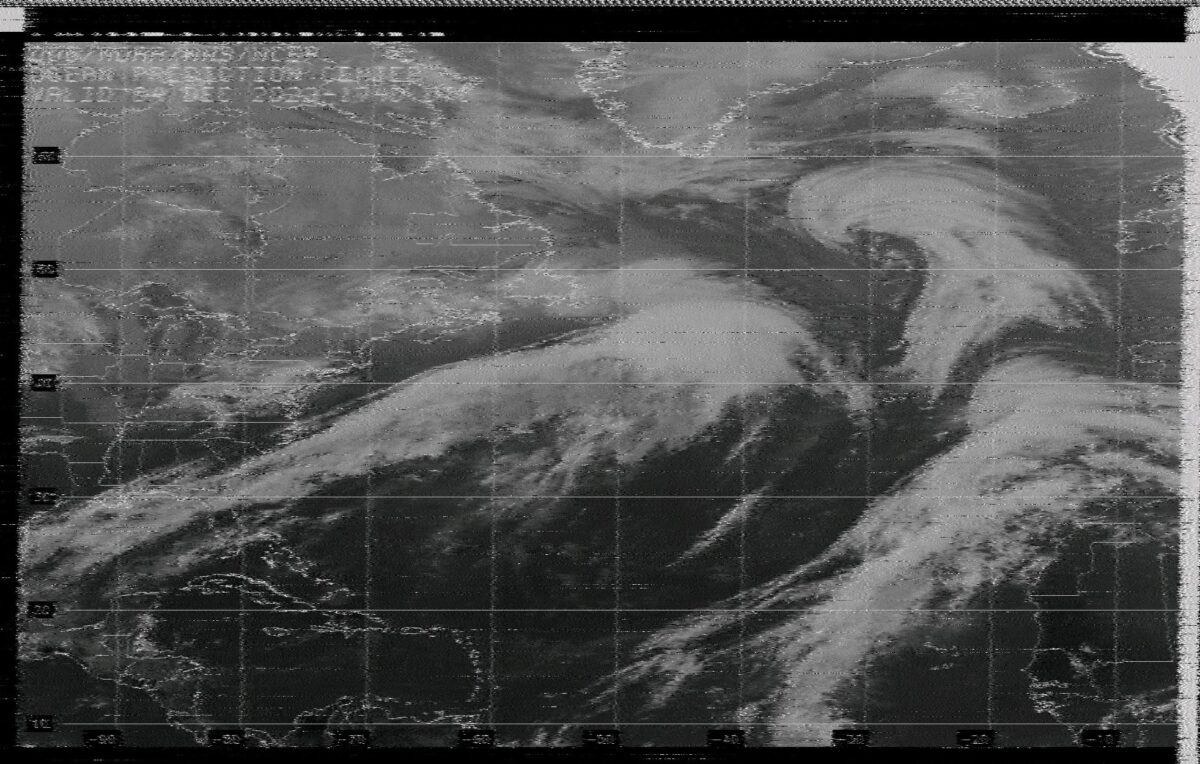
Many thanks to SWLing Post contributor, Carlos Latuff, who shares these recent Radiofax decodes on Twitter:
Hey Thomas my good man, have a look how good were the NOAA radiofax reception in Urca Beach, Rio de Janeiro, from USCG radio stations in Pt. Reyes, Boston and Honolulu:
Today, between 00h14 and 00h48 UTC, I received at Urca Beach, in Rio de Janeiro, #Brazil, radiofax from @NOAA broadcasted by @USCG in Honolulu, Hawaii, on the frequency of 16135 kHz USB. The only problem with this transmission is that the images were broken in some parts. pic.twitter.com/5geluA5eMv
Excellent propagation this afternoon at Praia da Urca, Rio de Janeiro, #Brazil, between 23h20 and 23h56 UTC, provided excellent reception of @NOAA radiofax transmitted from the @USCG radio station in Pt. Reyes, California, on the frequency of 22527 kHz. pic.twitter.com/w1zChefEmU
Gale warning issued today via radiofax by @NOAA for the Gulf of Tehuantepec, #Mexico. Broadcasted by @USCG in Pt. Reyes, California, received at 22h14 UTC in Urca Beach, Rio de Janeiro, #Brazil, frequency of 22527 kHz USB. pic.twitter.com/ISmnMcMwM0
Excellent propagation this afternoon at Urca Beach, Rio de Janeiro, #Brazil, between 21h15 and 22h02 UTC, provided excellent reception of @NOAA radiofaz broadcasted from the @USCG radio station in Boston, on the frequency of 12750 kHz USB. pic.twitter.com/m5o54U1tod
Many thanks to SWLing Post contributor, Patrizio Cardelli, who has discovered some interesting signals on the HF bands and is seeking information about them.
A little background: Patrizio asked me about these signals a few weeks ago and based on a quick glance at the spectrum and waterfall images I assumed it was DRM (Digital Radio Mondiale). I was wrong, of course. Had I looked at the actual frequency and bandwidth, I would have immediately realized is was not DRM. My email load has been so heavy as of late, and my time to reply at such a premium, I rushed through the reply–my apologies, Patrizio!
Patrizio followed up with this message:
Hello Thomas,
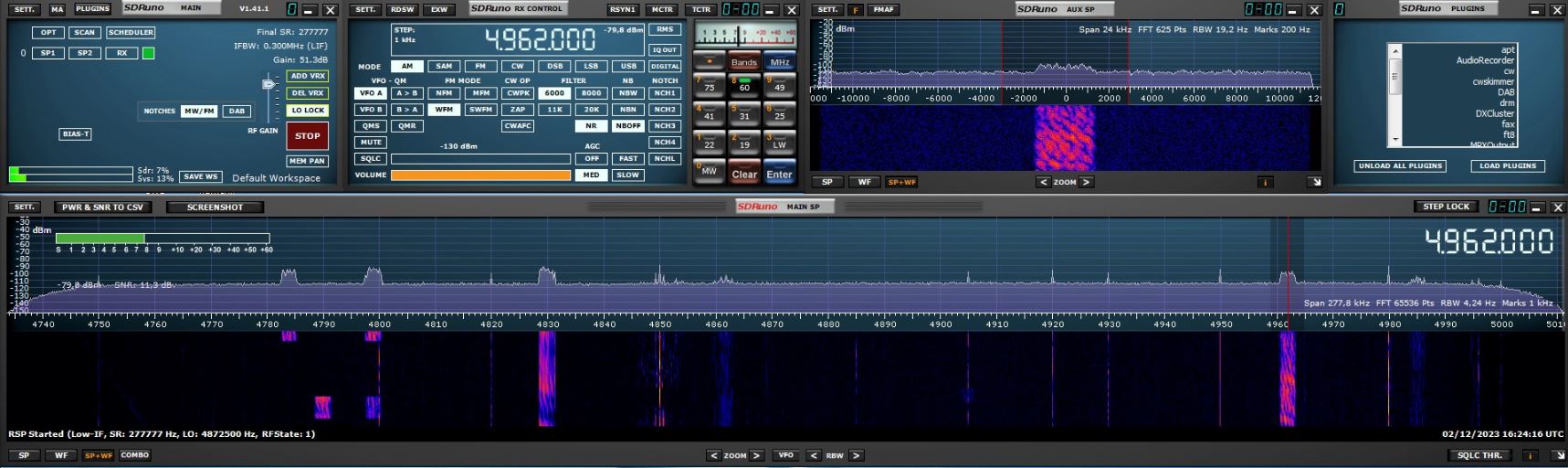
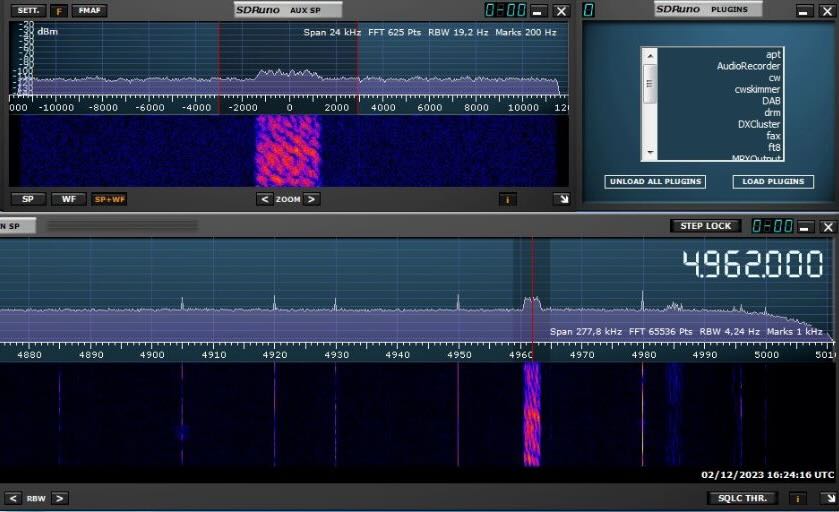
I hope this message finds you well. I wanted to share my recent radio exploration based on your advice. I followed your suggestion and investigated a sample signal within the 60-meter band, specifically settling on the one at 4.962 kHz.
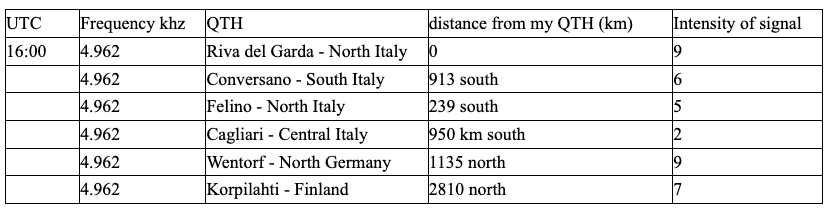
I attempted to decode it using the Dream software but encountered no success. It seems this isn’t a Digital Radio Mondiale (DRM) transmission. To rule out local QRM (interference), I tested various Kiwi SDR receivers across Europe, both to the south and north of my QTH. Interestingly, I managed to pick up this signal everywhere, with a stronger intensity noted in the northern locations.
I’m eager to publish this article to find out if other Shortwave Listeners (SWL) have been able to decode this transmission. Additionally, I’d like to mention that similar signals, either continuous or intermittent, are present on various HF frequencies.
I look forward to any insights or experiences others in the community might have regarding this intriguing signal.
Audio sample:
While I recognize these signals now, and I’m sure most of you who cruise the bands have seen/heard these as well, Patrizio is a relatively new SWL, turns out, and I thought it might be fun exploring just what these signals are.
Readers: If you know what these signals are, please comment. Indeed, I’m sure there are a number of SWLing Post readers who have hands-on time with generating these signals as well in a past life or current career. Let’s explore!
We inform you that the next few days December 4-5 Radio Exterior de España will be forced to suspend its shortwave broadcasts.
The reason: a cut in the electricity supply, beyond our control, which will affect the shortwave emitting center that Radio Exterior has in the town of Noblejas. The break is due to work that the Unión Fenosa company has to do in the electrical substation from that Toledo municipality and that will affect our facilities.
Consequently, shortwave emission will be suspended next Monday, December 4 and will last until Wednesday, December 6, which will be when the signal resumes.
We apologize for this incident, completely unrelated to the will of Radio Exterior de España.
Many thanks to SWLing Post contributor, Troy Riedel, who shares the following item from Spaceweather.com.
MULTIPLE CMEs ARE COMING: At least three CMEs are heading for Earth following a series of magnetic filament eruptions (#1, #2 & #3) earlier this week. Their collective arrival could spark G2-class geomagnetic storms with mid-latitude auroras on Nov. 30th and Dec. 1st. This forecast does not yet take into account a possible CME hurled toward us by today’s almost-X class solar flare. Keep reading!
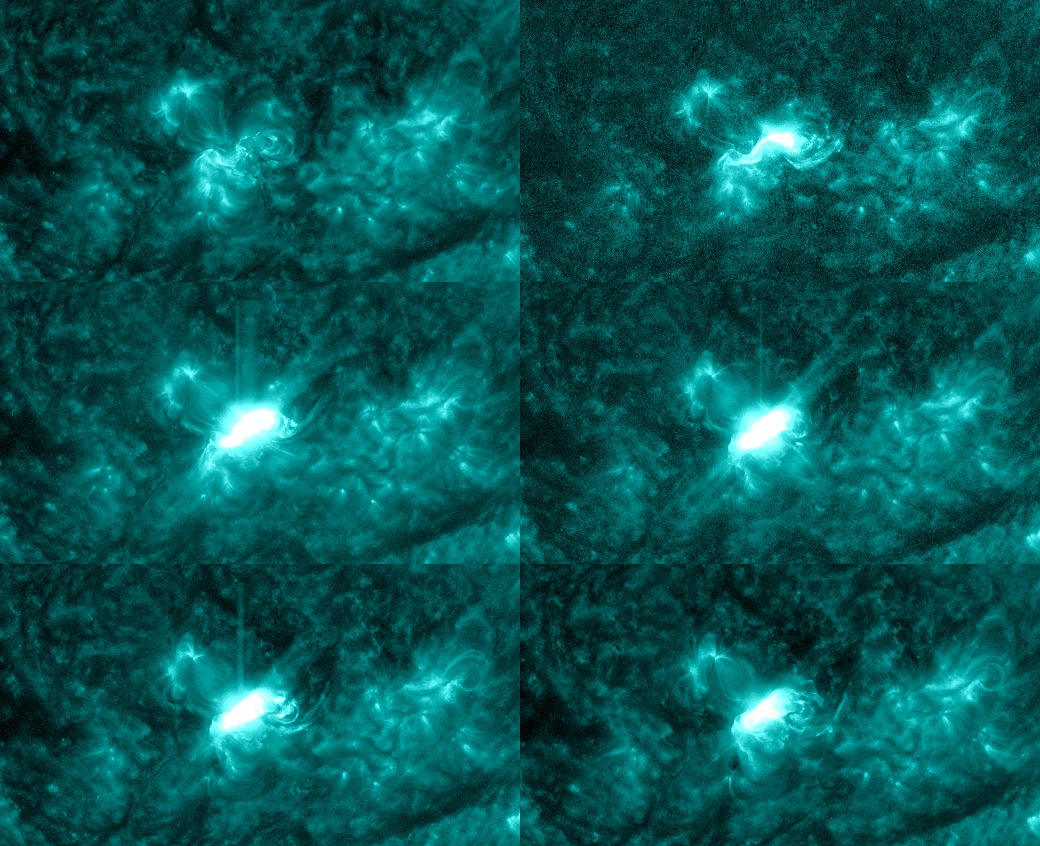
ALMOST-X CLASS SOLAR FLARE: Sunspot AR3500 erupted on Nov. 28th (1950 UT), producing an M9.8-class solar flare–only percentage points below category X. NASA’s Solar Dynamics Observatory recorded the blast:
A pulse of extreme UV radiation blacked out shortwave radio communications across the South Pacific Ocean and parts of the Americas: map. Mariners and ham radio operators may have noticed loss of signal at frequencies below 20 MHz.
This explosion almost certainly hurled a CME toward Earth. Confirmation awaits fresh data from SOHO coronagraphs. Stay tuned.
It’s GCHQ the spy department in the UK. In episode 4 one of the leading characters makes a visit and look so many Yaesu, Eddystone, Heathkit and many more radio’s.
Bye from Amsterdam,
Jarno – PA3DMI
Many thanks for sharing this, Jarno! This looks like a fascinating series as well. Thank you for the tip!