Author Archives: Thomas

Photos from the 2022 Milton Ontario Hamfest

Many thanks to SWLing Post contributor, Mike (VE3MKX), who writes:

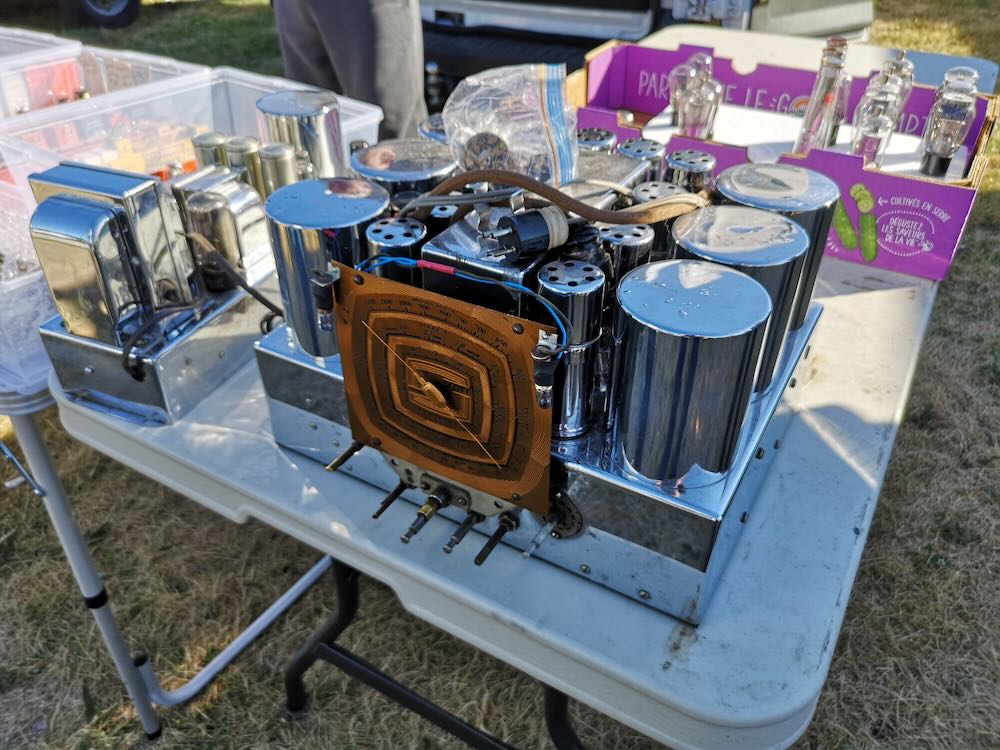
The following pictures are from a Hamfest which was held yearly at the Milton Fairgrounds in Milton Ontario, Canada. (Located 20 minutes west of Toronto).

The Burlington Amateur Radio Club organizes the event and confirms that they had 108 vendor spaces sold and over 475 general admin passed through the gates.

A great day of meeting friends, lots of deals and smiling faces!

Thank you so much for sharing this, Mike! I haven’t been to a hamfest yet this year, so it’s great to catch a glimpse of what looks like a very successful one! 

Readers: This is a large gallery of 132 photos courtesy of Kevin (VA3RCA) and Mike (VE3MKX). If you would like to view the entire image gallery click on the link to see more.  Continue reading

Ken reverse-engineers the Apollo spacecraft’s FM radio

Many thanks to SWLing Post contributor, Paul, who shares the following post from Ken Shirriffs’ Blog:

Reverse-engineering the Apollo spacecraft’s FM radio

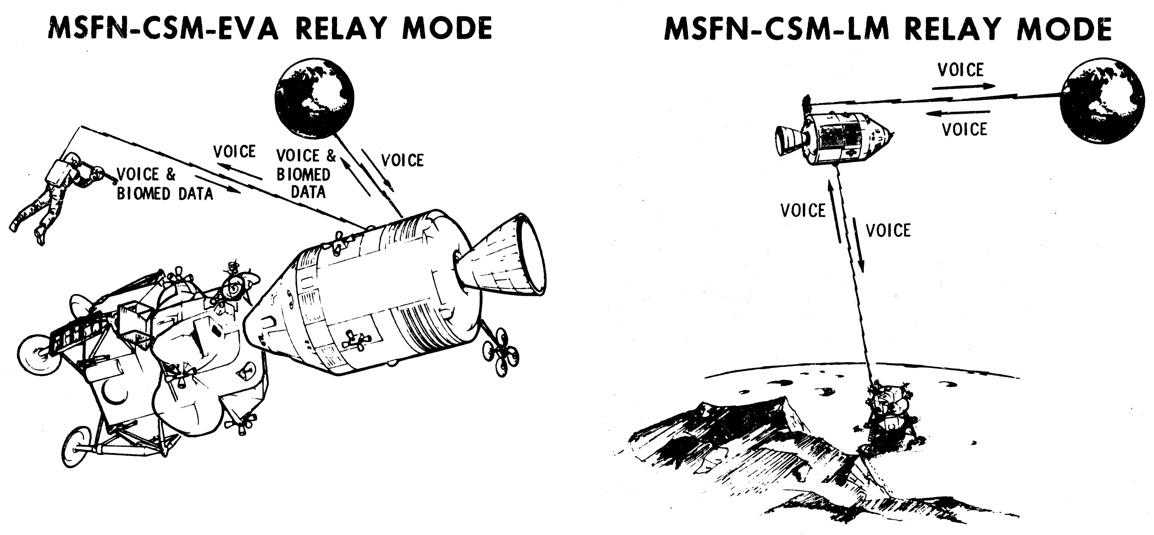
How did NASA communicate with the Apollo astronauts, hundreds of thousands of miles from Earth? The premodulation processor1 (below) was the heart of the communication system onboard the Apollo spacecraft. Its multiple functions included an FM radio for communication to the astronauts, implemented by the Voice Detector, the module second from the top. In this blog post, I reverse-engineer the circuitry for that module and explain how it worked.

The Apollo communication system was complex and full of redundancy. Most communication took place over a high-frequency radio link that supported audio, telemetry, scientific data, and television images.2 NASA’s massive 85-foot dish antennas transmitted signals to the spacecraft at 2106.4 megahertz, an S-band frequency, giving the system the name “Unified S-Band”. These radio signals were encoded using phase modulation;3 onboard the spacecraft, a complex box called the transponder received the S-band signal and demodulated it.4

The voice and data signals from Earth were combined through a second layer of modulation: voice was frequency-modulated (FM) onto a 30-kilohertz subcarrier while data was on a 70-kilohertz subcarrier, so the two signals wouldn’t conflict.5 One of the tasks of the premodulation processor was to extract the voice and data signals from the transponder’s output. These voice signals went to yet another box, the Audio Center Equipment, so the astronauts could hear the messages from the ground. The data signals were decoded by the Up-Data Link, allowing NASA to send commands to the Apollo Guidance Computer, control onboard relays, or set the spacecraft’s clock.

Many systems worked together for communication, but I’m focusing on a single module: the voice detector inside the premodulation processor that performed the FM demodulation. [Continue reading the full article…]

Changes to KTWR’s DRM broadcast schedule effective 3rd July, 2022

Many thanks to SWLing Post contributor, Mangosman, who shares the following tip from Mike Sabin at KTWR via Alokesh Gupta’s blog:

Due to requests for later broadcasts, improved propagation, and the addition of a program, KTWR is changing its DRM broadcast schedule effective 3rd July, 2022.

KTWR Digital Broadcasts
DRM broadcasts (Effective 3rd July 2022):

Day Time(UTC) Frequency Coverage Area Language
—————————————————
Saturday 1100-1127 12000 kHz China English
Saturday 1128-1230 9910 kHz Japan Japanese, English
Mon-Fri 1215-1245 9910 kHz China Mandarin
Sunday 1500-1545 15205 kHz India English
Sunday 1600-1630 15390 kHz India South Indian languages

(Mike Sabin, KTWR)

Full Schedule of RTI Transmission Tests and Special QSL

Many thanks to SWLing Post contributor, Gerard Koopal, who writes:

Dear Thomas,

[Per the email message below] from Radio Taiwan International, they will bring a direct transmission from Tamsui, Taiwan in German and French.

For correct reception reports there is a special QSL card available.

Reports can be sent to: [email protected] or via the Online Form or by snailmail (Radio Taiwan International, German Service, PO Box 123-199, Taipei 11199, Taiwan).

Wishing everybody a good reception!

Gerard Koopal

Almere, The Netherlands


Onderwerp: RTI direct broadcasts from Tamsui July 2022

Dear RTI listeners,

This year, RTI will once again be broadcasting its German-language program directly from the Tamsui transmitter in Taiwan on several days.

Broadcast dates and frequencies July 2022:

Frequency 11995 kHz 1700-1800 UTC
Frequency 9545 kHz 1900-2000 UTC

1) 08.07. Friday
2) 09.07. Saturday
3) 10.07. Sunday
4) 15.07. Friday
5) 16.07. Saturday
6) 17.07. Sunday
7) 22.07. Friday
8) 23.07. Saturday
9) 24.07. Sunday
10) 29.07. Friday
11) 30.07. Saturday
12) 31.07. Sunday

We confirm receipt reports with a special QSL card.

You can send reception reports to [email protected] by email, using the online form, or by mail (Radio Taiwan International, German Service, PO Box 123-199, Taipei 11199, Taiwan).

We would also like to point out that this year in August RTI will also be broadcasting French-language programs directly from the Tamsui transmitter on Fridays, Saturdays and Sundays.

We look forward to your reception reports!

Your RTI editorial team

https://de.rti.org.tw/

[email protected]


Thank you for the tip, Gerard!

Can the Eton Elite Satellit meet 2022 expectations?

Many thanks to SWLing Post contributor, Dan Robinson, for the following guest commentary:
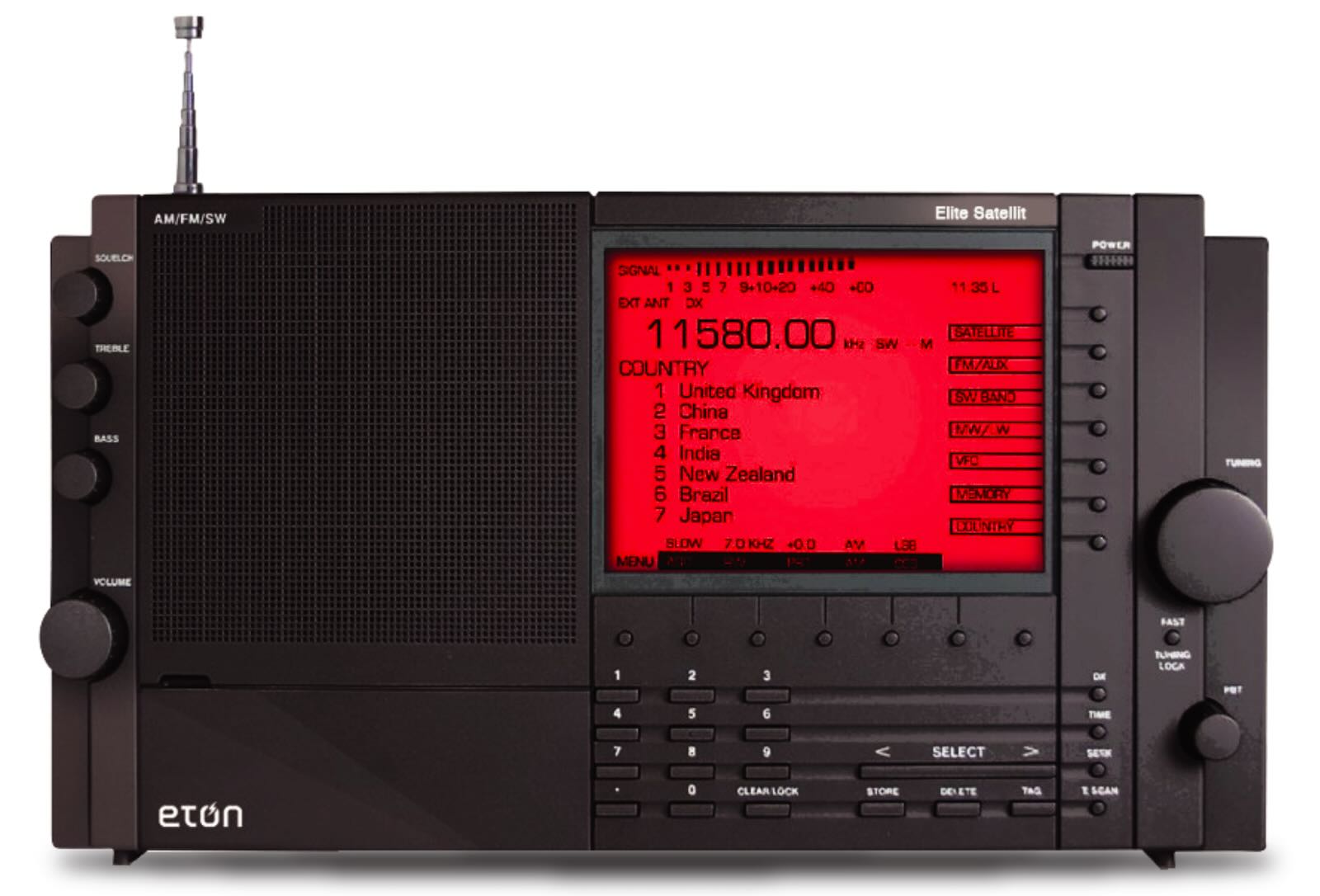

The Elite Satellit: Can Eton Deliver to Radio Users Who Expect Higher QC and Feature Standards?

by Dan Robinson

It’s been many years since the original E1 took the hobby world by storm. Everyone remembers the issues that plagued the E1, from the rubber coating that degraded over time, to display and encoder issues, and the calibration issues that frustrate some users.

In anticipation of the arrival of the Elite Satellit, I got both of my E1s out of storage — one in the 9xxx serial number range required a de-gooing session, accomplished quite well using Max Pro cleaner and 70% alcohol. It was interesting note, during that process, that the XM module on one side of the radio was more sensitive to color loss than other parts of the cabinet, reducing to an almost silver color when all was finished.
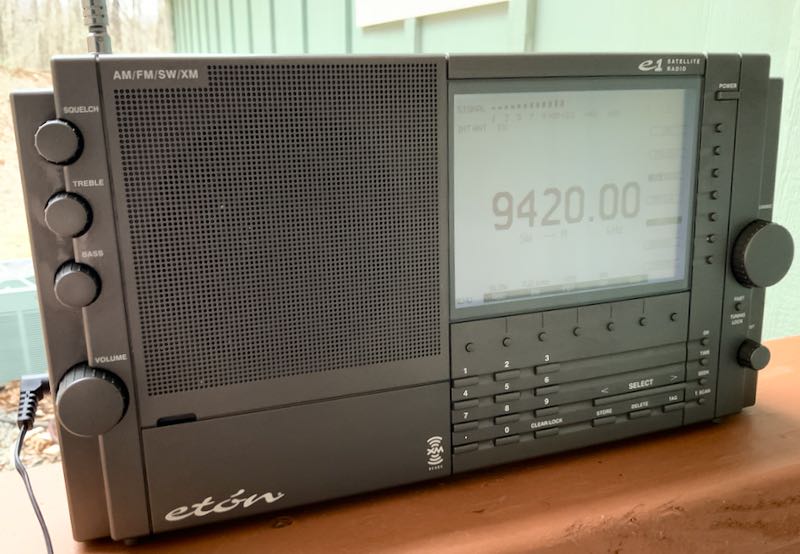
Original Eton E1 XM

Using the original E1s provided a reminder of how good these receivers were and still are, if you have managed to avoid display and encoder issues. The combination of PBT, triple selectivity and highly-effective SYNC was a blockbuster combination. The radio failed only in the area of quality control.

As Universal Radio and other distributors prepare to send out the first tranche of receivers, some thoughts are in order. The first is that one hopes Eton has lessons from the first go around regarding Quality Control. I have a sinking feeling about this based on my experiences in recent years reviewing receivers by Tecsun.

Eton needs to know that those who will buy the Elite Satellit, and that includes old-timers like myself but newcomers to the hobby, now have much higher standards specifically because of the features we have seen Tecsun and some other manufacturers put in portables.

Primarily, the presence of a recalibration capability really poses a challenge where the Elite Satellit is concerned. Discerning buyers no longer have to put up with a radio that has calibration and/or stability problems. This is why I am curious as to whether Eton included an adjustment function through software or an adjustment hole as with the original E1. So far, there has been no confirmation on this question from Eton or anyone else.
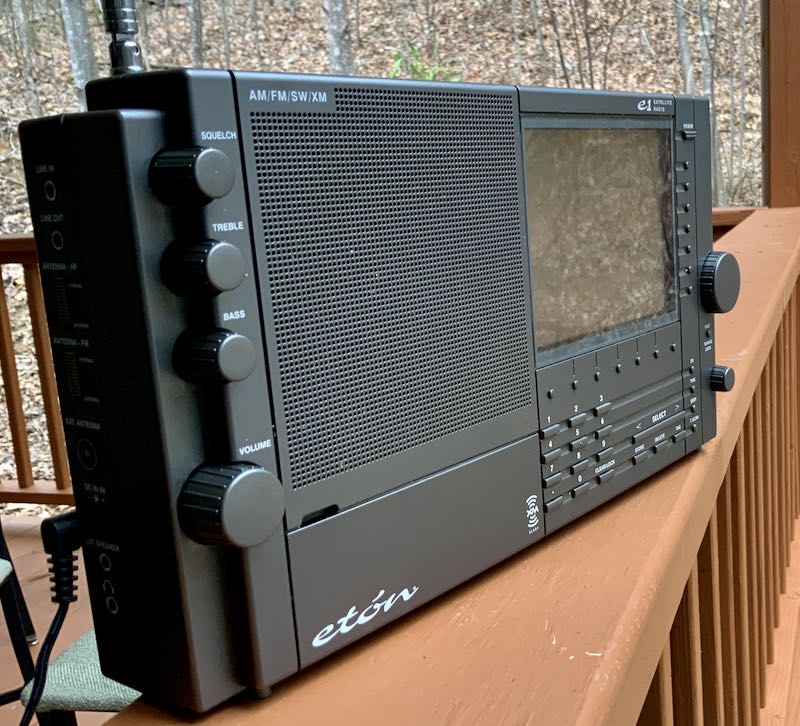
Original Eton E1 XM

With an older E1, tweaking of the master oscillator was possible through the small adjustment hold in the rear of the radio cabinet. This was tricky since in many units the hole was inconveniently located directly under one of the plastic ribs on the back.

I solved this problem by gently cutting a small section of one rib with a Dremel or similar tool, providing easier access. Still, adjustment has to be done carefully due to the sensitivity of the pot, and preferably with a non-metallic jewelers flat head screw driver. Even then, movements of the radio would often throw the radio back off.

But again, E1 users were spoiled by the recalibration capability which Tecsun included on receivers from the PL-880 to the 990x and 501s and even the PL-368, all of which provide a software method of zeroing frequency in SSB. Even Malahit SDRs have a fine adjustment setting in software.

If Eton has not taken this into account, and has not made any recalibration possible, I fear that it may face a good number of buyers who will simply return radios that suffer from significant frequency error. In short, a “good enough for government” approach by Eton when it comes to calibration QC is simply not going to be sufficient because for years now, Tecsun has been setting a higher standard.

Physical cosmetic issues too will also be an important indicator as to Eton’s attention to QC. If Eton learned its lesson from the rubberized cabinet fiasco, this should not be a major problem. But I would urge owners of the new Elite Satellit to examine your radio for QC issues, like LCD pixel problems, wobbly knobs and loose encoders, and issues with the telescopic antenna.

All of this becomes even more important because Eton is charging so much for this radio. Even taking inflation into account since the original E1 appeared, $599 for a radio that adds only HD and AIR band as features, but which still might suffer from QC problems is extremely high and I fear Eton may end up with numerous returns if the Elite Satellit fails in any key areas.

So, the clock ticks down to the moment when many of us will receive that box containing the Eton Elite Satellit. The question is will what is inside be able to meet the higher standards we have come to expect from a multi-band portable?

Radio Waves: New Yaesu FT-710 AESS, Ukraine’s Army FM, Foil 28 MHz antenna, and ATS-25 4.1 Firmware Review,

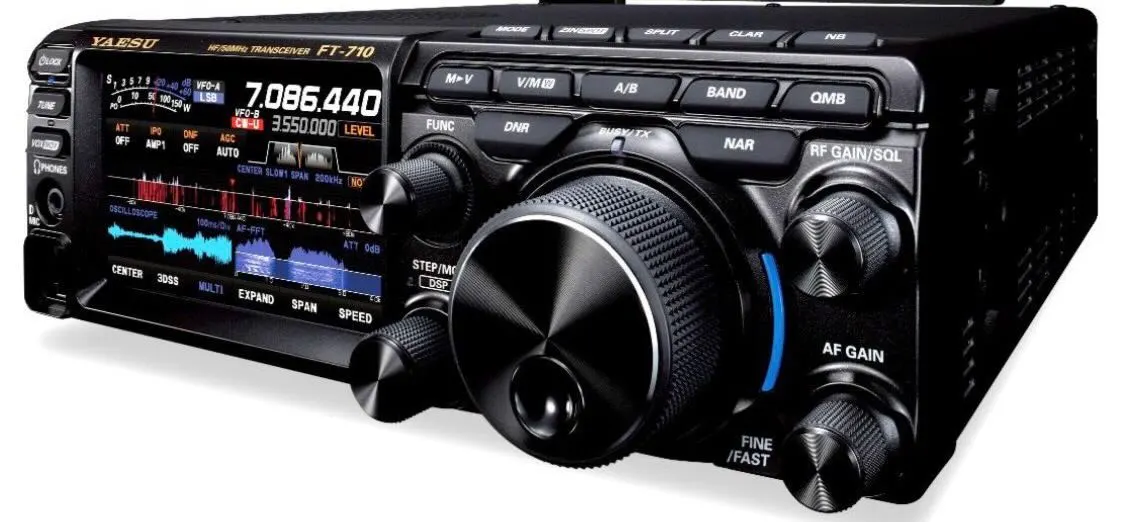
The Yaesu FT-710 AESS

Radio Waves:  Stories Making Waves in the World of Radio

Welcome to the SWLing Post’s Radio Waves, a collection of links to interesting stories making waves in the world of radio. Enjoy!

Many thanks to Eric Jon Magnuson for summarizing these news items for Radio Waves!


Yaesu Introduces the FT-710 AESS 100 SDR Transceiver (QRPer.com)

Yaesu is introducing a new 100 watt SDR transceiver to their product line: the Yaesu FT-170.

The Yaesu FT-710 will cover 160-6 meters with 100 watts output. There are two other Japanese market versions: the FT-710M and FT-710S which are 50 and 10 watt respectively.

This general coverage rig will feature “AESS”–Yaesu’s ‘Acoustic Enhanced Speaker System’ which “creates the high-fidelity audio output.” Yaesu notes that the FT-710 utilizes, “the advanced digital RF technology introduced in the FTDX101 and FTDX10 series.”

Click here to check out the published features and specifications of the new FT-710.

Ukraine’s ‘Army FM’ Radio Adapts To Full-Scale War (CoffeeOrDie)

KYIV, Ukraine — During the early morning hours of Feb. 24, as Russian missiles struck targets across Ukraine in the opening hours of the full-scale war, the Ukrainian military’s Army FM radio station went underground.

The team of seven army officers and about 10 civilian personnel abandoned their studio on the top floor of a downtown Kyiv building and relocated into a nearby basement. Inside the dank and dark underground space, they connected a mixing board and a couple of laptops to a mobile radio system, which the station’s reporters had previously used to report from the Donbas trenches.

“I just grabbed my Kalashnikov and went to work,” said Oleksandr Yurchenko, 32, a Ukrainian army second lieutenant assigned to Army FM.

While a Russian invasion force advanced to the outskirts of Kyiv in the war’s perilous first few days, the Army FM team stayed at their posts and worked in six-hour shifts to keep their programs running 24/7. They constructed makeshift beds from shipping pallets and stocked the basement studio with food and water. Body armor vests and Kalashnikovs occupied all available shelves and empty corners.

From this jury-rigged basement studio, Army FM continued to transmit information and entertainment programs to listeners across Ukraine — including into territories Russian forces invaded and occupied. [Continue reading…]

Hackaday: Homemade 28 MHz antenna made from foil (Hackaday via the Southgate ARC)

On Hackaday Chris Lott WD4OLP writes about DL1DN’s aluminum foil 20cm antenna for 28 MHz (10m) operation

David DL1DN, is an Amateur Radio enthusiast with a penchant for low-power (QRP) portable operations. Recently he was out and about, and found that 10 m propagation was wide open. Not discouraged by having forgotten his antenna, he kludges up a makeshift one using a 20 cm length of aluminum foil.

Read the Hackaday story and watch the video at
https://hackaday.com/2022/07/02/aluminum-foil-20-cm-antenna-for-10-m-operation/

Dave reviews the ATS-25 with Binns 4.1 firmware

Dave Zantow writes:

ATS-25 with Binns 4.1 firmware Review Now Posted. […] There were 7 different versions in the beta stage. New audio file added as well (Sync when it does not work so well, which is NOT all the time). Might be one more update before release (not sure right now).

Click here to check it out.


Do you enjoy the SWLing Post?

Please consider supporting us via Patreon or our Coffee Fund!

Your support makes articles like this one possible. Thank you!