Shortwave listening and everything radio including reviews, broadcasting, ham radio, field operation, DXing, maker kits, travel, emergency gear, events, and more
Many thanks to SWLing Post contributor, TomL, who has put together a four week series of Comb Stereo tests that will be aired on WRMI. Here’s the full announcement:
Starting this Saturday June 5 at 01:45-02:00 UTC (Friday 9:45pm EDT), I will be conducting a four-week series of tests using Comb Stereo. The broadcast will be aired on WRMI on 5850 kHz and will only be 15 minutes long. It will feature two minutes of “CNN” news by a computerized voice (sorry, I am doing this on-the-cheap!). Then, what follows is about 12.5 minutes of music encoded with Comb Stereo.
For you, the listener, to hear the Comb Stereo, you will need to record the broadcast to your digital recorder or SDR software and then play it back through your Windows PC using the instructions at the bottom of this announcement. I welcome feedback regarding such things as, 1 – I heard the broadcast and recorded it, 2 – I tried to setup my Windows PC but could not get the CSDecoder and Virtual Audio Cable to work, 3 – I got those things to work and opinions about what the stereo sounded like.
To repeat, you will not hear stereo unless you send your recorded audio file through the CSDecoder.
Do not expect FM Broadcast quality since Comb Stereo is a rudimentary form of creating two-channel sound. For instance, you may hear the stereo separation waiver a bit, or the sound stage image may wander, or a slight hollow sound at times. Sure, OK, but this is also a chance to hear stereo from a shortwave broadcast. So let me know your thoughts by sending feedback to [email protected] and I will tally up the results and post the findings here on the SWLing Post Blog.
Many thanks to Daz and Roseanna at Radio Northern Europe International for making the Comb Stereo available and to WRMI for the use of their transmitter.
TomL
P.S., please don’t mind the look of the web site at www.radiogumtree.com, it is still under repair and the web hosting company has to fix something or I end up replacing them!
RadioGumTree.com is a personal, eclectic look at Radio, Music, the Universe, and Beyond. For feedback or questions, please write to [email protected]. For program notes, please visit the Blog section of radiogumtree.com for more details.
The broadcast itself will not be archived on my web site due to copyright concerns.
For Radio episodes that are encoded in Comb Stereo, go to this web site for instructions on how to install the Comb Stereo decoder: https://rnei.org/stereo/
Man thanks to SWLing Post contributor, Jim Salmon (2E0RMI), for sharing the following:
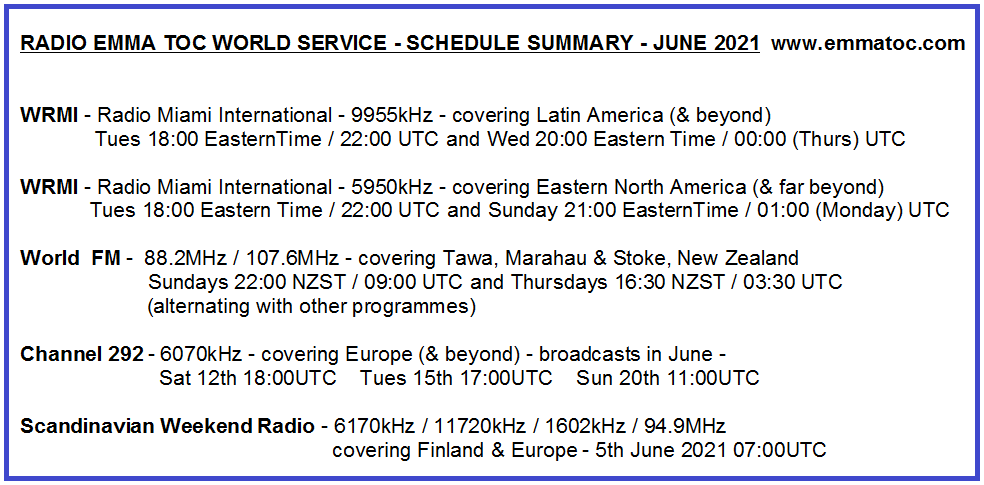
RADIO EMMA TOC WORLD SERVICE – SCHEDULE SUMMARY – JUNE 2021
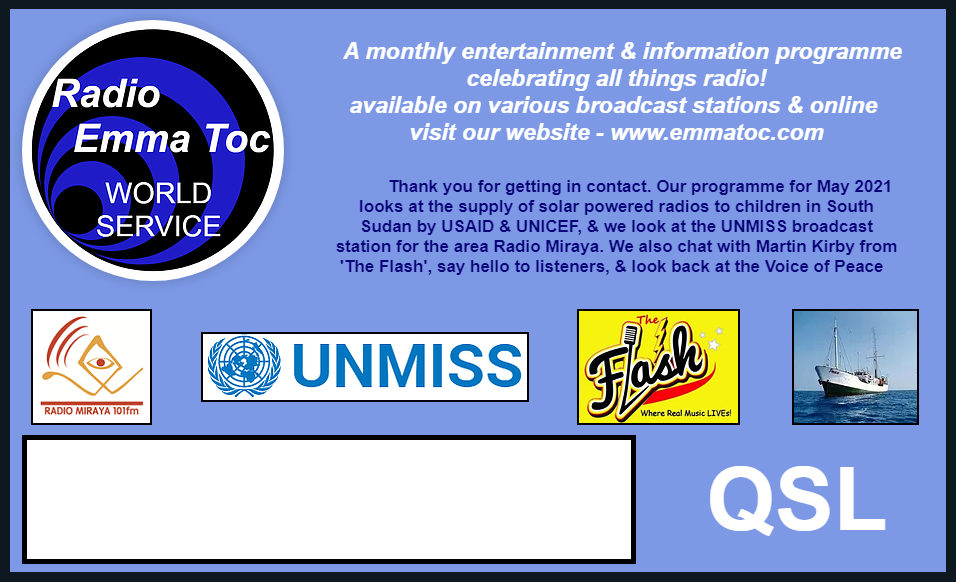
Programme Contents – Solar powered radios in South Sudan & Radio Miraya / interview with Martin Kirby from ‘The Flash’ / hellos to listeners / the Voice of Peace
Ways to listen… Radio Emma Toc World Service – programme no. 13 – May 2021
You can listen online – www.emmatoc.com – visit the ‘World Service’ page.
You can listen to our shortwave or MW or FM broadcasts via our relay partners as follows:
Happy listening! If you are outside the transmitter coverage areas, why not listen via the broadcasters’ online services. Website details for the above stations are listed on our own website www.emmatoc.org/worldserviceindex
If you don’t have access to receivers & aerials you can try using an online SDR receiver – ve3sun.com/KiwiSDR – experience the enjoyment of tuning around shortwave from worldwide locations online.
We are happy to issue eQSLs for reception reports sent to – [email protected] – & will gladly include for online reports. If using an online SDR, please give us the SDR location.
If any stations wish to relay our programme a download link is available on our website. Please advise us of times & dates so we can publicise in our schedule.
Many thanks to SWLing Post contributor, Giuseppe Morlè (IZ0GZW), who shares the following video and notes:
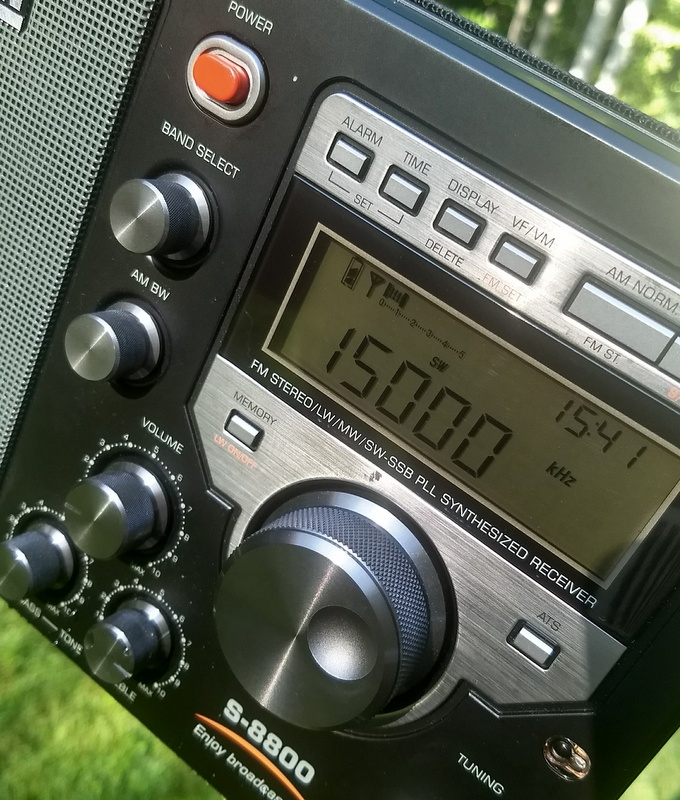
I recently bought a Tecsun S-8800 to be used mainly on shortwave. I carry it in an aluminum case to use it everywhere:
Many thanks for sharing this, Giuseppe! I love the integrated antenna–so clever!
Post readers: Giuseppe has had issues with the S-8800 accidently turning on in the case. Can anyone describe the button combo needed to lock the dial and controls during transport? I checked the manual but have found no reference. Please comment if you can help!
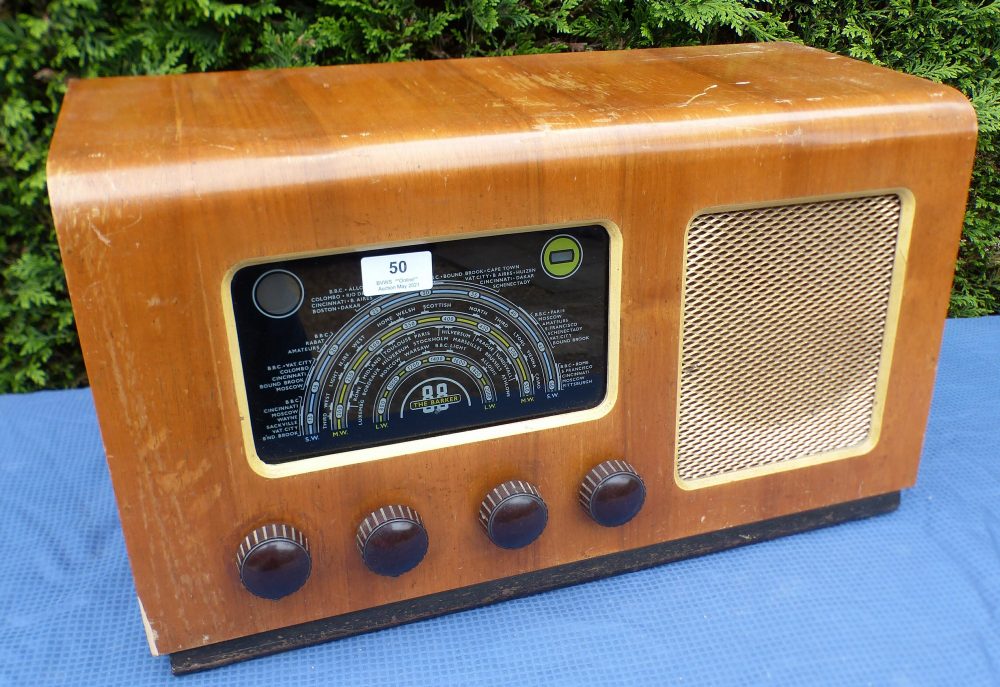
Wow! Thanks for sharing, Kris. I’ve been browsing the listings and I must say that I wouldn’t mind at all joining the BVWS to bid on some of these beauties!
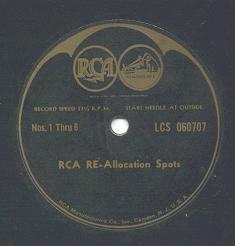
After listening to the BBC “Re-Tune” broadcasts, it reminded me of when the United States had its own “Re-Tune” day on March 29, 1941. It was referred to as “Moving Day”.
At 3:00 am, 802 of the 890 radio stations moved frequency. Following are a couple of articles about this day:
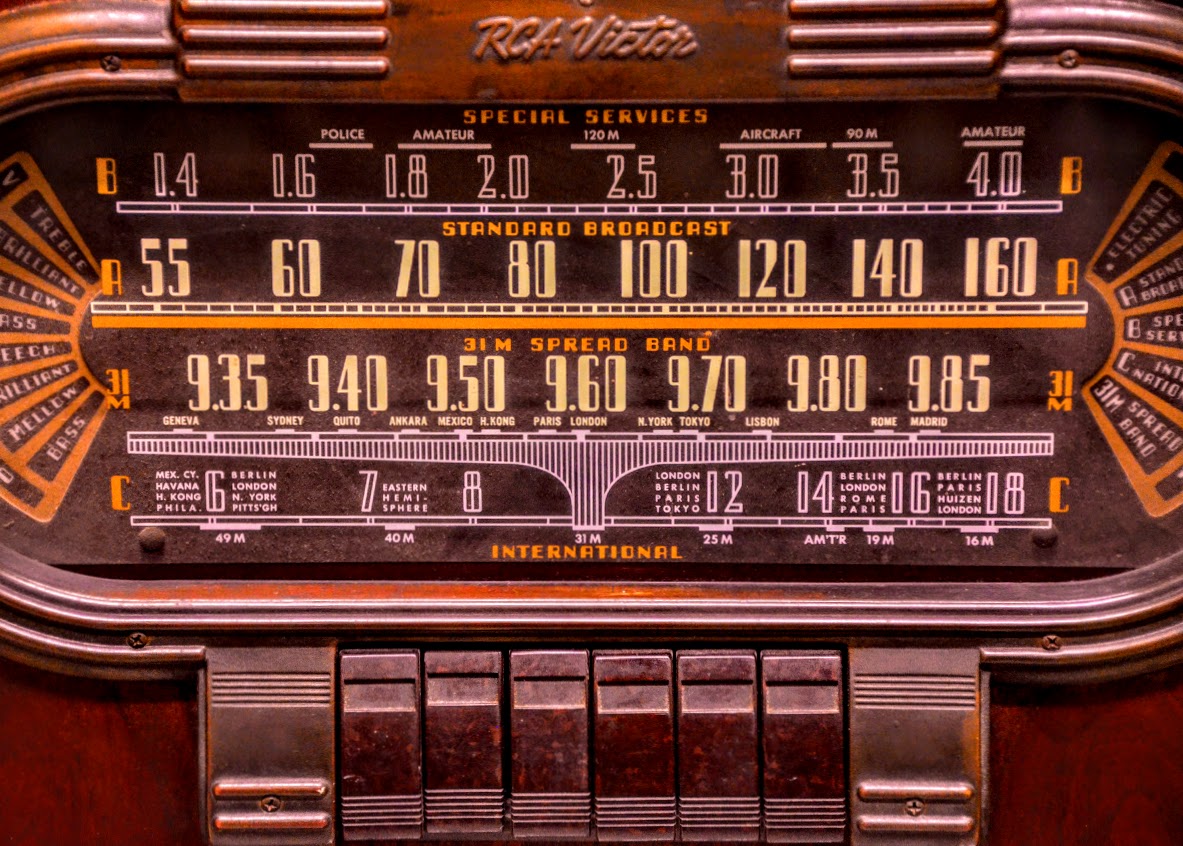
I love how it was used as an opportunity to get the radio listener to call on the radio technician to re-program the radio push buttons. And of course while the technician is there, have him do a full alignment and maybe replace a tube.
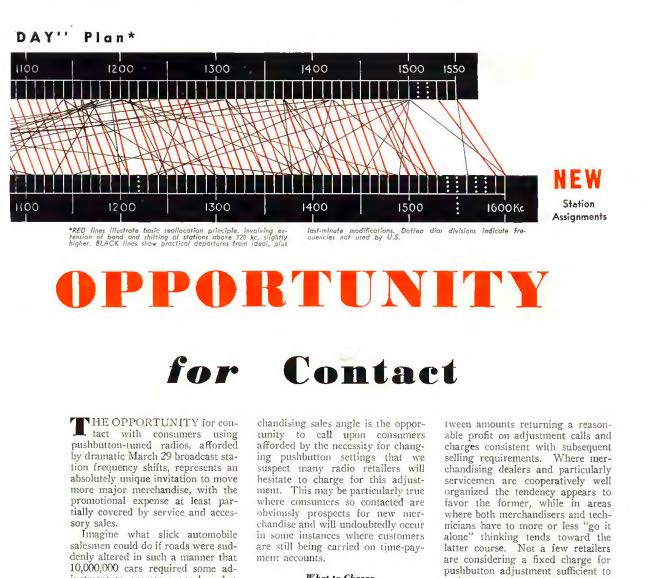
The March 1941 issue of Radio and Television Retailing (Pages 16-17) had the article “Radio’s Opportunity for Contact”.
While the entire article is an interesting read, the first few paragraphs sums up the opportumities:
THE OPPORTUNITY for contact with consumers using pushbutton-tuned radios., afforded by dramatic March 29 broadcast station frequency shifts, represents an absolutely unique invitation to move more major merchandise, with the promotional expense at least partially covered by service and accessory sales.
Imagine what slick automobile salesmen could do if roads were suddenly altered in such a manner that 10,000,000 cars required some adjustment to operate properly, what refrigerator salesmen might accomplish if a change in current necessitated motor manipulation, how laundry equipment salesmen would positively gloat over the glut of prospects if that many people with old machines actually asked them to call.
Calls make sales, as the records of many home specialty retailers conclusively prove, and the beauty of this particular opportunity to make them lies in the three-fold fact that cold-canvassing is completely unnecessary, that the motivating power of any campaign built around it is obviously not just trumped-up by the trade and that only dealers selling or servicing radios can capitalize in all departments of their business.
So valuable from a major merchandising sales angle is the opportunity to call upon consumers afforded by the necessity for changing pushbutton settings that we suspect many radio retailers will hesitate to charge for this adjustment.
This may be particularly true where consumers so contacted are obviously prospects for new merchandise and will undoubtedly occur in some instances where customers are still being carried on time-payment accounts.
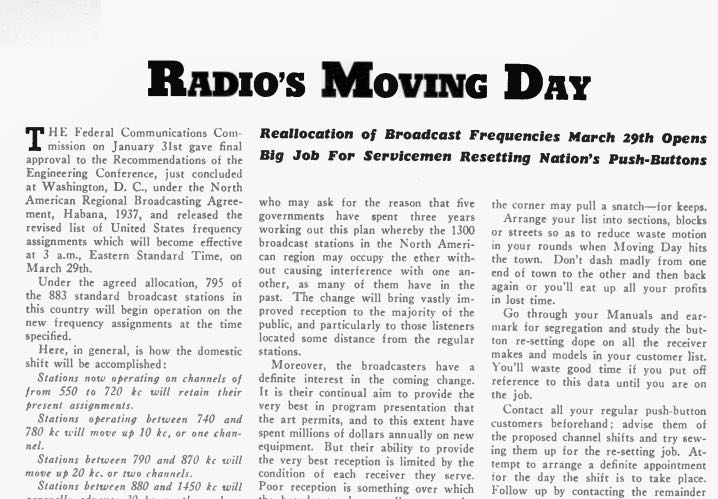
The Feb 1941 issue of Radio Service-Dealer (Page 8) also stressed the opportunities.
Reallocation of Broadcast Frequencies M arch 29th Opens Big Job For Service men Resetting Nation’s Push-Buttons
YOUR JOB
There are approximately 10 million push-button receivers in operation in this country. It will be your job to re-set the buttons for the new frequencies in the shortest possible time and with the least amount of confusion. It will also be your job and your opportunity to inspect these receivers for faulty operation. No such opportunity is likely to present itself again, so make the best of it.
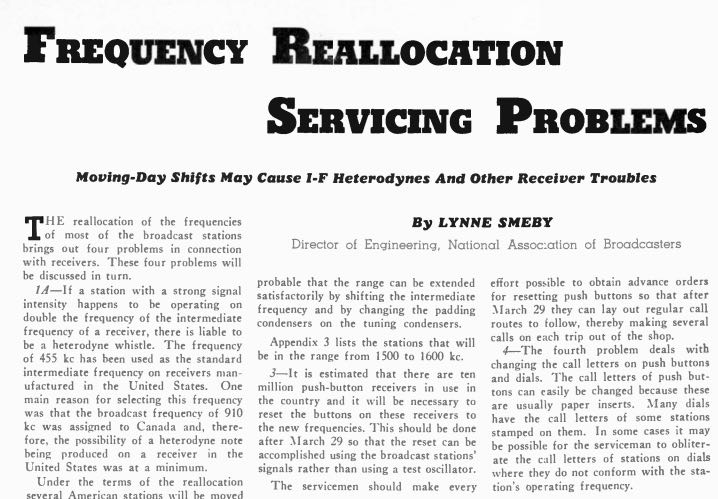
And on page 7 of the Mar 1941 issue of Radio Service-Dealer has the article FREQUENCY REALLOCATION SERVICING PROBLEMS
1A—If a station with a strong signal intensity happens to be operating on double the frequency of the intermediate frequency of a receiver, there is liable to be a heterodyne whistle. The frequency of 455 kc has been used as the standard intermediate frequency on receivers manufactured in the United States. One main reason for selecting this frequency was that the broadcast frequency of 910 kc was assigned to Canada and, therefore, the possibility of a heterodyne note being produced on a receiver in the United States was at a minimum. Under the terms of the reallocation several American stations will be moved to 910 kc thus producing a problem in the cities where these stations are to be located. If a heterodyne note is heard due to this cause the remedy is to shift the intermediate frequency to one side or another.
Thank you, Bill, for shedding more light on Radio Moving Day and, especially, providing us with the broadcaster and technician’s point of view.
Please support this website by adding us to your whitelist in your ad blocker. Ads are what helps us bring you premium content! Thank you!

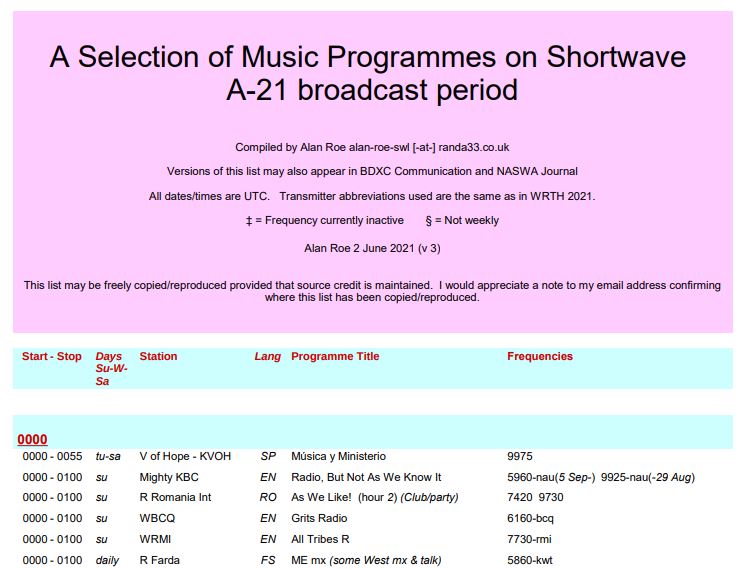 Many thanks to SWLing Post contributor, Alan Roe, who shares his latest A21 season guide to music on shortwave.