Author Archives: Thomas

Radio Fun: Monitoring ISS Astronaut David Saint-Jacques as he answers student questions

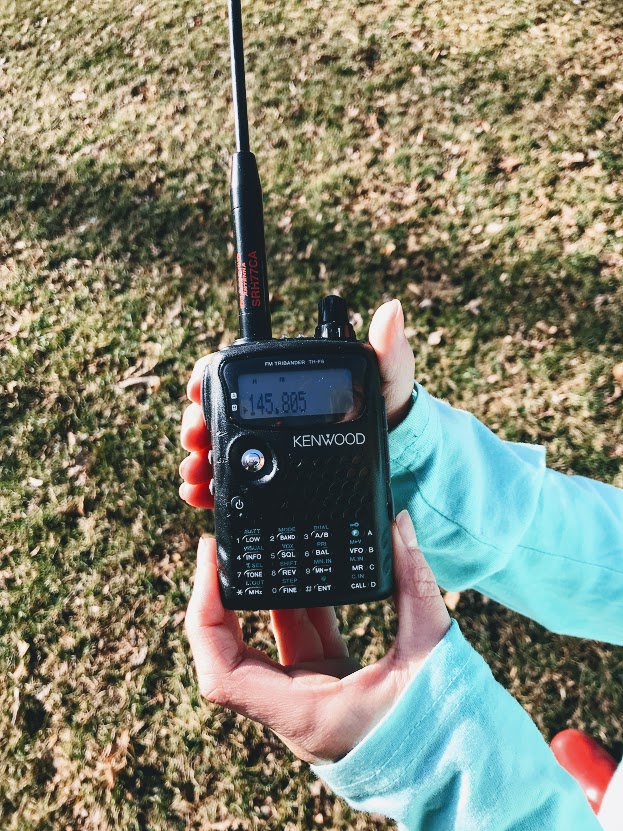
My daughter hold the Kenwood TH-F6 HT while we listen to the ISS contact.

Many thanks to my good buddy Eric (WD8RIF) for reminding me about a scheduled ARISS (Amateur Radio on the International Space Station) contact between Canadian astronaut David Saint-Jacques and Faith Christian Academy in Orlando, FL, USA.
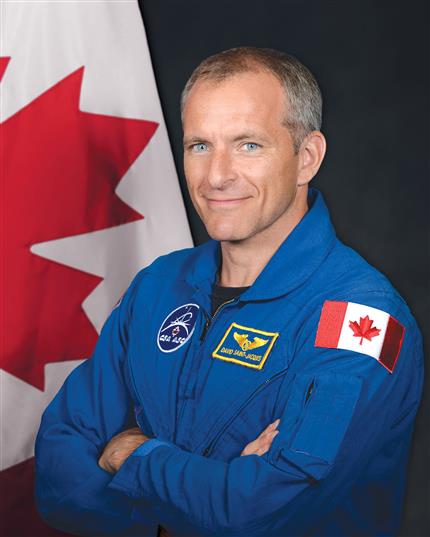
Astronaut David Saint-Jacques (Source: Canadian Space Agency)

Living in the mountains, I miss a lot of low angle ISS passes due to ridge lines blocking my line of sight. This time, though, the pass was high and mostly to my open south which meant it was one of the longest ARISS contacts I’m monitored.

My daughters drop everything to monitor radio or visual ISS passes–this February 14th pass was no exception.

In fact, I’m sure a lot of their enthusiasm about studying for their ham radio licenses stems from these ARISS events.

Of course, it doesn’t take an amateur radio license to monitor an ISS VHF transmission. I’ve used everything from handheld scanners to handheld ham radio transceivers. Click here to read a post with a short tutorial on monitoring ARISS contacts.

My daughters helped me make short videos of David Saint-Jacques’ replies (of course, we can’t hear the FL school’s transmissions). Below, I’ve matched the school’s questions with his answers:

Question regarding superstitions, traditions and rituals:

Click here to view on YouTube.

“Can you see any constellations while on the ISS and do you have a favorite one?”

Click here to view on YouTube.

“Have you ever experienced a major malfunction on the ISS?”

Click here to view on YouTube.

“Does everything in your body work the same in a microgravity environment, for instance, does your heart work harder to pump blood through the body?”

Click here to view on YouTube.

“Do your ears pop like they would when you fly in a plane?”

Click here to view on YouTube.

“Are you recognized as an astronaut on the streets?”

Click here to view on YouTube.

“Are you allowed to request certain things to be delivered by the cargo missions?”

Click here to view on YouTube.

“Describe the escape system on the ISS in case of an emergency.”

Click here to view on YouTube.

“How do you shave or cut your hair on the ISS without the hair floating away?”

Click here to view on YouTube.

“What experiment are you currently working on and is it going well?”

Click here to view on YouTube.

“What did you feel the first time you saw Earth from the ISS?”

Click here to view on YouTube.

Have you ever monitored an ARISS contact or grabbed one of the SSTV transmissions from the ISS?  Please comment!


Do you enjoy the SWLing Post?

Please consider supporting us via Patreon or our Coffee Fund!

Your support makes articles like this one possible. Thank you!

Video: The Secret Life of Radios

Many thanks to SWLing Post contributor, Skip Arey (N2EI), who shared the following video on Facebook:

Any electrical spark creates radio waves and acts as a transmitter. You hear sparks on a radio as interference. That’s why lighting makes radios crackle, and even the tiny spark in a switch is enough to make a noise on the radio when turning on a light./blockquote>

Click here to watch on YouTube.

Spectres of Shortwave streaming online for limited time

Many thanks to Amanda Dawn Christie, who writes:

I also want to let you know that Spectres of Shortwave is currently screening online, for a limited time (March 4), on this science film website: https://www.labocine.com/film/2172

I think it costs $3 for the month to access all of the films on this site.

Feel free to let others know.

Many thanks for letting us know, Amanda!

Post Readers: I’ve been to a screening of Spectres of Shortwave—it’s a wonderful film and certainly a must-watch for anyone who loved Radio Canada International.

Mark spots a self-powered radio in “The Division”

Many thanks to SWLing Post contributor, Mark Hirst, who shares the following:

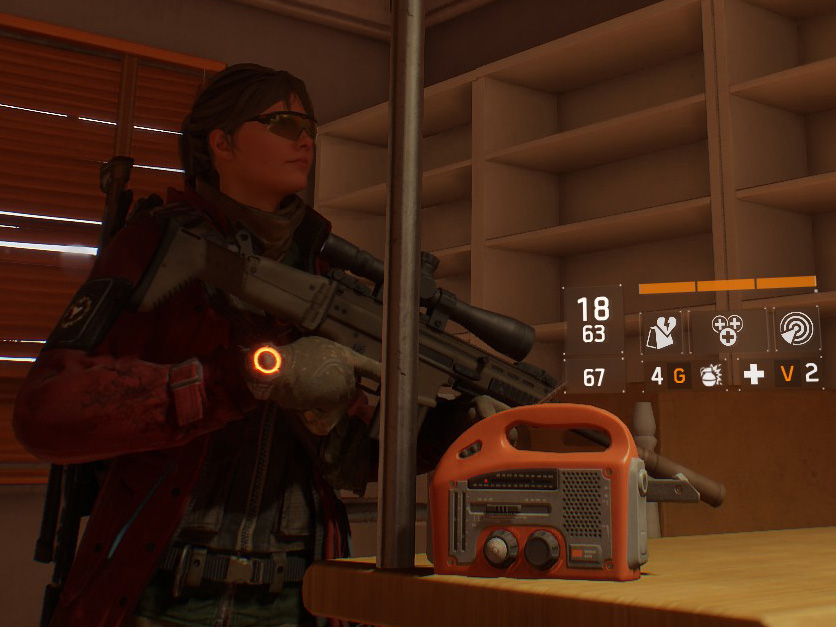
I’ve recently got back into computer games after a gap of several years, and have recently discovered one called “The Division”.

The level of detail in the game is amazing, and the representation of parts of Manhattan compare very favourably with Google Street View.

Radios popup fairly regularly as props in houses and military bases, including this windup model shown in the image above.

Thanks for sharing, Mark! That’s impressive design detail for a game. Looks like a radio I’d consider purchasing. I’m very curious if it’s based on a real life design–if so, I’ve never seen it. Please comment if you can ID this radio.

Stan compares the C. Crane CCRadio3 with the CCRadio2E

Many thanks to SWLing Post contributor, Stan Horzepa (WA1LOU), who shares the following post originally published on his blog:

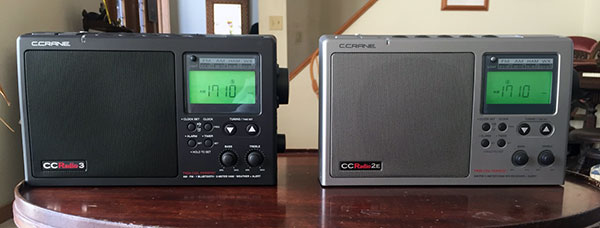
I bought a first-production-run C.Crane CCRadio3 AM/FM/WX/2-Meter receiver after reading K4SWL’s preview on his blog, The SWLing Post.

I already own the highly-regarded C.Crane CCRadio 2E Enhanced, which I reviewed here five years ago, so I decided to compare the two on the AM, FM and weather bands. Before comparing the two radios, I recalibrated the antennas of both radios, then with the radios sitting side-by-side, I tuned each radio through each band channel-by-channel

My findings follow.

On the AM band, the 3 captured signals faster than the 2E.

Occasionally, signals were stronger on the 3 than on the 2E and vice versa, but most of the time, the signal strength was the same on both radios. So I conclude that the sensitivity of the two radios are the same.

I tried the 3’s new Bluetooth function before reading the manual. I just pressed the Bluetooth button to access the Bluetooth mode and my iPhone and MacBook Pro found the 3 without pressing the radio’s Pair button, as instructed by the manual.

In conclusion, the differences I found between the 3 and the 2E were (1) the 3’s ability to capture AM signals was noticeably faster than the 2E and (2) the addition of the Bluetooth function in the 3.

I did not notice any other performance enhancements. I was hoping that the 3 might be more sensitive than the 2E (not that the 2E is not sensitive — it certainly is!), but I’d say that the 3 and 2E Enhanced are about equal sensitivity-wise, as well as selectivity-wise.

Believe it or not moments… During the comparison, I was very surprised that on two occasions (on 820 and 1500 kHz), each radio simultaneously received different stations while tuned to the same frequency!

Click here to check out Stan’s blog.

Thank you for sharing your thoughts after comparing the two receivers, Stan! I think this supports the idea that if one owns the CCRadio2E and doesn’t need Bluetooth functionality, there’s no real reason to upgrade to the CCRadio3. With that said, and as I think you found Stan, the Bluetooth functionality in the CCRadio3 is excellent. It must be one of the best Bluetooth receivers I’ve tested and as you point out, it’s also very easy to engage and use.

Thanks again!

Video: N1SPY brings a GE seven band radio back to life!

Many thanks to SWLing Post contributor, Ivan Cholakov, who writes:

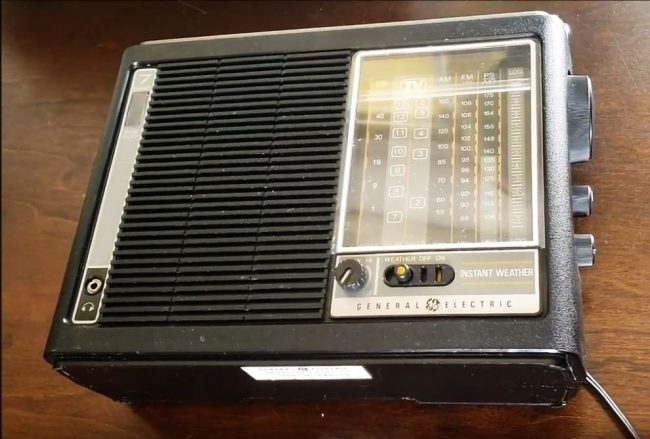
Thomas Cholakov (N1SPY) picked up an old General Electric radio from the 2019 Orlando Hamcation and brought it back to life. Unfortunately with all of the radio’s 7 bands, it did not have shortwave.

Click here to watch on YouTube.

Brilliant job resurrecting that GE portable, Tommy!!! Thank you for sharing.