Author Archives: Thomas

“DOGE Targeting VOA And Radio Free Europe”

DOGE Targeting VOA And Radio Free Europe. (Inside Radio)

Voice of America (VOA) and Radio Free Europe/Radio Liberty (RFE/RL) are in the sights of Elon Musk, the billionaire entrepreneur appointed by President Donald Trump to oversee the House Subcommittee on Delivering on Government Efficiency (DOGE).

Musk commented on a social media post by Richard Grenell, the U.S. Special Envoy for Special Missions, who said the radio networks are “state-owned media” and “are a relic of the past.”

“Yes, shut them down,” Musk wrote in his reply to the post. “Europe is free now (not counting stifling bureaucracy). Nobody listens to them anymore. It’s just radical left crazy people talking to themselves while torching $1B/year of US taxpayer money.” [Continue reading…]

Update: SWLing Post contributor, Jock Elliott notes that he wrote the following message and sent it via the Whitehouse contact page:

Mr. President;

First, I am not, and never have been, employed by Voice of America or Radio Free Europe.

But you might want to think twice before you shut them down.

If the electronic networks such as internet and mobile phones are ever shut down, you might want a means of communicating with the populations overseas; you might want to factor that into your decision-making process.

Radio can be an essential resource when the crunch comes, as was demonstrated recently in Western North Carolina and Eastern Tennessee: https://swling.com/blog/2024/11/a-shining-moment-for-ham-radio/

You might want to keep international broadcasting — with appropriate messaging — as “another club in your bag.”

Sincerely, Jock Elliott

World Radio Day 2025: Celebrating Nuxalk Radio’s Mission to Revive Language and Culture

This World Radio Day, we celebrate the power of community radio with World Wide Waves ’25: Whispers in the Air, a moving documentary presented by Maria Margaronis and produced by our friend David Goren.


This BBC World Service feature highlights Nuxalk Radio, a small yet powerful station broadcasting from a trailer in Bella Coola, British Columbia. For the past decade, this station has been a beacon of cultural revival, helping the Nuxalk people reclaim their language and identity after decades of suppression. Through bilingual weather forecasts, recordings of elders, and new music blending ancient and modern sounds, Nuxalk Radio is not just preserving the past—it’s building a bridge to the future. Don’t miss this inspiring story of resilience and the enduring power of radio.

Listen now: https://www.bbc.co.uk/programmes/w3ct7mch

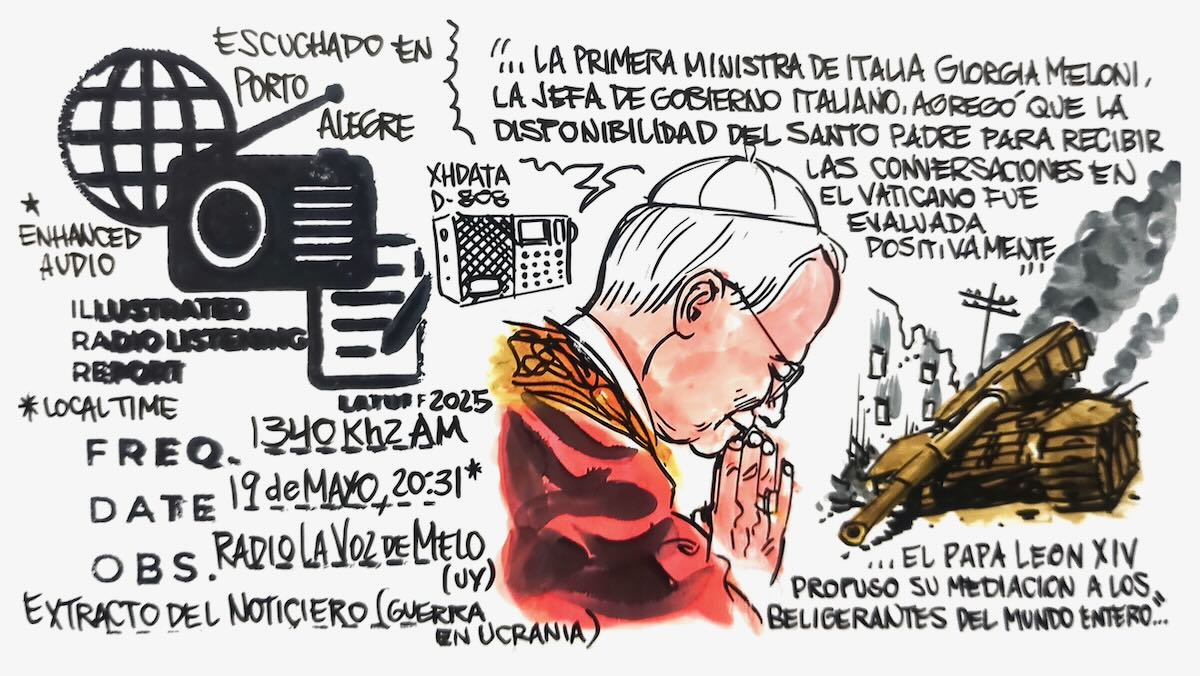
Carlos’ Illustrated Radio Listening Reports and Recordings of Radio 2 & Radio Nikkei 1 (February 12, 2025)

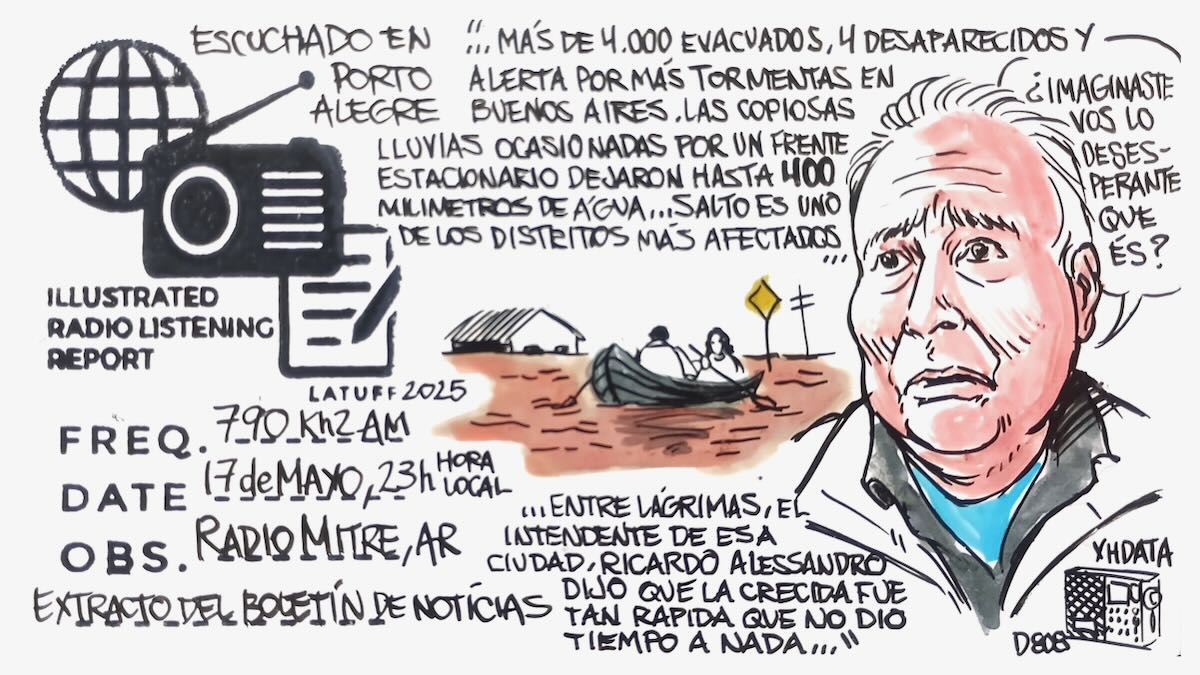
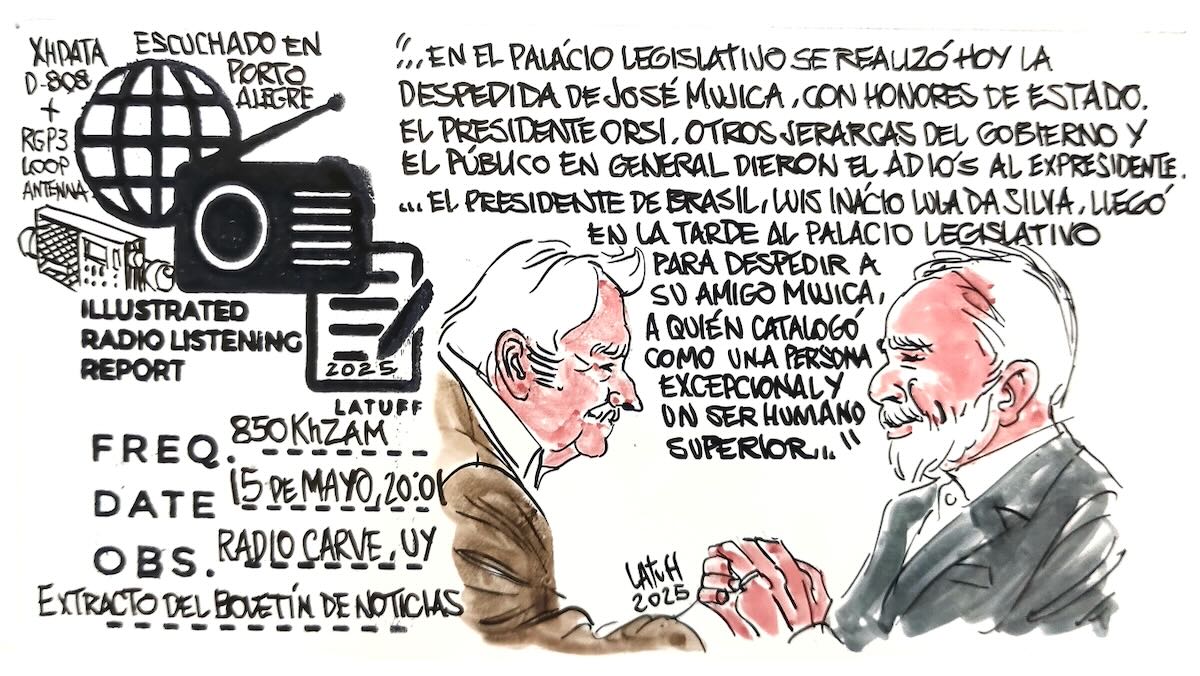
Many thanks to SWLing Post contributor and noted political cartoonist, Carlos Latuff, who shares illustrated radio listening report of recent Radio Nikkei 1 and Radio 2 broadcasts.


Carlos notes:

Radio 2 from Rosario, Argentina (1230 kHz MW)

Click here to view on YouTube.

Radio Nikkei 1, Japan (6055 kHz SW)

Click here to view on YouTube.

Alex is back with updated “made simple” shortwave frequency charts

Many thanks to SWLing Post contributor Alex, who has just informed me that he has updated his printer-friendly shortwave frequency charts once again.

Note that Alex creates his charts based on listening to broadcasters rather than importing schedules from other sources.

You can download his chart in PDF format by clicking here.

Carlos Explores the Sony ICR-N20: A Unique Radio Nikkei Experience from Brazil

Many thanks to SWLing Post contributor, Carlos Latuff, who shares the following guest post:


SONY ICR-N20 Quick Review

by Carlos Latuff

In the last century, several Japanese electronics manufacturers such as Sony, National-Panasonic, Hitachi, and Sanyo produced radio receivers aimed at the Japanese public and which had a peculiar characteristic: they came with crystal lock, preset frequencies from Radio Nikkei, which in the past was known by the acronym NSB (Nihon Shortwave Broadcasting) or “Radio Tampa”. For more information about this station, check out this post.

One of these models is the Sony ICR-N20, which, based on the date of the instruction manual I found on the Internet, must have been produced in the late 1990s. The device measures 150 mm × 75 mm × 36 mm and weighs 400 grams (with batteries). It has a 6.6 cm speaker (8 ohms) and a headphone output.

This device is analog and operates on the following frequencies:

Shortwave:

  • NSB1 3.925 MHz, 6.055 MHz, 9.595 MHz
  • NSB2 3.945 MHz, 6.115 MHz, 9.760 MHz
  • MW: 530 kHz ? 1.605 kHz

Currently, Radio Nikkei only broadcasts on two frequencies: 6.055 and 6.115 MHz.

It has a 7-segment telescopic antenna. No input for an external antenna.

It works on electrical power (DC 4.5 V) or 3 AA batteries.

As it’s primarily intended for the Japanese market, the buttons and dial panel are written in Japanese.

I have no complaints about the selectivity and sensitivity of the Sony ICR-N20 when it comes to medium waves. At night, in Porto Alegre (in the extreme south of Brazil), it was possible to receive (indoor) stations from Uruguay, Paraguay and Argentina, but due to its proximity to these countries, this is not such a difficult task. It’s not a receiver for the most ardent DX fan, but it does a good job of being a radio for regular, everyday listening.

In the case of shortwave, I was able to receive the signal from Radio Nikkei 1 and 2 close to the Guaiba waterfront. The signal from active frequencies is weak, but audible. With favorable propagation, the reception is sometimes surprising. Following the instructions in the instruction manual, I used a long wire antenna for better reception.

In my region, the most favorable propagation window is between 08:45 and 09:15 (UTC), and yesterday, for example, February 7, 2025, the signal reached well until 10:00 (UTC). On other frequencies, it is even possible to hear other stations, such as China Radio International, and even amateur radio interference. Remember that this is not a radio receiver with all shortwave frequency bands, but only those in which Nikkei Radio 1 and 2 operate.

Here are some of the listenings made with this receiver.

Radio Nikkei 1: February 7, 2025

Radio Nikkei 1: February 7, 2025

Radio Nikkei 1: February 4, 2025

Listening Session Video