Shortwave listening and everything radio including reviews, broadcasting, ham radio, field operation, DXing, maker kits, travel, emergency gear, events, and more
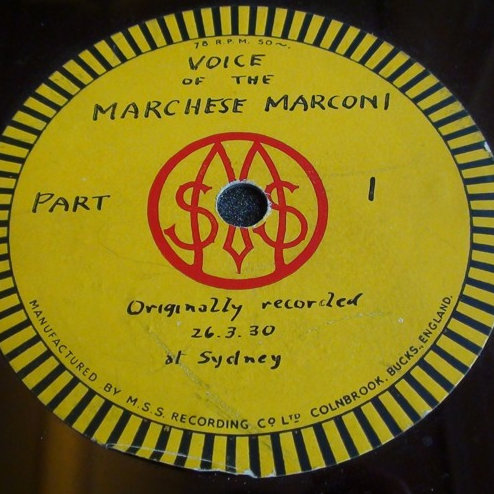
The Essex Record Office has published a recording of a speech made by Guglielmo Marconi in 1935. You can listen to the recording by clicking here or listening via the embedded player below (description follows):
“Second part of a speech made by Guglielmo Marconi on the occasion of the unveiling of the ‘Fisk Memorial’ at Wahroonga, Sydney, New South Wales, Australia on 14 December 1935 (the disc is incorrectly labelled). The ‘Fisk Memorial’ commemorates the first direct wireless message sent from the U.K. to Australia, in 1918.
In the speech, Marconi forecasts the impact that wireless communication will have on ship navigation, but also the world economy generally. Would he be surprised by how accurate he was in his prediction that ‘no country can make much headway’ without such technology?”
Many thanks to SWLing Post contributor, Dan Robinson, who shares a radio comparison he initially posted in the excellent Extreme Shortwave Listening Facebook group. Dan writes:
When the Sangean ATS-909X was first released a few years ago, I decided that I would hold off obtaining one to let whatever bugs there might be in production get worked out.
I have always been impressed by the design of the 909X, but was cautious when it came to the question of overall sensitivity. I once owned the 909, had it modified by Radio Labs, but that seemed not to do much — the 909, in my view, suffered too much from the well-known deafness issue when using the whip antenna.
Over the years, I used and still own many of the classic portables. This includes the SONY 7600GR, Grundig SAT 500/700, 2010, E-1, SONY SW100/SW07, SONY SW-55, and the radio I consider to be at or near the top of the small portable heap, the Pan RF-B65. But a couple of weeks ago, I broke down and bid for a new in box Sangean 909X. It’s the black version, and arrived a couple of days ago.
I remain impressed by the 909X’s design — beautiful radio, wonderful large LCD and backlight, excellent filtering, along with a feature we used to see in the SONY’s — adjustable/variable attenuation. But I wondered how the 909X would stack up against two of my favorites, the SW-07 and RF-B65. I was crossing my fingers — but alas, initial results are not encouraging.
While the radio initially on its own seems to be quite sensitive, I lined it up next to the SW-07 and RF-B65 and did a comparison. Now, first I must note that propagation continues to be in the dumpster and I conducted this test in late afternoon.
All three receivers were tuned to Cuba on 11,760 khz — they were located next to one another on a table in the top level of my home here in Maryland. The results are seen in the video below.
You can hear how much more clearly the SW-07 and especially the RF-B65 handle a signal. With the Panasonic, stations just pop. Same with the SW-07.
Disappointingly, as you can hear, stations on the 909X appear to be buried in noise. It’s quite extraordinary — I was very surprised by this comparison and intend to perform additional side-by-side tests in different areas of my home, which does suffer from high noise levels likely produced by electric lines and a transformer outside (which is why a run a Wellbrook on my main radio stack downstairs). But it is notable that the 909X appears to struggle so, while the old classic portables SW-07 and B65 excel. Interested in the views of others . . .
Dan, this is very similar to my experience with the Sangean ATS-909X.
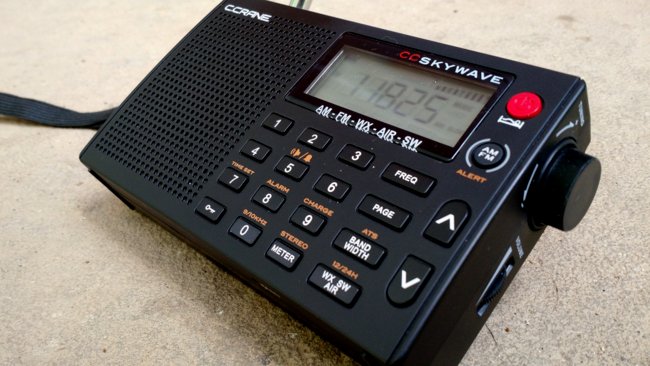
I find that the Skywave is so stable on the air band, I can use it to decode ACARS with the Android App!
Listened to WBCQ, and Arnie Coro’s show last night from Havana along with some Jazz music.
It pulled FM stations out of the air like nothing else, meaning the weaker ones here in my rural Ohio location. And I could pick up three NOAA broadcasts, two very strong, one scratchy…. Since the NOAA system is of course designed to let you pick up one station in whatever particular area of the county you live in, I consider this excellent!
With the AM I pulled in Canadians, Boston , stations in IOWA and KFI. I also note it’s very directional on AM… I could null out WTVN and pick up Texas with no problem. I have owned and do own lots of shortwave radios, and I MUST say, this is one hell of a good set!
It’s going into my Winter zip-up jacket pocket so it will always be handy for the DX Season, and I also notice that the headphones are VERY good, and have a long enough cord so it’s not pulling at my ears like some sort of damned harness… I HATE short earphone cords!
(And while I am on the subject of ear phones, and while I haven’t been zapped in the ear with static this year yet by dry air causing that annoying problem, I wonder how these earphones are going to do in that regard… the Sony’s are unbearable in Winter! Ouch! I wonder if anyone else out there has this problem besides me, and has found a solution?)
First of all, thank you for making me aware of the ACARS app and that you can successfully use it with the CC Skywave. I will add the ACARS app to my growing list of HamRadio/SWL applications and also try it myself!
Your experience with the CC Skywave is very similar to mine. It is a fabulous portable receiver. If it only had SSB and sync detection, it would be the ultimate compact portable. The CC Skywave is an everyday carry (EDC) radio for me–either it, or the Sony ICF-SW100, accompany me everywhere in my Timbuk2 messenger bag.
Regarding static discharge from headphones, I don’t think I’ve ever had this happen to me; sounds annoying, though! I suppose walking in dry winter conditions with a thick winter jacket could increase chances of discharge. Perhaps the in-ear design of the included CC earbuds–with silicon earpieces–will minimize and insulate you from this problem? Let us know!
Thank you for your assessment of the CC Skywave, William!
After learning about the new Tecsun S-8800, yesterday, I contacted Anna at Anon-Co and asked for any information regarding specs and availability. Anna replied:
“Regarding the S-8800, there is no information available of when this will be actually launched. I think that the absolute earliest could be some time in January, but I expect that it will be after Chinese New Year. To be honest, it is very difficult to say at this moment. There isn’t much information available about it yet.
Supposedly it is pretty much the same [chassis design] as the existing BCL-3000, but it will be a PLL radio with DSP IC. It should have SSB features, but other details (like SYNC) I’m not aware of at this moment. I’m hoping to hear more about this soon.
Anna will contact me as soon as she has more info about the S-8800 features and availability.
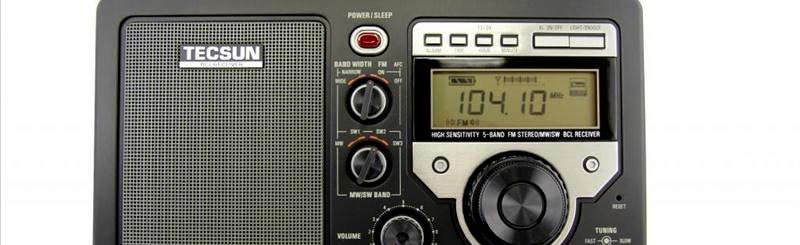
It seems that Tecsun has a new large portable in line.
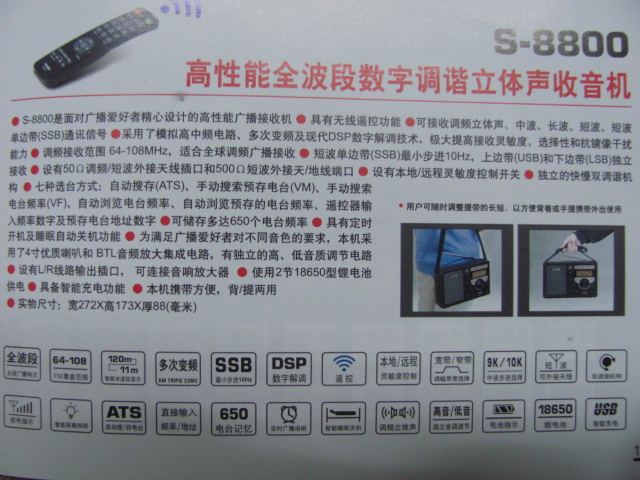
Someone posted a photo of a new Tecsun product catalogue which shows a new model S8800.
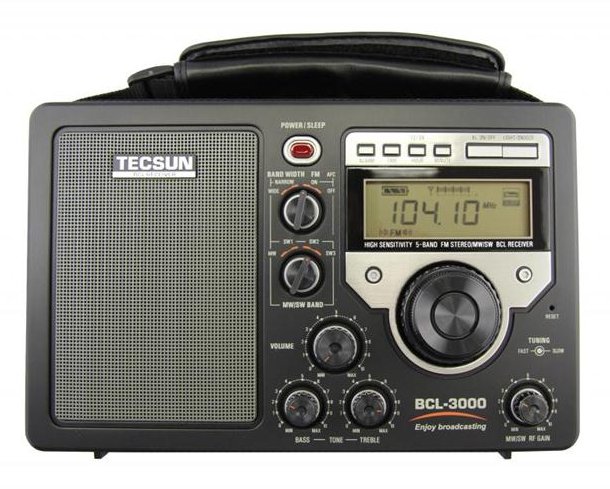
The Tecsun BCL-3000 for comparison.
Apparently it uses the housing of BCL3000 [see above] and is multiple conversion (so a PL880 inside?), DSP based with separate LSB/USB and 10Hz minimum tuning step, and comes with a remote control (for direct frequency input?). Two 18650 batteries are used.
Photo source: http://bbs.tecsun.com.cn/ via OWL. Click to enlarge.
Photo source: http://bbs.tecsun.com.cn/ via OWL. Click to enlarge.
[Here’s a] link to the post in Tecsun’s web forum:
Many thanks for sharing this find, OWL! This is a very curious development from Tecsun.
I can imagine why Tecsun is re-using the BCL-3000 (a.k.a. Grundig S350DL) body–not only is it roomy inside, but it’s proven to be a popular large portable form factor over the years. Of course, since this is an existing chassis design, design/development costs will be minimal. If Tecsun is including a remote, I’m sure OWL is correct: it’ll aid with direct frequency entry. The S-8800 will be the first portable shortwave radio with remote control I’ve seen in many years.
If audio is anything like its predecessors, I would expect rich fidelity from the built-in speaker. In terms of performance, though? This is a completely different receiver than the single-conversion BCL-3000, so only time will tell.
I’ve been traveling along the coast of South Carolina this week, and on Thursday, I found myself in the historic town of Conway, South Carolina. I parked downtown and strolled into the past via Papa’s General Store, a small local store with a lot of merchandise––and a lot of charm.
While browsing a display of antiques, I happened to notice a vintage radio perched on a high shelf. Here’s what caught my eye:
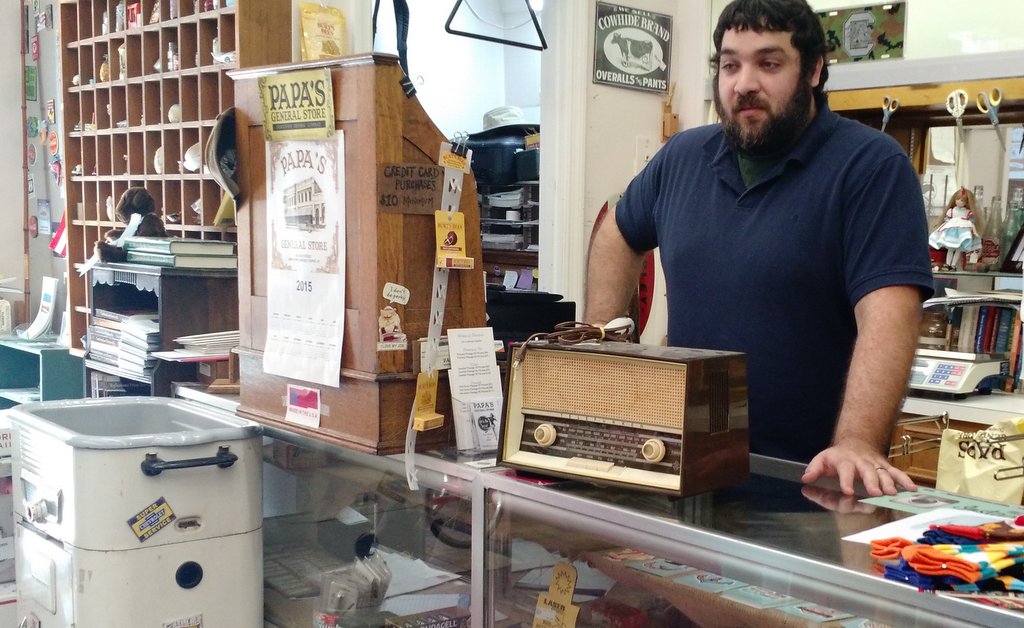
I asked, was the radio was for sale? And, indeed, it was. One of the sales clerks pulled it from the shelf, dusted off the top, and read the price: $74. I noted that it was a West German Telefunken receiver. I asked the clerk, Chris, if it worked, and he confirmed that it did; it belonged to his uncle, who had clearly taken very good care of it.
Chris allowed me to plug it in, turn it on, and tune in a couple of local stations…The Telefunken produced beautiful audio without even the slightest hint of a hum. Chris was pleased that I appreciated the radio, and sincerely wanted me to take it home, so he lowered the price a bit further. I agreed, and purchased it without hesitation. Just couldn’t help it…
Chris behind the counter with his uncle’s classic Telefunken.
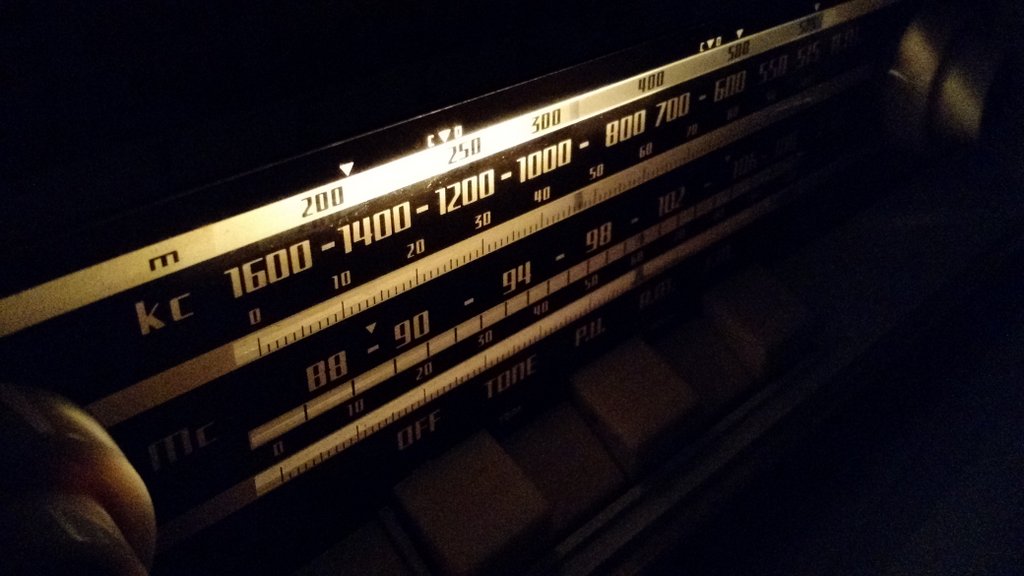
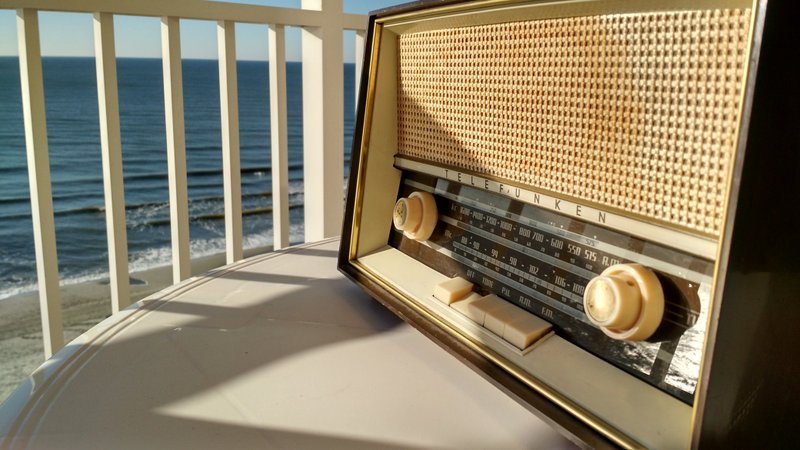
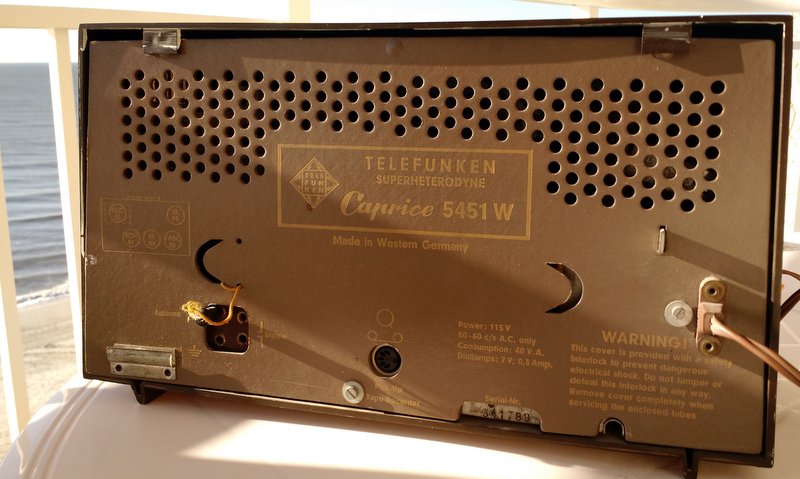
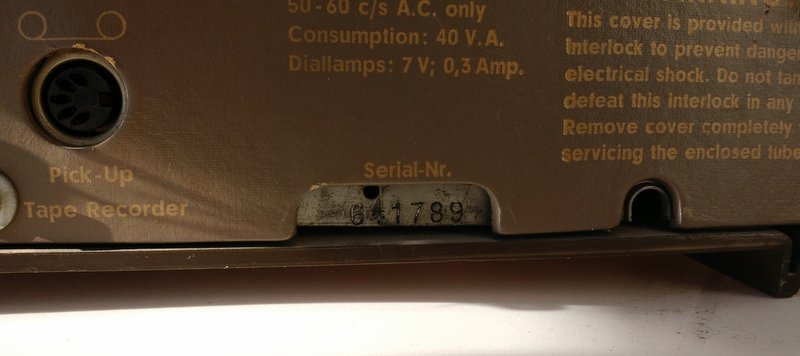
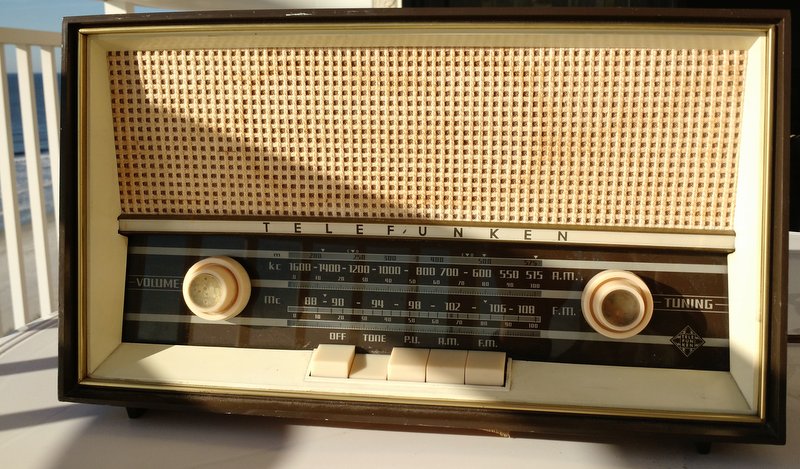
The Telefunken Superheterodyn Caprice 5451W covers the AM/mediumwave band and FM. It’s a tube radio produced in the early 1960s in West Germany, and is now the only tube-based radio I own that covers the FM band.
Of course, I was very eager to get the Telefunken on the air, so that afternoon I headed to our balcony overlooking the Atlantic, tuned around a bit on the mediumwave band…and was simply amazed at all it could receive. I picked up my smart phone, and with it made a very short recording of the Cuban station, Radio Reloj, on 820 kHz:
My smart phone’s microphone doesn’t begin to do the Telefunken’s rich audio justice, but you can clearly hear Radio Reloj’s ticks and “RR” in Morse Code at the top of the minute (indeed, if you’re listening with headphones, you may also hear crashing waves in the background). Something nearby generated a lot of RFI right on frequency, too , but the rest of the broadcast band had a surprisingly low noise floor.
I also spent some time with the Telefunken on the FM broadcast band; with a simple wire antenna, this worked wonders.
In my humble op, the audio the Telefunken produces is simply beautiful. And so, I’ve got to add, is this vintage radio. See for yourself.
Please support this website by adding us to your whitelist in your ad blocker. Ads are what helps us bring you premium content! Thank you!