Category Archives: AM

BBC World Service Radio Archive: how you can help

The BBC World Service Radio Archive (Prototype) contains over 50,000 digital recordings, spanning 45 years of the World Service; indeed, more than the BBC can tag and categorize by hand. Read below to learn how you can create a login with the archive, browse, listen to and tag recordings if you wish.

(Source: BBC Research and Development)

BBCWSArchive

BBC Research & Development is running an experiment with the BBC’s World Service radioarchive to demonstrate how to put large media archives online using a combination of algorithms and people. With your help we aim to comprehensively and accurately tag this collection of BBC programmes.

This prototype website includes over 50,000 English-language radio programmes from the BBC World Service radio archive spanning the past 45 years, which have all been categorised by a machine. You can explore the archive, listen to the programmes and help improve it by validating and adding tags.

[Click here for more details…]

Many thanks to Mike Barraclough for the tip!

AM sync lessens noise in this The Voice of Greece broadcast

TheParthenonAthensSometimes, the Voice of Greece plays very little Greek music; October 10th was one of those occasions.  Nonetheless, I recorded that evening’s broadcast.

Using AM sync for sideband noise

In the first hour of the 10/10 VOG broadcast, you’ll hear a pulsating noise from an unknown origin (possibly a jammer?). The noise was centered about 20 kHz above VOG.

Fortunately, most of the noise was in the upper side band of the VOG signal, so I was able to mitigate it by using an AM sync lock on the lower side band. Without AM sync, this VOG broadcast––and its music mix––was almost inaudible.

If you have a synchronous detector on your receiver and tune in a station with interference, always try turning on sync lock and locking it on either the upper or lower sideband. If most of the noise resides in one of the sidebands, the lock can help tremendously. I often use this method while listening to AM pirate radio stations in noisy conditions.

A confession…

I have no idea what she’s talking about–it could be something absolutely mundane–but I love this radio host’s voice as she speaks and Pink Floyd’s Comfortably Numb begins(Start listening around 26:00)

Click here to download more than two hours of the Voice of Greece, recorded on October 10, 2013, starting around 03:15 UTC on 9,420 kHz, or simply listen via the embedded player below. Most of the noise disappears around 00:21:

Thanks to US shutdown, pirate radio activity reaches an all-time high

Pirate flag-001As frustrated as many are over the US government shutdown, it nonetheless offers one unique benefit to the shortwave radio community, and to pirate radio in particular––no FCC enforcement.

As we mentioned earlier, the FCC’s enforcement arm was shut down along with all other FCC activities that weren’t directly connected with “the protection of life or property.”

The result?  Pirates––lots of pirates––on the air! The Jolly Roger flaps in the breeze…

Pirate radio activity since the shutdown has truly been at a record high, with pirates taking to the airwaves throughout the week, and especially on the weekends.

Case in point: this past weekend, the North American “pirate radio grounds” of 6,920-6,970 kHz were packed with pirate radio stations.  There were even crowded band conditions; at one point I tweeted that there were no less than three pirates broadcasting simultaneously in just a small chunk of bandwidth on AM. Indeed, there may even have been a fourth that I couldn’t quite detect…An unusual occurrence, to say the least.  And with pirate radio’s favorite holiday, Halloween (think War of the Worlds), fast approaching, there’s likely to be more such unusual activity.

In the meantime, check out a few of our recent pirate radio recordings.

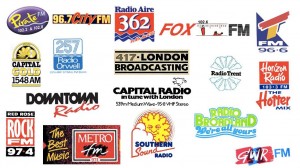
40th Anniversary Montage of ILR Radio Stations

IRL-StationLogosHat tip to Mike Barraclough for sharing a link to this audio/video montage on the BBC website celebrating the 40th anniversary of Independent Local Radio (ILR) with air check clips from stations across the country.

Even if you have never lived in the UK, there’s some serious radio nostalgia in this montage.

Many of these ILR stations still broadcast today, and you can listen to the majority of them via TuneIn radio.

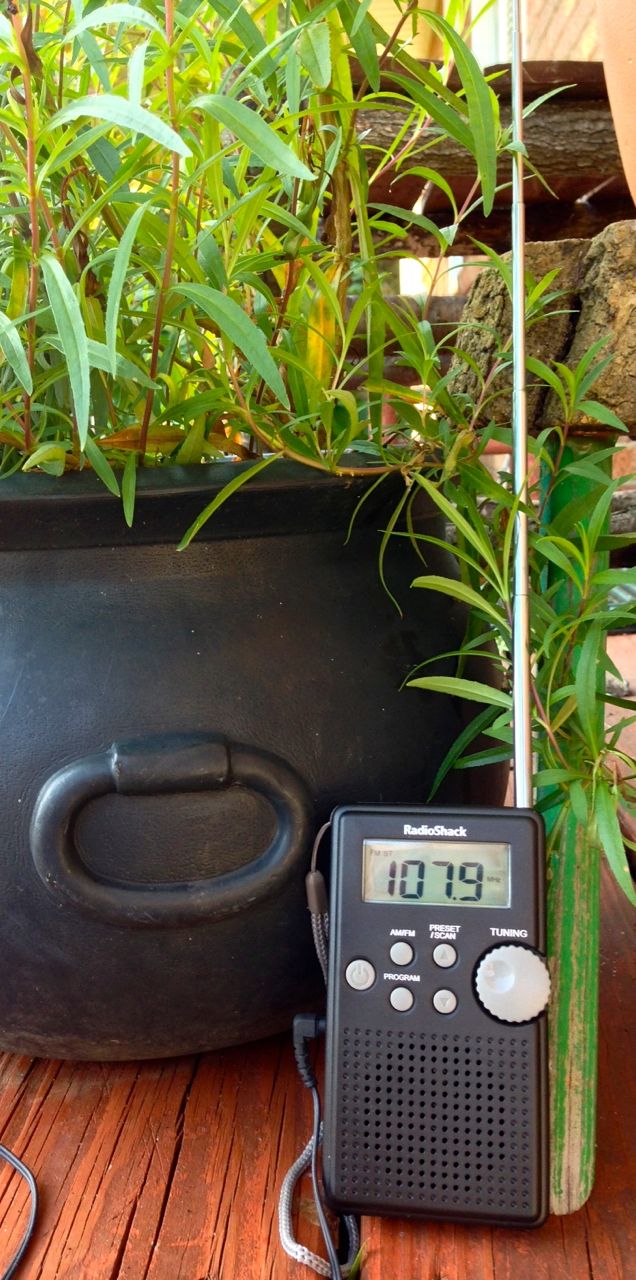
Review of the RadioShack AM/FM portable digital radio, Model 12-587

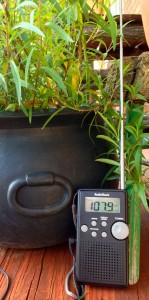
The RadioShack Model 12-587 AM/FM Radio

The RadioShack Model 12-587 AM/FM Radio

Three days a week, my father––now in his seventies––takes a three mile walk through his home town, revisiting the neighborhoods of his youth. He began the walks upon retirement, and in my opinion, the routine has helped keep him in great shape. When he first started walking I learned he was carrying around a heavy AM/FM radio with him.  I bought him a bargain one-off Coby AM/FM portable that is not only lightweight but sports a handy neck strap. Dad’s loved it. Indeed––much to my surprise––it’s lasted about ten years, and is still playing, although starting to show signs of wear…

So I decided it was time to test drive a suitable replacement. After searching, I found the RadioShack Model 12-587 AM/FM radio. At a clearance price of $14.99 (US), there will be no loss of sleep if Dad misplaces it or drops it on the pavement.

Still, I couldn’t resist giving it the once-over, and thought I might share the mini review that resulted. As I always say for radios in this price range, my expectations were low.

Here’s a summary of this little AM/FM radio’s pros and cons:
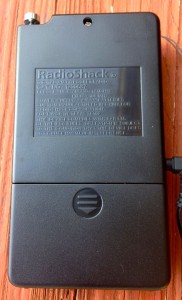
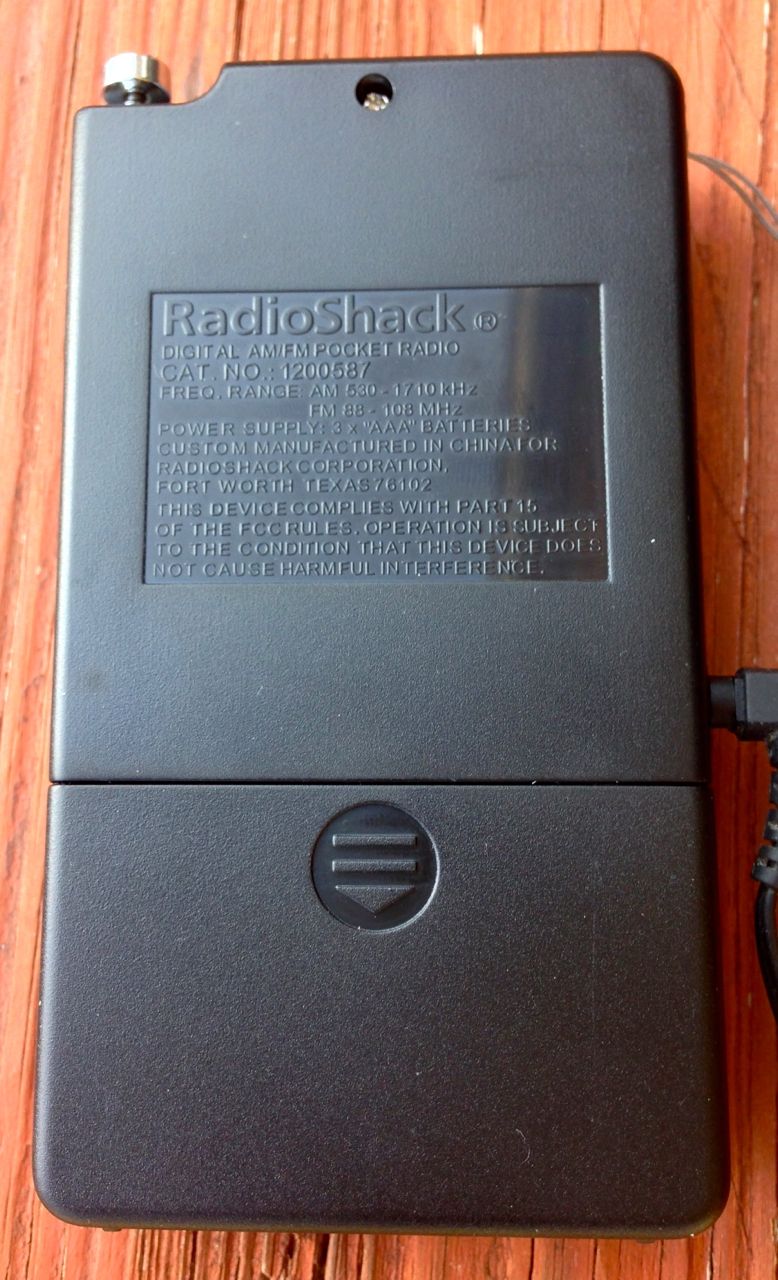
Back of model RadioShack 12-587

Back of model RadioShack 12-587

Pros:

  • Very good FM selectivity and sensitivity
  • Excellent FM stereo lock
  • Scan function both useful and quick
  • 10 AM and 10 FM memories (see con)
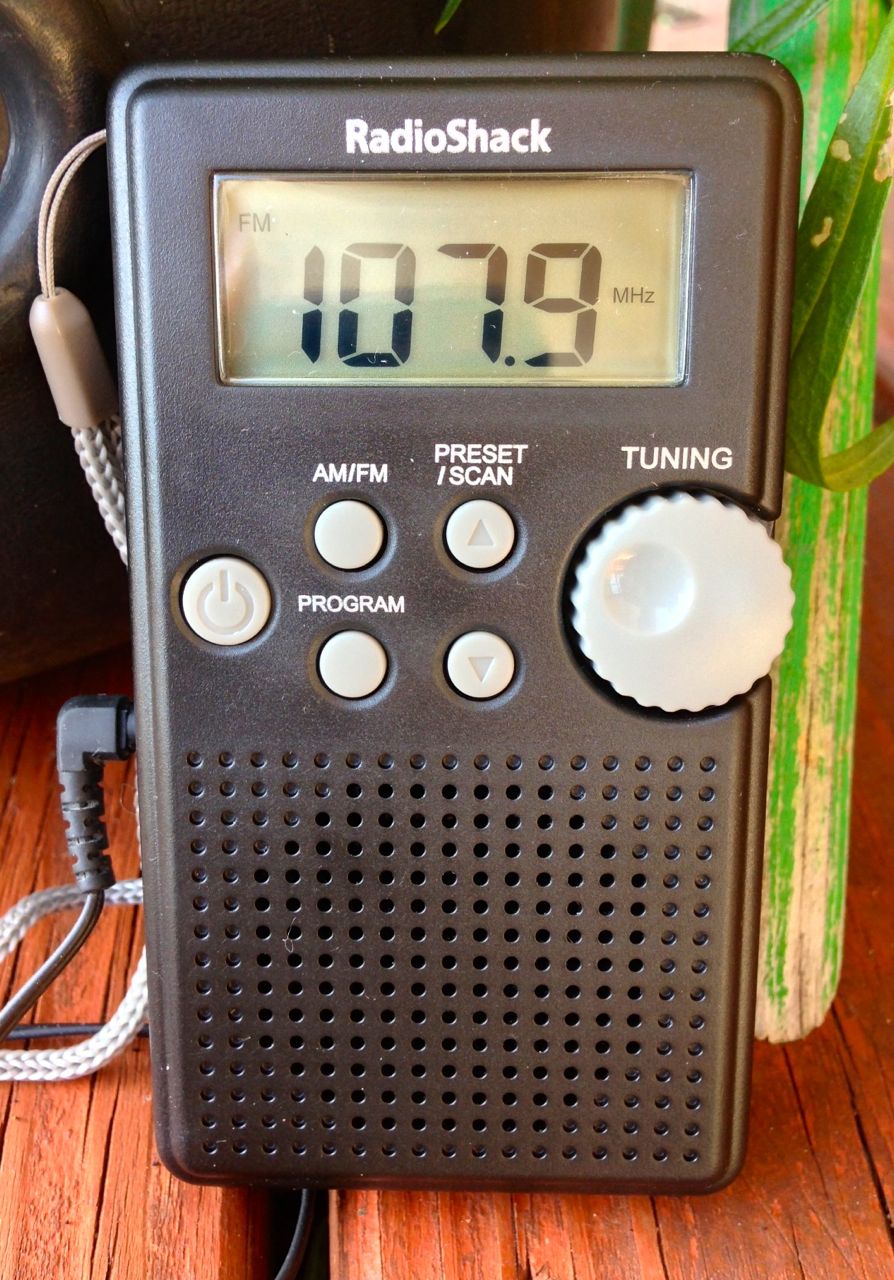
  • Large, amber back-lit LCD display
  • Simple control lock switch on right side
  • AM (medium wave) sensitivity adequate
  • AM nulling above average
  • Plastic “blister” packaging very easy to open!

Cons:

  • Tinny sounding audio via built-in speaker
  • Headphone audio lacks high/low; mid-range only
  • Memory allocations supposedly volatile (when batteries are replaced)
  • AM frequency steps fixed at 10 kHz (cannot adapt to 9 kHz steps used in rest of the world)
  • AM (medium wave) sensitivity mediocre at best
  • Complete mute while tuning; not capable of band-scanning
  • Dimple on tuning knob not useful
  • Very sensitive to noise (QRM) on the AM band, resulting in static popping/crackling in audio

Obviously, this is not a radio for the radio hobbyist or world traveler, as it lacks any real medium wave sensitivity and cannot tune in 9 kHz steps. FM tuning is also locked on odd frequencies, thus will not work throughout parts of the world with even spacing. And though the radio is touted as having “extended bass,” the audio is tinny, even via headphones.
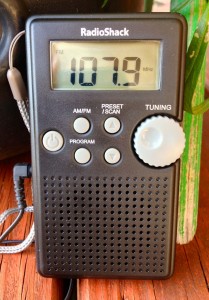
RadioShack-Model12-587-AMFMRadio-2BUT.  This is a perfect example of a situation in which, though cons outweigh pros, the RS Model 12-587 is a great match for its intended purpose: my father’s morning walks. Why? It’s a simple-to-operate radio with a large, back-lit display (Dad won’t need to put on his glasses to read it). It receives local AM and FM stations very well. The mid-range audio––while lacking ample fidelity for music––are perfect for the talk shows he listens to while walking. The radio is durable, lightweight, easy to tune, and has a lock feature. It is also remarkably easy to program memories: simply press the program button until preset flashes in the LCD display, use the scan up/down buttons to choose a memory number then press program again.  It’s also very affordable, so no problem to replace as necessary.

In conclusion, the RS Model 12-587 is not a performance radio––and I wouldn’t generally recommend it––but it suits my father’s needs very well.  Like to walk or run? Maybe it’s just what you’re looking for, too.

The Tuckerton Tower’s long (and unlikely!) history

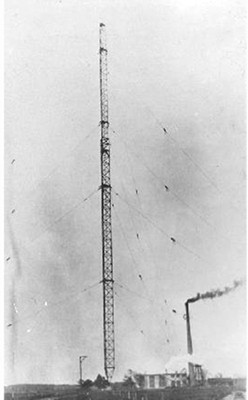
The Tuckerton Tower circa 1916 (Souce: Tom Mcnally mcnally.cc)

The Tuckerton Tower, circa 1916 (Souce: Tom Mcnally mcnally.cc)

I love radio history, and I dive right into it when something especially piques my interest. This morning, a news item from a local newspaper in New Jersey about that state’s famed, but nearly forgotten, Tuckerton Tower did just that.

Built in 1912, the Tuckerton Tower was once the tallest structure in the US.  Indeed, it was at that time the second tallest structure in the world (the Eiffel Tower had it beat by 243 feet).  Though on US soil, it was originally built by––get this––the German government, in order to communicate with an identical tower in Eilvese, Germany (see comments); of course, it also communicated with naval vessels. According to many sources, the US government may have been completely unaware of the construction of this communication monolith until it neared completion.

But that’s just the beginning of the story:  When the US entered WWI, the US government took over the tower’s operations and placed Tuckerton’s German operators and engineers in a POW camp.  Then, post-war, the newly-formed Radio Corporation of America (RCA) assumed the tower’s operation with the intention of using it for the latest and greatest innovation in radio communications: voice over wireless. Tuckerton Tower continued under RCA’s operation until the US government drafted it into service again, this time during WWII.

But even though the tower survived two world wars, weather events like nor’easters, and The Great Depression, by the late 1940s it was considered obsolete. Several attempts were made to preserve the historic structure, but on December 28, 1955, it was torn down and cut for scrap.  Today, a lower section of the tower can be viewed at the Tuckerton Historical Society’s museum, while the concrete block anchors that once held the monolithic structure upright now rest, somewhat defiantly, in the center of a residential area.

If you find this tower’s history as remarkable as I do, check out this informative and detailed article in The Sandpiper and Tom McNally’s History of Tuckerton Wireless which includes some excellent photos of the tower throughout history.

Are there any readers of The SWLing Post with memories long enough to remember the Tuckerton Tower, or who have heard stories about it?  Please comment!

The Take Away interviews Ajit Pai

AjitPaiMany thanks to Dan Srebnick for sending a link to this piece on The Take Away.

In The Quest To Save AM Radio, John Hockenberry talks about AM radio nostalgia and then interviews Ajit Pai (who was mentioned in a post a few days ago).

Click here to download an MP3 of the interview or simply listen via the embedded player below.