Category Archives: AM

2+ Hours of Voice of Greece Jazz

If you need a little jazz music in your life today, you’re in luck. Saturday, I recorded over 2 hours of jazz programming from Voice of Greece (see update below) on 9,420 kHz starting around 20:00 UTC on a Microtelecom Perseus. Propagation was good, and other than an occasional static crash, fidelity excellent for the SW bands.

You can listen via the player below, or simply download the MP3 by clicking here.

UPDATE: Once again, this long stretch of music with VOG was due to a strike. SWLing Post reader, Christos, comments below:

Another strike-day of ERT, so another non-stop recording for you. On Saturday they played jazz and on Sunday they continued with Greek music. Doing an exception this time, because of the coming general elections on 6th of May, they provided short news bulletins every hour, along with the usual announcements “we are on strike for our rights”. I enjoyed the same program from local FM. It was the only program transmitted from all national networks in both FM and medium waves. I visited the ERT Radio House, (Radiomegaron), the day before your recording was made, to attend a concert and I took a photo of a banner of VOG, in Greek.

Christos kindly sent me the following ERT image with the Voice of Greece in Greek:

ABC video highlights the Dooen transmitter on World Radio Day

The Dooen tower "hat" (photo: ABC)

(Source: Australian Broadcasting Corporation)

Standing 201-metres tall with a 19-metre wide capacitive ‘top hat’, the 3WV mast in western Victoria stands out in the vast flat landscape that stretches below it.
Celebrating 75th years of service, the occasion of World Radio Day seemed a worthy time to pay tribute to this impressive technological structure.

“It really meant a lot to us. It must’ve been a big undertaking in 1936 to build it because cranes and things that are about today weren’t even heard of,” says long time Horsham resident James Heard.

And while the locals are proud of the trusty Dooen mast, its power reaches far wider than just this wide brown land.

In fact 594 AM has even been heard as far as Canada, Japan and South Africa.

The staggering reach is aided by the distinctive ‘top hat’ and the low frequency of the AM band. While obviously a success, the antenna was the first of its kind in Australia and acted as a prototype for other services.

“It’s the first solid-state 50-kilowatt broadcast transmitter installed for the ABC and it was the test bed for the installations across the rest of the country,” says Tim Hughes, Transmission Coordinator for ABC Victoria.

So whether you’re tuning in from snowy Canada or just down the road, thanks be to the 3WV transmitter.

I’m sure many an ultralight DXer would like to snag this transmitter! Watch the 3+ minute video on the ABC website.

John Allen keeps radio history alive

(Source: Delmarva Now)

A fat and sassy black cat purrs in John Allen’s lap. Relaxing in his favorite chair, Allen’s fingers vanished into the silky fur as he stroked his cat while listening to the Big Band sounds coming through a 1930s radio.

With its warm wood finish and the soft yellow glow of light from the dial, the vintage radio is as soothing as the thin shadows in the room.

[…]Stacked neatly in his living room are a dozen or so radios from the past. The sets are piled several deep. Other are stored in his shop, tucked tightly on shelves.

[…]”Maybe if you count the regular radios, the military radios, and the spy radios, I might have a little more than 200,” he said.

That’s right, he said “spy radios.”

Click hear to read the full story on Delmarva Now. If you like this sort of article, you have to check out the BBC radio documentary on Gerry Wells.

Where radio history and art meet: An interview with Geoffrey Roberts

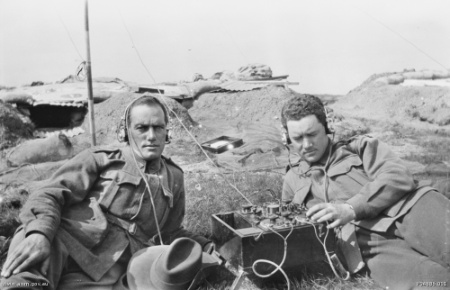
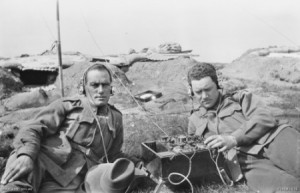
Fanciful and functional: A Marconi Mk III crystal shortwave tuner set in the service of Australian signallers. (Photo: Wikimedia Commons)

At the SWLing Post, we love radio history and that of technology in general; clearly, steps taken in our past indicate how we will blaze trails into our future. But that’s not the only reason to appreciate vintage technologies.  Developed in an environment with limited resources and infrastructure, the forms these technologies often took were resultingly unique:  hand-wrought, self-servicing, robust, efficient, interactive, engaging, elegant, and sometimes truly magical.  In other words, an art form.

And in the world of radio, form simply couldn’t follow function more intimately than in a crystal radio.

Even the name is magical, suggesting, perhaps, a receiver which culls sound waves from clear stone, or unleashes ancient voices long immured in ice.  But a crystal radio has yet another mystery up its sleeve:  it has no power source. These sets are passive receivers, meaning that while other radios use a power source (usually electricity) to amplify radio signals, the crystal set draws power from radio waves received via a long wire antenna. It’s the simplest type of radio receiver, and can be made from a few inexpensive parts, like an antenna wire, a tuning coil of copper wire, a crystal detector, and  earphones.

My first crystal radio set was made with a Quaker Oatmeal box, a bunch of wire, and a small earpiece.  Nothing elegant about it, but it was nonetheless magical, as I listened to the sound waves it drew from the ether.  Ultimately, all crystal radios have the same components as my oatmeal box variety–a tuning coil of copper wire, crystal detector, antenna and earphones–but fortunately not all follow the oatmeal box design. Indeed, some are worthy of an art museum, such as London’s Tate.

Introducing Geoffrey Roberts
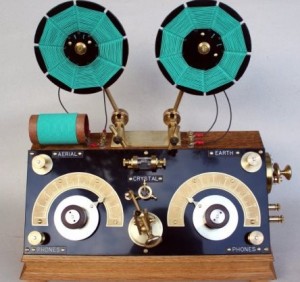
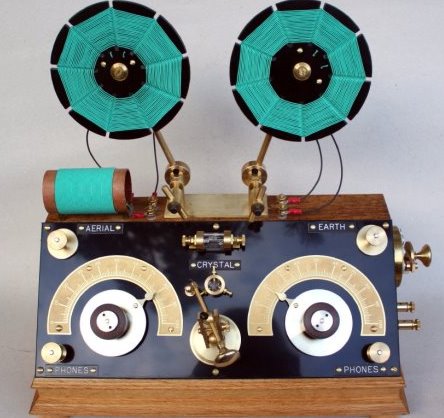
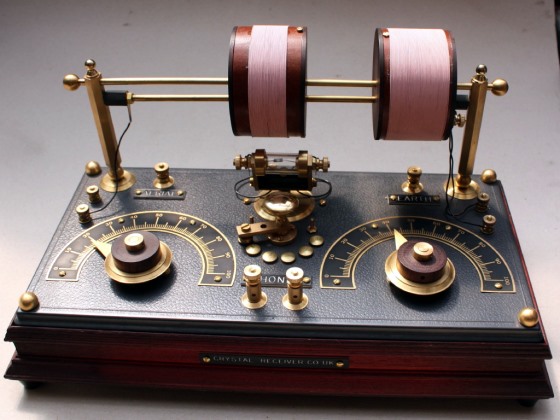
Geoff Roberts' "HGW1 Time Machine." A crystal radio like no other. The Time Traveller would feel at home in front of this machine. (photo: Geoffrey Roberts

One glance at Roberts’ collection of hand-made crystal receivers, and it’s clear one is in the presence of a remarkable artist.

Roberts’ designs are very much inspired by the earliest crystal radios, and he also takes cues from classic science-fiction. The stunningly fanciful receiver to the right, for example, is titled, “HGW1 Time Machine.”

Indeed, his crystal sets would be absolutely at home aboard Nemo’s Nautilus or any steampunk time travel machine. They fire the imagination.  It comes as no surprise, therefore, that Roberts was recently asked by the curator of the Tate Britain to exhibit his singularly fascinating works, along with those of the Crystal Radio Club, in a show entitled the ‘Restless Times Exhibition,” which commemorates the work of artisans and artists for the period between the wars of the past century (1914-1945).

We simply had to know more about what makes Geoff Roberts tick, so asked him if he would allow us to interview him for the SWLing Post. He’s most kindly obliged–so with no further ado, I present crystal radio artist, Geoff Roberts.

SWLing: When you design a new radio, from what–or where–do you draw inspiration?
Geoff: When I’m designing a radio I have a particular circuit in mind that I would like to try out, and from the circuit diagram I can visualise what possible layout combinations it could have. The inspiration for the design is based upon a theme that I’m thinking of at the same time as the circuit, i.e., the ‘Time Machine’ or Captain Nemo’s Nautilus.
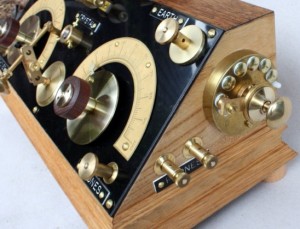
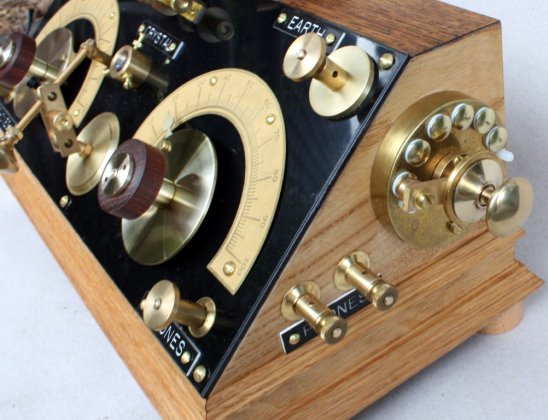
Side view of the HGW1. (photo: Geoffrey Roberts)

SWLing: Do you know what the radio will look like before you start building it? Do you make preliminary sketches, for example, or do you have an image in your mind?
Geoff: There is no initial engineering drawing with my radios; I complete a radio before I have put pen to paper, but there may be some thumbnail sketches of various parts that make up the whole design. Sometimes if I’m having difficulty resolving an idea I sleep on it, and it is more often than not resolved by the morning.

SWLing: Many of your radios are named after classic science fiction authors. Tell us about your relationship with science fiction.
Geoff: I have always had a fascination for science fiction in whatever form it is, be it TV series like Dr Who or Star Trek or the classic stories by Jules Verne or HG Wells. I do not actually read many science fiction novels–I simply do not have the time–it is reserved for practical things.
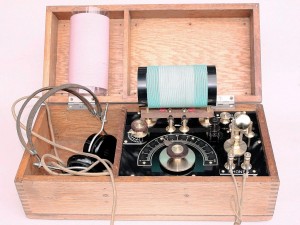
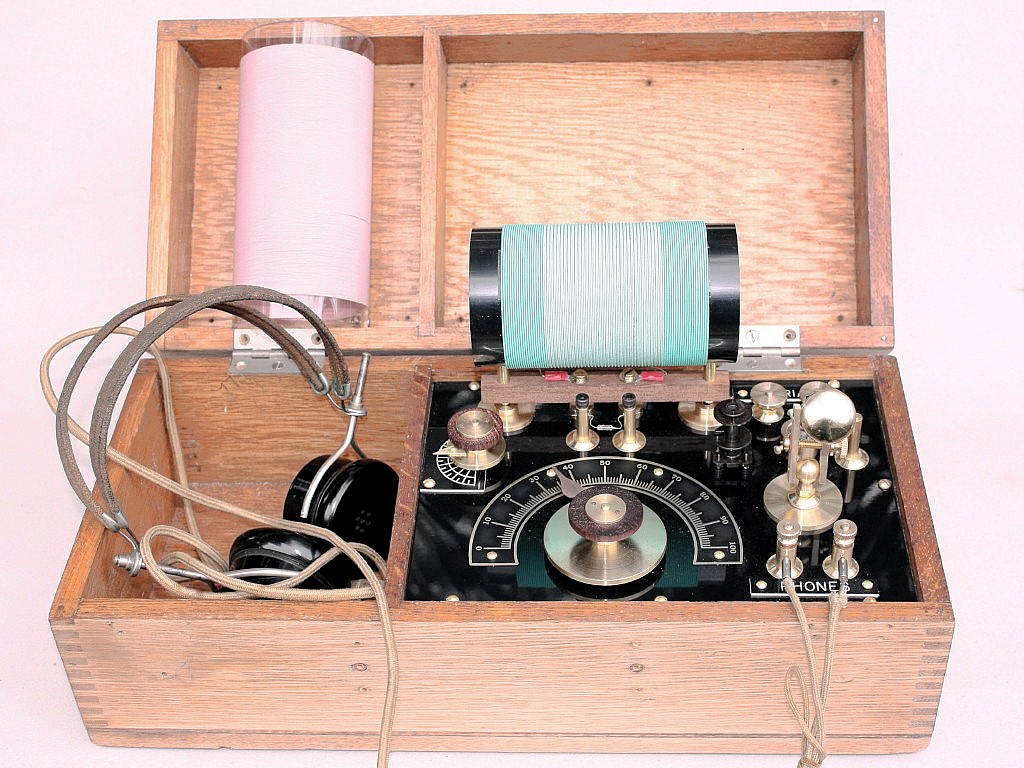
The Heart of Oak Crystal Radio (photo: Geoffrey Roberts)

SWLing: So why do you build crystal sets? Why not more modern pieces of technology?
Geoff: The crystal sets, to me, are a satisfying way to employ the combination of traditional hand craftworking skills and radio or electrical knowledge that I have learnt over years of practical experience. Crystal sets are a timeless electrical device that are just as appropriate today than yester year, possibly even more so in the coming ‘Green Age’ of renewable or low energy useage. It is still an evolving technology with better components, lower electrical loss materials, and Litz wires, plus highly-tuned circuits: these were just not available to the amateur builder many years ago at the dawn of radio. I have built many modern electronic devices employing integrated circuits or transistors, but there is an increasing complexity of circuitry and miniturization that really only favors the robot and not that of a human hand. I keep coming back to a simpler, more satisfying art form that is a collectable piece of equipment, rather than a disposable one.

SWLing: Tell us a little about your history in radio…when did you first become interested?
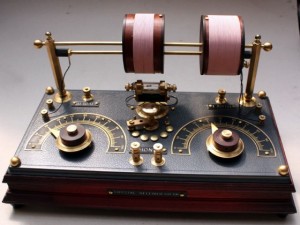
The "Jules Verne" (photo: Geoffrey Roberts)

Geoff: I first became interested in radio at an early age of eleven, when my uncle who used to visit us every Wednesday evening would always bring a small gift or piece of chocolate. One evening he was carrying a small oak box about six inches square. He opened the lid, and there were a few small brass parts on a black face plate.  There were three labels: “aerial,” “earth,” and “phones,” and a big knob in the middle. He connected up a pair of headphones, and put a wire round the picture rail, and one to an earth stake outside just below the back room window. I was amazed I could hear voices and music. I spent most of my early youth listening to pop music from Radio Luxembourg on that old crystal set, sometimes late into the night and under the bedclothes when, unknown to my parents, I should have been sleeping.
From that day onward I was hooked on radio more and more, and built my first crystal set from a toilet roll tube and wire from out of an old transformer that I found on a junk heap on waste ground nearby home.
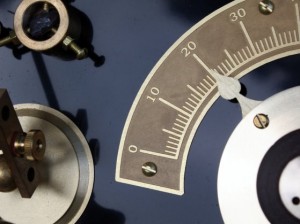
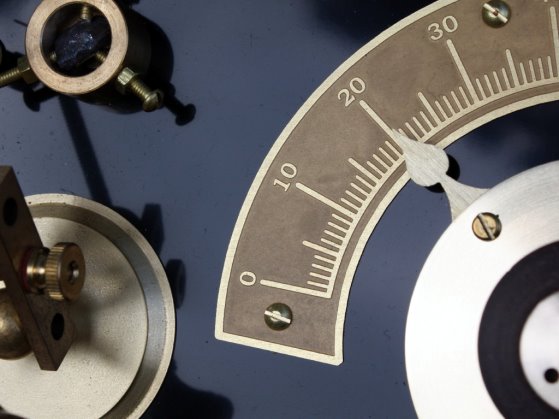
Detail from the HGW1 dial pointer. (photo: Geoffrey Roberts)

I used to cut out the capacitors and resistors and started to make up a collection of commonly used parts. By the age of 12 I had been given a Philips Electronic Engineers Kit for Christmas. This kit was really for kids to learn basic electronics by using a simple breadboard designs.
One evening I built a one-transistor radio from the kit and heard two radio hams talking to each other. This was another big revelation to me in that it was possible to talk to a friend by using radio. It was not long after I had my own license to operate on the radio waves, and started a career with GPO telecommunications just after leaving school–but that is another story.

SWLing: When you listen to radio–on a crystal set, on shortwave or otherwise–what stations would we most likely find you listening to?

Geoff: I still have the fascination with radio now after nearly six decades have passed, and I still listen to my favorite pop music–as it was then, it still is now. Someone said, ‘All you need is Love’ and that is very true…

SWLing: What are your plans going forward? Do you have other radio designs in mind?
Geoff: I plan to build more radios in the next few years and have extended my workshop this year to take in more light engineering equipment. The Dr. Frankenstein radio is in my visualisation as a project; it will be made of spare parts, of course, but not too many dead bodies!! [haha]

SWLing: What was your experience like at the Tate Britain’s crystal radio exhibition?
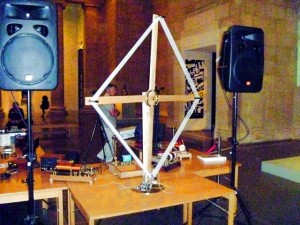
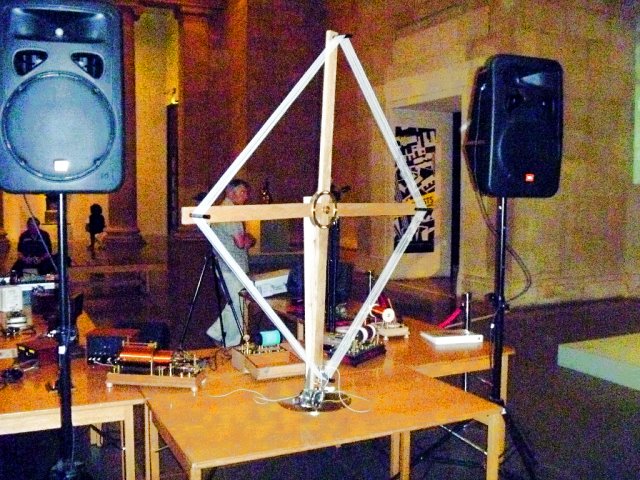
"We did not have the use of a longwire or earth in the Tate Gallery so I made a frame aerial which performed very well inside the Tate considering the building was mostly solid stone and ironwork. (source: Heart of England Crystal Radio Club)

Geoff: It was a wonderful and awe-inspiring experience recently to be invited to exhibit and actually operate some of my crystal receivers in the Tate Britain ‘Restless Times’ exhibition a couple of months ago. A feeling that I will relish for the rest of my life, and that will always give me fresh enthusiasm.

SWLing: If I wanted to buy one of your crystal radios, where could I purchase one?
Geoff: I would be only too pleased to make a crystal receiver to order for you personally to your specification, or to my own design, and you can find full ordering details on my website or by emailing me direct…Thank you for listening to my little story.

Geoff Roberts, G8DHI "Thank you for listening to my little story."

SWLing:  The pleasure was all mine. Thank you, sir, not only for bringing forward such a simple, magical technology, but doing so with such artistry and spirit.  Best of luck!

Post Script
Geoff, you’re one cool guy. Thoroughly enjoyed the interview. Please do let us know when you finish “Frankenstein;” we’d love to publish some photos here, if we may–and warn the public, should it escape!

Many, many thanks to @NW7US who led me to the website of Geoffrey Roberts–Geoff’s Crystal Receivers–and, in turn, to this delightful gentleman, artist, and ham. Sure you’d like him, too.
Resources:


How to turn your AM radio into a metal detector

Really? This radio could find a missing toy?

While watching Curious George on PBS Kids with my four year old, I learned something. In the episode we viewed–“Curious George, Metal Detective”–George needs a metal detector to find a toy robot he’s lost in the sand, but the one he’s borrowed has run out of batteries.  “How about making one?” his scientist friend suggests. Make one? “It’s easy,” she explains: simply by taping an AM radio and calculator together, you can make your own metal detector. George tries it, and–lo and behold–finds his missing toy.

Really? I wondered. Was this PBS show feeding my skeptical children science fiction?

I quickly googled the notion, and apparently, it works!  Watch the video below for a tutorial on building your own deluxe model:

Lessons learned? You’re never too old to learn from Curious George, PBS, or the fellow in this video.  And radios are clearly even more versatile than even I guessed.

Now, back to metal detecting…Is that another soda can?

A review of the Sony SRF-59 — cheap, fun Mediumwave DX thrills

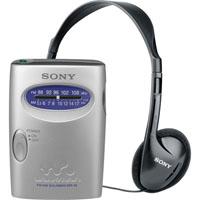
The Sony SRF-59

A few years ago, I heard a lot of buzz in AM/Mediumwave radio circles about a small, inexpensive radio called the Sony SRF-59. Discussions were focused on the incredible performance of this diminutive low-cost radio and how it held it own against some real benchmark receivers. Out of curiosity, I did a search on the radio to see what it looked like–I expected some Tecsun PL-like unit–and found that, much to my surprise, it’s a simple, analog, totally unassuming AM/FM walkman.  Say, what?

The far biggest surprise came with my price search, however. The SRF-59 is easy to find at $14.95 US. Really, you ask? Oh, yes–and it’s readily available at many online and big box stores.

So–carefully counting my pocket change–I took the plunge, and bought one.

The radio came in a basic plastic blister pack, and it also included headphones. I can’t comment on the headphones as I didn’t even bother unpacking them; instead, I plugged my new SRF-59 into my favorite Sony earbuds.

I have to admit, the AM band on this little radio does indeed shine. Not only is the receiver sensitive and relatively selective (meaning, I don’t hear adjacent signals when tuned in), but it also has excellent audio.  Amazingly, it lives up to all of the praise I had heard about it. I’m quite amazed, in fact, at how well this little unit can null out stations by rotating the radio body a few degrees. Most impressive.

Though I’m no major FM radio listener, I can also vouch for its FM performance, which is quite good.

Pros:

  • lightweight–indeed, one can safely say, “ultralight”
  • very inexpensive, by comparision
  • operates almost indefinitely on one AA cell
  • simple design, durable construction
  • AM (Mediumwave) sensitivity and selectivity comparable to $100 shortwave portables
  • because tuning is analog, it works in North America just as well as in Japan (see cons)
Cons:
  • tuning is analog, thus no stations can be saved to memory and there is a noticeable amount of receiver drift if listening over long periods of time
  • no fine-tuning mechanism means that tuning in weak stations takes precision skill on the SRF-59’s very small dial
  • no built-in speaker (this is a Walkman, after all)
In summary, you will regret not purchasing this radio should Sony pull it from the market without warning. While it is a walkman with the above listed limitations, it’s nonetheless a first-rate AM/MW receiver and might be a great avenue into the fun hobby of ultralight DXing.
In short, the Sony SRF-59 is a real gem. But don’t take my word for it, either–go check one out for yourself!
Where to buy:

  • B&H photo
  • Amazon


The most durable portable shortwave radios for traveling

A great portable radio is your passport to the world while traveling, even in remote areas.

I receive a lot of emails from SWLing.com readers, quite often from those who about to embark upon international travel–sometimes to remote locations–and who are looking for a durable travel shortave radio.  These travelers are looking for a basic travel radio which, while it might not need to survive being submerged underwater or dropped from a cliff, will hold up in the semi-protected environment of a suitcase or backpack experiencing some rough baggage handling.

I travel a great deal myself, and always carry a shortwave radio with me (actually, I usually take more than one). Here are some considerations I use to determine which radios go in my bag or pack, and thus make good travel companions:

  • Rugged enough to withstand typical suitcase/backpack travel conditions
  • Lightweight and relatively compact size
  • Supplied protective travel case
  • Efficient operation on AA cells, the most common batteries found in the world
  • Useful travel features, like auto-tuning, alarm/clock functions, sleep timer
  • Relatively inexpensive–if you lose your radio or it gets stolen, you don’t want it to ruin your trip
To be clear, none of the radios on the list that follows are marketed as  “ultra-tough radios”–indeed, I know of no capable SW portable that is–but these do represent the most durable I’ve personally tested and used in my travels.

The best shortwave portables for travel

Full-featured portable – The Sony ICF-SW7600GR ($130-150 US)
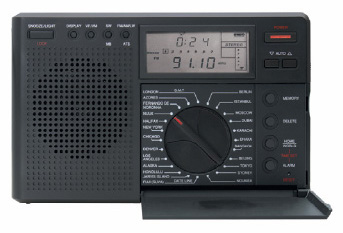
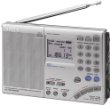
This Sony shortwave radio is a classic, with solid, time-tested performance, and features to please both the beginner and the seasoned radio enthusiast. It is full-featured, with excellent SSB and exceptional sync detection. I grab the ‘7600GR when I plan to do a little DXing on vacation. It has everything I need.

The Sony ICF-SW7600GR is still made in Japan and the case is metal. It feels like a very high-quality portable when holding it in your hands. The lock button is a sliding switch on the top part of the radio face–easy to turn on and off intentionally, difficult to do so unintentionally. Additionally, it comes with a decent padded case. The ‘7600GR operates on 4 AA cells. The only travel feature the ‘7600GR lacks is an alarm, and that’s okay by me; for the features and durability, I’ll keep the Sony and use my cell phone or watch for an alarm. The instruction manual is comprehensive and easy to read. Read the full review here.


Compact portable – The Grundig G8 Traveller II ($25-50 US)

Actually designed with the traveler in mind, the Grundig G8 will make for an excellent companion on your next venture. I’m quite impressed with this radio:  shortwave reception is good, and FM reception exceptional. The AM broadcast band does suffer from some images (a type of signal interference in which aural “ghosts” of other broadcasts layer over the one you’re trying to hear), though still quite respectable. The G8’s audio is a little tinny out of the built-in speaker, though quite good for a radio this compact. The customary price for the G8 is $49.95, but occasionally retailers place them on sale for nearly half this price. I especially like the fact that there is a front cover on the G8 which protects many of the controls. The body is somewhat rubberized and the zip case that comes with the radio is padded and perfectly designed for suitcase/backpack travel. The G8 is also smaller than a paperback book.

The G8 does not have SSB capability like the Sony does, but it is a good product for casual broadcast listener. The G8 also has a great alarm clock function and a world time selector switch on the front:  simply dial up your time zone as you cross the planet. The G8 uses 3 AA cells.

Pocket portable – CountyComm ETFR ($25 US)

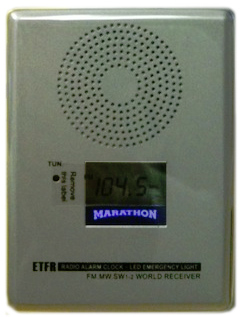
The County Comm Marathon ETFR Emergency Task Force Radio is a very small ultra-portable radio. The ETFR is similar to the earlier County Comm GP-4L, but was produced initially for the Canadian military, thus it features enhanced cold-weather operation. It is very durable–indeed, military-grade durability at least with regards to impact. To my knowledge, it is not waterproof, but it will certainly withstand your airline’s roughest luggage treatment.
The ETFR is no incredible performer, but the price is low and it is quite capable of catching the major international broadcasters–indeed its sensitivity is better than I had anticipated. The tuning is actually analog, though the display is digital, thus you can expect a little receiver drift if you keep this radio on a broadcast for very long. The ETFR operates efficiently on 2 AA cells providing up to 150 hours at 40% volume or 70 hours of illumination from the built-in LED light. The ETFR also has a built-in clock and alarm feature.

In my humble opinion, all frequent travelers should keep a County Comm ETFR in their go-to vehicle and/or travel bag.

Also (I have to admit) this radio looks very cool in the carry case that Universal sells.  Together, these make a great bon voyage gift for any traveler.


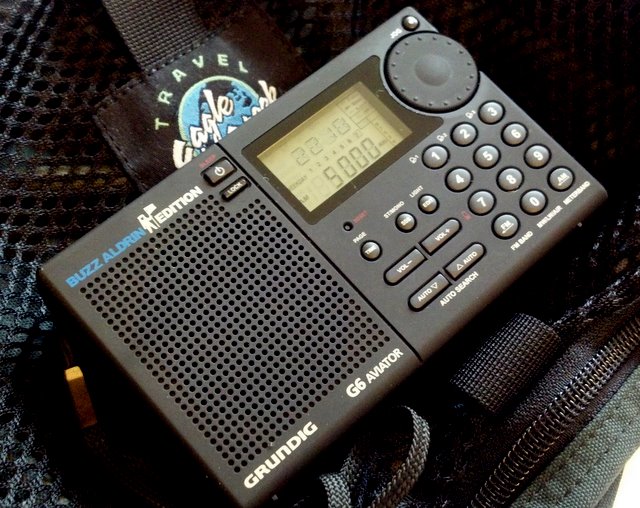
The G6 makes for an excellent travelling companion

UPDATE 11 March 2012: Check out our latest post and review of the Grundig G6–a pocket-sized portable ready for the road warrior.


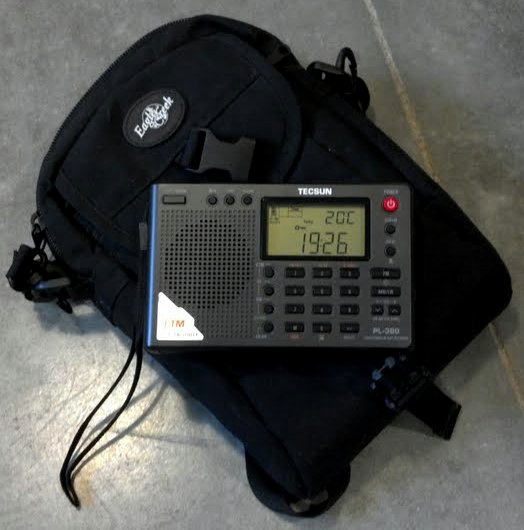
My Tecsun PL-380 and the small Eagle Creek pack that also holds my Zoom H1 recorder, earphones, audio cables, external antenna, spare batteries and Kindle.

UPDATE 23 May 2012: Yes, I’ve also added the incredible PL-380 to the travel list as well.  Read the full post here. Thanks for the comment, Alan!