Category Archives: Broadcasters

World Radio Day

WRDThis was posted on the European broadcasting Union page:

To mark World Radio Day (13 February), the European Broadcasting Union (EBU) is organizing a ‘Musical Caravan’ from east to west in partnership with other broadcasting unions across the globe.

Listeners will be taken around the world in a little over two hours.

This special compilation submitted by EBU Members, Associates and its sister unions (ABU, ASBU and CBU*) and coordinated by the EBU Music Unit in Geneva consists of songs representing the musical heritage of 34 countries.

The broad list of contributions include a Richard Strauss lied recorded by Bavarian Radio, an Indonesian song for peace and friendship, a folk tune from India and carnival music from the Caribbean.

The EBU will also share key facts about radio listening compiled by the organization’s Media Intelligence Unit in the week leading up to World Radio Day 2016 on its Facebook page and Twitter account.

Another highlight of the EBU’s contribution to World Radio Day 2016 will be a special performance of Beethoven’s Ninth Symphony by the NHK Symphony Orchestra of Tokyo and the Kunitachi College of Music Chorus. An interview with conductor Paavo Järvi can be found here.

EBU Head of Radio Graham Dixon said: “Radio plays a very significant part in all our lives. On average, we will listen to nine years of radio in a lifetime – more than any activity except breathing and sleeping!  Radio provides a convenient way to encounter new ideas, new music and new ways of thinking, and also provides valuable company to counter isolation and loss.  Nine years of an average lifetime is indeed an impressive figure, but the real personal impact of radio cannot be quantified. World Radio Day provides a great opportunity to reflect on the power of radio.“

– See more at: http://www3.ebu.ch/news/2016/02/ebu-takes-listeners-on-a-global

Robert Gulley, AK3Q, is the author of this post and a regular contributor to the SWLing Post. Robert also blogs at All Things Radio.
The Mighty KBC is seeking sponsorship

DX-402-KBC-2

Many thanks to SWLing Post reader, Mike Nikolich (N9OVQ), who writes:

Hi, Tom:

Uncle Eric mentioned [this past weekend] on The Mighty KBC (6040 kHz) around 0145 UTC that they will be leaving the airwaves if they cannot attract enough advertising revenue.

I would really miss this radio station if it left the air. 

[…]I’m sure Kenwood, ICOM, Ham Radio Outlet and C Crain have enough discretionary funds to advertise on this station and I can’t imagine a more targeted ad buy for shortwave listeners than The Mighty KBC.

Thanks for the message, Mike! Yes, I would also miss The Mighty KBC if they left the air–their music program, “The Giant Jukebox” is one of my favorites.

If you have any sponsorship leads or ideas, please contact The Mighty KBC via their website.

Paul schedules new shortwave broadcasts via WRMI, WBCQ and Channel 292

SP600Dial3

Many thanks to SWLing Post reader, Paul Walker, who writes:

I will be doing another broadcast on Shortwave and it’s going to be even bigger and better right now.

Tentatively, this is how the broadcast schedule times/frequencies work out to be:

  • WBCQ 5110khz and 9330khz Friday March 11th, 2016
    10pm to 12midnight Eastern (which is 0300 to 0500 UTC Saturday March 12th)
  • WRMI 11580khz Thursday March 10th, 2016 Thursday March 10th, 2016
    8pm to 10pm Eastern (which is 0100 to 0300utc on Friday March 11th)
  • Channel 292, 6070khz (Germany transmitter site) Friday March 110th, 2016
    10pm to 12midnight UK time (which is 5pm to 7pm eastern, not that Channel 292 can be heard in the US… just giving you a frame of reference)

I am in the process of booking all this time, so something could change in terms of times/dates between now and the broadcast dates.

I’ll be doing 2 hours of rock n roll and country music .. no commercials, no pleading for money, no asking for donations.. just me, playing the music I like.. because. well I want to and I can.

I’m paying for time on all 4 of these stations out of MY OWN POCKET, again for no reason, other then I want to.

So many complain about what radio lacks, wether am, fm or sw and lament about the old days or suggest what would work today.. but want it done with other people’s money.. they won’t put up and shut up. What I do won’t change radio or make much of a difference in the grand scheme of shortwave radio, but I can have fun and share my love of radio and music with others.

I am trying to secure an hour or two on a United Kingdom area AM station as well if it is affordable and I can find one to sell me time.

Writing to you from an apartment only 500 feet from the frozen Yukon river in Alaska’s interior region.

Excellent news, Paul! Please keep us informed as I’m happy to post any updates you may have. We’ll be listening!

China Radio International’s overwhelming AM bandwidth via Havana

Scott-Marine-SLR-M-Dial

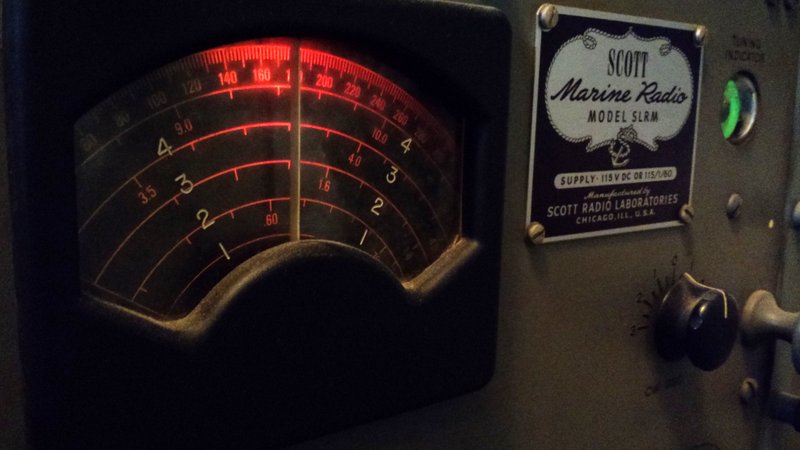
This morning, I listened to Radio Australia on 9,580 kHz with my WWII era Scott Marine Radio SLR-M (above).

Radio Australia provides a reliable, strong signal into North America every morning and it’s where I typically tune for the morning news at the top of the hour.

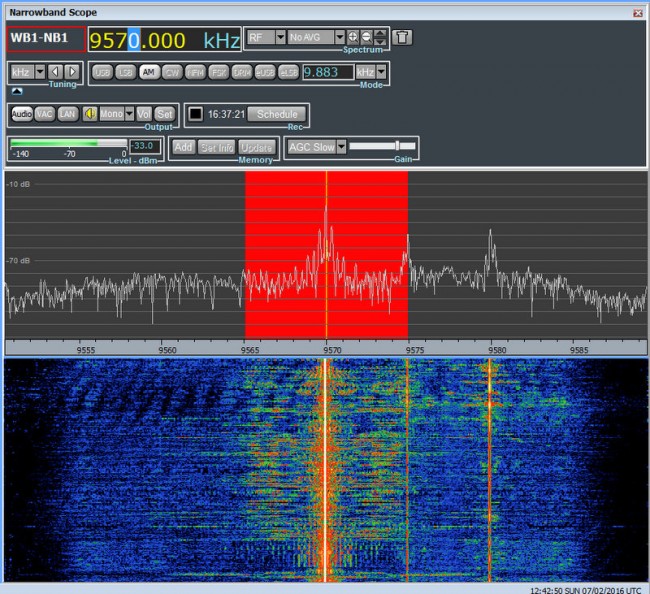
China Radio International also fires up on the adjacent frequency of 9570 kHz around 1200 UTC–their signal is also incredibly strong here as it’s relayed from Radio Havana Cuba at 250 kW. CRI’s bandwidth is almost always wider than 10 kHz–indeed, it’s often 20 kHz–which means that it completely wipes out any average adjacent signal.

Indeed, when I’m testing selectivity on portable shortwave radios, I’ll often tune to Radio Australia and wait for CRI to fire up on 9570 kHz. If the portable radio can still lock onto Radio Australia after CRI is on the air–or, better yet, if an upper side band sync lock can eliminate all traces of CRI–I know the receiver has decent selectivity.

This morning, when CRI began transmitting at 1200 UTC, their signal completely wiped out every trace of Radio Australia. Though the SLR-M’s narrow AM filter is still quite wide, it can typically cope with the adjacent CRI carrier.

I fired up the TitanSDR to see what CRI’s signal looked like on a spectrum display–here’s what I found:

China-Radio-International-Bandwidth

CRI’s AM bandwidth was 30+ kHz wide! 

In my book, that was an abusive use of the band.

This was, by no means, an isolated event. It was just particularly annoying for me this morning as I was enjoying a good cup of coffee and the morning ABC news.

I’ll send a message to CRI and RHC about this, but I have my doubts anyone will take action.

Okay–sorry about the rant!

Live365 is no more

Live365_logo

As of February 1, 2016, the Internet radio pioneer Live365 has closed shop.

I imagine many SWLing Post readers are familiar with Live365, especially if you have a WiFi radio with the Live365 app.

While I’ve never been an avid listener of Live365, I have certainly enjoyed a wide variety of independent Internet radio stations via the platform.

Why did Live365 close shop? Here’s what Forbes.com suggests:

“It is rumored that the service is being forced into early retirement because of new royalty rates that digital radio producers now need to adhere to. Late in 2015, the Copyright Royalty Board handed down its decision about what internet radio services will need to pay per stream, and it apparently hurt Live365 so much that it can no longer afford for the rights to play music. Companies like Pandora lobbied hard for the court to lower royalty rates for the next five years, and while certain kinds of streams will cost internet radio stations and services less, it will cost platforms more overall to continue to play music. This may not be the only reason why Live365 is going out of business, but it appears to have been a factor.”

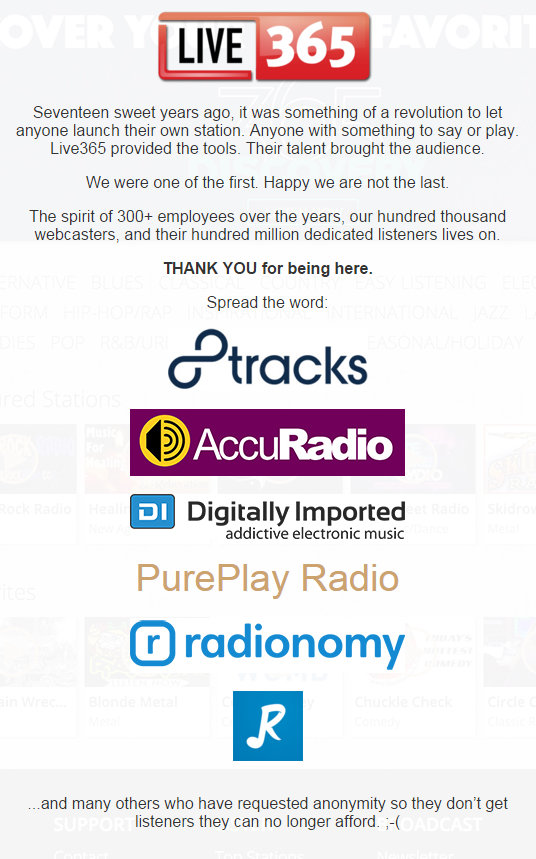
I’m sure the new royalty rates had had a major influence on the decision to close down. Here’s a screen capture of the parting message from Live365’s web site:

Live365-Message

That is the conundrum of Internet streaming services: the more listeners, the more it costs to broadcast due to both bandwidth and royalties. Your success–especially when the music industry moves toward higher costs and more restrictions–might very well lead to your demise.

Perhaps this is where traditional over-the-air radio still has a small advantage–though the barrier of entry is much higher than Internet broadcasting.

Terry recommends the Public Radio Fan portal

PublicRadioFan

Many thanks to SWLing Post reader, Terry (VE7TEB) who writes:

You may have already posted this, but if not here is an excellent Public Radio resource, perhaps worthy of another mention: http://www.publicradiofan.com/

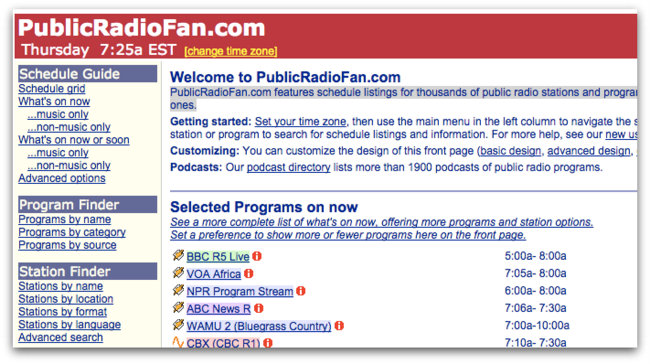
Indeed, Terry! Public Radio Fan is a fantastic resource–especially for SWLs who enjoy listening to public broadcasters who are no longer on shortwave. The site makes it easy to search for broadcasters; it has a very simple and responsive user interface.

Public Radio Fan was created in 2001 and is maintained by its creator, Kevin Kelly. I don’t know where he finds the time to curate this database, but I’m glad he does!

Definitely worth the mention. Thank you, Terry!

Click here to go to Public Radio Fan.

Shortwave Radio Recordings: Voice of Greece

Fullscreen capture 1302016 14356 AM

The Voice of Greece is an unpredictable broadcaster these days. VOG is not on the air as much as in the past and doesn’t seem to follow a broadcast schedule. I only hear them perhaps once or twice per week now.

But I’m not complaining–after all, this is a shortwave broadcaster that basically came back from the dead.

I love VOG’s music programs and last night their Avlis transmitter was fired up and relaying some wonderful tunes.

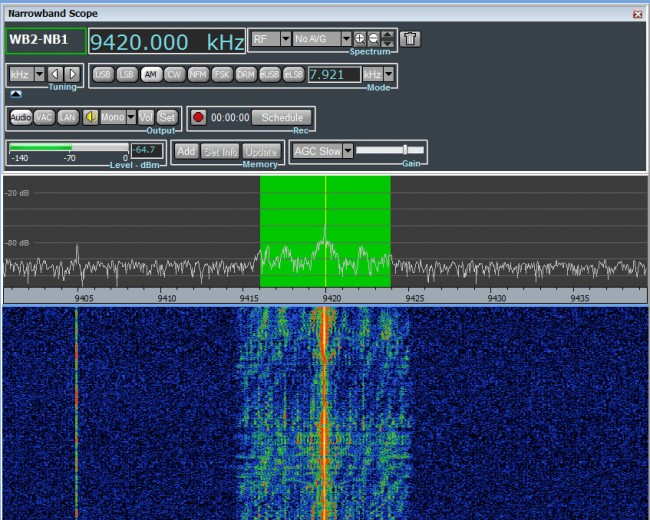
The following recording was made on January 30, 2016 starting at 0145 UTC on 9420 kHz. I made this recording with the TitanSDR Pro receiver connected to a large skyloop antenna. Click here to download the MP3, or simply listen via the embedded player below:

I also had the TitanSDR simultaneously recording pirate radio spectrum just below the 40 meter ham band. I’m saving that bit of spectrum for a rainy day!

Anyone else tune to VOG last night?