This “1930’s style” receiver via Jack Donio playing The Mighty KBC:
The Mighty KBC on a home brew, single tube receiver
3 Replies

This “1930’s style” receiver via Jack Donio playing The Mighty KBC:
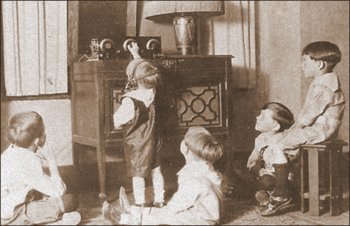
“Whoa! Timmy, is that Europe calling?”
You’ll typically find North American radio pirates here on the SWLing Post, but on occasion, I do manage to pull in a station or two from Europe. Last night was one of those rare occasions, and I have Ragnar at Pirates Week to thank for the tip.
I tuned in Europirate Radio Borderhunter on 15,500 kHz AM, starting around 21:50 UTC. For an AM signal out of Europe, I was most impressed with Radio Borderhunter‘s strong signal.
I recorded about forty minutes of the pirate’s broadcast before propagation shifted. He then moved down to 6,210 kHz in the 48 meter band, a prime Europirate hangout, to continue his show.
Click here to download the recording as an MP3, or simply listen via the embedded player below:
By the way, check out Ragnar’s latest podcast on Pirates Week!

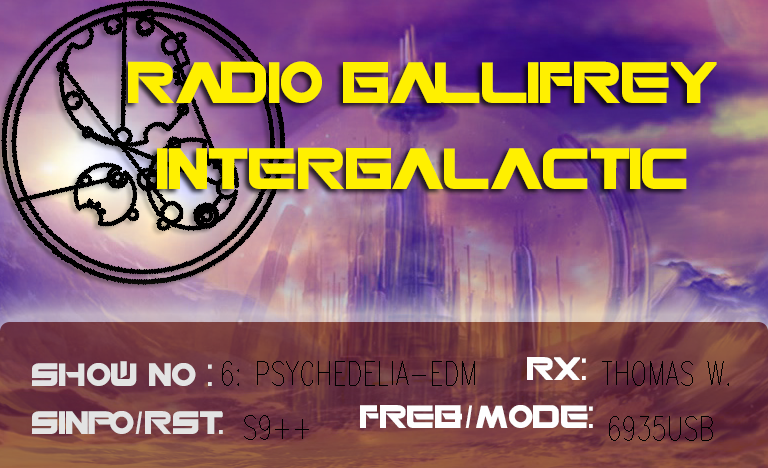
The Citadel of the Time Lords on Gallifrey (Source: Wikimedia Commons)
Last night, I recorded pirate station, Radio Gallifrey Intergalactic.
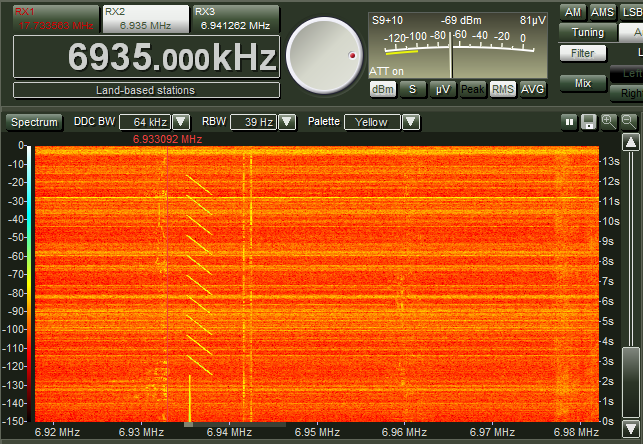
RGI appeared on 6,935 kHz USB and started their broadcast with a set of audio sweeps (which looked rather distinctive on my SDR’s waterfall), followed by tones and then straight into the Dr. Who theme.
What followed was a free-form set of spacy electronic music; from ambient to trance. You’ll hear their station ID in Morse code.
Click here to download an MP3 of the full broadcast, or simply listen via the embedded player below:
 (Source: VOA Radiogram)
VOA Radiogram for the weekend of 21-22 September 2013 is produced using Fldigi3.21.76AB. For best results, use this version, available from www.w1hkj.com/alpha/fldigi/v3.21/
One improvement in 3.21.76AB is that it can send images in MFSK64 and MFSK128. Previously, MFSK32 was the fastest MFSK mode for sending images without the pictures appearing skewed (off center). Images do not transmit more quickly in MFSK64 and MFSK128, but they do have higher resolution.
If your decoded MFSK64 and MFSK128 images are still slanted or skewed, calibration of the receive codec might be helpful. One such method for doing this is described here: www.w1hkj.com/FldigiHelp-3.21/DigiWWV.html.
Our non-Latin alphabet of the week is Greek. You will need the UTF-8 character set for the Greek and for some of the punctuation in the English items. I forgot to change some of the typographic apostrophes ’ to typewriter apostrophes ’ , so they will not display correctly if you do not have the UTF-8 character set. In Fldigi, that adjustment is made in Configure > Colors & Fonts.
This weekend’s program includes an English VOA News item in Flmsg format. When all the text is received, the story will render, or pop up, as a new web page on your browser, suitable for saving or forwarding. To make Flmsg work with Fldigi (both can be downloaded from w1hkj.com), in Fldigi: Configure > Misc > NBEMS — Under Reception of flmsg files, check both boxes, and under that indicate where your Flmsg.exe file is located.
Much of the show this weekend is in the MFSK64 mode, which might be a bit optimistic if reception conditions are less than ideal.
Here is the lineup of modes for VOA Radiogram, 21-22 September 2013:
2:53 MFSK16: Program preview
2:40 MFSK32: Sample of Greek text
:49 MFSK32 image: VOA Greek Service logo
3:01 MFSK32: “Need to Protect the Internet”
1:45 MFSK64: Radio Free Sarawak/Discovery Channel
2:23 MFSK64 image: “Duck Commander”
:27 MFSK128: CNBC Saracens deal
:48 MFSK128 image: CNBC logo
:45 MFSK32: E-mail address
4:40 MFSK64: BBC Worldwide, Giglio TV, Voice of Greece, All India Radio
2:55 MFSK64/Flmsg: VOA News re Voyager Golden Record
2:17 MFSK32 image: Voyager Golden Record
:33 MFSK32: Closing announcementsVOA Radiogram transmission schedule
(all days and times UTC)
Sat 1600-1630 17860 kHz
Sun 0230-0300 5745 kHz
Sun 1300-1330 6095 kHz
Sun 1930-2000 15670 kHz
All via the Edward R. Murrow transmitting station in North Carolina.Please send reception reports to [email protected]
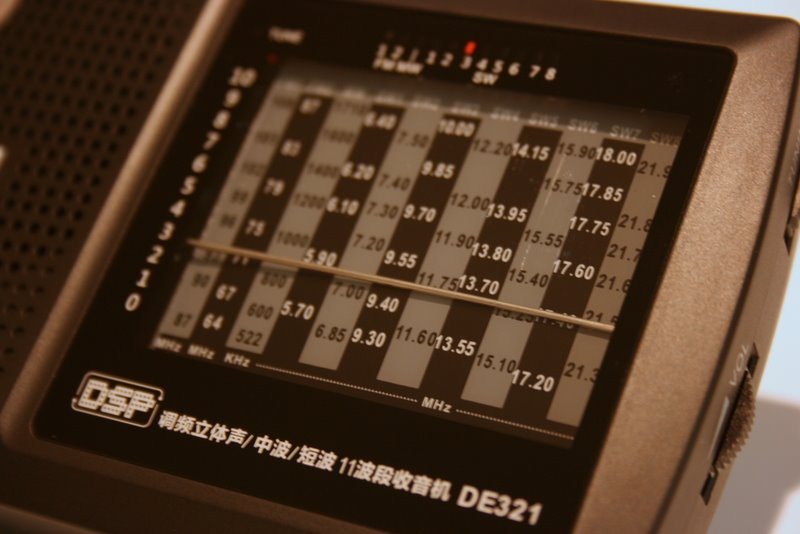 I’m not surprised to find that North Korean families hide shortwave radios. After all, if it’s well hidden, and listened to privately, there is no way the government can monitor what is heard on shortwave, nor trace it back to the family listening. This is what separates radio from the Internet and mobile devices:
(Source: New Focus International)
Many North Korean families keep a secret item at home, whose discovery may lead to harsh punishment. Away from prying eyes and in the privacy of their homes, North Koreans enjoy using items forbidden by the state, according to North Koreans who have recently escaped from the country.
“In every North Korean home, there is at least one secret item” says Jung Young-chul* (age 34), who left Korea in 2012. He had a short-wave radio in the house and the family would secretly listen to South Korean broadcasts. To avoid being caught, they kept the radio hidden under a container for keeping rice.
They were not the only ones with a hidden radio. Jung explains, “Once, a friend described a story that I had heard the night before while listening to a South Korean broadcast. I brought it up with him one night in drink, and he confided that his family too had a radio. We laughed about it together.”
If you want to hear North Korean propaganda on shortwave radio (via the Voice of Korea), check here for the latest schedule or even listen to this recent recording.
This post tagged in the category: Why shortwave radio?
Check out this brilliant video tour of the BBC Woofferton Transmitting Station, presented by Senior Transmitter Engineer Dave Porter (G40YX). The video is divided in seven parts, thus I’ve created a playlist that will automatically load each video in order.
Click here to start the playlist on YouTube, or simply watch the tour through the embedded video player below. Enjoy:
Many thanks to Dave Porter for hosting this video tour and to Mike Barraclough for the tip!
If you would like to read a detailed history of Woofferton, be sure to check out our post:
Shortwave Radio History: 50 years of transmitting at BBC Woofferton
 On October 13, 2013 PCJ Radio International will conduct a two hour DRM test transmission.
Date: October 13, 2013
Time: 10:30 to 12:30 UTC
Frequency: 15,645 khz
Beam: South East & East Asia
Send your reception reports for this transmission to [email protected]