Category Archives: Broadcasters

Own a piece of National Public Radio history

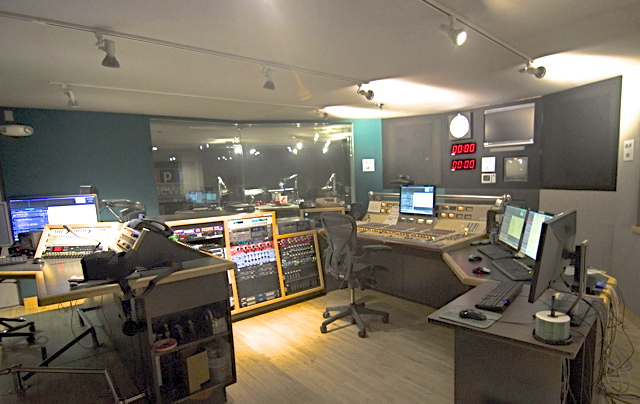
STUDIO 2A - THE HOME OF BOTH NPR FLAGSHIP PROGRAMS MORNING EDITION AND ALL THINGS CONSIDERED,

NPR Studio 2A, home of NPR’s Morning Edition and All Things Considered, is one of the lots up for auction.

National Public Radio (NPR) is moving to a new building in Washington, DC.  They’re auctioning off all of the studio equipment and furniture they’re leaving behind.

Here’s your chance to own a piece of radio history–and, perhaps, start your own radio station or recording studio!

Click here to view the list of items up for auction.


Shortwave Radio Recordings: The Disco Palace (in DRM)

DiscoBallPerhaps one of the things I love the most about SWLing is the sheer variety of broadcasters out there. We can sample diverse offerings across a broad spectrum–from the BBC World Service to Radio Romania International, from pirate stations to numbers stations.

There’s even The Disco Palace: a station that plays only disco music, and each show is mixed thematically. This station broadcasts online and over shortwave radio via DRM (Digital Radio Mondiale).

Last week–specifically, on March 15, 2013–I caught about thirty minutes of The Disco Palace broadcast and was able to record it from my Bonito RadioJet IF Receiver. Reception on 17,875 MHz was excellent, although the DRM signal wasn’t quite strong enough for comfortable stereo decoding.

The following TDP recording starts around 2030 UTC (about halfway through the broadcast). Click here to download the recording as an MP3, or simply listen via the embedded player below:

Radio Netherlands Worldwide archives in danger

RNW(Source: NRC Handelsblad, with translation by Andy Sennitt.)

Radio Netherlands Worldwide and the Broadcasting Music Centre must find a new home for their archives by 1 July. RNW is still looking for a home for its extensive music collection, paper archives and recordings of many broadcasts in languages such as Indonesian, Arabic and Sranan Tongo since 1947. The Broadcasting Music Centre has from 1 August no place for five kilometres of sheet music, sometimes handwritten.

Media Historian Huub Wijfjes finds it astonishing. “We have institutions like Sound and Vision and the Eye Film Institute that were established to ensure that we don’t make the mistakes of the sixties and seventies when everything was discarded. Now the same thing is likely to happen again. For me, my sources will be lost. ”

Sound and Vision seems a logical place, but there is a problem. Collection Curator Hans van der Windt explains: “Access to large archives costs money that we don’t have. For example, we need to have the copyright to the material in order to make it available for research, but most organizations don’t want to give up the copyright.”

Many thanks to Andy Sennit for apprising us of this and for translating the original item from the NRC Handelsblad. I do sincerely hope that an educational institution or benefactor steps up to the plate to help RNW find a proper home for these significant and invaluable archives.

Shortwave Radio Recordings: Voice of Greece

greeceFor your listening pleasure: alomost four hours of music, and a little Greek commentary, from the Voice of Greece.

Recorded on March 8th, 2013 on 9.42 MHz at 22:00 UTC.

Click here to download the full recording, or simply listen via the embedded player below:

VOA Radiograms Today (17 March 2013)

VOARadiogram(Source: VOA Radiogram)

The third airplay of VOA Radiogram is coming soon, at 1300 UTC, on 6095 kHz. Another, directed to Europe, will be at 1930 UTC on 15670 kHz.

Thanks to the many listeners throughout Europe, North America, and even in Asia, who have sent reports, audio, screenshots, spectrum displays, etc. After the last transmission today, I will summarize the results in this website.

WRMI, Radio Miami International, 9955 kHz, is transmitting IDs in the Olivia 8-1000 mode until 0400 UTC Monday (midnight EDT). These are centered on 1300 and 2500 Hz. Don’t be discouraged by the low signal level of WRMI, or by the Cuban jamming on the frequency. You might get a good decode of Olivia 8-1000 anyway.

VOA Radiogram “soft launch” this weekend

VOARadioGramKudos to VOA research analyst Dr. Kim Andrew Elliott for his remarkable innovation:  VOA Radiograms (i.e., digital text messages sent over shortwave broadcast radio), and for promoting this concept through the Voice of America. His persistance, with support from forward-thinking shortwave broadcasters like WBCQ, WRMI and The Mighty KBC, who have all broadcasted his digital messages, has paid off.  Classic technology meets current in this new communication mode which makes internet disruption absolutely irrelevant, and which is even impervious, to a great degree, to interference.

This weekend, the VOA Radiogram will become a reality:

(Source: VOA Radiogram)

VOA Radiogram will “soft launch” this weekend. Here is the transmission schedule (all days and times are UTC):

Saturday 1600-1630 17860 kHz

Sunday 0230-0300 5745 kHz (Saturday evening in North America)

Sunday 1300-1330 6095 kHz

Sunday 1930-2000 15670 kHz

All via the IBB Edward R Murrow Transmitting Station in North Carolina.

The digital text modes to be transmitted this weekend on VOA Radiogram are as follows. Each text transmission will be one minute, unless otherwise specified. Asterisk * denotes RSID: if your RxID is on, Fldigi will automatically switch to this mode and audio frequency. The other modes you can decode from your recording.

  1. BPSK31 on 2000 Hz*
  2. QPSK31 on 1000Hz, BPSK31* on 2000 Hz
  3. QPSK31 on 1000Hz*, PSK63F on 1500Hz, BPSK31 on 2000 Hz
  4. QPSK63 on 1000 Hz, PSKR125 on 1500 Hz*, BPSK63 on 2000 Hz
  5. QPSK125 on 1000Hz, PSKR250 on 1500 Hz*, BPSK63 on 2000 Hz
  6. QPSK250 on 800 Hz, PSKR500 on 1500Hz*, BPSK250 on 2200Hz
  7. QPSK500 on 800 Hz, PSKR1000 on 1500 Hz*, BPSK500 on 2200 Hz
  8. PSKR500 on 1000 Hz, PSK63F on 1500 Hz, PSKR125 on 2000 Hz, and PSKR250 on 2500 Hz* (5 min 40 secs).  The latter portions of the PSKR250 and 500 transmissions are formatted for Flmsg. (In Fldigi, Configure > Misc > NBEMS > under Reception of flmsg files, click Open with flmsg and Open in browser, and below that state the location of the flmsg.exe file.)
  9. MFSK32 image on 1500 Hz (54 seconds)

In future weeks, after the “hard launch” of VOA Radiogram, only one mode will be transmitted at one time. This will ensure the highest possible signal-to-noise ratio and the best possible chances for a successful decode.

See also how to decode the modes.

Send reports to radiogram(at)voanews.com

Follow @voaradiogram

Keep up-to-date with all future broadcasts, digital modes and methods for decoding on the VOA Radiogram website, and by following them on Twitter: @voaradiogram.

Vatican Radio: breaking news broken?

Pope Francis I

Pope Francis I (Photo: Vatican Radio)

A few moments ago, Cardinal Jorge Mario Bergoglio of Argentina was elected Pope, becoming the first pontiff from the Americas, and taking the name Pope Francis I. When breaking news like this is happens, I often turn to shortwave radio to hear it “from the source;” what better station for news about the Papal elections than Vatican Radio? Right?

Hm. When I turned to Vatican Radio on 13.765 MHZ at 20:00 UTC today, here is what I heard:

After a little music and announcement confusion–including what sounds like at least three audio feeds coming in at once–Vatican Radio settles on an announcement program which states, in several languages, “Vatican Radio’s programming schedule is currently being modified to cover the election of the new Pope.”

It wasn’t until thirty minutes later (20:30 UTC), when the Vatican Radio service to Africa started in French on 11.625 MHz, that I heard any substantive news about the new Pope:

radio_vaticanoOf course, I can find information about the new Pope from any one of two million different online sources, but it did surprise me that Vatican Radio wasn’t better prepared for this event.  I even wondered if there was a different broadcast running on a consecutive frequency, so I checked; all were identical, however.

Still, the radio archivist in me can’t help but experience some appreciation of the confusion on the airwaves. After all, this is a genuine piece of radio history and a fascinating thirty minutes of audio in the wake of a big decision.

In my mind, I envision the Vatican Radio staff frantically stirring to assemble news–for which they had no advance notice–regarding the new Pope. No doubt, the CNNs, BBCs, and Al Jazeeras of the world had pre-prepared material on each of the papal candidates. When the white plume of smoke announcing the election was first spotted, these broadcasters were likely more than ready to pull out the appropriate material and publish.

Perhaps this is not how Vatican Radio usually operates. Indeed, I suspect their live feed of events experienced a technical difficulty which they have, no doubt, since resolved. And for what it’s worth, their website was appropriately up-to-date.

History:  sometimes bumpy, but always fascinating.  Especially on the airwaves.