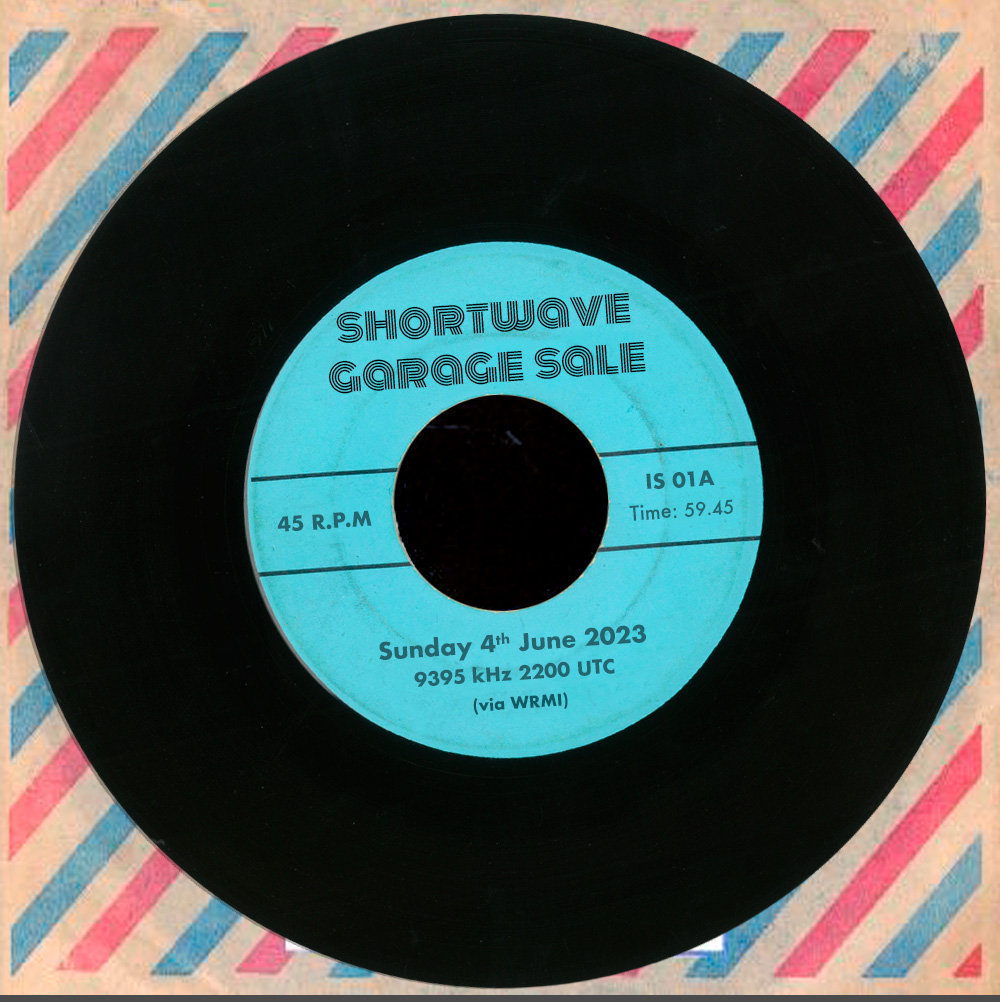
Apologies for last week’s non-appearance on 9395 Khz, looks like WRMI was down all evening on that frequency. Fingers crossed the Imaginary Stations 45th Parallel Midwinter Broadcast will now be on this Sunday 19th February 2023 on 9395 kHz at 2300 hrs UTC. We promise there will be a good bit of circular latitude fun and some fine forty fives played throughout the show. We’d love you to join us this time. Fastradioburst23
Category Archives: Guest Posts
Paul explores the incredibly affordable XHDATA D-219
Many thanks to SWLing Post contributor, Paul Jamet, who shares the following article that was originally published in the Radio Club du Perche Newsletter.
Note that Paul also includes information about the new XHDATA D-109 and an XHDATA sale in the addendum of his article!
Let’s discover the XHDATA D-219
by Paul JAMET
A truly incredible performance/price ratio
A year ago, many people wondered if it was wise to resume short wave broadcasts to Russia and Ukraine (CIRAF Zone 29). Although a century old, this technology is still widely used around the world. Moreover, the world market for Short Wave receivers is apparently doing well because new models are regularly arriving on the market, in particular ultra-portable DSP receivers with surprising performance. As proof, the latest XHDATA model: the D-219, marketed since November 2022. This is a very easy-to-use receiver, with a vintage look and a needle dial, which is available in gray or silver, for less than $7 (excluding shipping and batteries) on the XHDATA company website.
The D-219 is a “Full DSP” receiver which allows it to be very sensitive and power efficient. It is powered by two AA/R6 rechargeable batteries or by the mains (batteries and 220/5.0 volt adapter not supplied). A small multilingual manual – including French – is provided.
From my point of view, the most important innovation – on a DSP receiver of this price – is the possibility of precise tuning when searching for stations with a pointer dial; there is absolutely no play, which allows perfect and stable tuning to the desired frequency. This receiver has a 3.5 mm jack, a rear stand and a hand strap. The 7-core telescopic antenna is about 55 cm long and provides good reception of FM and SW stations. The sound quality is very good for this 150g receiver (without batteries)! It has two FM bands (87-108 and 64-87 MHz), the AM band (Medium Waves) from 522 to 1620 kHz and nine SW bands from 4750 to 22000 kHz. See photo above.
For a SWL, it’s a real pleasure to explore the 9 Short Wave bands. For instance, I have already easily tuned to international stations several thousand kilometers away only with the telescopic antenna, such as RFA – Radio Free Asia – broadcasting from Agignan Point and Tinian Island in the Pacific Ocean.
Audio samples:
VoA in Dari from Udon Thani on 12075 kHz (250 kW; 9900 km):
RSI in English from Kall Krekell on 6005 kHz (1 kW; 350 km)
Note: A 23-foot wire antenna was clipped onto the whip antenna
recordings made by placing my smartphone near the speaker of the receiver.
QSLs
I received two QSLs (Year of the Rabbit) sent by RFA. See attached images below. These QSL confirm my reception reports (recordings made with the XHDATA D-219 and sent to RFA)
Summary
In conclusion, the XHDATA D-219 is really very easy to use. I can only recommend it to anyone who wants to start exploring the wide world of shortwave with a receiver that offers a truly amazing performance/price ratio!
Paul JAMET
NB: DSP technology – Digital Signal Processing – allows, among other things, to reduce noise and limit distortion; it is perfectly adapted to the processing of radio signals.
Addendum: XHDATA sale and new D-109
1.) The RADIWOW web site is no longer updated and will be closed soon
30% discount on D-808 (65$) and R-108 (37.80$) for instance, till Feb, 16th.
Have a glance to this website : https://xhdata.com.cn/
NB : I have no affiliation with XHDATA!
2.) The new XHDATA D-109 is a new radio that will release in 2023:
Let say in one or two weeks … It could be only an upgrade of the R-108 with news features (Bluetooth and micro SD card)
Wait and see …
This is the 45th Parallel calling…
Hi all shortwave community, Fastradioburst23 here letting you know about the 45th Parallel Midwinter Broadcast this Sunday 12th February 2023 courtesy of the Imaginary Stations crew. It’s on 9395 kHz at 2300 hrs UTC via WRMI. There will be a good bit of circular latitude fun and some fine forty fives played throughout the show. We’d love you to join us!
Guest Post: Old Fashioned Band-Scan after the Solar Storms
Many thanks to SWLing Post contributor, TomL, who shares the following guest post:
Old Fashioned Band-Scan after the Solar Storms
by TomL
This is just an old fashioned band scan to randomly see what I could hear after last week’s solar perturbations when the Solar Flux Index went well over 200. I considered what I could hear on the shortwave broadcast bands, even though the SFI had quieted down to around 135. Would the ionosphere still be holding on to the charge built up during the solar storms? The date and time was January 30, 2023 around 1400 through 1600 UTC. By the way, as of today (February 2), the bands are dead and cannot hear any of these even though the Solar Flux is about the same!
I will not have time to describe my antenna setup now at my noisy Condominium in detail. I have been experimenting with a DX Engineering NCC2 antenna phasing device for the past year with somewhat good results. I had to place dedicated receive antennas in many different ways in order to find an arrangement that works in conjunction with the two Ham Radio antenna wires out on the porch. Sometimes it helps by lowering the noise, sometimes the native antenna by itself, or peaking the signal, has better reception even though it might be slightly more noisy. By matching one of two receive-only antennas (the left Heathkit switch) with one of the Ham Radio antennas (the right Daiwa switch), I can usually eke out some extra decibels of signal-to-noise improvement. Continue reading
A DXpedition to East Sandy
Many thanks to SWLing Post contributor, Don Moore–noted author, traveler, and DXer–for the following guest post:
A DXpedition to East Sandy
By Don Moore
When I was in college over forty years ago, seven of us had a small DX club in central Pennsylvania. A couple of times a year we would gather at the house of one of our parents for an all-night DX session. We shared tips and ideas, had fun, and always heard some new DX. Good DX can happen anywhere if conditions are right and most of mine over the past fifty years took place at wherever home happened to be at the time. But most of my best experiences and best memories of DXing were not made at home. They were made by getting together to DX with other hobbyists such as we did back in college.
Nowadays when I get together to DX with other hobbyists it’s to go on a DXpedition, which is nothing more than taking your receiver to a place where DXing will be better than at home because there’s less noise and you can erect better antennas. Simple DXpeditions can be done from cars. My old friend Dave Valko used to go on what he called micro-DXpeditions. He drove to a remote spot in the mountains not far from town, laid out a few hundred feet of wire, and then DXed from his car for a couple hours. He frequently did this around dawn and around sunset and got some great DX. I know several other DXers that do this today, either at countryside locations or in large parks.
I’ve done micro-DXpeditions a few times. It’s fun but it always lacks an important element: other DXers. For me, the best DXpeditions aren’t just about hearing interesting stuff (although that is very important). They are also about sharing the hobby with other interested friends. And the best way to do that is to go on a real DXpedition with them.
For three years in a row prior to the pandemic a group of eight of us had rented a lodge in rural central Ohio for an annual DXpedition. Covid shelved our plans for 2020 but by the summer of 2021 we were all looking forward to a fourth DXpedition in September. Then another wave of covid swept across the country and we canceled a few weeks before the event. Fortunately, the worst of those days are behind us and we finally had our fourth DXpedition the first week of October of this year. Unfortunately, only five of us could make it – Ralph Brandi, Mike Nikolich, Andy Robins, Mark Taylor and I.
For four nights our DXpedition home was the same place in western Pennsylvania that we had canceled at in 2021. The location was a rural house on the bluffs overlooking the Allegheny River near the old East Sandy railroad bridge (now a hiking trail). It’s always a gamble going to a new place chosen solely based on the AirBnB listing and other information found online. But this site had all the appearances of being a good place to DX from. The pictures and Google satellite view showed that there were trees around the house and large nearby open fields surrounded by woodland. The terrain was relatively flat when viewed on 3D satellite view. We would have plenty of space for a variety of antennas. Furthermore, it didn’t look to be a noisy location. The nearest neighbor was over a quarter mile to the south and because the house was the last one on the road that powerlines stopped at the driveway. I couldn’t have done much better if I had designed the location myself.
ANTENNAS
Good antennas are the most important part of any DXpedition and erecting them is usually the most time-consuming part of set-up. Still, you never really know what’s going to fit until you’re there. I arrived at 2 p.m. and Mark pulled in a few minutes later. We immediately walked the grounds and were pleased with what we saw. Ralph arrived while we were laying out the first antenna. Mike and Andy arrived later in the afternoon in time to help finish up.
Our DXpedition antenna farm consisted of two delta loops, a DKaz, and two BOGs. The delta loops used Wellbrook ALA-100LN units and are as I described a few years ago in my article on radio travel. These are easy to erect and are good all-around antennas for anything below 30 MegaHertz. The DKaz (instructions here) is a rather complex-to-build antenna designed for medium wave. Ralph uses one at home which he had taken down for the summer to make yard work easier. He brought the pieces and put it up by himself. The two BOGs (Beverage-on-the-ground) were a 300-meter wire to the northeast and a 220-meter wire to the north. Beverages are good for long wave, medium wave, and the lower shortwave frequencies. Continue reading
Born in the ER: Andrew’s portable SULA antenna
Many thanks to SWLing Post contributor, Andrew (VK2ZRK), who writes:
Just thought I would share some pics of my SULA build which I constructed in the Emergency department’s antenna building section in between catastrophies here in Australia.
I built it out of 8mm fibreglass tube from a kite supply, 8mm kite nocks, 13mm equal cross irrigation fitting and lots of double wall glue lined heat shrink. The 8mm tube with a short bit of heat shrink is a slip fit into the id of the 13mm equal cross which I secured with more heat shrink.
I then cut the frame to length allowing for the length of the kite nocks. I secured the kite nocks with more heat shrink. I then soldered the resister to 2 lengths of Davis RF 12g antenna wire and fed this through the kite nocks terminating it at the nooelec balun on the opposite side to the resistor.
I think it worked out well. It is very light. I built it to use with my SDRPlay RSPdx.
Thank you to everyone involved in the design process and for providing it to the swling.com community.
Cheers
Andrew VK2ZRK
In all the years I’ve been hosting the SWLing Post, I can safely say that we’ve never featured an antenna constructed in an Emergency Department of a hospital. Thank you, Andrew!
The feedback from the SULA antenna build has been phenomenal. The three-part series detailing the SULA antenna from concept to build was the most popular of 2022 on the SWLing Post.
Thank you for sharing the photos of your antenna. What a professional job, Andrew!
Readers, if you’d like to learn more about the SULA antenna, check out this three-part series–a collaboration between the amazing Grayhat and 13dka.
Guest Post: 10 Meter Beacon DXing
Many thanks to SWLing Post contributor, Walter Salmaniw, who shares the following guest post:
10 Meter Beacon DXing
by Walter Salmaniw, Masset, BC
My hobby of radio listening has evolved over the years. Beginning with crystal radios as a child in the 60s, I’ve migrated through SWLing with numerous rigs including the kings of valve technology, like the Collins R390A and Racal RA17, and then on to high end mil-spec solid state rigs: Racals, Harris, Ten-Tec, and my all-time favourite, the Rockwell-Collins HF-2050 receiver. Unfortunately, broadcast band stations, especially transmitting to North America, have dwindled over the years, and my favourite Pacific stations also disappeared: 120 and 90 meter Indonesians, the 60 meter AIR network, and the numerous PNG stations. Well, what’s one to do?
About 10 years ago, I switched over to MW DXing, and especially trans-Pacific and trans-Atlantic DX. My cottage near Masset, BC is the ideal location for such DXing, as I have an ocean beach location, the room for some great antennas, and very low noise in the area. This has produced some incredible DX, and I’ve been honoured with visits by some pretty eminent DXers, including Victor Goonetilleke from Sri Lanka, Mauno Ritola from Norway, Vlad Titarev from Ukraine, as well as our own experts in DXing from Victoria and the Pacific North-West of the US.
MW DXing is great, but that involves DXing primarily during the night time and early morning hours. What to do with the rest of the day? Well, with the rising sunspot counts and heading toward the peak of the next solar cycle, why not look at 10 meters? About 2 years ago, with a lot of help from the local DX geniuses, I was able to remote my set-up in Masset, and DX even when at home in Victoria, BC. 10 meters has consistently remained open almost every afternoon. Now, I’m not a ham, and at this point, have no interest in obtaining my ham license. However, I noted a lot of beacon activity on 10 meters.
I’ve dabbled in LW NDB DX, which can be a lot of fun. Why not do something similar on the higher frequencies? Not being a ham, I needed some help with decoding the beacons. Thankfully, one can often see the CW and it’s slow enough to read in many cases. Being a bit too lazy for that exercise, though, I’ve tried several software solutions to use with my KiwiSDR and Perseus SDR in Masset. Fldigi is probably best known, and works fairly well. Another program I use is MixW, which I’ve always liked for SSTV reception. Another is CW Decoder. None, however, get anywhere close to how well CW Skimmer works. It’s an awesome program, albeit a pricey one. I’m still in the test phase, but will likely go ahead and fork over the $75 to purchase this. It will even take control of my Perseus receiver and decode 192 kHz worth of spectrum. Wow!
Here’s an example of what the band looked like last weekend:
There happened to have been a world-wide CW DX competition, but nonetheless, there were literally hundreds of CW signals to be decoded! Now, for me, however, I was more interested in the Beacon region of 10 M which is roughly between 28150 and 28300 kHz. I’ve found CW Skimmer to be a perfect tool to decode the beacons. Not only is it very accurate, but one can also easily see the CW signal with the dahs and dits on the screen and a continual readout of the messages. Most of these beacons run 5 or 10 W, and all are run by amateurs. Where to find information about who they belong to? That’s easy as well. WI5V.net has a great 10 M beacon list at https://wi5v.net/beacon-list-table-version/ . That’s my go to, but I also have DL8WX.de’s beacon list on my laptop, giving even more information, like contact e-mails, etc. He’s found at: http://www.dl8wx.de/BAKE_KW.HTM
What type of antenna do I use? Well, none of mine are 10 M antennas at all. Most are, in fact, for DXing trans-oceanic MW DX! Still, they seem to work quite well. My go-to has been a DKAZ antenna aimed 290 degrees. Now, that’s 180 deg to where most of my Beacon activity comes from. How come? Well, Nick Hall-Patch, MW DXer extraordinaire, used his ENZEC antenna prediction program to see how the DKAZ works on 28 MHz, and sure enough, it’s opposite to MW DX. On the lower band, it’s best aimed 290 deg, but 180 deg opposite on 28 MHz! Who would have guessed that one? In any case, the next time I’m in Masset, I plan on putting up a simple vertical for 10 meters, seeing that solar max is still a year or two away, so there’s plenty of time for some fun DX!
Here’s what I’ve heard with a few afternoons of listening. My best catch has been Darwin, Australia!
28207 N4XRO 1924 CW 5 watt beacon heard with a bit of a buzzy signal best deciphered on my 110 deg DKAZ…. 17/Oct/2022 (Salmaniw, Masset, BC)
28236.5 W0KIZ 1933 CW Another well heard beacon this morning giving ID in CW along with location. Also very strong at 23:11 recheck. Almost a barn burner! Not bad for 5 watts! 17/Oct/2022 (Salmaniw, Masset, BC)
28244 WA6APQ 1934 CW Much stronger, and it shows with their 30 watts output, with slow CW giving callsign, then location. Very strong when rechecking at 23:05 UTC. Frequency is actually a little lower than listed. Actually measuring 28243.942 kHz. 17/Oct/2022 (Salmaniw, Masset, BC)
28287 WI6J 1949 CW Poor reception, but with same format giving ID and location. 17/Oct/2022 (Salmaniw, Masset, BC)
28250 K0HTF 2248 CW Fairly good copy of this beacon away from the coast now in Iowa. Only giving callsign/B. Tom ‘Doc’ Gruis
replyed to my email confirming he’s feeding 20 Watts from an Old President radio and feeding an AR-10 antenna. Thanks, Doc! 17/Oct/2022 (Salmaniw, Masset, BC)
28248.3 NJ5T 2258 CW A relatively difficult catch, but I decoded the J5 part of his call, as well as ‘dipole’. 17/Oct/2022 (Salmaniw, Masset, BC)
28215 KA9SZX 1954 CW Beacon quite well heard from Masset. Most of my 10 meter beacon loggings have been a more N/S axis, but this one is coming in nicely in our early afternoon. Callsign and power listed as 3 W, along with his email address. 5/Nov/2022 (Salmaniw, Masset, BC)
28218 AC0KC 2035 CW Despite being listed as on 28218.5, he’s actually on the even channel at fair level into Masset. Solar powered and only 3W, into a Bazooka antenna (what’s that?). Call sign repeated. 5/Nov/2022 (Salmaniw, Masset, BC)
28220 AA8HS 2123 CW Despite listed as 30 Hz higher, I’m hearing them on the even channel with repeated IDs. Fair level. Antenna listed is a vertical J-Pole. 5/Nov/2022 (Salmaniw, Masset, BC)
28230.3 W2MQO 2125 CW Strong reception with call sign as W2MQ0/B repeated twice, then tones, and cycle repeats. Into a Bazooka Antenna. 5/Nov/2022 (Salmaniw, Masset, BC)
28203 KG8C0 2132 CW Another strong beacon with call sign, and prolonged tone, and repeat. 5/Nov/2022 (Salmaniw, Masset, BC)
28203.5 K6LL 2134 CW Strong signal also from California, ID’ing as K6LLL/BCN, and giving location and QSL info. 5/Nov/2022 (Salmaniw, Masset, BC)
28193 VE4ARM 1827 CW Excellent reception of my first 10 meter Canadian Beacon. Run by the Austin, MD Amateur Radio Museum, as outlined in their beacon text. 6/Nov/2022 (Salmaniw, Masset, BC)
28284.8 N9TNY 2226 CW Another new one for me from Illinois. Not a particularly great afternoon, but nonetheless, a number of CW Beacons on 10 meters are visible/audible. Callsign is given, then PSE RST. Not sure what that means? Wiki tells me that this is like SIO or SINPO code. Stands for Readability-Signal Strength-Tone. Hmm. 28/Nov/2022 (Salmaniw, Masset, BC)
28297 NS9RC 2237 CW Another Illinois Beacon audible. This one is weak, but fiddling with the KiwiSDR AGC settings, makes for a much better decode (mostly raising the CW Threshold (marked Thresh CW in the AGC section). Near 100% correct decode now. Chicago is sent along with call sign. 28/Nov/2022 (Salmaniw, Masset, BC)
28287 WI6J 2240 CW Strong signal from this Californian, and heard before. VVV VI6J/B Bakersfield CA DM 5 28/Nov/2022 (Salmaniw, Masset, BC)
28254.5 K4JEE 2243 CW Good copy with VVV DE K4JEE/B K4JEE/B K4JEE/B LOUISVILLE, KY 28/Nov/2022 (Salmaniw, Masset, BC)
28236.5 W0KIZ 2300 CW Always one of the strongest beacons on 10 meters, and not disappointing this afternoon. VVV W0KIZ/B DENVER, COLORADO . 5 WATTS, So does he mean 5 or 0.5 Watts? Presumably 5 Watts. 28/Nov/2022 (Salmaniw, Masset, BC)
28206.5 KA7TXS/B 2303 CW Nice reception with VVV DE KA7TXS/B DM22 Listed in dl8wx.de website, but not the primary one I use (wi5v.net Beacon Website). 28/Nov/2022 (Salmaniw, Masset, BC)
28209 N5TIT/B 2315 CW Fair reception with VVV DE N5TIT/B EM1UPX, or something similar. 28/Nov/2022 (Salmaniw, Masset, BC)
28211.8 AC7GZ 2321 CW Good reception for only 3 W with VVV DE AC7GZ AC7GZ AC7GZ DM3BI. The latter is the ham grid square, near Mesa, AZ. 28/Nov/2022 (Salmaniw, Masset, BC)
28232.3 W7SWL 2323 CW I like the callsign! Fair reception with VV DE W7SWL TUCSON AZ DM42 The band is fading fast. Fascinating that the best antenna for 10 m Beacon reception today is my 290 deg DKAZ (and not the 110 deg DKAZ). Not sure why! 28/Nov/2022 (Salmaniw, Masset, BC)
28206.5 N4SO 2231 CW Very weak, but really picked up just now. DE N4SO/B repeated. A fine catch! 30/Nov/2022 (Salmaniw, Masset, BC)
28212.8 AC7GZ 2253 CW Very strong reception with VVV DE AC7GZ AC7GZ AC7GZ DM43BI 30/Nov/2022 (Salmaniw, Masset, BC)
28209.5 N2UHC 2300 CW Tough copy, but bits of STPAUL decoded. as well as N2UHC/B. 30/Nov/2022 (Salmaniw, Masset, BC)
28254.5 K4JEE 2308 CW Strong reception with ID and location. Deep fades, as well, though. 30/Nov/2022 (Salmaniw, Masset, BC)
28255.8 WI5V 2310 CW Fair reception with occasional good fade-ups with WI5V/B repeated. 30/Nov/2022 (Salmaniw, Masset, BC)
28175.5 VE3BKM 2034 CW Hearing an unlisted beacon. VE3BKM/BCN repeated, often at strong level. A new one for me! 5/Dec/2022 (Salmaniw, Masset, BC)
28168 VA3KAH 2040 CW I have no idea where this island is located, so had to look it up. Fair reception with VV DE VA3DAH/B It’s located to the north of Lake Simcoe in southern Ontario. 5/Dec/2022 (Salmaniw, Masset, BC)
28145 DL2WB 2048 CW A highly tentative logging. All I hear is the occasional tone for several seconds, then off. Nothing else listed on this frequency, so no idea! 5/Dec/2022 (Salmaniw, Masset, BC)
28203 KG8CO 2055 CW Very strong signal with repeated KG8CO/BT 5/Dec/2022 (Salmaniw, Masset, BC)
28203.5 K6LLL 2058 CW Weak reception with VVV K6LLL/BC Grid Square coordinates, and PSE QSL TNX DE K6LL/BCN. 5/Dec/2022 (Salmaniw, Masset, BC)
28206.3 KA7TXS 2100 CW Strong reception, although a bit of a congested part of the band making decodes a tad difficult. Not listed on my main source (WI5V Beacon website), but it is on the dl8wx.de website. 5/Dec/2022 (Salmaniw, Masset, BC)
28208 WD5GLO 2126 CW Fair copy with WD5GLO/B repeated 3 times and OK OK 5/Dec/2022 (Salmaniw, Masset, BC)
28209.1 N5TIT 2130 CW Poor reception this afternoon, but making out the call-sign. VVV DE N5TIT/B. 100 Hz higher than listed. 5/Dec/2022 (Salmaniw, Masset, BC)
28209.5 N2UHC 2133 CW Poor reception, but seeing his callsign. Fades up to quite good at times. N2UHC/B EM27JM N2UHC/B ST PAUL KS. 5/Dec/2022 (Salmaniw, Masset, BC)
28212.1 AC7GZ 2140 CW A regular visitor to Masset. Fair to good this afternoon with VVV DE AC7GZ DM43BI 5/Dec/2022 (Salmaniw, Masset, BC)
28215 KA9SZX 2142 CW A slower rate beacon at good reception: VVVV KA9SZX KA9SZX KA9SZX BCN MACOMB IL PWR 3W GRID EN40PK EMAIL KA9SZXWAYAHOO.COM Now that’s a full information beacon! 5/Dec/2022 (Salmaniw, Masset, BC)
28217.7 K4PAR 2152 CW Very weak, but fully decodable with VV DE K4PAR/B. Listed as from the Piedmont ARC and 25 W. Just barely audible. 5/Dec/2022 (Salmaniw, Masset, BC)
28220.15 AA8HS 2155 CW Measuring below their listed 28.2203 frequency. Weak but in the clear. 5/Dec/2022 (Salmaniw, Masset, BC)
28232.3 W7SWL 2206 CW Now that’s a call-sign! He wasn’t there a few minutes ago, but noticed a very powerful beacon. VVV DE W7SWL W7SWL TUCSON AZ DM42 and repeated. 5/Dec/2022 (Salmaniw, Masset, BC)
28254.5 K4JEE 2220 CW Another beacon I recognize from previous sessions. Fair to good reception this afternoon with VVV DE K4JEE/B K4JEE/B K4JEE/B LOUISVILLE, KU EM78. 5/Dec/2022 (Salmaniw, Masset, BC)
28255.8 WI5V 2226 CW Weak reception, with some AM QRM. VVV DE WI5V/B 5/Dec/2022 (Salmaniw, Masset, BC)
28278.5 WA4OTD 2228 CW Weak, but in the clear with callsign and location. 5/Dec/2022 (Salmaniw, Masset, BC)
28280 K5AB 2231 CW Strong reception with DE K5AB EM01BEACON, repeated, then CENTRAL TEXAS 5/Dec/2022 (Salmaniw, Masset, BC)
28281.1 W8EH 2234 CW 100 Hz above their listed frequency at fair level with callsign and grid square reference. 5/Dec/2022 (Salmaniw, Masset, BC)
28284.8 N9TNY 2237 CW Strong reception with callsign and grid square reference. 5/Dec/2022 (Salmaniw, Masset, BC)
28236.5 W0KIZ 2243 CW Again, a beacon not there a few minutes ago, but really burning up the receiver with repeated VVV DE W0KIZ/B DENVER COLORADO 5 WATTS. 5/Dec/2022 (Salmaniw, Masset, BC)
28240 W8EDU/B 2223 CW Weak, but readable. For only a watt, I’m impressed! Giving callsign and grid square location. Found them on the dl8wx.de beacon website. Location and operator is the Case Western Reserve University amateur radio club. 8/Dec/2022 (Salmaniw, Masset, BC)
28252.5 WD8INF 2227 CW Good reception with callsign and grid square locatioon (EM79). 8/Dec/2022 (Salmaniw, Masset, BC)
28258.5 AC5JM 2229 CW Good copy with callsign and OK repeated. 8/Dec/2022 (Salmaniw, Masset, BC)
28277.56 WA4OTD 2232 CW Fair copy. Listed in the WI5V beacon website on 28.2788, so a bit lower in reality. Giving callsign, grid square, and CARMEL 8/Dec/2022 (Salmaniw, Masset, BC)
28281.1 W8EH 2235 CW Good reception with callsign and grid square (EM79). Clearly, Ohio is coming in well this afternoon. Normally I’m hearing AC7AV on or near this channel (Green Acres, WA). 8/Dec/2022 (Salmaniw, Masset, BC)
28284.8 N9TNY 2237 CW Strong signal with VVV DE N9TNY/B EN51 PSE RST. 8/Dec/2022 (Salmaniw, Masset, BC)
28271 W4ZZK 2245 CW A very weak signal heard while monitoring another very adjacent signal. , giving the callsign/B. CW Skimmer comes through again! 8/Dec/2022 (Salmaniw, Masset, BC)
28290.8 K5TLJ 2302 CW Weak reception, but able to copy AR AR AR DE K5TLJ/B K5TLJ/B K5TLJ/B AR Band is quickly fading, so looks like this is the top frequency beacon I can hear now. 8/Dec/2022 (Salmaniw, Masset, BC)
28250 K5AB 2341 CW A this late hour, very little propagating in the 10M Beacon band. Nonetheless, good reception from this high power beacon with DE D5AB EM01BEACON DE D5AB CENTRAL TEXAS. 14/Dec/2022 (Salmaniw, Masset, BC)
28268.334 VK8VF 2344 CW My first Australian beacon! Very weak, but the call sign is being decoded by CW Skimmer. Not even visible on the waterfall. 334 Hz high compared to the listed 28.268 on the WI5V Beacon website. 14/Dec/2022 (Salmaniw, Masset, BC)
28189 VE4TEN 2100 CW Great reception this afternoon. The band had many 10 M beacons, but unfortunately, I had other family matters today. Still, nabbed this one, with an interesting call, and flea powered as well. 18/Dec/2022 (Salmaniw, Masset, BC)
28193 LU2DT 2355 CW My surprise for the afternoon, and my first Argentinian beacon. Fair reception. Long, somewhat garbled tone, followed by VV DE LU2DT LU2DT GF12FA. Distance approximately 12,432 kM with bearing 125 degrees! 19/Dec/2022 (Salmaniw, Masset, BC)
I hope that I’ve wetted your appetite into trying something, “completely different” in our radio monitoring hobby. Who knows next what I’ll want to try!
Walter Salmaniw, Masset and Victoria, BC