Category Archives: Ham Radio

Changes to Iceland’s ham radio call sign configuration

(Source: Southgate ARC)

Iceland plans to end ham radio call sign discrimination

On November 9, 2017 Iceland’s Ministry of Transport and Local Government has published draft changes to the Radio Regulations for comment

The national society, Icelandic Radio Amateurs (IRA), had proposed ending the practice of highlighting amateurs who had Novice call signs, an N was added to their call sign. In addition the IRA proposed ending another discriminatory practice where Icelandic call signs reflected the geographic call area where a station is located.

The Post and Telecom Administration’s new draft Radio Regulations incorporate the IRA’s requests and the frequency allocation table has been updated to include the 630m and 60m bands.

Read the Icelandic Radio Amateur article in Google English at
http://tinyurl.com/IcelandIRA

Draft amendment with new frequency table
https://www.stjornarradid.is/lisalib/getfile.aspx?itemid=a0bf8794-c538-11e7-941e-005056bc4d74

The old frequency table is at
https://www.reglugerd.is/reglugerdir/allar/nr/348-2004

Free Ham Radio Class videos available online

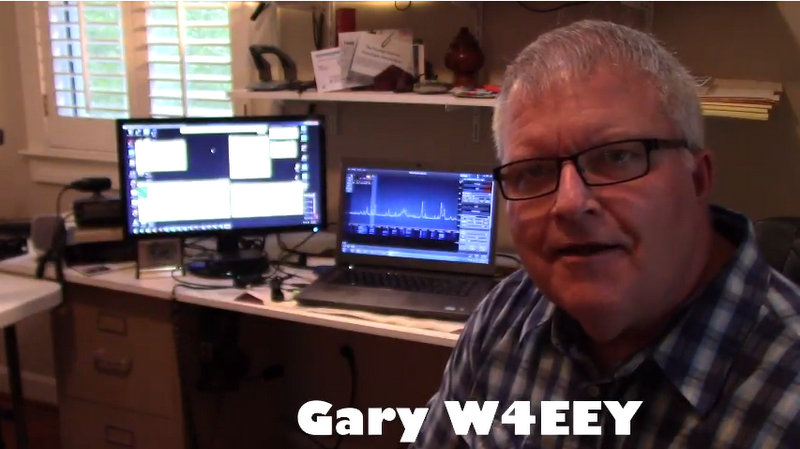
Many thanks to SWLing Post contributor, Gary Wise (W4EEY), who shares the following:

As you might know, Dave Ivey, KE4EA, and I have been teaching Ham Radio classes in Greer, South Carolina (under the sponsorship of the Greer Amateur Radio Club – and Greer Parks and Recreation). We are completing Technician and General classes later this month.

What might be of interest to your readers, if they have ever thought about getting their own Ham Radio license, is that we have recorded the classes, and posted them online at my YouTube channel. Anyone can view the videos and prepare for the amateur radio exams at home. License Tests are given by a variety of Volunteer Examineers all over the United States.

A link to the channel is here. (The channel name is my callsign, W4EEY.)

We use the ARRL License Manuals as a basis for the class. Links to the books are here:

Technician http://www.arrl.org/shop/ARRL-Ham-Radio-License-Manual-Spiral-Bound/

General http://www.arrl.org/shop/ARRL-General-Class-License-Manual-Spiral-Bound/

Extra http://www.arrl.org/shop/ARRL-Extra-Class-License-Manual-Spiral-Bound/

This was all new to us this year and the first videos are pretty basic. But we’ve made improvements along the way, and hope to continue with the effort. We will have Technician and Amateur Extra classes starting in January and will continue to record and edit the videos for each new class session.

Ham Radio is the best hobby in the world! Dave and I enjoy teaching the classes and helping others into this great hobby.

Vy 73,

Gary W4EEY

Thank you so much for sharing this, Gary!

Readers, what Gary didn’t mention is that I’ve checked out his ham radio classes in person–he invited Vlado (N3CZ) and I to do a presentation on my favorite topic: field portable radio! The class was packed with students and all of them were enthusiastic. Gary and Dave have really put their labor of love into a proper class, with peer support and interactive hands-on demonstrations. I was amazed with the diverse group of students in his Technician class last year.

Again, thanks for sharing, Gary and keep up the good work!

Check out their ham radio class videos on Gary’s YouTube channel.

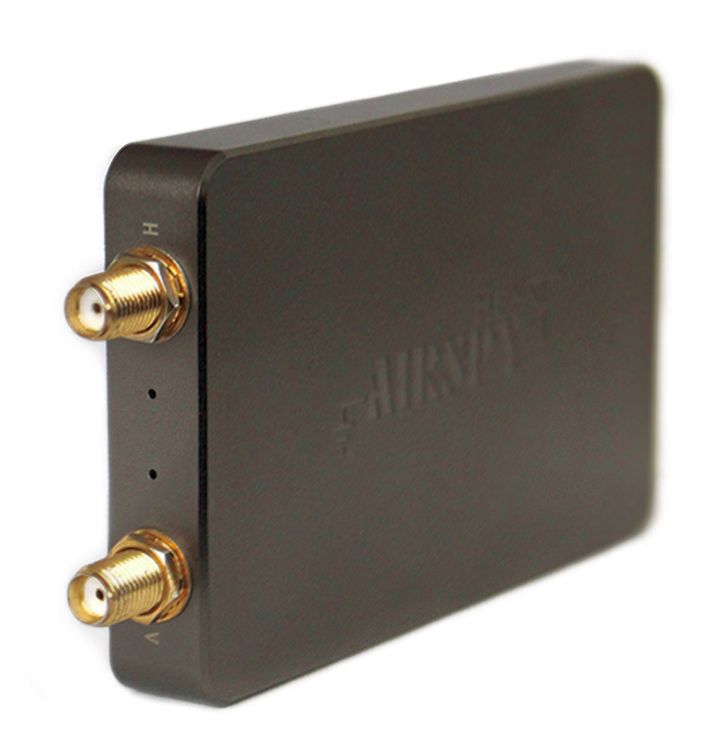
Airspy’s latest: The Airspy HF+ SDR

SDR manufacturer, Airspy, has a new product shipping “really really really soon” (per their website). The Airspy HF+ promises improved frequency agility through the use of high-performance passive mixers with a polyphase harmonic rejection structure. Airspy states that no external band filters are required as they are with many budget SDRs.

There are many other improvements over their previous iterations. Here’s the product information copied from the Airspy HF+ page on Airspy’s website:

(Source: Airspy)

The Software Defined Radio revolution brought great flexibility in VHF and UHF reception. Today we offer the best wide band receivers which address these needs. We also provide a high performance extension for weak-signal wide band reception on HF – something other competing solutions fail to address efficiently.

Airspy HF+ is a paradigm shift in high performance HF radio design. It is a joint effort between Airspy, Itead Studio and a top-tier semiconductor company to build a state of the art SDR for HF and VHF bands.

Like most high-end HF receivers, the HF+ uses very high dynamic range ADC’s and front-ends. But unlike the current offerings in the market, it also brings more frequency agility by using high performance passive mixers with an excellent polyphase harmonic rejection structure. No external band aid filters are required like the lower end HF receivers, which makes it the ideal companion for light portable high performance operation.

Both the architecture and level of integration achieved in this design allow us to bring top performance reception at a very affordable price.

All the major SDR software is supported. Check the download page.

State of the Art SDR streaming technology!

We concentrated state of the art DSP and networking techniques into our SpyServer software to allow multiple users to stream high quality IQ data from the same receiver at the same time. No compromises in the quality were made like it is usually done in Web SDR interfaces. You get actual IQ data you can process with your plugins and extract the last bit of information out of it.
The server software is highly scalable and can run on computers as small as the $7 Orange Pi Zero to top end 64bit servers with multiple cores/cpus, including the popular Raspberry Pi series.

HF Tuner

Airspy HF+ achieves excellent HF performance by means of a low-loss band filterhigh linearity LNAhigh linearity tunable RF filter, a polyphase harmonic rejection (HR) mixer that rejects up to the 21st harmonic and multi-stage analog and digital IF filtering.
The 6 dB-stepped AGC gain is fully controlled by the software running in the DSP which optimizes the gain distribution in real time for optimal sensitivity and linearity. Harmonic rejection is a key issue in wide band HF receivers because of the large input signal bandwidth of the input signal. The output of the IF-filter is then digitalized by a high dynamic range sigma delta IF ADC for further signal processing in the digital domain.

VHF Tuners

Excellent VHF performance is also achieved by using optimized signal paths composed of band filtershigh linearity LNAs with a stepped AGC, a polyphase harmonic rejection mixer and IF filters optimized for their respective bands.
The amplifier gain is switchable in 3 dB-steps and fully controlled by the AGC running in the DSP. The RF signal is converted to baseband by a high linearity passive mixer with a polyphase harmonic rejection structure. The low-IF signal is then converted into the digital domain by the same IF ADC used in the HF chain.

IF Sampling

The IF analog to digital converter (ADC) is a 4th order multi-bit noise shaping topology; it features very high dynamic range and linearity. The IF-ADC sampling rate is determined by a control algorithm running in the embedded DSP. This advanced technique adjusts the sampling rate depending on the tuning frequency with the goal of avoiding the disturbances and spurs generated by the switching discrete-time sections of the IF-ADC.

Digital Down Converter

Once the IF signal is digitalized, the high sample rate I/Q stream is then frequency translated and processed with cascaded CIC and FIR decimation stages. After every stage, the sample rate is reduced and the resolution increased. The final signal at the output has 18bit resolution and an alias rejection performance of 108 dBc. The data is then scaled to 16bit and sent to the Micro-Controller for streaming over USB.

Architectural Advantages

The main advantages over techniques from the legacy super-heterodynes up to the now mainstream direct sampling is that the whole receiver chain is well protected against out of band blockers while still relaxing the RF filtering constraints, making it simple and cost effective.
The natural filtering of the sigma-delta ADC combined with the excellent linearity and sensitivity of the analog chain reaches an unprecedented level of performance and integration.

Use it over the network!

Connect as many SDR applications as needed to the HF+, over the Internet or in your own local network with near zero latency thanks to the new SPY Server software.
This setup basically brings all the flexibility of Web based SDRs while still benefiting from the full power of desktop applications. The IQ data is processed in the server with state of the art DSP and only the required chunk of spectrum is sent over the network. What is sent is the actual IQ signal, not compressed audio. This means you can use all your favorite plugins to process the IF, eliminate noise and perform heavy lifting of the signals as you are used to do with locally connected SDR’s.
We have a tradition of building multi-tools, so we made sure the SPY Server runs on 32/64bit Windows and Linux on Intel and ARM processors without any compromises. Low cost Raspberry Pi 3 and Odroid boards are in the party.

Technical specifications

  • HF coverage between DC .. 31 MHz
  • VHF coverage between 60 .. 260 MHz
  • -140.0 dBm (0.02 µV / 50 ohms at 15MHz) MDS Typ. at 500Hz bandwidth in HF
  • -141.5 dBm MDS Typ. at 500 Hz bandwidth in FM Broadcast Band (60 – 108 MHz)
  • -142.5 dBm MDS Typ. at 500 Hz bandwidth in VHF Aviation Band (118 – 136 MHz)
  • -140.5 dBm MDS Typ. at 500 Hz bandwidth in VHF Commercial Band (136 – 174 MHz)
  • -139.0 dBm MDS Typ. at 500 Hz bandwidth in the upper VHF Band (> 174 MHz)
  • +15 dBm IIP3 on HF at maximum gain
  • +13 dBm IIP3 on VHF at maximum gain
  • 110 dB blocking dynamic range (BDR) in HF
  • 95 dB blocking dynamic range (BDR) in VHF
  • 150+ dB combined selectivity (hardware + software)
  • 120 dB Image Rejection (software)
  • Up to 660 kHz alias and image free output for 768 ksps IQ
  • 18 bit Embedded Digital Down Converter (DDC)
  • 22 bit! Resolution at 3 kHz channel using State of the Art DDC (SDR# and SDR-Console)
  • +10 dBm Maximum RF input
  • 0.5 ppm high precision, low phase noise clock
  • 1 PPB! frequency adjustment capability
  • Very low phase noise PLL (-110 dBc/Hz @ 1kHz separation @ 100 MHz)
  • 2 x High Dynamic Range Sigma Delta ADCs @ up to 36 MSPS
  • No Silicon RF switch to introduce IMD in the HF path
  • Routable RF inputs
  • Wide Band RF filter bank
  • Tracking RF filters
  • Sharp IF filters with 0.1 dB ripple
  • Smart AGC with real time optimization of the gain distribution
  • All RF inputs are matched to 50 ohms
  • 4 x Programmable GPIO’s
  • No drivers required! 100% Plug-and-play on Windows Vista, Seven, 8, 8.1 and 10
  • Industrial Operating Temperature: -45°C to 85°C

Typical Applications

  • High Performance Networked HF/VHF Radio
  • Ham Radio (HF + 2m)
  • Short Wave Listening (SWL)
  • AM DX
  • FM DX
  • VHF-L TV DX
  • Remote Telemetry Radio Receiver
  • Low Bands IoT

Supported Operating Systems

  • Windows Vista, 7, 8, 8.1 and 10
  • Linux
  • *BSD
  • OSX

Supported Hardware

  • Intel compatible PC
  • Raspberry Pi 2 and 3
  • Odroid C1, C2 and XU4
  • Many other Single Board Computers (SBC)

Minimum hardware requirements

  • 1GHz Pentium or ARM
  • 1GB of RAM (to run your own OS, HF+ barely needs 1MB of memory)
  • High speed USB 2.0 controller

Supported Software

Developer API

  • Open source, multi-platform user mode driver libairspyhf on github

No price point has yet been made public–at least, none that I have discovered. Of course, we’ll post shipping and pricing details when they become available. Follow the tag AirSpy for more. Check out the Airspy website for full details and documentation.

HAARP Amateur Radio Experiment

(Source: Southgate ARC)

Radio ham’s HAARP experiment

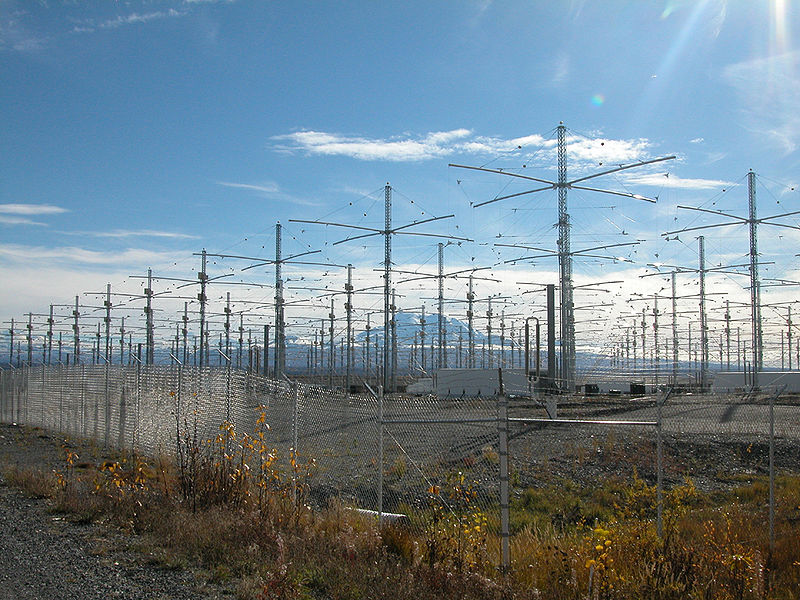
The IEEE Spectrum reports on the Slow Scan Television (SSTV) transmissions made from Alaska’s HAARP facility by radio amateur Chris Fallen KL3WX

In late September, Christopher Fallen and technicians at the High Frequency Active Auroral Research Program (HAARP) near Gakona, Alaska, switched on a giant array of 180 antennas. They were hoping to produce radio-induced airglow, also known as artificial aurora, as a way to better understand the mechanics of natural aurora.

He embedded images into the powerful radio wave that HAARP uses to heat a patch of the ionosphere, and alerted amateur radio enthusiasts through Twitter. As the experiment ran, his feed began to light up with tweets from listeners who were sending the images back to him.

Fallen, an assistant professor at the University of Alaska Fairbanks’ Geophysical Institute, had transmitted two UAF logos, a cat photo, and a QR code granting the recipient 0.001 Bitcoin.

Messages returned from Pueblo, Colo., and Victoria, British Columbia. Given that HAARP’s antennas point directly up at the sky instead of out toward the horizon, Fallen was pleased with the results. “As powerful as HAARP is, it’s just a big radio,” he says.

It’s actually a giant phased array radio transmitter capable of sending 3.6 megawatts of energy into the ionosphere.

Read the full story at
https://spectrum.ieee.org/tech-talk/telecom/wireless/scientists-in-alaska-attempt-to-produce-fake-aurora-with-giant-antenna-array

Click here to read at the Southgate ARC Website.

Radio Day at Mount Mitchell State Park

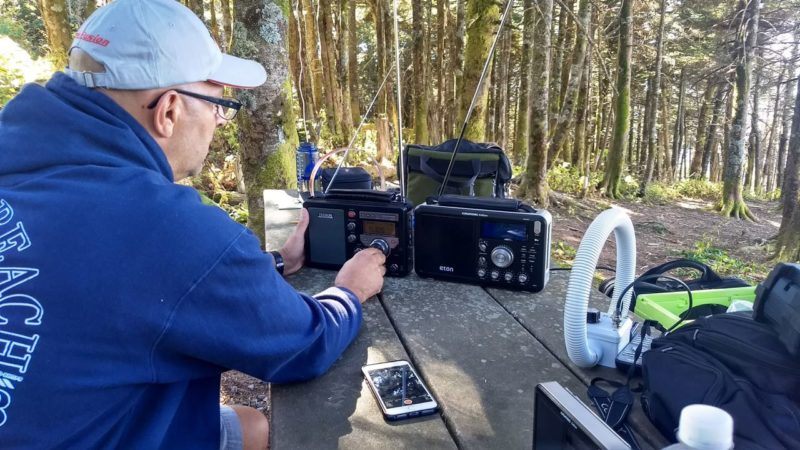
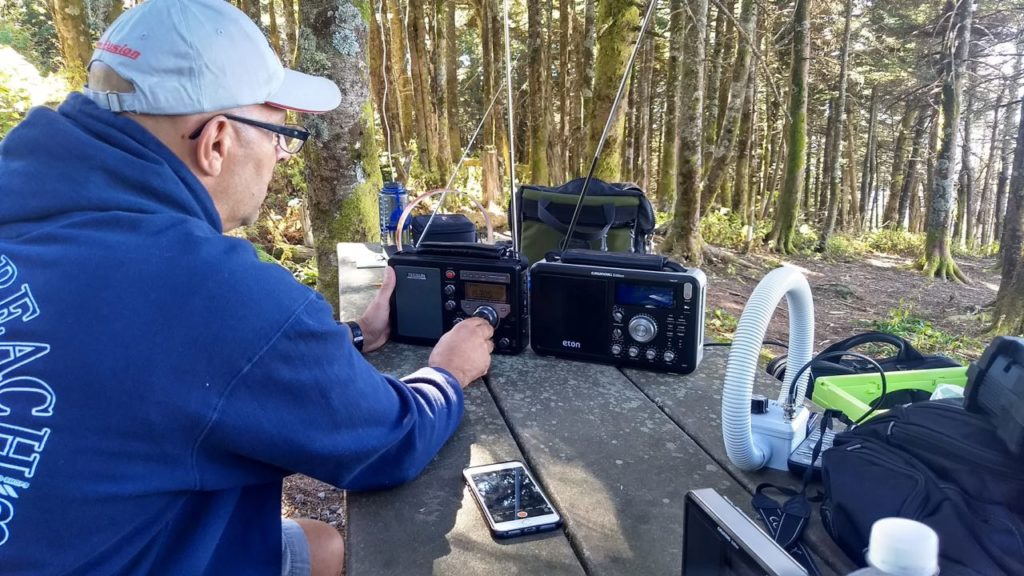
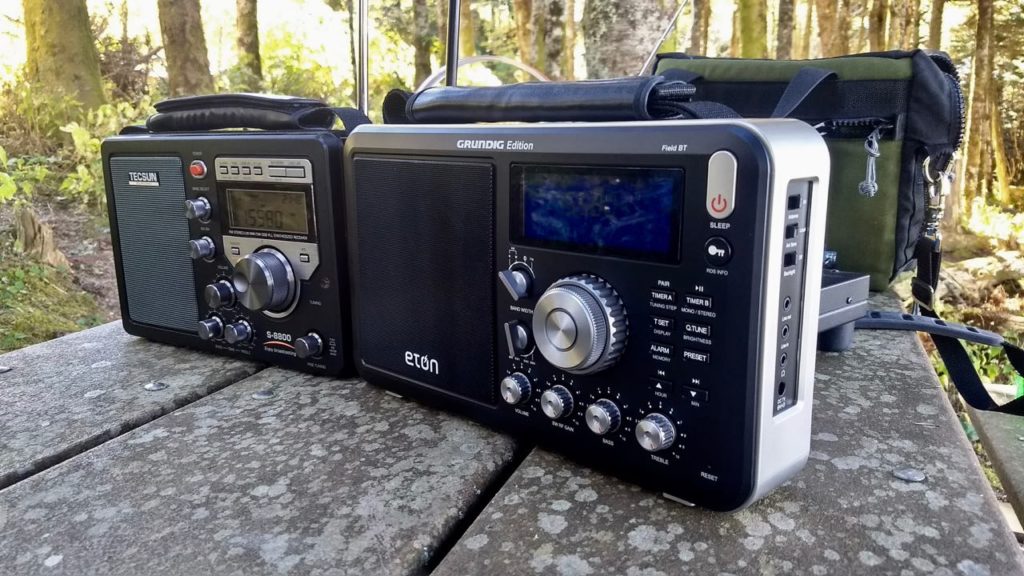
Troy Riedel preparing the Tecsun S-8800 and Grundig Field BT for a comparison review.

Shortly after publishing my review of the Tecsun S-8800, SWLing Post contributor Troy Riedel contacted me and asked if I would consider comparing the S-8800 to the Grundig Field BT. Of course I was very curious how the $130 Grundig Field BT might compare with the $268 Tecsun S-8800, but I’ve got a lot on my plate at the moment and didn’t really want to purchase another large portable.

Long story short: Troy found a honey of a deal on a perfect Grundig Edition Field BT via eBay. He ordered it and we decided to bring the two radios together yesterday at beautiful Mount Mitchell State Park the highest point east of the Mississippi river.

Yesterday was an ideal day, too. The weather was picture-perfect, the park was (surprisingly) not too busy and propagation was the best I’ve experienced in weeks.

Troy left early in the morning and embarked on the 6+ hour pilgrimage to Mount Mitchell–I only live an hour away, so it was a casual drive for me. We met at noon.

Parks On The Air

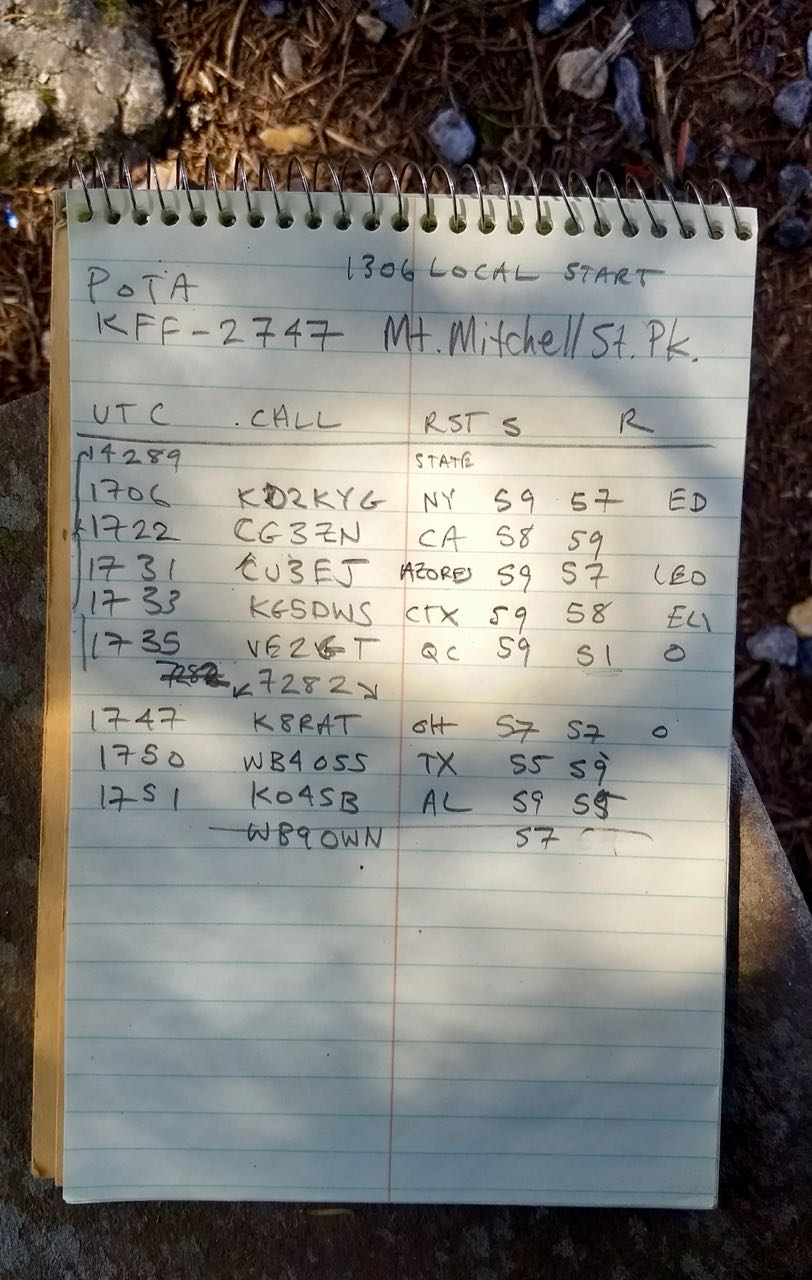
After a quick lunch, we deployed my Elecraft KX2 with EFT Trail-Friendly antenna and made my first Parks On The Air (POTA) activation.

You might recall I was very active during the ARRL National Parks On The Air (NPOTA) program last year, but since then I’ve done few field deployments. It was great fun to get on the air again and do a park activation for the World Wide Flora & Fauna POTA program.
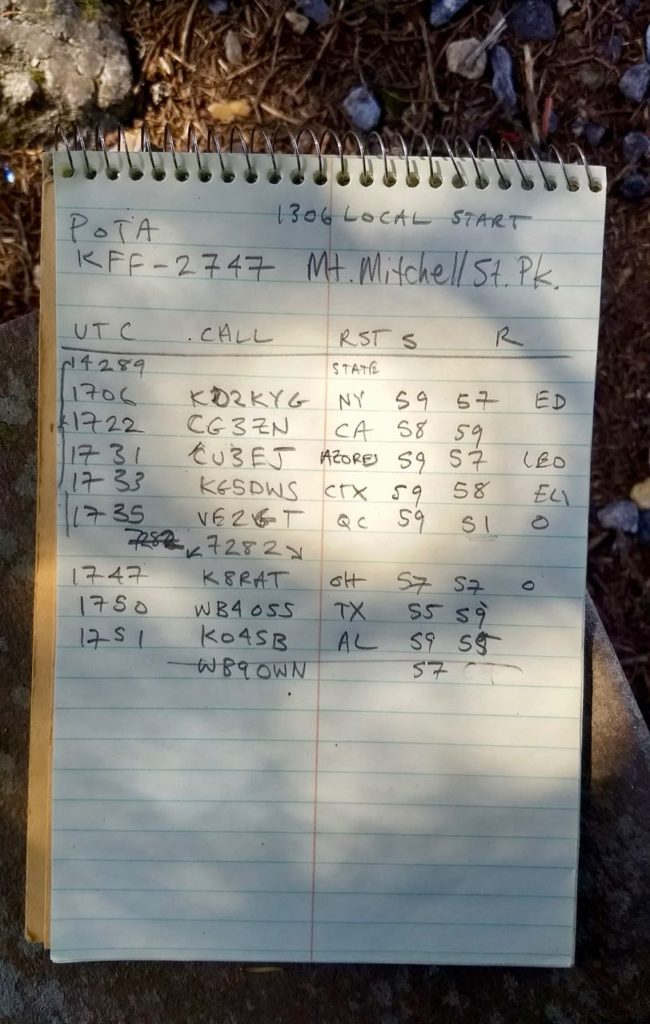
While we didn’t log a lot of stations, I was still impressed we worked stations from Texas to Quebec to the Azores. Not bad for 10 watts SSB!

Sure, I only worked a handful of stations, but this activation was essentially unannounced so chasers had no advance notice. No doubt, many more POTA activations are in my future! The bug has bitten!

Radio Fun

Except for a break to eat dinner at the park restaurant and a short hike to the peak of Mount Mitchell,  we played radio until about 8:00 PM. It was amazing, uninterrupted fun.

Troy spent a lot of time comparing the Tecsun S-8800 with the Grundig Field BT and made several videos. No doubt, he’ll post his thoughts and review in the near future!
Being a bit of radio geek, I couldn’t help but bring a few “extra” radios and accessories. Here’s what I packed:

We were a little disappointed to discover that both my Tecsun PL-680 and Grundig Satellit exhibited flaky behavior.

During my S-8800 comparison tests, a few weeks ago, I did notice that sometimes when I turned on the PL-680, it was absolutely deaf. Next time I turned it on, it worked fine. Yesterday, the PL-680 simply didn’t want to perform. I’m not sure what happened.
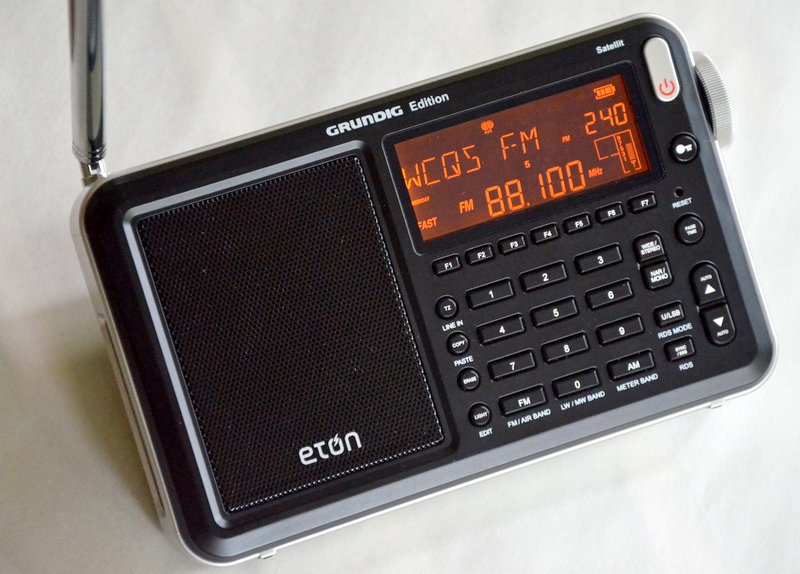
The Grundig Satellit, on the other hand, worked great, but sometimes if you touched either the antenna or even brought your hands near the radio body while tuned to a station, it would go deaf. You could correct this by tuning off frequency, then back on–still…very strange! It’s as if the AGC or RF gain were hanging up.

Have any Post readers experienced this before? I’ll look into the issue this week and reset both radios. Perhaps that will help.

A great “Mini DXpedition”
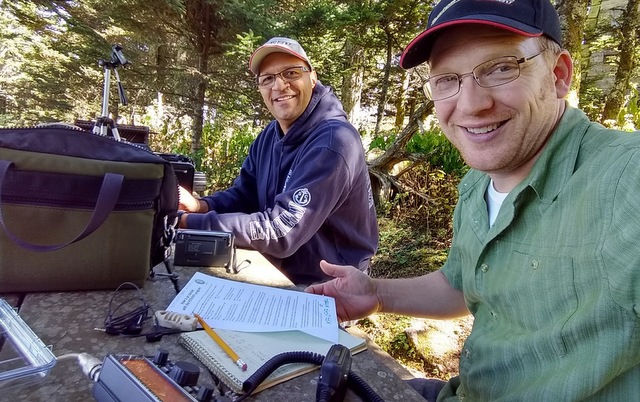
Thank you, Troy, for suggesting the meet up and for making the pilgrimage. It was great meeting you in person! I also thoroughly enjoyed watching someone else do comparison tests and exploring a new radio–Troy certainly has a knack for doing radio evaluations!

This has encouraged me to do more meet-ups, perhaps during my travels. Great fun!

Post Readers: be on the lookout for Troy’s comparison of the Grundig Field BT and Tecsun S-8800 in the coming days/weeks (no pressure, Troy!).

UPDATE: Click here to read Troy’s comparison.

CC Skywave SSB: C. Crane publishes pre-order page with pricing, availability and features

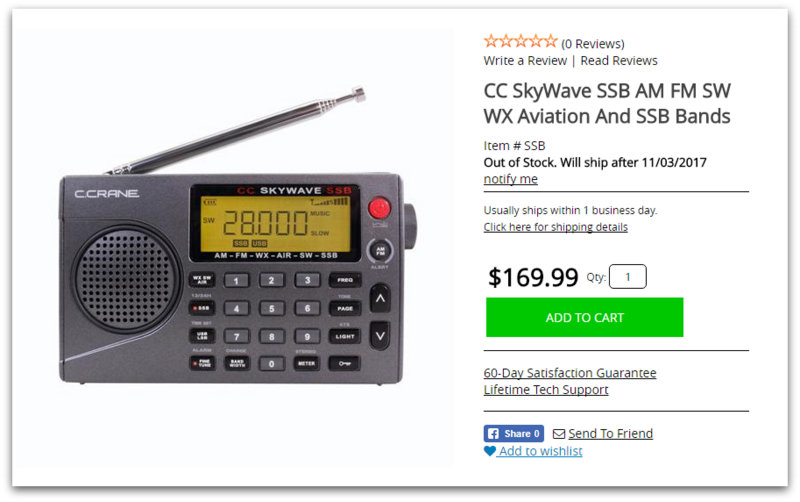
C. Crane has published a full pre-order page for their latest travel portable: the CC Skywave SSB.

The price is $169.99 US–they’ve noted an expected ship date of sometime after November 3, 2017.

We’ve been testing a pilot run CC Skywave SSB and recently posted photos. Once we have an production unit, we’ll post comparison videos and review notes.

Click here to view the CC Skywave SSB product page at C. Crane.

Photos: HRO Milwaukee Superfest 2017

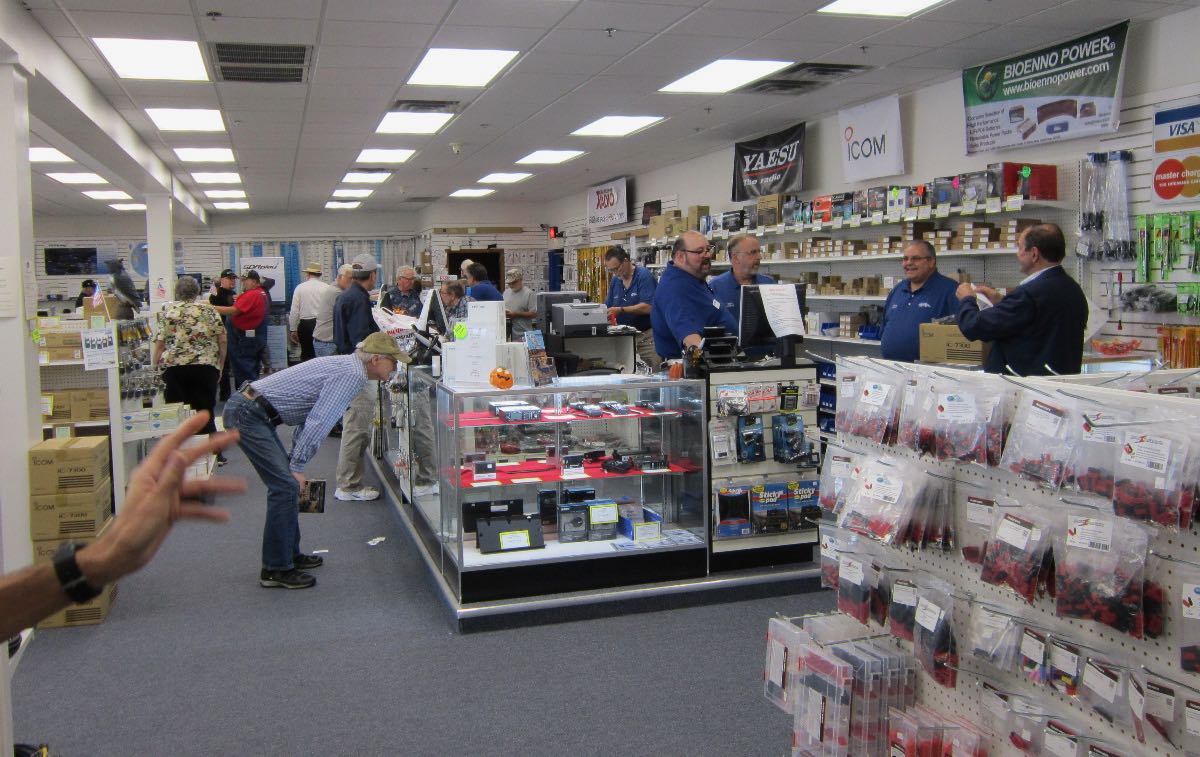
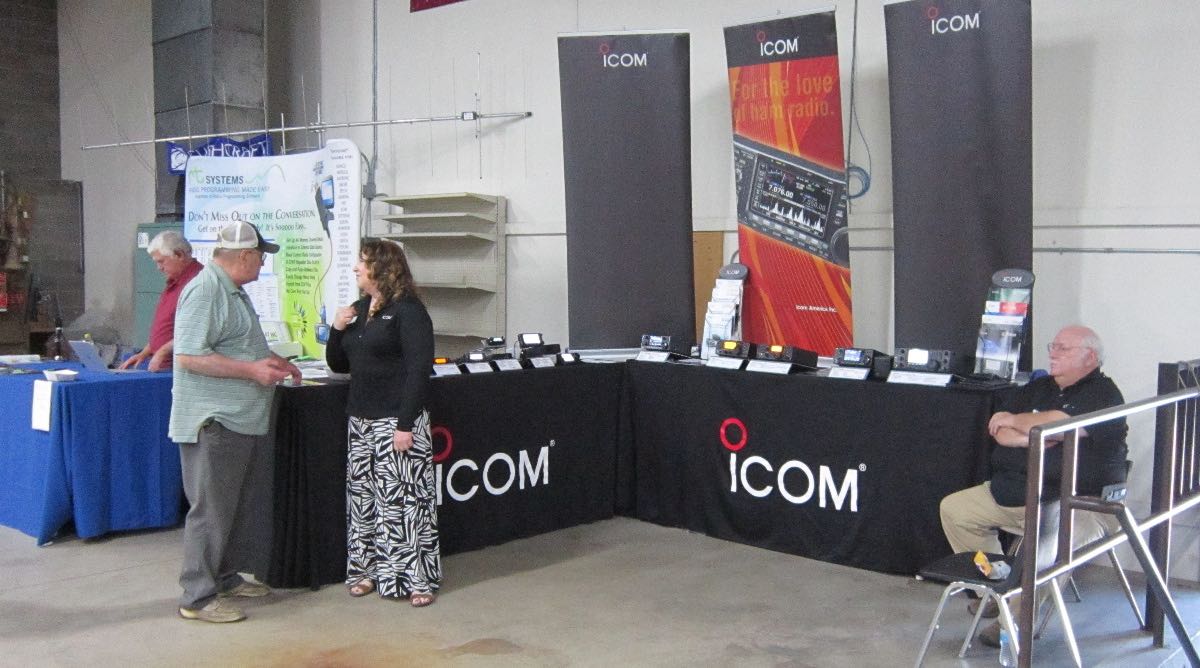
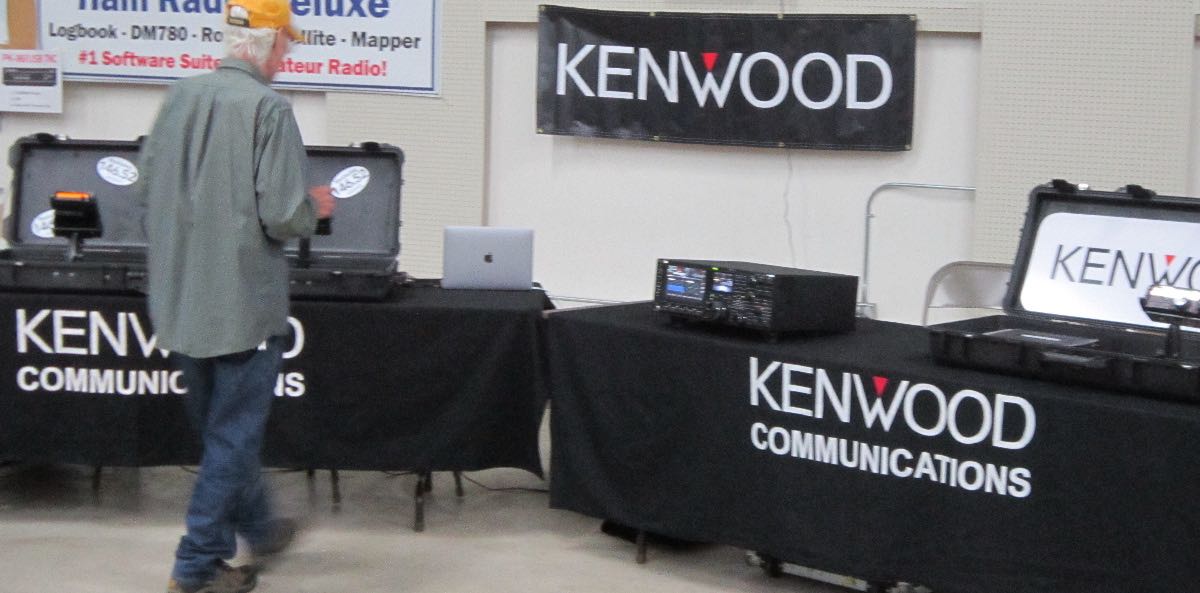
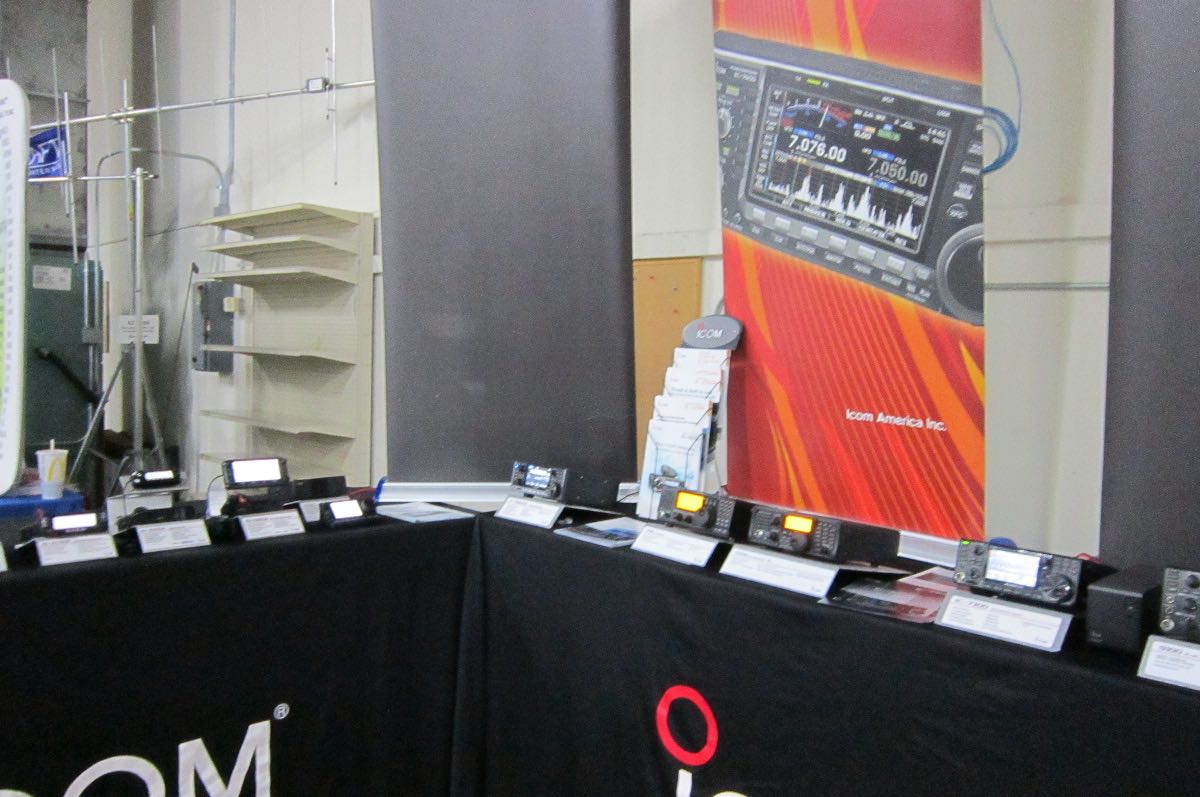
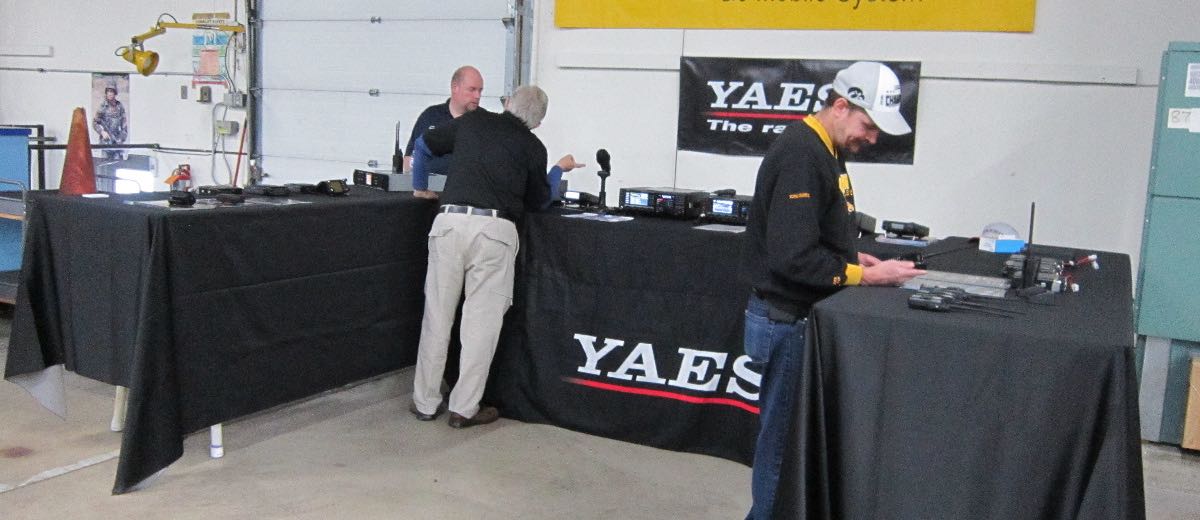
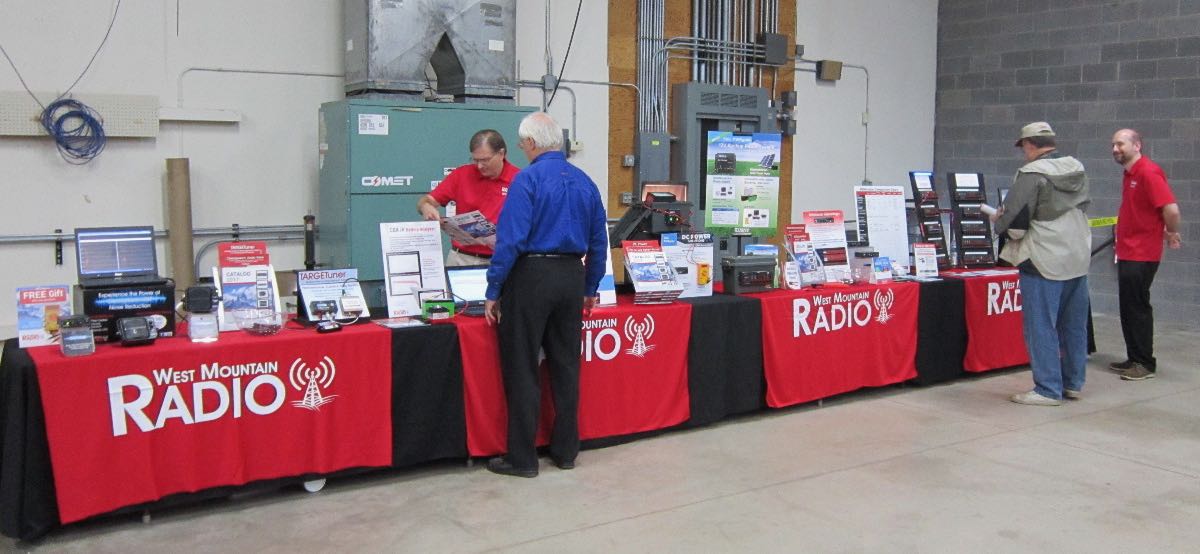
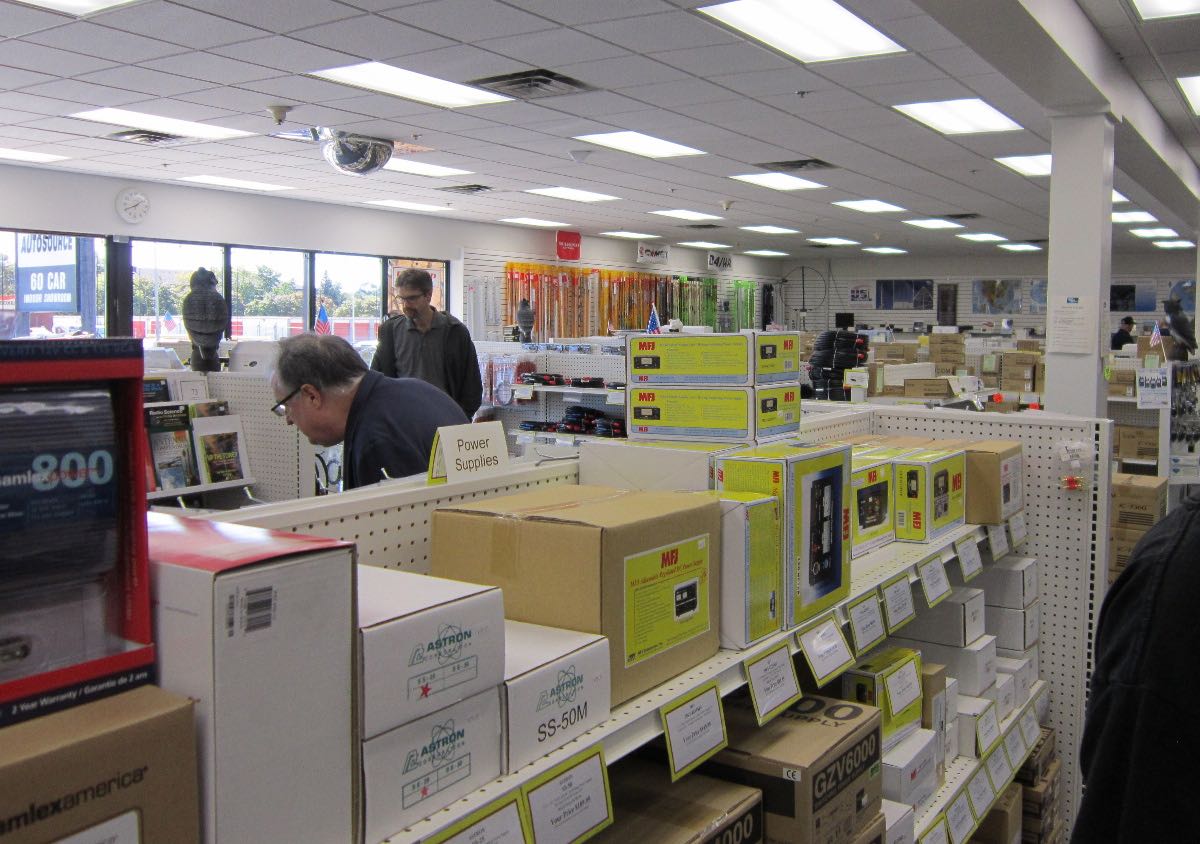
Many thanks to SWLing Post contributor, Dave Zantow, who shares the following photos from Ham Radio Outlet’s “Superfest” in Milwaukee this past weekend.  Dave notes:

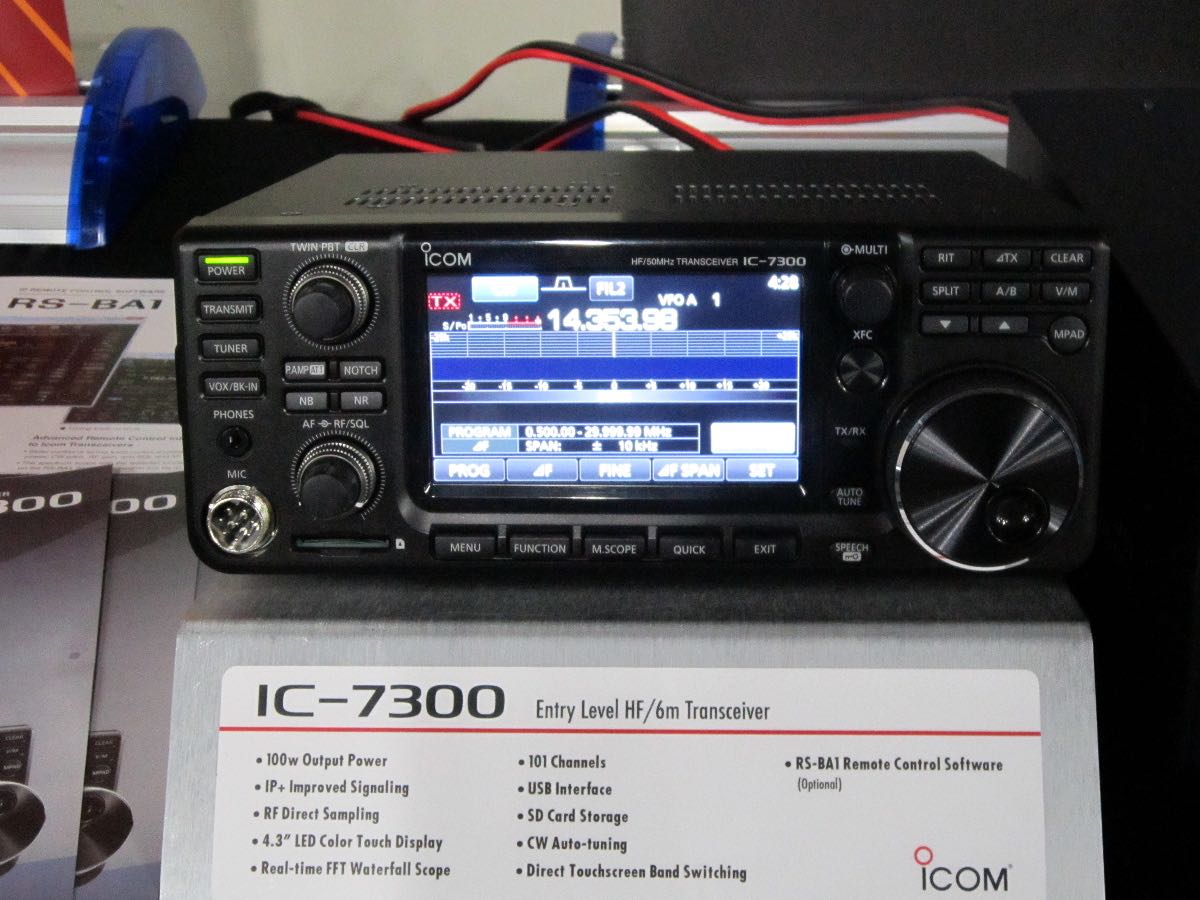
“Turnout was OK busy but not overcrowded. They had a “in store special” on the Icom IC-7300, few pennies under $ 1100. (after the $ 100. rebate). Saw at least 2 sold when I was around the main counter. I myself did not make any purchases.”

Thanks for the photos, Dave!

The HRO Milwaukee store appears to have an excellent selection of inventory. And an Icom IC-7300 for $1100 US?  That’s a great deal, in my opinion.