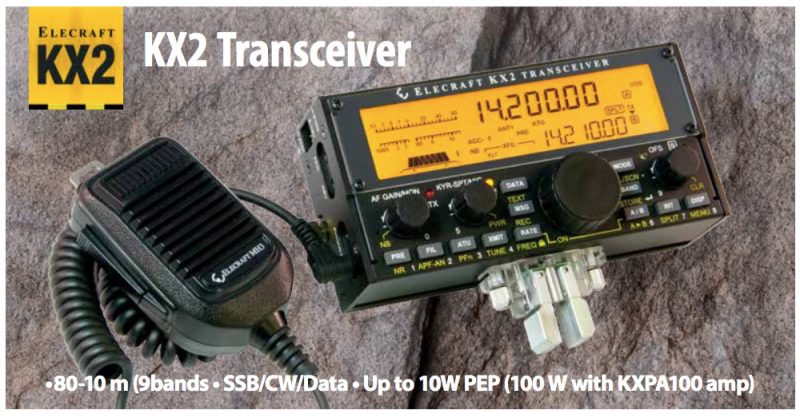
Click here to download the PDF version of the Elecraft KX2 product sheet (2 pages).


On my way this morning to FDIM and the 2016 Dayton Hamvention.
Since I own the Elecraft KX3, Elecraft K2 and the Elecraft KX1, I’m excited to see that Elecraft has announced a new addition to their product line: the Elecraft KX2. Elecraft will feature the KX2 at Four Days In May (FDIM) and the Dayton Hamvention.
I am attending vendor’s night at FDIM and the full Dayton Hamvention. I will post photos of the KX2 here–follow updates by bookmarking the tag KX2.
Full details from the Elecraft press release, via Southgate ARC, below:

(Source: Southgate ARC)
New KX2 radio to be announced this Thursday at the Dayton Hamvention 2016
Hello to all,
We are please to announce a new radio to complement the KX3 and the KX-Line. Here are the details.
What: Elecraft announces the KX2, Ultra-portable radio
When: Thursday, May 16th, 1300Z
Where: Four Days In May QRP event, part of the Dayton Hamfest activities
Elecraft is excited to announce a new radio targeting the Ultra-portable market with a Fit-In-Your-Pocket size. Please see the attached brochure for details.
Pricing
– KX2: $749.00
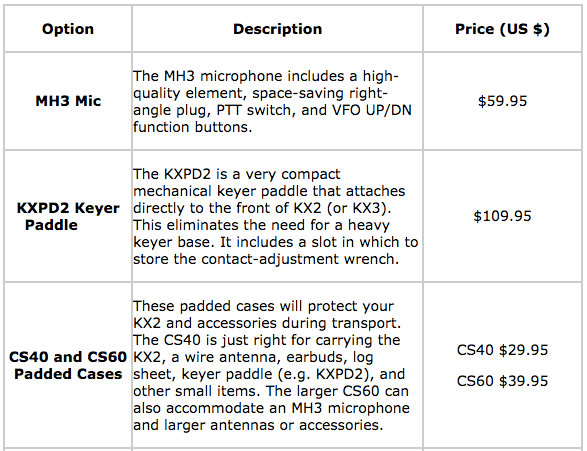
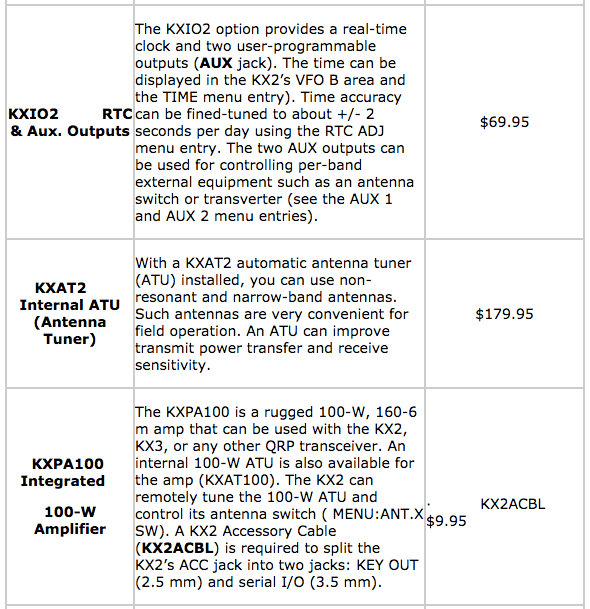
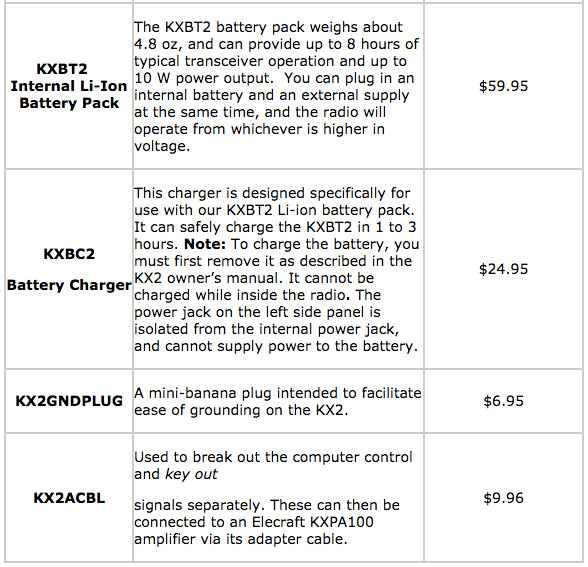
– Options and accessories: Please see the table below for pricing. Also see the FAQ for details.
Ordering/Availability
Distributors are encouraged to order both the KX2 and accessories now. The KX2 is already in production and early ordering will ensure your position for deliveries.
Note that the KX2 will be available in full, factory-built form only. There will be 2 internally-installed options available immediately. See the FAQ for more details.
Marketing Collateral Available
You will find a new section in the Elecraft Egnyte repository that contains:
– The attached brochure in editable form for you to translate and convert to local printing formats.
– A KX2 Date Sheet
– A KX2 Frequently Asked Questions (FAQ) in editable form
– Hi Resolution images for use with your marketing and web site content
Special Note on the new KX2 Battery and Charger system
– Elecraft will be stocking the KXBT2 (Li-ion Battery) and the KXBC2 (Li-ion Charger) for your to order.
– We have also arranged for you to purchase both items directly from our supplier, Tenergy (www.tenergy.com)
– Please see the attached document, KX2 Battery info v1.0, with the details.
Along with many of the Elecraft team, I’ll be in Dayton to launch the KX2 but will be able to answer questions as needed.
Again, we are excited to offer you increased business opportunities with the KX2 launch!
Cheers,
David
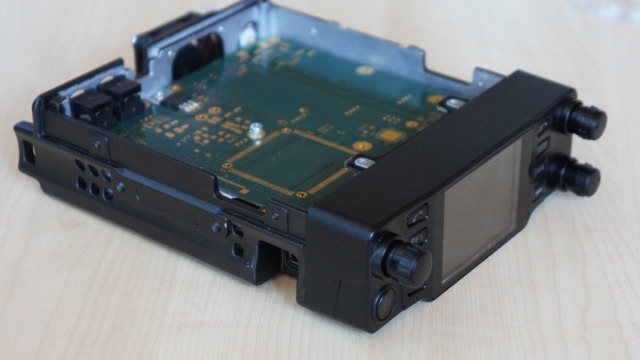
An announcement has been made by Kurt, OE1KBC and reported by concerning a multi-mode radio combining various digital modes. The radio/computer is called simply NEW RADIO and is a joint initiative of the ÖVSV, DARC and IARU R1. As stated in Don’s article:
the “NEW RADIO” that will operate on the 2m & 70cm bands and support the most common ham digital modes, including DMR, D-STAR and C4FM (System Fusion), plus analog FM. As reported in the article, the NEW RADIO has been created by hams for the ham radio community will feature a colour touch screen display, 50W of power output, a 1.8 GHz processor, a Linux operating system, plus dual AMBE+ vocoders, allowing for full-duplex, cross-band operation. Also, one of the biggest features of the NEW RADIO is that it will include a built-in LTE wireless modem and SIM card allowing it to be Internet connected while on the go. Apparently, with it being Internet connected, the NEW RADIO will be able to automatically download frequencies, offsets, contacts and other configuration information on the go, allowing for instant updates for users. (The full article may be found here.)
I certainly hope this radio really is “ready for Prime Time” soon as it might very well fill a big need by allowing use of multiple systems without the need to carry around a radio for each digital mode. I suspect many hams have hesitated to jump on the digital bandwagon simply because of not knowing which standard would have dominance. Nobody wants to relieve the VHS/Beta experience! (Yes, I am dating myself here!)
If anyone gets a look at this radio at Dayton I hope you will share with us your impressions!
Robert Gulley, AK3Q, is the author of this post and a regular contributor to the SWLing Post. Robert also blogs at All Things Radio.
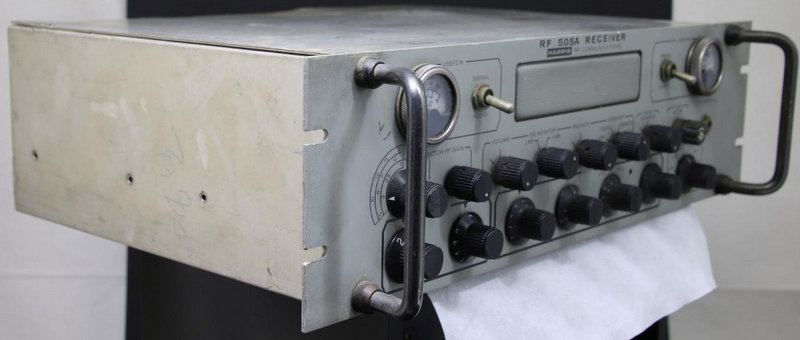
In response to our post mentioning the Harris RF-505A, SWLing Post contributor, Bob LaRose (W6ACU), writes:
I know the RF-505A very well. It was introduced in about 1969 while I worked at Harris in Rochester. I started working there as a Co-Op student while at RIT and then after I got my BSEE I joined them full time, initially as a Field Engineer but quickly found my way into Marketing and eventually Sales.
Right after the first version came out, the RF-505, I took one home to my parent’s house for a weekend and did some SWLing with it. It was very neat in one respect – it tuned ISB (Independent Side Band) and in those days there were a number of utility stations using ISB (separate traffic on each sideband). To an SWL some of the most interesting of these were the VOA point-to-point links from the East and West Coast, each carrying two simultaneous program feeds for the overseas relay stations!
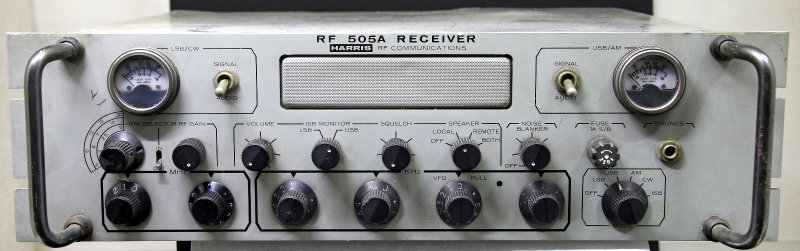
While overall a good receiver my personal results on the sensitivity of the original RF-505 were not very positive. On the bench with exactly a 50 ohm source it looked good but on a real world antenna it was pretty numb. Eventually, after a lot of internal arguments, they came out with the RF-505A that included a tunable active preselector as shown in the photos. Problem solved.
For a ham or SWL the RF-505 was a real pain in the butt to tune. You could dial in any exact frequency but the decade switches didn’t roll over (either mechanically or electrically) so you had to do a lot of knob twiddling to do any kind of band scanning. The detents on the switches connected to the knobs were pretty stiff so you could easily take some finger skin off tuning around!
If I remember correctly Harris built them for about a five year period and then replaced them with the RF-550, which was a monster of a receiver with all kinds of advanced features. It included a keyboard with electronic display.
Great memories!
Thanks so much for this RF-505A insight, Bob! I had a hunch that band-scanning wasn’t the RF-505A’s strong suit–it would be incredibly cumbersome to scan with so much “knob twiddling.”
It must have been pretty amazing to work for the legendary Harris corporation. Thanks for sharing!
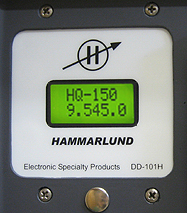 Many thanks to SWLing Post reader, Jeff (KB7AIL), who shares the following:
Saw the article on the DC meter in a Hammerlund HQ180.
Another mod I have seen is replacing the meter with a digital display.
http://www.electronicspecialtyproducts.com/dd101.html
It integrates with the HQ180 nicely.
They also have digi-displays in cases or use with other receivers/transceivers.
Very cool, Jeff. While I know a digital display might kill the vintage look for some enthusiasts, I have to admire such a useful modification to replace a broken Hammarlund clock/meter.
As Jeff mentions, Electronic Specialty Products has a number of external digital display boxes as well. Check out their full line of products on the ESP website.
(Source: 73 Radio Row press release)
A new website designed for radio amateurs, SWL’ers, CB’ers and all communications hobbyists has launched on the Internet recreating the atmosphere of the famed Radio Row in New York City.
According to its founder, Richard Fisher, KI6SN, “’73 Radio Row’ takes its cue from an era when New York’s legendary radio district bustled with communications fanatics shopping for surplus and used gear along Cortlandt Street in Lower Manhattan.” 73 Radio Row’s Web address is: http://www.73RadioRow.com
The site features used radio receivers, transmitters and transceivers, as well as unbuilt kits, new/old stock antennas, Morse instruments and station accessories of all kinds.
“We are crazy about radio, the same as everyone else,” Fisher said. “RETRO is NOWtro.” For complete details, visit: http://www.73RadioRow.com or write to: [email protected]. Call (951) 395-1923.
I discovered 73 Radio Row right after it launched–I ordered a portable ER TiCK Deluxe Keyer for the very affordable price of $26 US shipped.
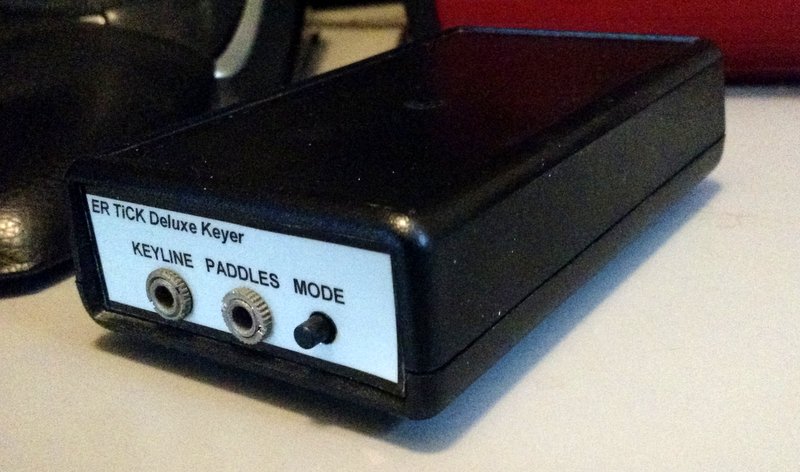
The keyer was dispatched immediately and I received it within a couple of days.
I know Richard Fisher (KI6SN) quite well and can certainly vouch for his integrity. In fact, he’s even giving a portion of 73 Radio Row proceeds to Ears To Our World–what a nice guy!
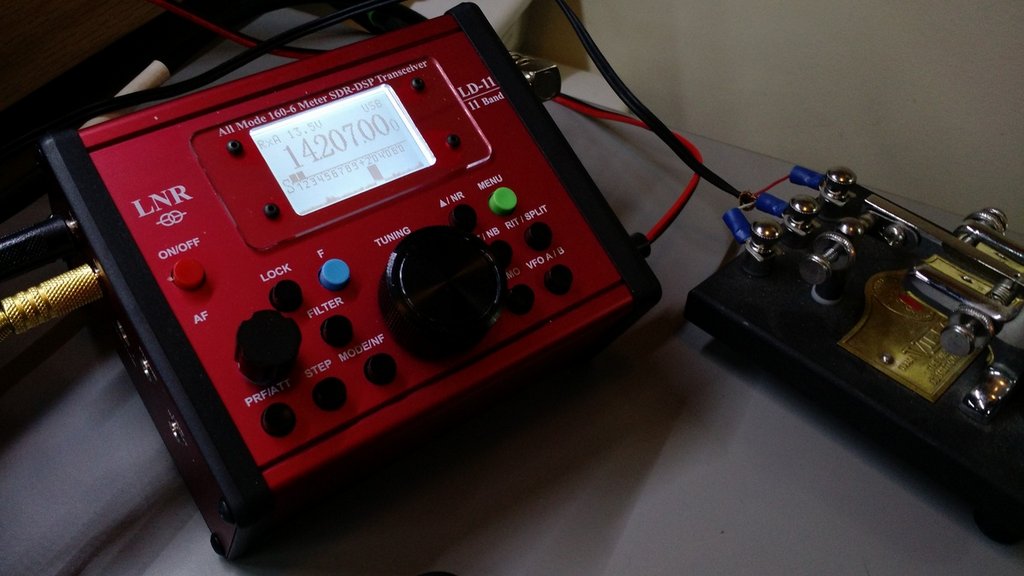
A couple weeks ago, LNR Precision sent me their new LD-11 Digital Direct Conversion QRP transceiver on loan for review.
The LD-11 is basically a small, tabletop SDR transceiver. It’s like a miniature, simplified version of the Icom IC-7300 I’ve also been evaluating.
The LD-11 is an all-mode and all-band transceiver–meaning, it includes SSB, CW, CW-R, Digi, AM and FM modes on all amateur radio bands (160 – 10 meters).
Though the LD-11 isn’t advertised as having a general coverage receiver, it will indeed tune the entire HF band.
You do this by entering the LD-11’s administration mode. LNR describes this in the LD-11 product manual, but suggests you contact them for help the first time you do this. In the admin panel, you’ll find functions that allow you to set the band edges on each amateur radio band.
For a preliminary test of broadcast reception, I moved the lower band edge of the 30 meter ham radio band to 8.2 MHz.
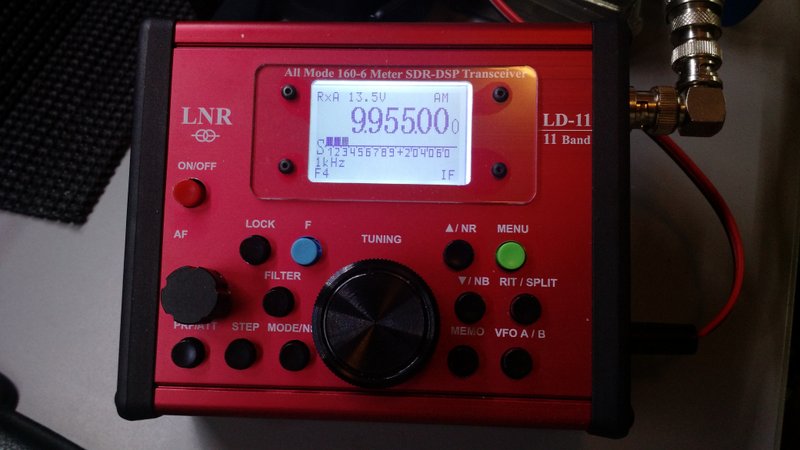
After saving the settings and re-starting the LD-11 in normal operation mode, I could then tune the entire 31 meter broadcast band on the LD-11.
Hypothetically, you could either widen each amateur radio band to include adjacent broadcast bands, or you could simply set one of the ham bands to include the entire HF spectrum. To make it easier to navigate and tune through the bands, I’m choosing the former method over the latter.
Since the LD-11 has a proper AM mode, broadcasts sound great–especially via headphones!
Better yet? The AM filter width can be widened to an impressive 9.6 kHz! Woo hoo!
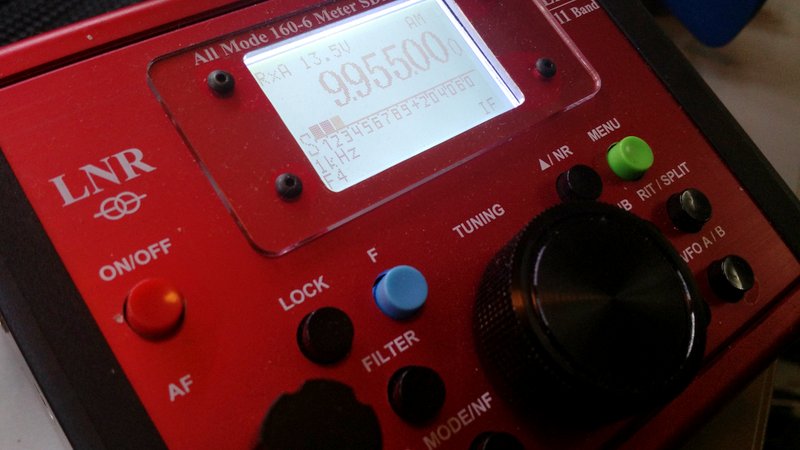
The LD-11 has four filter slots: F1, F2, F3 and F4.
The F1-F3 slots can be set to a fixed user-defined widths (common widths are default).
F4 can be altered to any available filter width without having to enter the admin mode of the transceiver. Simply press the “F” (blue function button) and the FILTER button simultaneously and use the encoder/tuning knob to specify the filter width in .1 kHz steps. Pressing the F and FILTER button simultaneously again, will save your filter width for the F4 position.
I’ve been using the F4 filter position for widths between about 8.2 and 9.6 kHz in AM.
It’s still early days with the LD-11, but I’m enjoying this little transceiver immensely. It reminds me of one of my favorite QRP transceivers of yesteryear: the Index Labs QRP Plus (though the LD-11 is much smaller, more versatile and has a much better front end than the QRP Plus!).
LNR Precision sold out all of their first run LD-11 units within moments of having announced availability. I’m willing to bet they’ll bring a few LD-11s to the upcoming Dayton Hamvention, though.
Check inventory status and view LD-11 details on LNR Precision’s website.