Category Archives: Ham Radio

Canada: Individual causing malicious interference triggers parliament petition

(Source: Radio Amateurs of Canada via Bruce Atchison)

*/For immediate release:/*

https://wp.rac.ca/ised-canada-responds-to-petition-about-interference/

On June 6, 2018, Martin Bérubé of Louiseville, Quebec initiated a petition involving a radio station that was “generating interference on purpose”. The petition attracted 1,135 signatures and was presented to the House of Commons on January 30, 2019.

The Government of Canada tabled the following response on March 18, 2019.

“Innovation, Science and Economic Development Canada <http://www.ic.gc.ca/eic/site/icgc.nsf/eng/home> (ISED) was informed of the individual’s conduct in December 2015 by a group of Amateur Radio operators from Quebec. The individual was operating an Amateur Radio station without proper authorization and was known to insult, threaten and impersonate other Amateur operators.

As the individual disregarded ISED’s written and verbal warnings, the department took action to enforce the /Act/. Due to repeated offences, ISED carried out three searches of the individual’s residences and issued seven notices of violation totalling $2,500 plus fees.

On October 17, 2018, the individual was found guilty of these seven violations of subsection 4(1) of the /Radiocommunication Act/, pursuant to subsection 10(1) of the /Act/, by Justice of the Peace Annie Vanasse at the Trois-Rivières Courthouse.

ISED also called upon a federal prosecutor to obtain an injunction against the individual. This injunction is currently at the interlocutory stage. ISED understands that the individual has not been heard on Amateur Radio since August 8, 2018. ISED is closely following this case.”

The text of the petition and the Government Response can be found at the following link:

https://petitions.ourcommons.ca/en/Petition/Details?Petition=e-1631

*Alan Griffin
RAC MarCom Director*
FCC invites comments on ARRL Technician Enhancement proposal

(Source: Southgate ARC)

The FCC has invited public comments on ARRL’s 2018 Petition for Rule Making, now designated as RM-11828, which asks the FCC to expand HF privileges for Technician licensees to include limited phone privileges on 75, 40, and 15 meters, plus RTTY and digital mode privileges on 80, 40, 15, and 10 meters.

Interested parties have 30 days to comment. The Technician enhancement proposals stemmed from the recommendations of the ARRL Board of Directors’ Entry-Level License Committee, which explored various initiatives and gauged member opinions in 2016 and 2017.

“This action will enhance the available license operating privileges in what has become the principal entry-level license class in the Amateur Service,” ARRL said in its Petition. “It will attract more newcomers to Amateur Radio, it will result in increased retention of licensees who hold Technician Class licenses, and it will provide an improved incentive for entry-level licensees to increase technical self-training and pursue higher license class achievement and development of communications skills.”

Specifically, ARRL proposes to provide Technician licensees – both present and future – with:
* Phone privileges at 3.900 to 4.000 MHz, 7.225 to 7.300 MHz, and 21.350 to 21.450 MHz.
* RTTY and digital privileges in current Technician allocations on 80, 40, 15, and 10 meters.

The ARRL petition points out the explosion in popularity of various digital modes over the past 2 decades. Under the ARRL plan, the maximum HF power level for Technician operators would remain at 200 W PEP. The few remaining Novice licensees would gain no new privileges under ARRL’s proposal.

ARRL’s petition points to the need for compelling incentives not only to become a radio amateur in the first place, but then to upgrade and further develop skills. Demographic and technological changes call for a “periodic rebalancing” between those two objectives, ARRL maintained in his proposal. The FCC has not assessed entry-level operating privileges since 2005.

The Entry-Level License Committee offered very specific data- and survey-supported findings about growth in Amateur Radio and its place in the advanced technological demographic, which includes individuals younger than 30. It received significant input from ARRL members via more than 8,000 survey responses. “The Committee’s analysis noted that today, Amateur Radio exists among many more modes of communication than it did half a century ago, or even 20 years ago,” ARRL said in its petition.

Now numbering some 384,500, Technician licensees comprise more than half of the US Amateur Radio population. ARRL stressed in its petition the urgency of making the license more attractive to newcomers, in part to improve upon Science, Technology, Engineering, and Mathematics (STEM) education, “that inescapably accompanies a healthy, growing Amateur Radio Service.”

ARRL said its proposal is critical to develop improved operating skills, increasing emergency preparedness participation, improving technical self-training, and boosting overall growth in the Amateur Service, which has remained nearly inert at about 1% per year.

The Entry-Level License Committee determined that the current Technician class question pool already covers far more material than necessary for an entry-level exam to validate expanded privileges.

ARRL told the FCC that it would continue to refine examination preparation and training materials aimed at STEM topics, increase outreach and recruitment, work with Amateur Radio clubs, and encourage educational institutions to utilize Amateur Radio in STEM and other experiential learning programs.

How to file your comment

(Source: ARRL)

Those interested posting brief comments on the ARRL Technician Enhancement proposal (RM-11828) using the Electronic Comment Filing System (ECFS) should access FCC Electronic Comment Filing System Express. In the “Proceeding(s)” field, enter the number of the PRM, i.e., RM-11828 (using this format), complete all required fields, and enter comments in the box provided. You may review your post before filing. All information you provide, including name and address, will be publicly available once you post your comment(s). For more information, visit “How to Comment on FCC Proceedings.”

CNN Travel features the abandoned Duga Radar site near Chernobyl

(Source: CNN Travel via Heath Hall)

(CNN) — The peaceful untouched forest north of Ukraine’s capital, Kiev, is a perfect spot to enjoy the outdoors — save for one fact.

It contains the radiation-contaminated Chernobyl Exclusion Zone, established in 1986 after the world’s worst nuclear disaster sent a wave of radiation fallout across Europe.

Since 2011 it’s been a major draw for adventurous tourists, but the forests here conceal another legacy of the Cold War, with a far more sinister and mysterious reputation.

The Duga radar.

Though once a closely guarded secret, this immense structure can be seen for miles around, rearing up through the mist over the horizon — a surreal sight.

From a distance, it appears to be a gigantic wall. On close inspection, it’s an enormous, dilapidated structure made up of hundreds of huge antennas and turbines.

The Duga radar (which translates as “The Arc”) was once one of the most powerful military facilities in the Soviet Union’s communist empire.

It still stands a towering 150 meters (492 feet) high and stretches almost 700 meters in length. But, left to rot in the radioactive winds of Chernobyl, it’s now in a sad state of industrial decay.

Anyone exploring the undergrowth at its feet will stumble upon neglected vehicles, steel barrels, broken electronic devices and metallic rubbish, the remainders of the hasty evacuation shortly after the nuclear disaster.[…]

Click here to continue reading the full article and explore the photo gallery at CNN Travel.

TC notes differences between Kenwood TH-D74 and TH-F6A on MW/SW

Many thanks to SWLing Post contributor, TC, who shares the following response to Ivan’s post about the Kenwood TH-D74 on mediumwave:

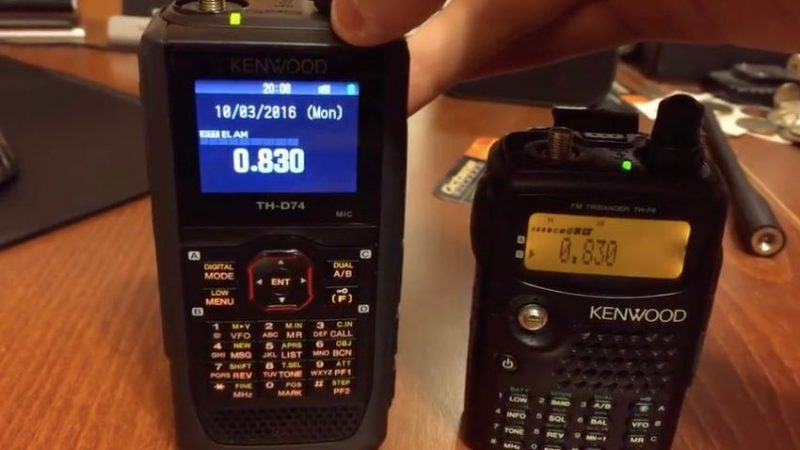
A couple of years ago, I published a side-by-side comparison of the TH-F6A and the TH-D74 on YouTube comparing reception of a local AM broadcast station. The F6A was far more sensitive on the AM broadcast band than the TH-D74.

You can see the video here:

Click here to view on YouTube.

I didn’t take the internal orientation of the bars into account, but the D74 is less sensitive in pretty much any orientation compared to the older F6A.

I contacted Kenwood about the difference, and they stated something to the effect of while the TH-D74 does receive MW, it wasn’t necessarily designed for it, and thus the reception there suffers compared to the F6A.

However, the tradeoff here seems to be better shortwave reception in the TH-D74 compared to the F6A. Hook the D74 up to a large wire antenna and you can easily pull in stuff on the shortwave broadcast and ham bands, and the IF filters help quite a bit as well.

Thanks for sharing, TC! I own a few wideband handheld transceivers so I keep a short SMA “pigtail” in my EDC pack that I can use to enhance HF performance. I simply clip a 15′ wire onto the pigtail’s  exposed conductor to enhance HF performance. Also, as Ivan points out, inductively pairing any of these tiny radios with a mag loop antenna will also augment performance on mediumwave.

Thanks again for sharing!

Photos from the 2019 Charlotte Hamfest

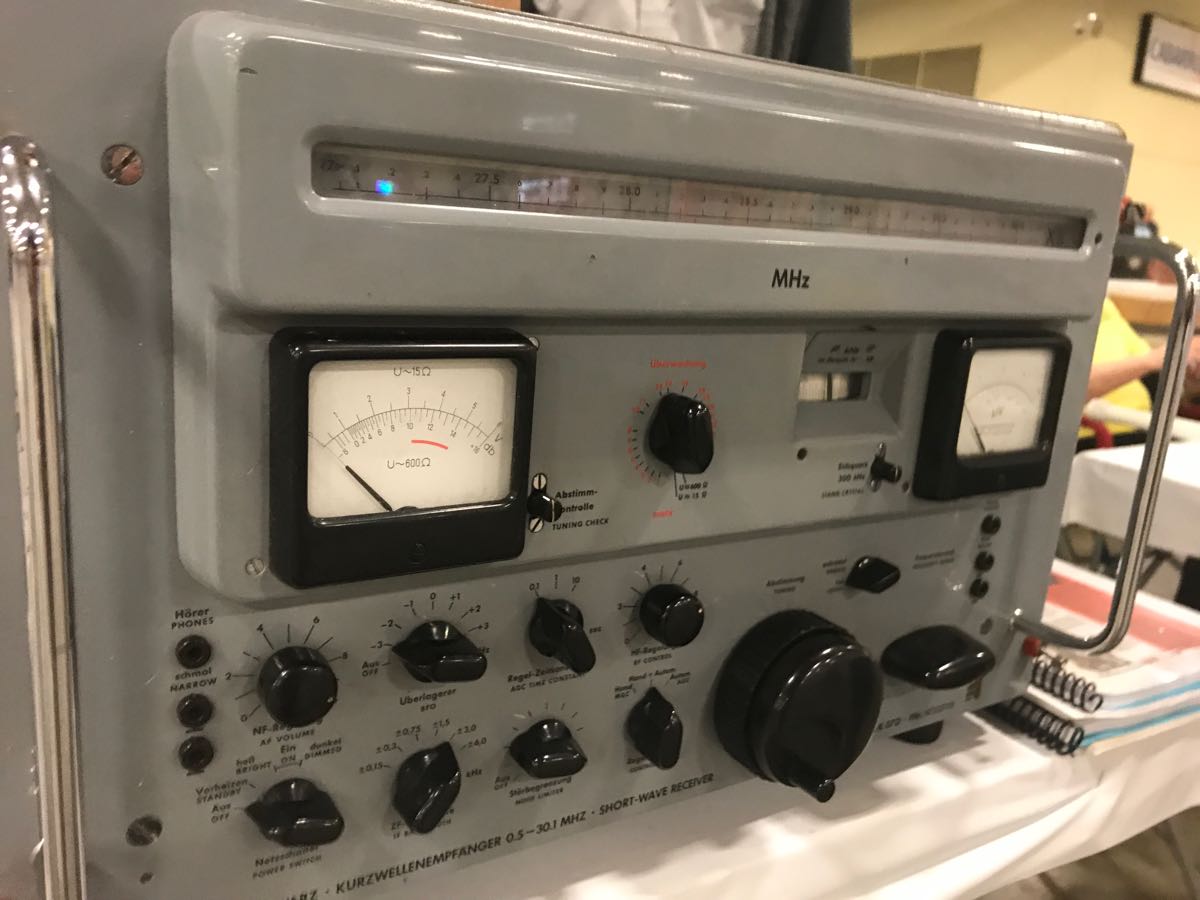
This RS HF receiver was pristine. If I had the budget and the shack space, it would have gone back with me. See more photos in our gallery below.

Yesterday morning around 5:30 AM I started my nearly three hour pilgrimage to the 2019 Charlotte (North Carolina) Hamfest. The Charlotte Hamfest is one of the larger regional hamfests in the area–due to its central location, it attracts people from all of the surrounding states.

The Charlotte Hamfest typically falls on the heels of (or the same weekend as) the Winter SWL Fest in Pennsylvania so I usually don’t even put the dates in my calendar. Indeed, the last time I attended the Charlotte Hamfest was about twenty years ago! It was at a different location and, back then, was also very much a computer show. Today it’s almost purely radio.

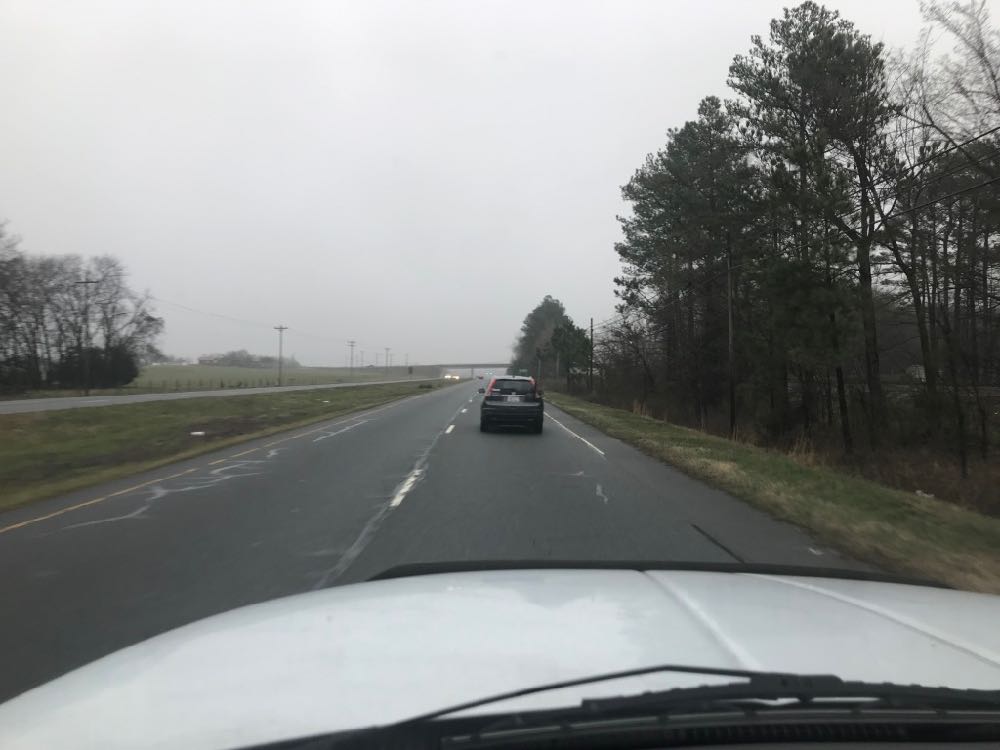
Following Vlado to the hamfest site on a very foggy, rainy Saturday morning.

The Charlotte Hamfest is a Friday/Saturday event held at the Cabarrus Arena & Events Center in Concord, NC. The center is a superb hamfest venue: it’s well lit, clean, spacious and can easily house all of the vendors indoors–a huge bonus as weather was less than desirable.

My buddy, Vlado (N3CZ) reserved two vendor tables and packed it with gear to sell–I also brought along a handful of items.

I was very impressed with the turnout–indeed, it was one of the busiest regional hamfests I’ve attended in ages. I sold a couple of items and Vlado sold a lot (he also purchased a lot, but that’s another story!).

I believe I’ll start putting the Charlotte hamfest in my calendar–even though timing isn’t always convenient for me, I think it’s well worth the trip!

Kudos to the Mecklenburg Amateur Radio Society for putting on such a great show!

Photos

I’ve embedded over 140 photos of the Charlotte Hamfest below–click each one to enlarge. Being a lover of vintage radios, my photos feature a lot of boat anchors. Note that when possible, I try to include the price tags for each item.

Note: If you can’t view the embedded photos below in our email digest, click here to view them on the web.

Do you enjoy the SWLing Post?

Please consider supporting us via Patreon or our Coffee Fund!

Your support makes articles like this one possible. Thank you!

Ivan checks out the Kenwood TH-D74’s mediumwave performance

Many thanks to SWLing Post contributor, Ivan (NO2CW), who writes:

One category of receivers not much talked about are the wideband handhelds. I first owned one of those in 1992 when I paid a ton of money for an AOR-1000. Not only did it cost me a lot but I also ordered it from the UK so it was not subject to the “cellular blocked” rule. Don’t ask me why, it never made any difference in the end.

As a busy shortwave listener at the time I was eager to check out reception as the radio also featured Shorwave coverage and even a BFO (Beat Frequency Oscillator) knob! To sum it up it was a great receiver above 30 mHz but Shortwave and Mediumwave was barely there, with a 15 kHz wide filter and low sensitivity.

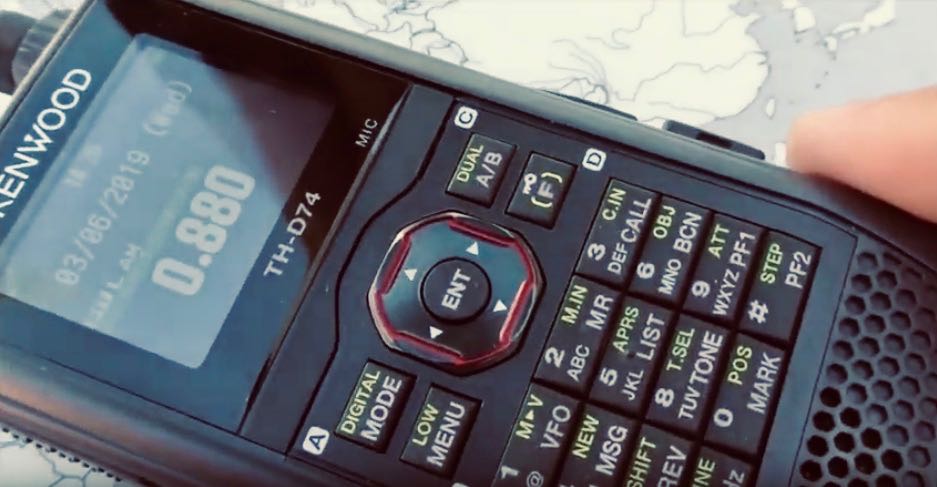
Well today I have in my hands a Kenwood TH-D74A – a top of the line handheld triband amateur radio transceiver with Medium Wave and Short Wave coverage. The radio is expensive due to the presence of GPS, D Star and APRS, but those are a features for the radio amateur. What about performance on the low frequencies?

Here is my video of the test which revealed surprising results:

Click here to view on YouTube.

So next time you consider purchasing a new receiver,as you dive into the choice of portables, SDRs, tabletops and classics from eBay you may consider adding this category as well – handhelds with wide band coverage.

Thank you, Ivan!  You’ve inspired me to check out mediumwave performance on a few wideband handy talkies I own: the Yaesu VX-3R, Yaesu FT2DR and the Kenwood TH-F6A. To my knowledge, all three have internal ferrite bars (tiny ones) but I’ve never actually compared their performance with each other. That could be a lot of fun. I also own an AN200 MW loop antenna so this could be an excellent test to see how it pairs with each radio.  I’m especially curious about the wee VX-3R!

Thanks again, Ivan. We always enjoy your videos and posts.

Advice on preserving 1940s era homemade records

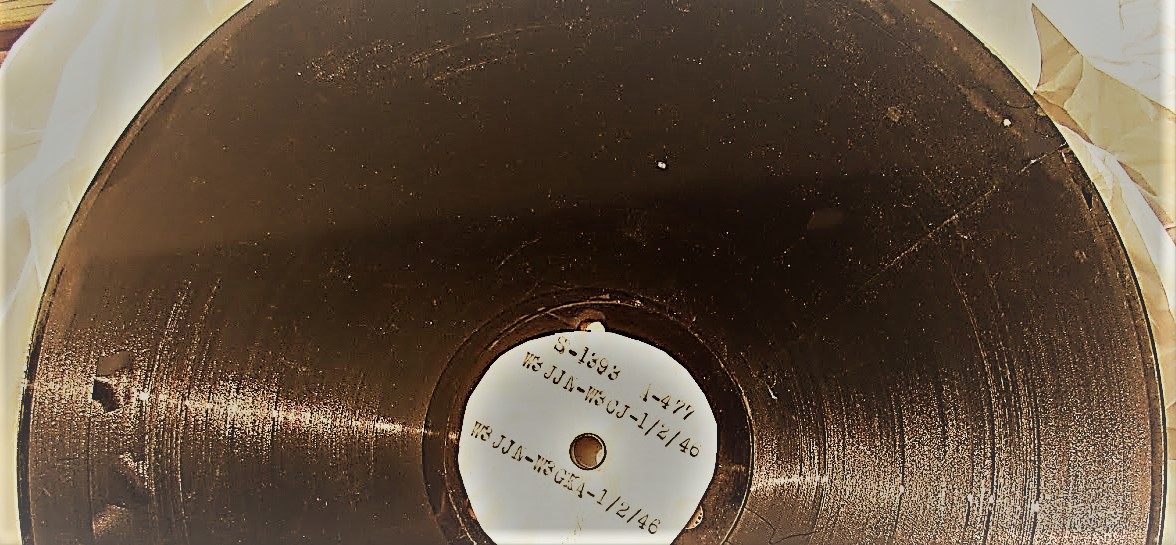
At the Winter SWL Fest last week, my friend, Andrew Yoder (author of the Pirate Radio Annual) told me about a recent find: homemade records by amateur radio operator W3JJN.

Andrew wrote about these recordings on his blog:

[…]Before open-reel decks were wire recorders. Information was magnetized onto a fine reel of stainless steel wire. It was essentially the same concept as tape decks, whether open reel or cassette, only the tape system was a refinement (an oxide coating on a plastic tape), rather than trying to magnetize a wire.

[…]Before wire recorders were record recorders. These took an audio source and the needle cut a blank disc with grooves. From what I understand, these homemade discs weren’t meant to be played back too many times because the needles wore into the grooves more quickly than commercially manufactured records. I’m not sure what they were all made from, but I know that some were aluminum discs with a thin layer of plastic.

I always look for the homemade records because there weren’t too many options for audio sources back then. By the open-reel tape era, a lot of people were recording entire albums to tape, so they weren’t necessarily recording the radio. But, for example, in 1940, the options were basically either family greetings, someone singing or a band playing, or the radio. And chances are good that any recording you find is the only one in existence.

I found three of these on Saturday.

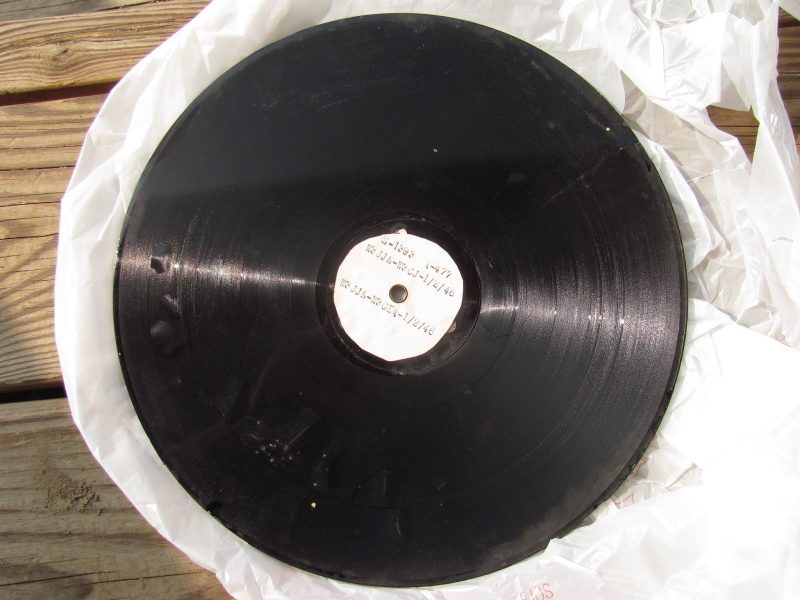
Here’s a photo of one.

They are amateur radio QSOs from W3JJN to a couple of other operators. W3JJN cataloged the discs by side . . . and this was number 477. So, at least 237 other records existed in his homemade record collection at one time. The sides that I have are dated in late 1945 and early 1946. To me, this is an astounding find because I’m not sure how many recordings exist of any amateur radio operations prior to 1950, not to mention that this is still very early in the post-war period.

I did some searching on W3JJN and he was William E. Belz, who lived at that time on 1509 Linden Avenue in Baltimore, Maryland. He was a TV repairman who was born in Duncansville, PA, and died in 1981 after a lengthy illness.

My big problem here is that these records are disintegrating. The plastic layer is cracking badly and separating from the aluminum discs. I guess what I really need is one of the laser turntables that can play back audio from broken discs and won’t damage the grooves. I don’t think I can risk playing any of these on a regular turntable, but I want to recover the audio quickly before the discs degrade further.

Click here to read the full article.

Post readers: Any advice on preserving these recordings? It sounds like using an actual needle to make a digital copy might be a little too destructive.  Are there alternatives?  Please comment if you have any experience or suggestions!