Category Archives: Mediumwave

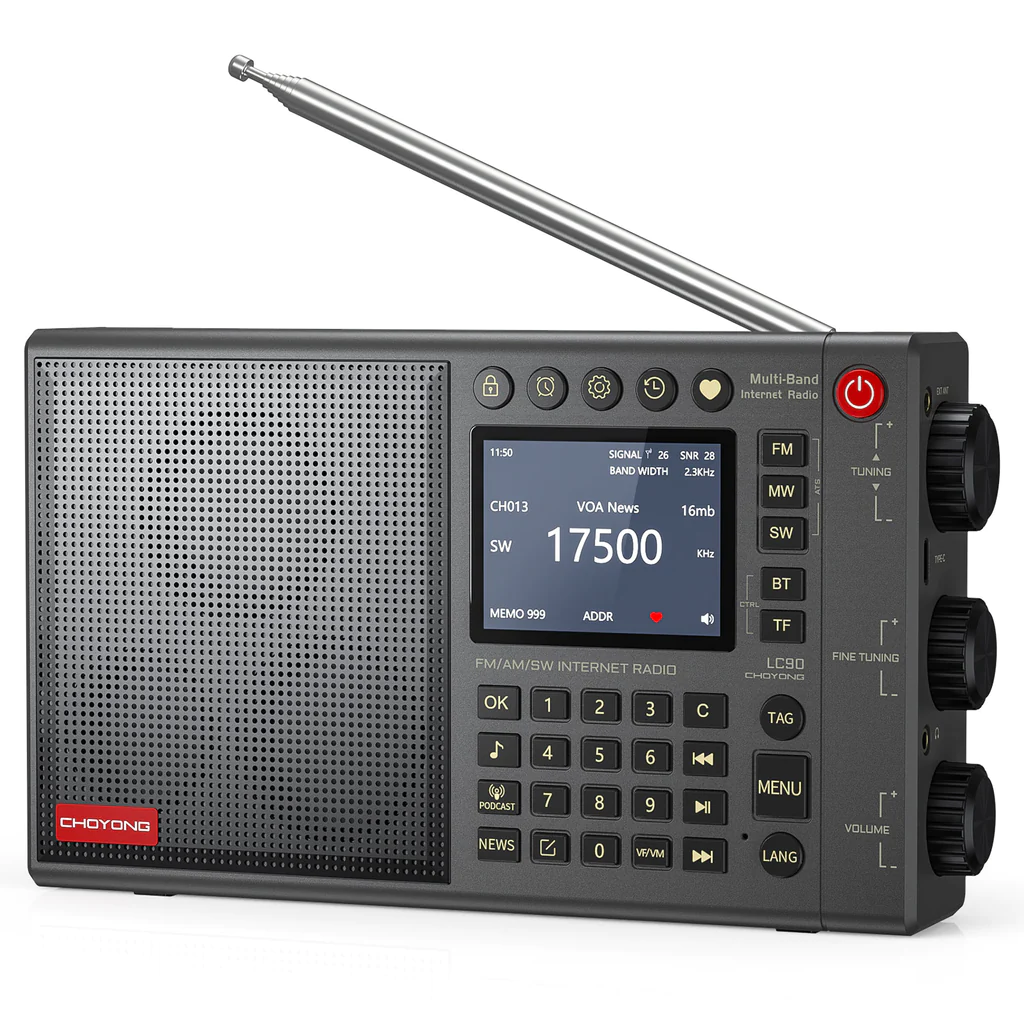
Michael compares the Choyong LC90 Export and Chinese Versions

Many thanks to SWLing Post contributor, Michael Ye (BD4AAQ), for the following guest post:


Twins, Yet Each One Unique – A Comparison of the Worldwide Version of LC90 with its Chinese Counterpart

by Michael Ye (BD4AAQ)

The export version of the LC90 is now available in the market [affiliate link]. Previously, we examined the Chinese version, which has been in the China market since early 2023. Instead of a review of the export version, this article will focus on the similarities and differences between the two LC90 versions – the version that has just started to be distributed outside China and the version that is already being sold in China. A link to my previous article can be found by clicking here.

One thing to note is the name of the manufacturer. In my previous review, I used Chaoyuan, the “pinyin” phonetic of the Chinese characters of the name of the company. As it turned out, the westernised spelling that the company uses is Choyong, or Choyong Electronics.

The LC90, a hybrid radio that combines the Internet radio with the traditional radio, is a bold move and seems to be well-received by shortwave listeners and beyond. Let’s explore what these two versions of the same model have to offer.

Appearance

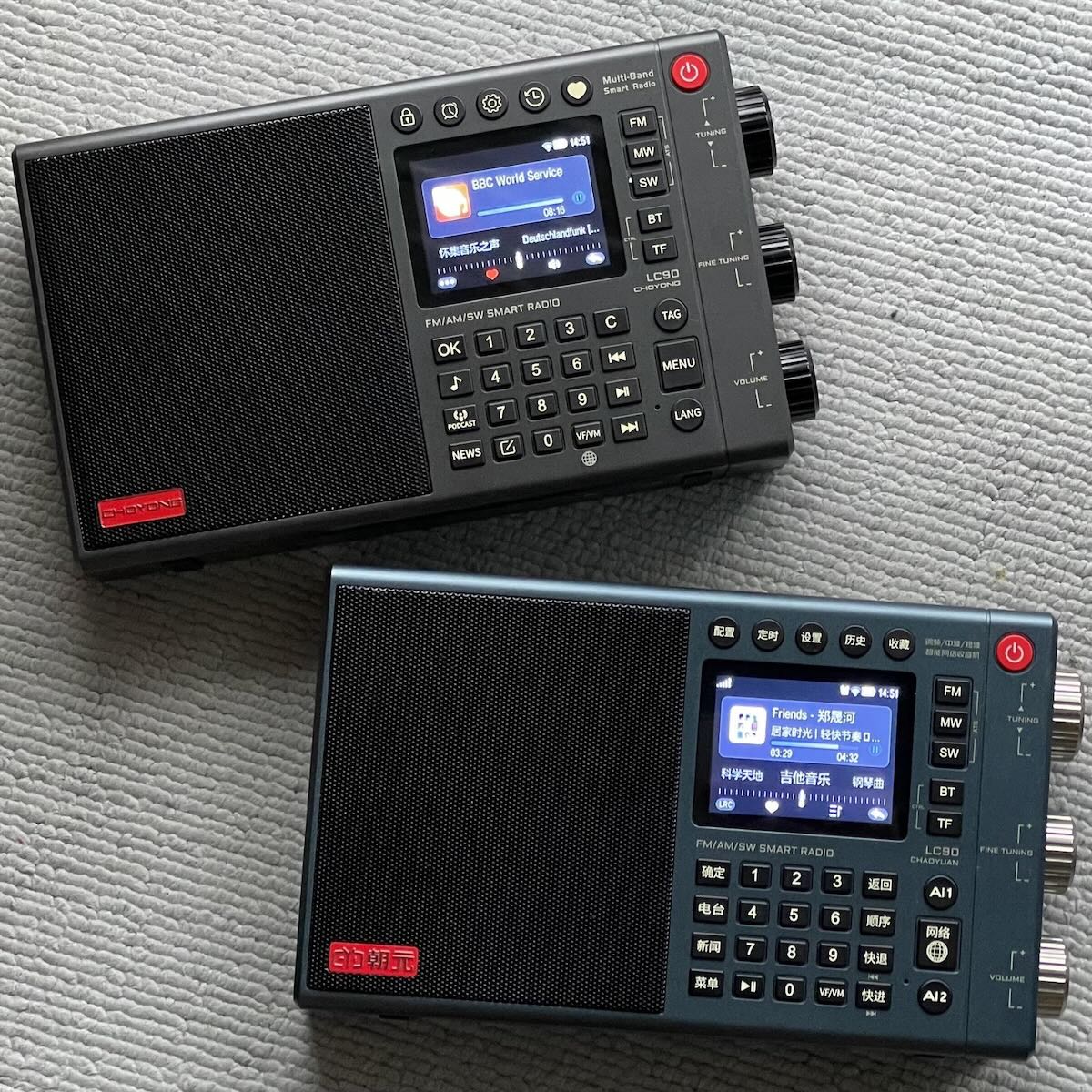
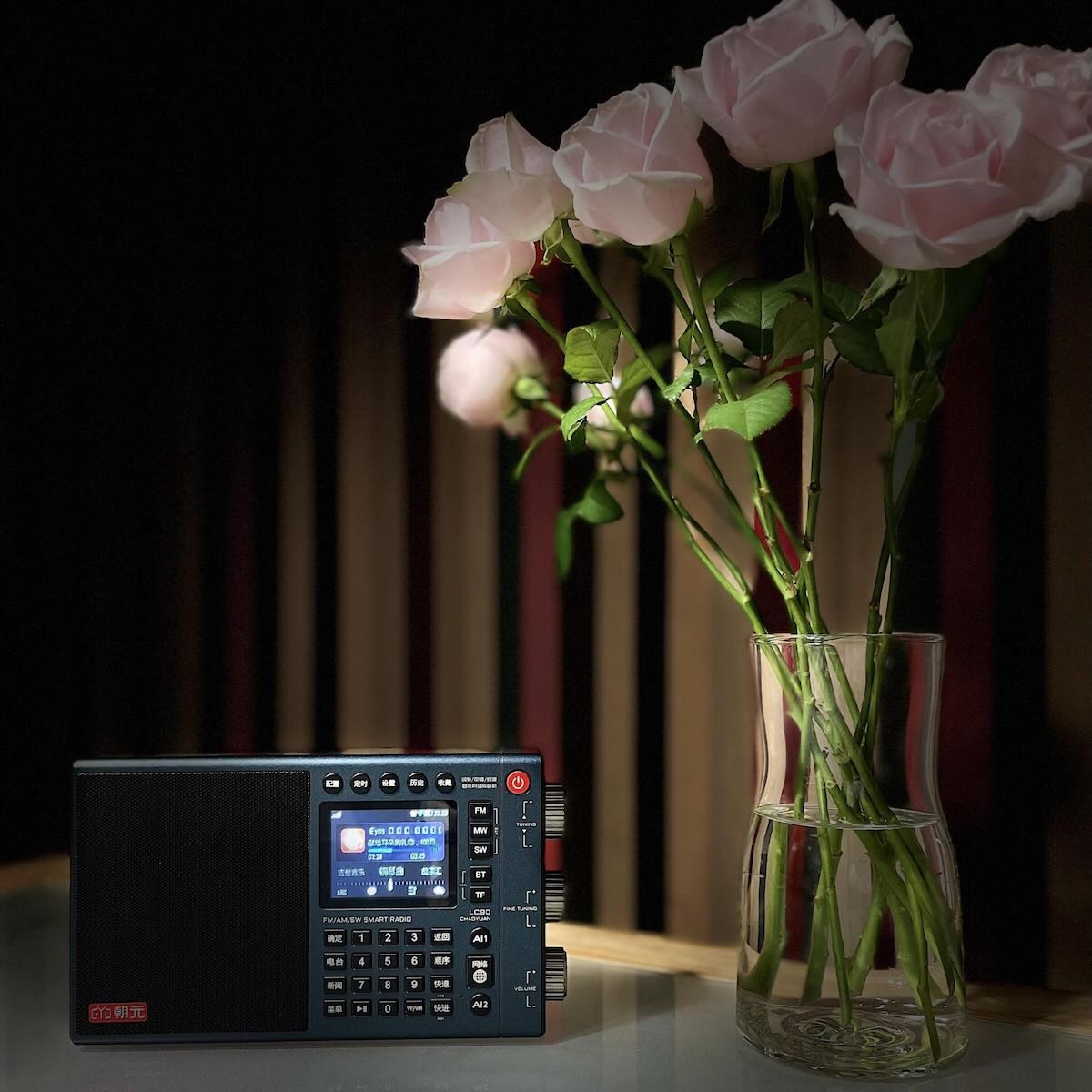
The two versions of the radio look the same in appearance. However, upon closer inspection, you will notice the language on the buttons differs. The export version has all the buttons labeled in English, while the buttons of the Chinese version have a mixture of Chinese and English.

Traditional Radio

I do not find differences between the FM, MW and SW features of the two versions. Both versions have the specifications as follows: FM: 64-108 MHz, MW: 522-1710 kHz and SW: 2.3-26.10 MHz. Shortwave performance remains excellent. However, for the export version, you could toggle the MW tuning step between 9 kHz and 10 kHz, and the FM tuning step as well, through the setup (gearbox) button, but it does not seem possible to change any tuning step on the Chinese version – this seems to be a matter of software upgrade and so is not really an issue.

On both versions, press MW again to enter LW (153-279 kHz).

Internet Radio

In terms of the stations that can be heard, the Internet radio exhibits significant differences from that of the Chinese version. The Chinese version is designed to exclusively feature Chinese language stations (and a few English language stations) in China. If we were to liken the Chinese Internet radio to a closed system such as iOS, it would be stable, reliable but restrictive. In contrast, the export version could be compared to Android, offering more open, inclusive and customisable user experience.

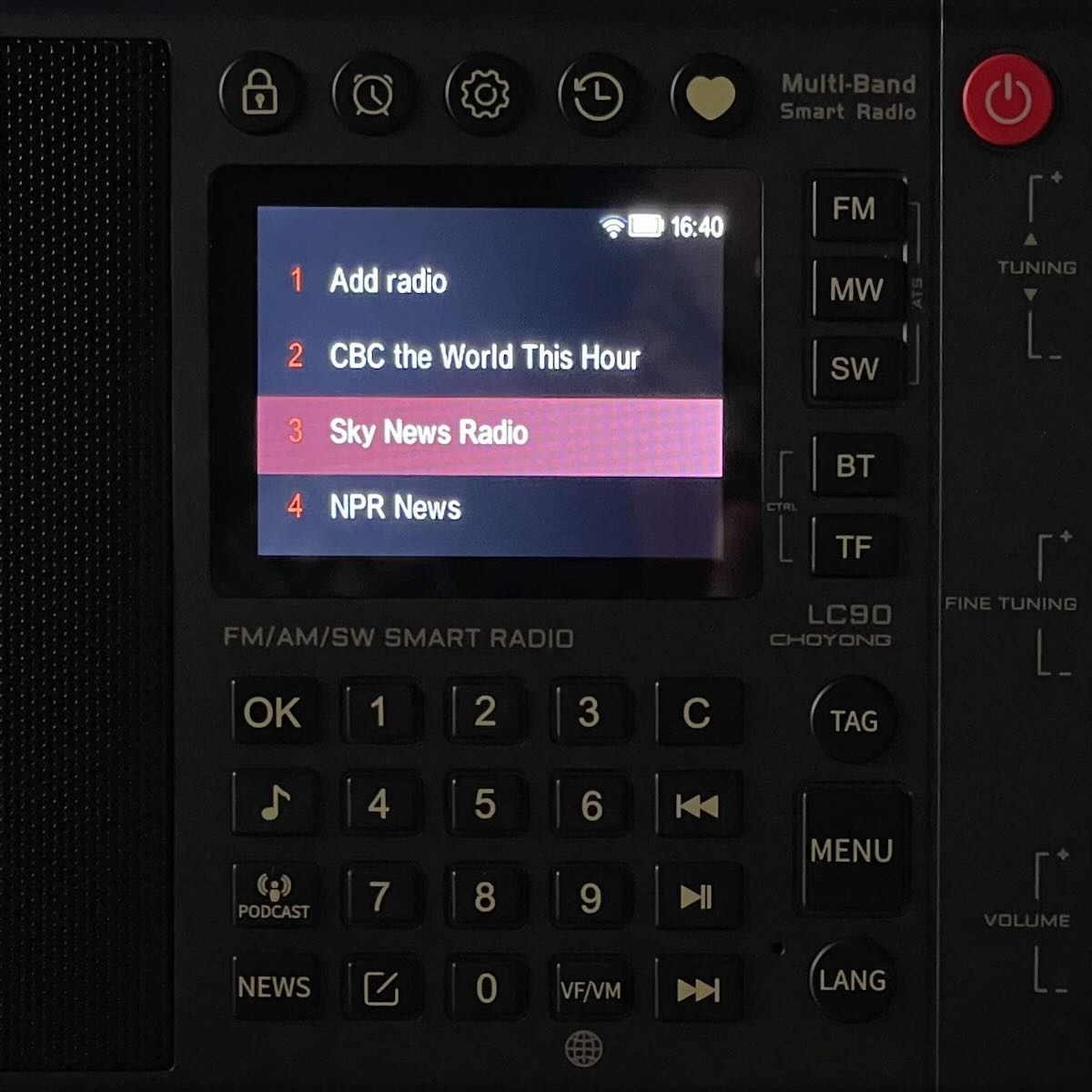
On the export version, the MENU button provides access to the main menu, which begins with the six continents (excluding Antarctica) and allows users to navigate to the desired country and then select a specific station. Additionally, shortcut keys are available for direct access to MUSIC, PODCAST, NEWS, TAG and LANG (languages).

TAG and LANG for Ai1 and Ai2 Buttons

On the Chinese version, two buttons, Ai1 and Ai2, serve as voice assistants. Activate and speak to them and the radio directly plays the content (Ai1) or displays search results for users to choose from (Ai2). They come in handy when you look for a specific item, for instance the title of a song or a talk show. On the export version, however, the voice assistants have been removed and replaced with shortcuts TAG and LANG.

Add Your Own Stations

The Chinese version has about 1000 Chinese Internet stations built-in. On the worldwide version of the radio, there is a vast number of Internet stations available, literally tens of thousands of them, in different languages, and from different corners of the world. The number is updated from time to time. And that is not all. A really cool feature is the ability to add stations of your choice and it is easy to do with the help of a mobile phone. Unfortunately, this feature for adding your own stations is not available in the Chinese version.

Nano SIM card

The Chinese version comes with a built-in nano SIM card that is prepaid and provides Internet data. To continue using it, simply add credit to the card. In contrast, the export version does not include a prepaid, data-enabled SIM card for the user. Still, the user can use a WI-FI connection or purchase a 4G nano SIM card to insert into the device’s slot.

Some Features Not Discussed Previously

Both versions have the following features:

  • Keyboard backlight;
  • IPS LCD with backlight;
  • Type-C charging cable supplied;
  • TF card supported (to store and play your own music); and
  • Bluetooth for the radio to serve as a Bluetooth speaker.

The integration of high-tech gadgets and advanced devices into our daily routines has become indispensable in this age of the Internet. It is essential to adapt to the ever-evolving nature of the times.

Bottom Line

The Choyong LC90 is an exceptional radio that combines traditional radio features with modern Internet capabilities. It is available in both domestic and worldwide versions. The revolutionary design of the LC90 allows for excellent overall performance in both over-the-air radio reception and online streaming/podcasting.

There is no difference in traditional radio reception and performance between the domestic and worldwide versions of the LC90. However, the Internet features are drastically different, as the worldwide version serves audiences around the world, while the Chinese version is dedicated to the audience in China.

Overall, the Choyong LC90 offers a unique combination of traditional radio and modern Internet capabilities, making it a versatile and high-performing device for radio enthusiasts and music lovers.

Wish List

Is SSB decoding necessary? Well, it depends. The radio primarily caters to broadcast listeners, but both hardcore amateur radio hobbyists and general listeners may find it appealing. While adding SSB decoding can enhance its functionality, it will increase costs and may require additional space, considering it already combines two radios in one device.

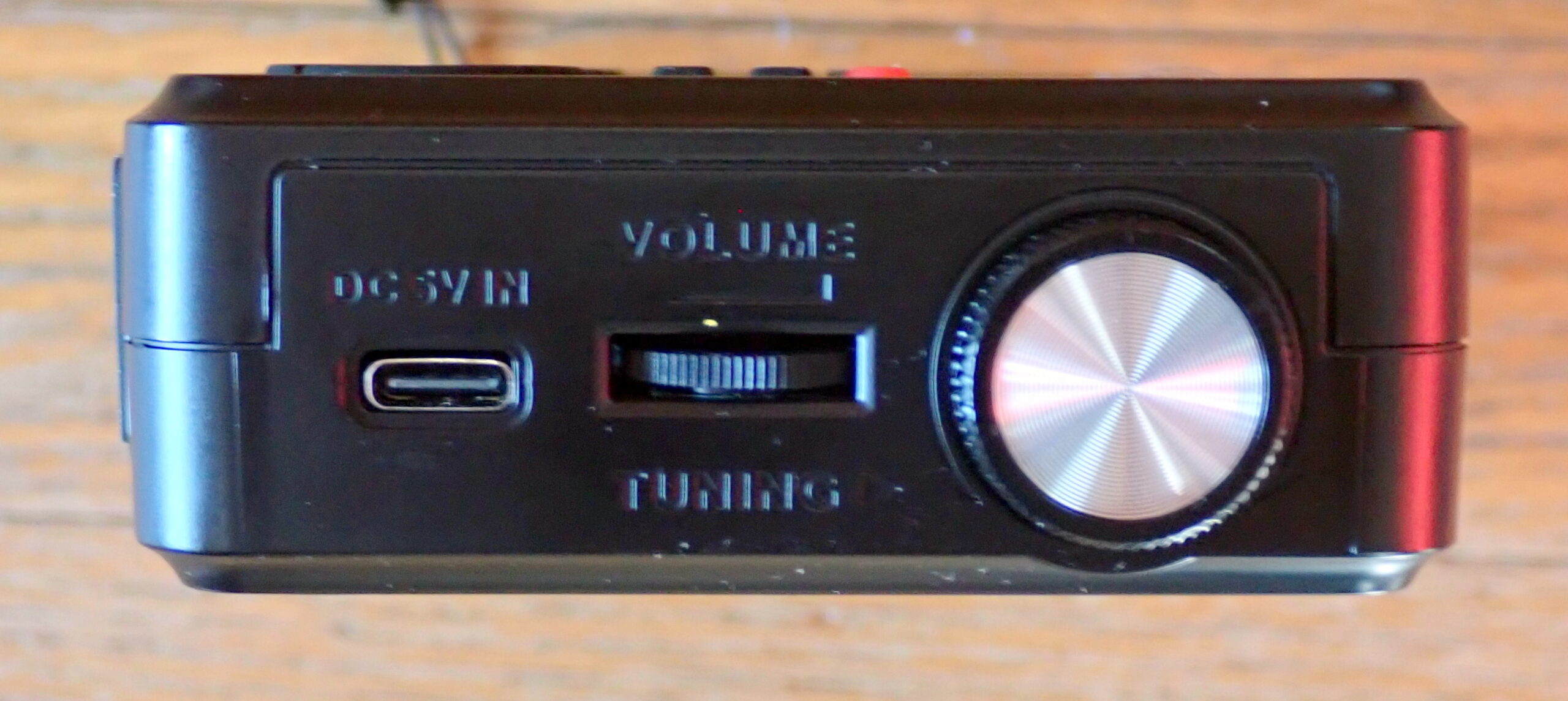
There are two switches, the red button (upper right) and the volume/sleep knob (lower right side). Is it really necessary to have both?

On the export version, the “network error” message may occasionally pop up, and the radio would become quiet until human intervention steps in. Is it feasible for the radio to automatically resume play after the network error is cleared?

For some users, the antenna jack is a bit too close to the tuning knob. In most situations, this proximity does not impact the radio’s operation. However, if you need to connect an antenna using a connector, you may encounter difficulty or even find it impossible to plug it in.

Click here to check out the Choyong LC90 (export version) on Amazon.com.

Note that this Amazon link supports the SWLing Post at no cost to you. Thank you!

Taking a look at the XHDATA D109-WB . . . a sweet spot on the price/performance curve

By Jock Elliott, KB2GOM

The XHDATA D109-WB is a small radio that hits a sweet spot on the price/performance curve, delivering a lot of performance for not a lot of money (probably less than $60 US, depending on the source).

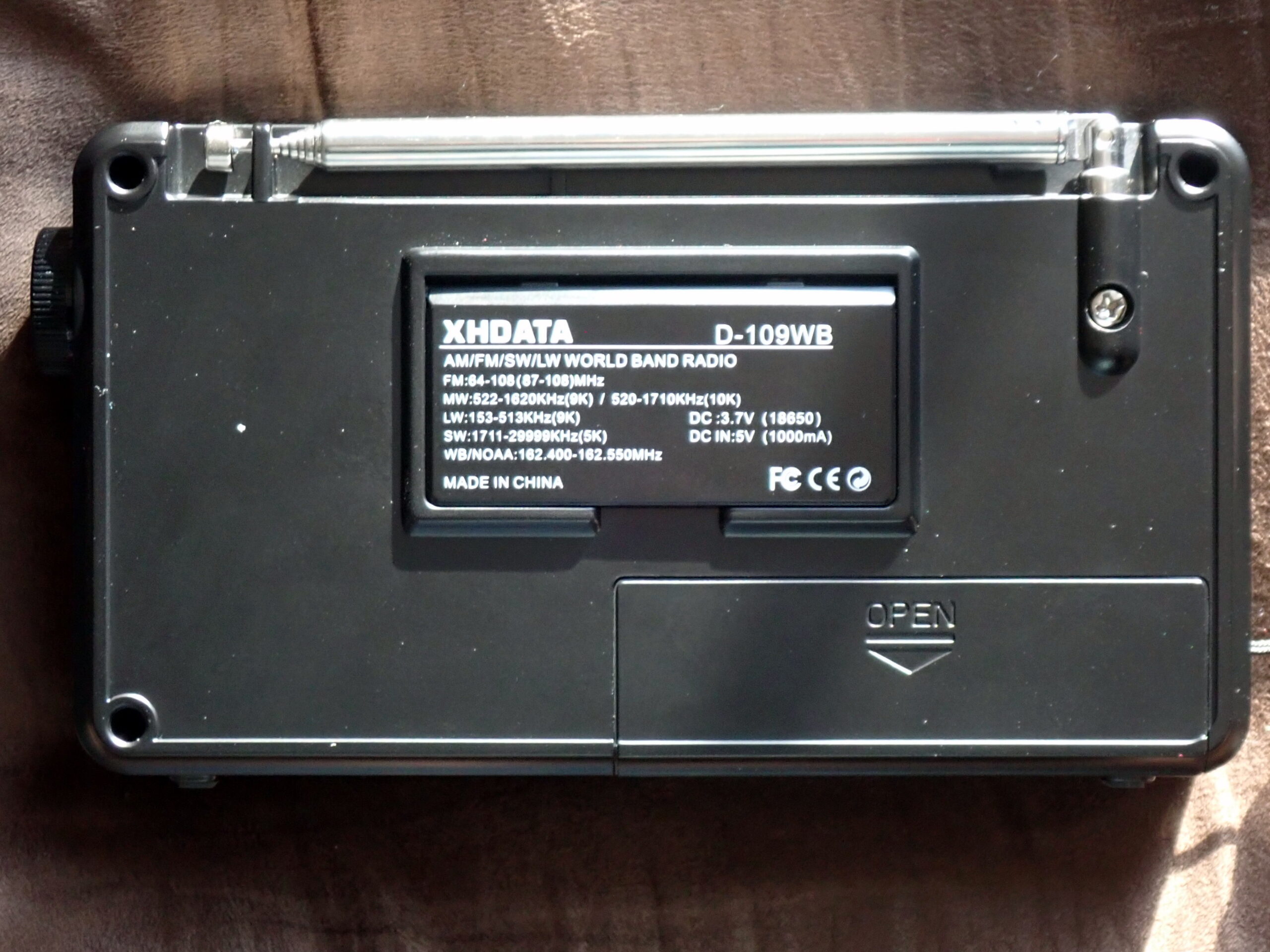
The D109-WB measures 5.9″L x 1.45″W x 3.07″H and weighs just over 10 ounces. It covers FM 64-108MHz, AM (medium wave) 520-1710KHz, LW 153-513KHz(9K), SW 1711-29999KHz, and seven NOAA Weather Radio channels 162.40-162.55MHz with alert function. It does not receive single-sideband signals. It offers 100 FM memories, 100 LW memories, 100 MW memories, and 300 SW memories. Further, it offers 1, 2, 3, 4, and 6 kHz bandwidths on MW and SW bands.

On the left side of the front panel is a plastic grill that fronts an inch-and-a-half speaker. On the right side is a small LCD screen with backlight that functions as information central for the D109-WB. Below it are 15 buttons (3 rows of 5 buttons each) that control various functions, including an “SOS Emergency Distress Sound and Light Alarm,” manual tuning and various auto scanning and auto memory storage schemes, band selection, DX/local receive mode selection, 9/10 kH MW spacing, clock alarms, bandwidth selection, a key lock/display switch, and a manual tune/memory mode switch, among others. Below those 15 buttons is a 3 x 4 numerical key pad for memory and direct frequency entry functions. To the right of the keypad are 5 buttons set in a circular pattern for controlling Bluetooth use and connectivity and MP3  playback (I did not test these last two functions).

On the right side of the case, you will find a type-C socket for plugging in a cable to charge the 18650 battery, a wheel for volume control, and a tuning knob.

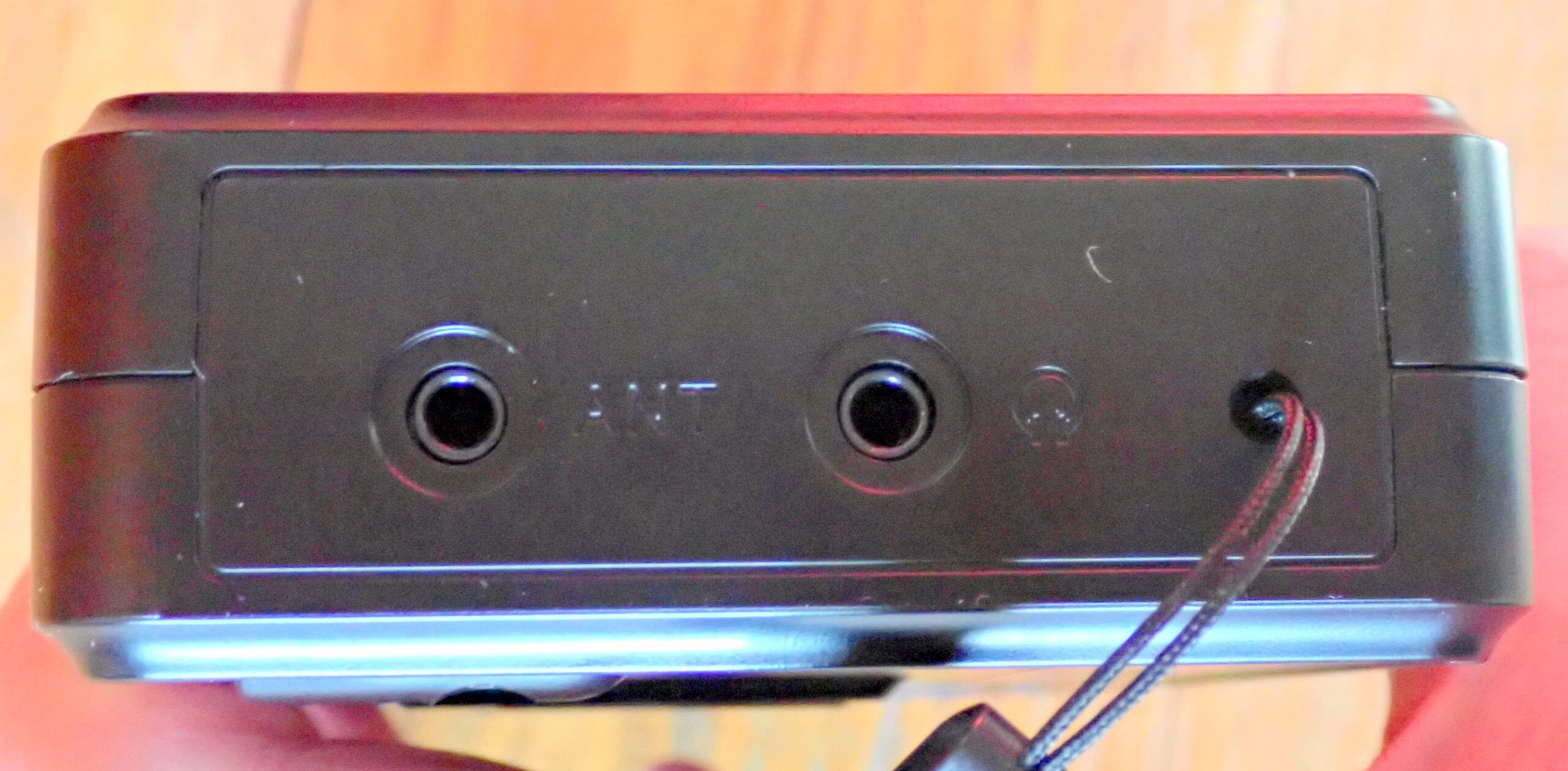
On the left side of the case are 3.5 mm headphone and external antenna jacks.

On the back panel is a flip-out support and a hatch for accessing the battery. On the top, there is a fold-over 21-inch telescoping antenna and, on the bottom, two anti-skid rubber feet.

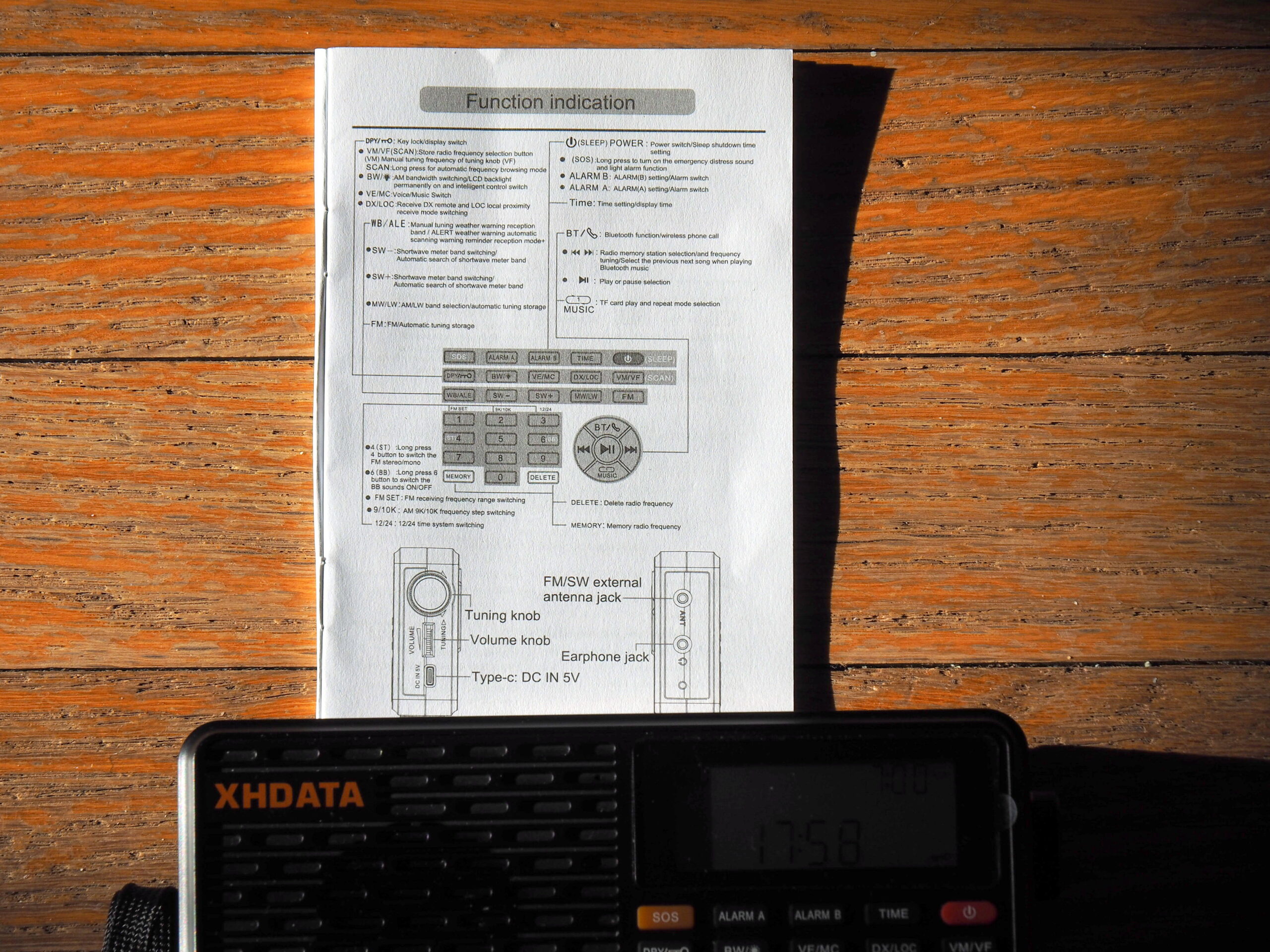
In all, I found the D109-WB to be solidly constructed with fit and finish appropriate to a radio in its price class. The only serious deficit I found in the D109-WB was the extremely small type in the owner’s manual. Consult the photograph below to see what I mean.

The D109-WB was straightforward to operate, and I enjoyed it. One cute trick was variable-speed tuning: on MW, turn the knob slowly, and it will change frequency in 1 kHz increments. Turn the knob fast, and the tuning rate jumps to 10 kHz increments (or 9 kHz, if you have selected that tuning option). Variable-speed tuning works the same way on the shortwave bands, and on the FM band, the slow tuning rate is .01 MHz, and it jumps to .1 MHz when the knob is turned quickly. I had not experienced variable-speed tuning in any other radio, and I like it . . . a lot.

But what I was really wanted to know was how well did the D109-WB perform?

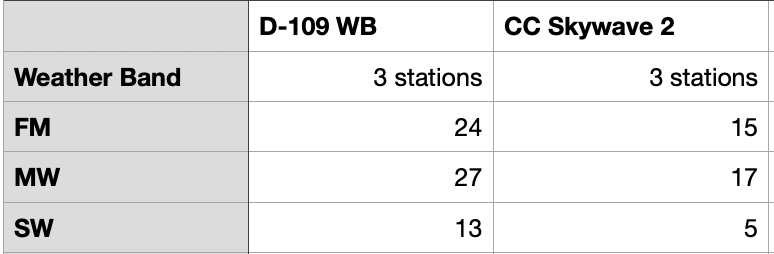
Now here’s the rub: I don’t have any test equipment . . . but I do own a CCrane Skywave 2. So I sat down on a bright sunny afternoon with the D109-WB and the Skywave 2 side-by-side and compared them. I found that both would receive two weather channels loud and clear and one more weather channel marginally. Then I tuned firm the medium wave band, then the FM band, running the two radios in parallel and found that there was nothing that I could hear on Skywave 2 that I could not also hear on the D109-WB, and vice versa. In other words, I found the electrical performance of the two radios to be very similar . . . except, of course, that the Skywave receives the AIR band, and the D109-WB does not.

One of the things that I enjoy doing is to grab a radio, select a band, punch the SCAN button, and see what’s out there. Since I also own a Tecsun PL-880, I decided to run a scan on each band on each radio (D109-WB, Skywave 2, and PL-880) with its native whip antenna and see how many detectable signals I could find on each. By “signal,” I mean any place where the scan stopped where I could hear music, voices, or anything that sounded like a transmitted signal, as opposed to pure noise.

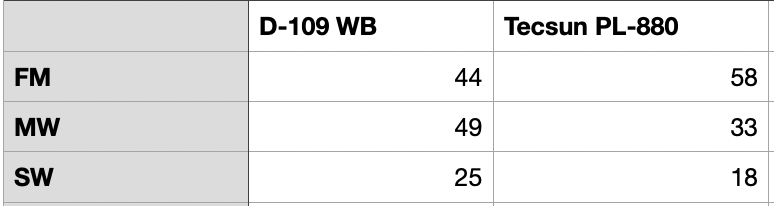
So here are the results of two different testing sessions on two different nights:

D109-WB vs. CCrane Skywave

D109-WB vs. Tecsun PL-880

A caution: before you start drawing conclusions from the results above about which radio is more sensitive than another, it is important to consider that those results may be heavily skewed by whatever “SCAN” algorithm is programmed into each radio. Further, the parameters of the SCAN algorithm for a particular radio are a black box to those who use the radio. What I can conclude from those results is that, if you want to be a lazy DXer like me and use the SCAN button for cruising the bands, the D109-WB will deliver pleasing results.

Since the D109-WB has a socket for plugging in an external antenna, I plugged in a 45-foot loop antenna. The D109-WB overloaded, but when I set the DX/local switch to local, the overloading went away but there was still a boost in signal-to-noise from the external antenna.

So, the bottom line: the XHDATA D109-WB delivers a whole lot of fun and performance at a very reasonable price, and I can easily recommend it for both newbies and old-timers alike.

In fact, if you want to turn a kid onto radio, here’s an idea: give the child a D109-WB and a paper atlas, explain how both work, then set that kid to work logging as many stations as possible and looking up where they are located. Heck, that sounds like fun to me.

Click here to check out the XHDATA D109-WB on Amazon.com

(note: this affiliate link supports the SWLing Post at no cost to you)

Mediumwave DXer logs KFIZ from Arctic Finland

Many thanks to SWLing Post contributor, Ulis Fleming, who shares the following article from KFIZ via Twitter. I love these articles where a mediumwave DXer blows the minds of a small AM radio station’s staff!

Finnish man hears KFIZ radio transmission on radio in Artic Circle

A man from Finland contacted KFIZ recently to let us know he was listening to our station IN Finland earlier this month. And while it doesn’t sound like such a big deal since we do announce you can listen around the world on the “Tune In” app, this person actually heard us on the AM spectrum of frequencies.

Jari is a self described AM radio enthusiast in Finland that says he is passionate about listening to and identifying AM stations from around the world.

In early December, Jari travelled about 750 miles from his home in southern Finland, by train and car, to an isolated area in Northern Finland, well into the Artic Circle, where he has a base station set up designed to pull in AM radio signals from around the world. Jari says conditions are ideal there because there is ample space for long antennas and little to no man-made electrical noise or interference.

On December 4th at 6:00 Universal time, which would have been midnight local Fond du Lac time, Jari recorded a transmission on his receiver. Its very faint but it’s our station’s radio ID that we play often throughout the day that says “News Talk 1450, KFIZ Fond Du Lac – a Mountain Dog Media Station.”

Given how hard it is to hear, you can respect the fact that Jari now has transmissions confirmed from over 800 stations from North America.

While generally AM radio waves only travel at most 100 miles from the transmitting antennas, with the right conditions, usually during the nighttime hours, AM radio waves can reflect off the ionosphere and propagate past the curvature of the earth, a phenomenon called “skywave” propagation.

So from all of us here at KFIZ, if you are listening locally, on the tune in App, or isolated deep within the Artic Circle, we want to say thanks for listening.

Click here to read at KFIZ. 

KGGF’s Old-Time Christmas Radio Drama and Music!

Many thanks to SWLing Post contributor, James Copeland (KDØICP), who writes:

Hi Thomas,

Hope you are doing well. A few years ago, I sent you a story about radio dramas we were doing on my college radio station, KSDB in Manhattan, KS. Well, I’m now working at KGGF in Coffeyville, KS, continuing the tradition on this heritage AM station.

Earlier this month, we broadcast a community Christmas program to benefit our local theater in town that is being restored. The broadcast featured two old-time radio dramas and local music. Coffeyville, KS is a small town with a population under 9,000, but it has one of the oldest and largest radio stations in the area. 10 KW day and 5 KW night on 690 kHz. I thought some in your audience might enjoy trying to tune in Christmas morning at 8 a.m. CST for the rebroadcast of the program. A link for more information and the audio as well is available here:

https://kggfradio.com/local-news/721426

For those who are interested in the technical details of the broadcast, I used two ribbon mics and the main microphones, an RCA 77-DX and an RCA BK-11. The room acoustics proved to be a bit of a challenge with the final mix, but the whole thing was live with no edits and while it was far from perfect, I think the genuine nature of the community program shines through. The signal was sent to the station using a VHF Marti remote pickup unit. This particular recording was made at the station.

Also, if your readers are interested in submitting QSL reports, I would be glad to answer them. We usually get a few throughout the year, and I especially enjoyed a report early this year from some of the serious DXers in Norway!

Merry Christmas and 73!

James Copeland, KDØICP

Many thanks, James, for sharing this here on the SWLing Post. We all love a good radio production! It’s brilliant that you’ve brought this tradition to Coffeyville, KS!

I’ve also linked to the audio file of the broadcast below:

Announcing Don Moore’s latest book: Tales of a Vagabond DXer

Many thanks to SWLing Post contributor and friend Don Moore–noted author, traveler, and DXer–for sharing the following announcement about his latest book! Don is a brilliant author–you’ll enjoy accompanying him on his travels and radio journey in this latest book. I highly recommend all of his work!


Tales of a Vagabond DXer

Tales of a Vagabond DXer by Don Moore is a new book focusing on Latin American radio and DXing. In this 300-page volume, Don blends together stories from his radio station visits, his travels, and his experiences as a DXer. Don has been an active member of the DX listening hobby for over five decades. His interest in Latin American radio inspired him to serve in the Peace Corps in Honduras in the early 1980s.

Since then, he has traveled extensively in Latin America and visited more than 150 radio stations in the region. He has written dozens of articles on Latin American DXing for radio hobby publications including Monitoring Times, the NASWA Journal, Review of International Broadcasting, and Passport to World Band Radio. Today, Don is a regular contributor to the SWLing Post Blog.

Tales of a Vagabond DXer is available from Amazon.com in trade-sized paperback for $12.99 or Kindle eBook for $4.99, or for equivalent prices in local currencies on non-US Amazon stores.

Paperback: https://amzn.to/3t98tZt

Kindle: https://amzn.to/47O3Nak

Note: the Amazon Affiliate links above not only support author Don Moore, but Amazon shares a small percentage of the final sale with the SWLing Post as well. 

“Attempt to Pass AM for Every Vehicle Act in Senate Falls Short”

Photo by Courtney Corlew

(Source: Radio World via Dennis Dura)

Attempt to Pass AM for Every Vehicle Act in Senate Falls Short

Sen. Rand Paul objected, saying “mandating that all cars have AM radio is antithetical”

A maneuver by Senate sponsors of the “AM Radio for Every Vehicle Act” to pass the bill by avoiding a vote of the full Senate this week has fallen short.

The push to use “unanimous consent” to pass the bill was led by Sens. Ted Cruz (R-TX), Edward Markey (D-MA) and Ben Ray Luján (D-NM). However, (R-KY) objected to its passage.

“Mandating that all cars have AM radio is antithetical to any notion of limited government,” Sen. Paul said on the floor of the U.S. Senate on Tuesday.

Paul said there is irony in seeing Republicans come to the floor to pass bills that place mandates upon American businesses, “therefore picking winners and losers.” [Continue reading…]

Don Moore’s Photo Album: Loja, Ecuador

Iglesia San Francisco, Loja

Many thanks to SWLing Post contributor, Don Moore–noted author, traveler, and DXer–for the latest installment of his Photo Album guest post series:


Don Moore’s Photo Album: Loja, Ecuador

by Don Moore

A few months ago I did a two-part feature on my favorite small Latin American city, Cuenca, Ecuador.  This time let’s journey to a nearby smaller city that I don’t know very well but want to spend more time in.

Loja is about two hundred kilometers south of Cuenca on a paved highway that runs through a long valley before climbing into the mountains to twist and turn the rest of the way. Look at the route on Google Maps and you’ll see what I mean. Today it’s a picturesque four-hour bus ride but when I made the trip the first time in 1985 it was a tortuous twelve-hour journey on rough dirt roads.

The roads today may be smooth and paved but Loja is still the most isolated major town in Ecuador. The city is so far south that it is closer to the Peruvian border than it is to any other town of size in Ecuador. This isolation has both forced the region to be self-reliant and cushioned it from problems in the rest of the country. For three years in the mid-1800s the province of Loja even governed itself as a peaceful independent country while the rest of Ecuador was mired in a bloody civil war.

One of Loja’s many picturesque streets.

Loja’s population of around 200,000 (a third the size of Cuenca) makes it the twelfth largest city in Ecuador. But Loja is one of those places that has always punched above its weight. The economy is strong as it’s the center of one of the best coffee growing areas in South America and the city is the main transit point for the gold fields to the east in the Ecuadorian Amazon. Loja is widely thought of as the most cultured and educated city in the country. Two of its universities rank in the country’s top ten. And everyone agrees that Loja is the center of Ecuadorian music. One of the city’s several museums has room after room filled with displays about the many famous musicians that have come from (and continue to come from) Loja. Free concerts are held in the city’s plazas at least once a week.

Loja has always been forward-looking. In 1890 the city installed one of the first hydroelectric generators in all of South America. That was just eight years after the first plant was installed in the United States. A little over a century later, in 2013, the first windfarm in continental Ecuador was constructed on a ridge above the city. The eleven windmills produce sixteen megawatts and phase two of the project, which is now under construction, will add another forty-six megawatts. A recently approved third phase will add another 110 megawatts.

Windmills overlooking Loja

The First Visit

My first visit to Loja was in March 1985 after that long twelve-hour bus ride from Cuenca. I remember Loja as being a pretty but sleepy small city. We only stayed two nights and one day. My primary goal was to visit Radio Centinela del Sur and get a QSL for myself and several friends. I don’t recall anything from that long ago visit but I did get the QSLs. Radio Centinela was founded in 1956 so it wasn’t the first radio station in Loja. But it was the first one to last for more than a few years. On shortwave Radio Centinela del Sur was a station that changed frequency a lot. I first heard it in 1974 on 5020 kHz but most of my logs were made in the early and mid-1980s when 4890 kHz was in use. In the 1990s Radio Centinela del Sur used 4771 and 4899 kHz at various times. The station left shortwave for good by the late 1990s.

Radio Centinela de Sur in 1985

Business card from 1985

The second oldest station in Loja was Radio Nacional Progreso, founded in 1958. I have many logs of the station on its 5060 kHz (variable) frequency from the 1970s through the 1990s. I don’t remember why I didn’t visit them in 1985. Maybe the office was outside of town and difficult to get to. Loja’s other shortwave station was the Catholic broadcaster Radio Luz y Vida, founded in 1967. In the early 1970s the station used 4825 kHz on shortwave but around 1978 they switched to 4850 kHz. I last logged them there in 1997. Radio Luz y Vida was only a few blocks from our hotel and I stopped by several times but the inner door was always locked and I never got to see more than the entrance way. Continue reading