Shortwave listening and everything radio including reviews, broadcasting, ham radio, field operation, DXing, maker kits, travel, emergency gear, events, and more
Many thanks to SWLing Post contributor, Ulis Fleming, who shares the following article from KFIZ via Twitter. I love these articles where a mediumwave DXer blows the minds of a small AM radio station’s staff!
A man from Finland contacted KFIZ recently to let us know he was listening to our station IN Finland earlier this month. And while it doesn’t sound like such a big deal since we do announce you can listen around the world on the “Tune In” app, this person actually heard us on the AM spectrum of frequencies.
Jari is a self described AM radio enthusiast in Finland that says he is passionate about listening to and identifying AM stations from around the world.
In early December, Jari travelled about 750 miles from his home in southern Finland, by train and car, to an isolated area in Northern Finland, well into the Artic Circle, where he has a base station set up designed to pull in AM radio signals from around the world. Jari says conditions are ideal there because there is ample space for long antennas and little to no man-made electrical noise or interference.
On December 4th at 6:00 Universal time, which would have been midnight local Fond du Lac time, Jari recorded a transmission on his receiver. Its very faint but it’s our station’s radio ID that we play often throughout the day that says “News Talk 1450, KFIZ Fond Du Lac – a Mountain Dog Media Station.”
Given how hard it is to hear, you can respect the fact that Jari now has transmissions confirmed from over 800 stations from North America.
While generally AM radio waves only travel at most 100 miles from the transmitting antennas, with the right conditions, usually during the nighttime hours, AM radio waves can reflect off the ionosphere and propagate past the curvature of the earth, a phenomenon called “skywave” propagation.
So from all of us here at KFIZ, if you are listening locally, on the tune in App, or isolated deep within the Artic Circle, we want to say thanks for listening.
Earlier this month, we broadcast a community Christmas program to benefit our local theater in town that is being restored. The broadcast featured two old-time radio dramas and local music. Coffeyville, KS is a small town with a population under 9,000, but it has one of the oldest and largest radio stations in the area. 10 KW day and 5 KW night on 690 kHz. I thought some in your audience might enjoy trying to tune in Christmas morning at 8 a.m. CST for the rebroadcast of the program. A link for more information and the audio as well is available here:
For those who are interested in the technical details of the broadcast, I used two ribbon mics and the main microphones, an RCA 77-DX and an RCA BK-11. The room acoustics proved to be a bit of a challenge with the final mix, but the whole thing was live with no edits and while it was far from perfect, I think the genuine nature of the community program shines through. The signal was sent to the station using a VHF Marti remote pickup unit. This particular recording was made at the station.
Also, if your readers are interested in submitting QSL reports, I would be glad to answer them. We usually get a few throughout the year, and I especially enjoyed a report early this year from some of the serious DXers in Norway!
Merry Christmas and 73!
James Copeland, KDØICP
Many thanks, James, for sharing this here on the SWLing Post. We all love a good radio production! It’s brilliant that you’ve brought this tradition to Coffeyville, KS!
I’ve also linked to the audio file of the broadcast below:
Many thanks to SWLing Post contributor and friend Don Moore–noted author, traveler, and DXer–for sharing the following announcement about his latest book! Don is a brilliant author–you’ll enjoy accompanying him on his travels and radio journey in this latest book. I highly recommend all of his work!
Tales of a Vagabond DXer
Tales of a Vagabond DXer by Don Moore is a new book focusing on Latin American radio and DXing. In this 300-page volume, Don blends together stories from his radio station visits, his travels, and his experiences as a DXer. Don has been an active member of the DX listening hobby for over five decades. His interest in Latin American radio inspired him to serve in the Peace Corps in Honduras in the early 1980s.
Since then, he has traveled extensively in Latin America and visited more than 150 radio stations in the region. He has written dozens of articles on Latin American DXing for radio hobby publications including Monitoring Times, the NASWA Journal, Review of International Broadcasting, and Passport to World Band Radio. Today, Don is a regular contributor to the SWLing Post Blog.
Tales of a Vagabond DXer is available from Amazon.com in trade-sized paperback for $12.99 or Kindle eBook for $4.99, or for equivalent prices in local currencies on non-US Amazon stores.
Note: the Amazon Affiliate links above not only support author Don Moore, but Amazon shares a small percentage of the final sale with the SWLing Post as well.
Sen. Rand Paul objected, saying “mandating that all cars have AM radio is antithetical”
A maneuver by Senate sponsors of the “AM Radio for Every Vehicle Act” to pass the bill by avoiding a vote of the full Senate this week has fallen short.
The push to use “unanimous consent” to pass the bill was led by Sens. Ted Cruz (R-TX), Edward Markey (D-MA) and Ben Ray Luján (D-NM). However, (R-KY) objected to its passage.
“Mandating that all cars have AM radio is antithetical to any notion of limited government,” Sen. Paul said on the floor of the U.S. Senate on Tuesday.
Paul said there is irony in seeing Republicans come to the floor to pass bills that place mandates upon American businesses, “therefore picking winners and losers.” [Continue reading…]
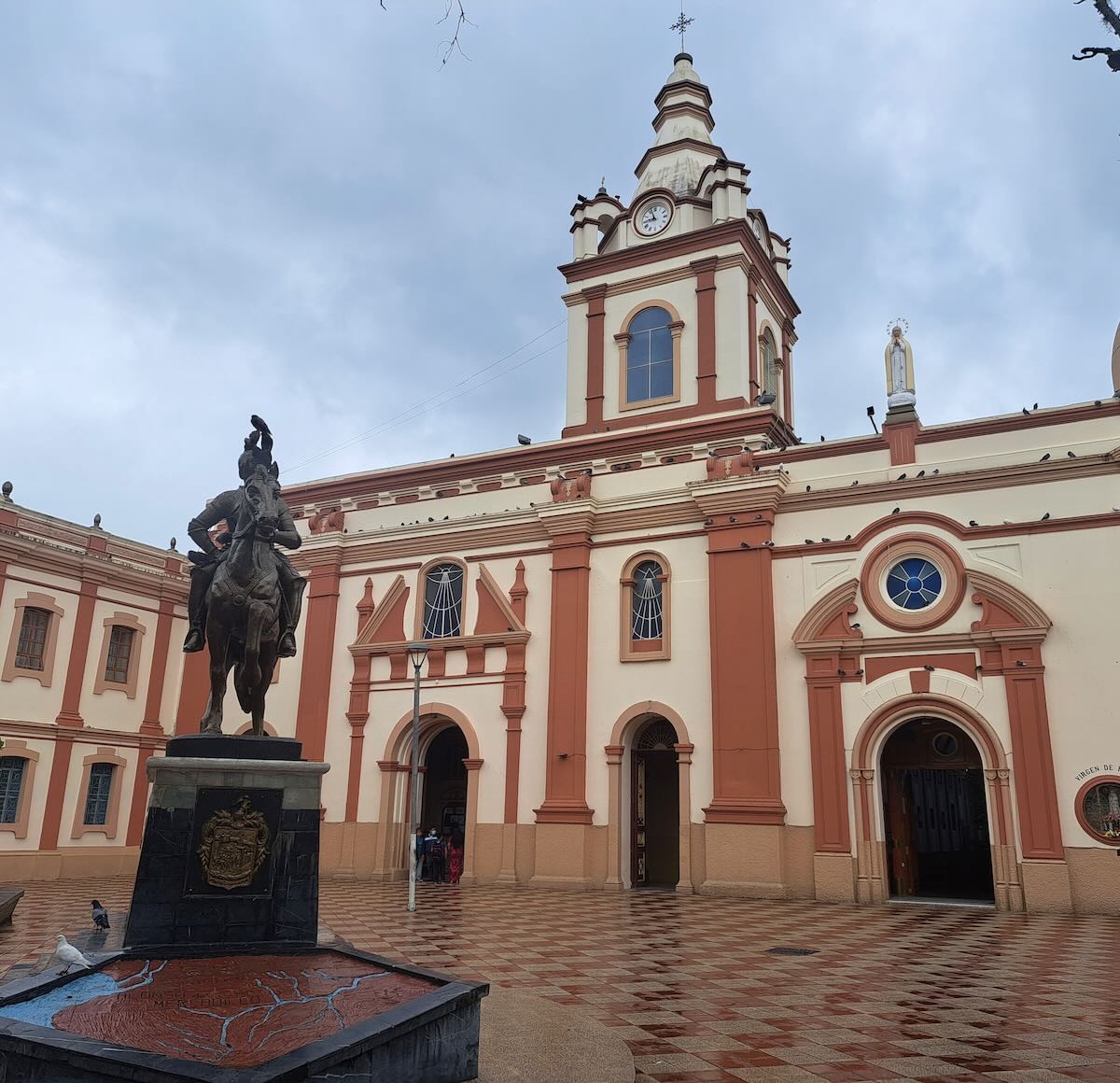
A few months ago I did a two-part feature on my favorite small Latin American city, Cuenca, Ecuador. This time let’s journey to a nearby smaller city that I don’t know very well but want to spend more time in.
Loja is about two hundred kilometers south of Cuenca on a paved highway that runs through a long valley before climbing into the mountains to twist and turn the rest of the way. Look at the route on Google Maps and you’ll see what I mean. Today it’s a picturesque four-hour bus ride but when I made the trip the first time in 1985 it was a tortuous twelve-hour journey on rough dirt roads.
The roads today may be smooth and paved but Loja is still the most isolated major town in Ecuador. The city is so far south that it is closer to the Peruvian border than it is to any other town of size in Ecuador. This isolation has both forced the region to be self-reliant and cushioned it from problems in the rest of the country. For three years in the mid-1800s the province of Loja even governed itself as a peaceful independent country while the rest of Ecuador was mired in a bloody civil war.
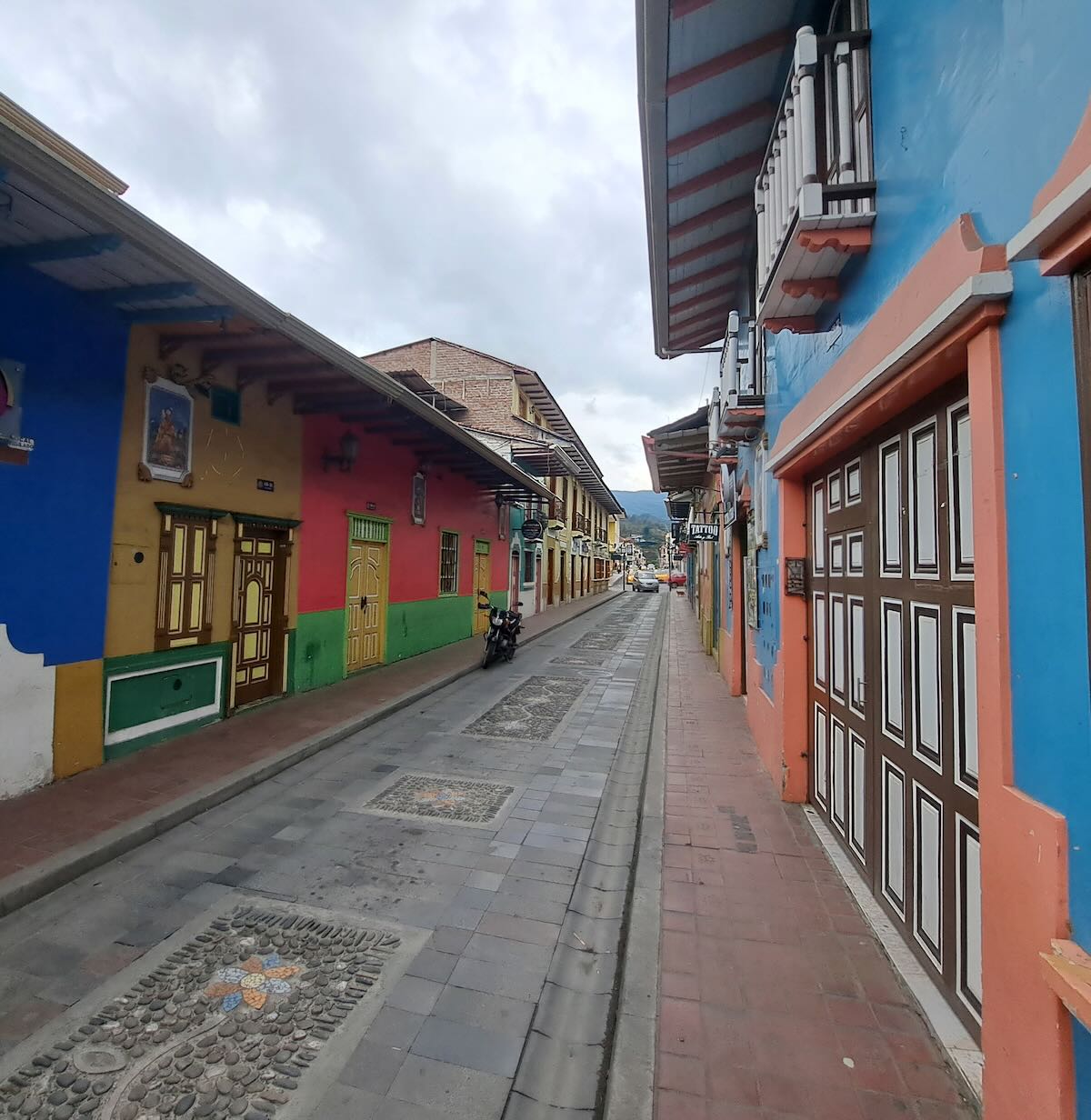
One of Loja’s many picturesque streets.
Loja’s population of around 200,000 (a third the size of Cuenca) makes it the twelfth largest city in Ecuador. But Loja is one of those places that has always punched above its weight. The economy is strong as it’s the center of one of the best coffee growing areas in South America and the city is the main transit point for the gold fields to the east in the Ecuadorian Amazon. Loja is widely thought of as the most cultured and educated city in the country. Two of its universities rank in the country’s top ten. And everyone agrees that Loja is the center of Ecuadorian music. One of the city’s several museums has room after room filled with displays about the many famous musicians that have come from (and continue to come from) Loja. Free concerts are held in the city’s plazas at least once a week.
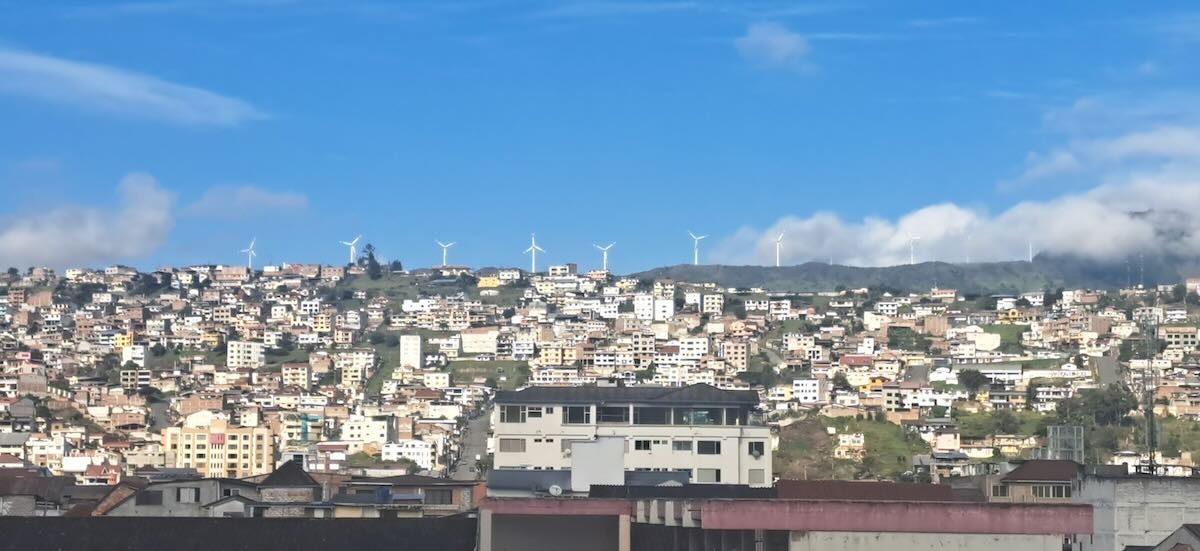
Loja has always been forward-looking. In 1890 the city installed one of the first hydroelectric generators in all of South America. That was just eight years after the first plant was installed in the United States. A little over a century later, in 2013, the first windfarm in continental Ecuador was constructed on a ridge above the city. The eleven windmills produce sixteen megawatts and phase two of the project, which is now under construction, will add another forty-six megawatts. A recently approved third phase will add another 110 megawatts.
Windmills overlooking Loja
The First Visit
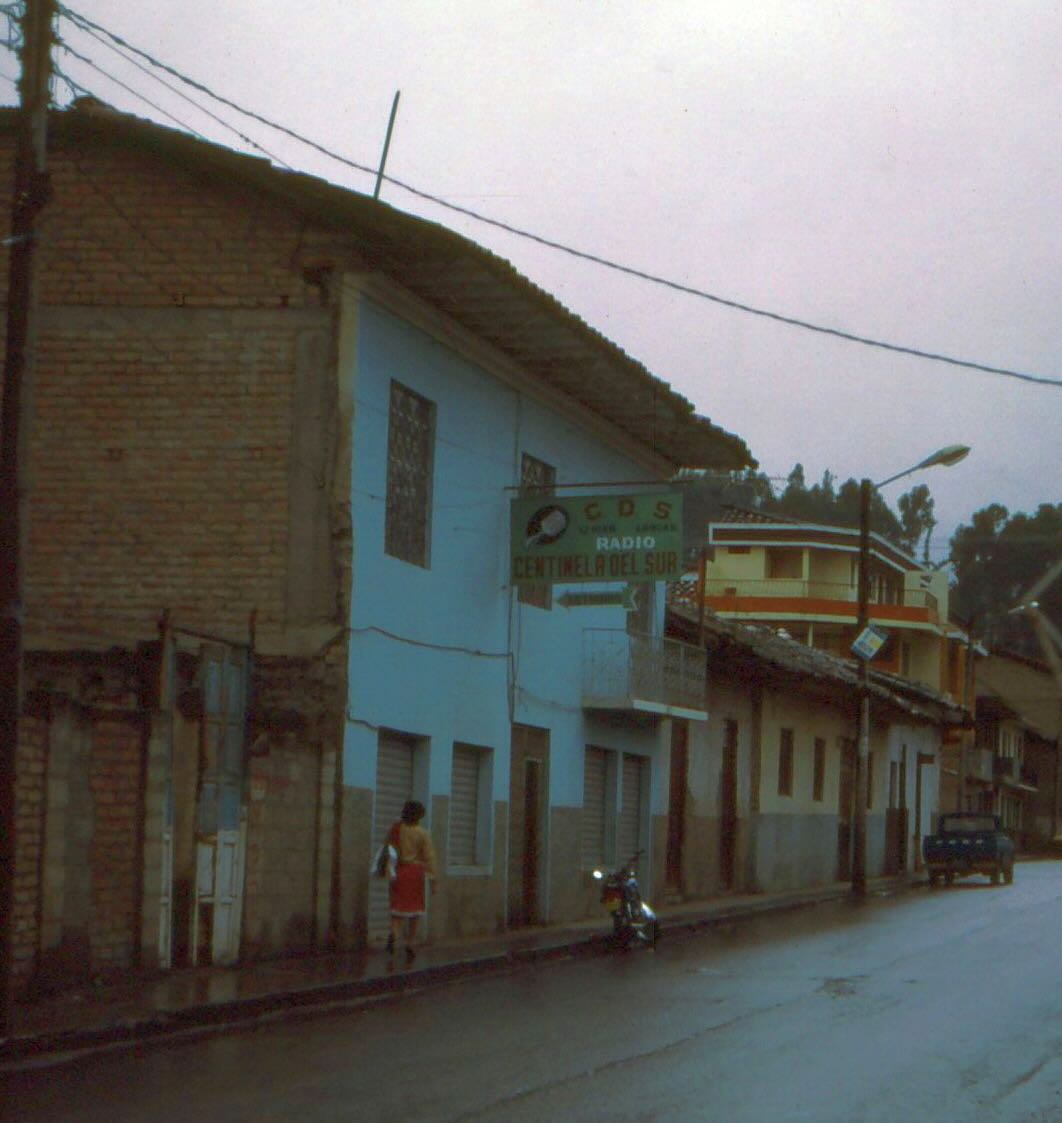
My first visit to Loja was in March 1985 after that long twelve-hour bus ride from Cuenca. I remember Loja as being a pretty but sleepy small city. We only stayed two nights and one day. My primary goal was to visit Radio Centinela del Sur and get a QSL for myself and several friends. I don’t recall anything from that long ago visit but I did get the QSLs. Radio Centinela was founded in 1956 so it wasn’t the first radio station in Loja. But it was the first one to last for more than a few years. On shortwave Radio Centinela del Sur was a station that changed frequency a lot. I first heard it in 1974 on 5020 kHz but most of my logs were made in the early and mid-1980s when 4890 kHz was in use. In the 1990s Radio Centinela del Sur used 4771 and 4899 kHz at various times. The station left shortwave for good by the late 1990s.
Radio Centinela de Sur in 1985
Business card from 1985
The second oldest station in Loja was Radio Nacional Progreso, founded in 1958. I have many logs of the station on its 5060 kHz (variable) frequency from the 1970s through the 1990s. I don’t remember why I didn’t visit them in 1985. Maybe the office was outside of town and difficult to get to. Loja’s other shortwave station was the Catholic broadcaster Radio Luz y Vida, founded in 1967. In the early 1970s the station used 4825 kHz on shortwave but around 1978 they switched to 4850 kHz. I last logged them there in 1997. Radio Luz y Vida was only a few blocks from our hotel and I stopped by several times but the inner door was always locked and I never got to see more than the entrance way. Continue reading →
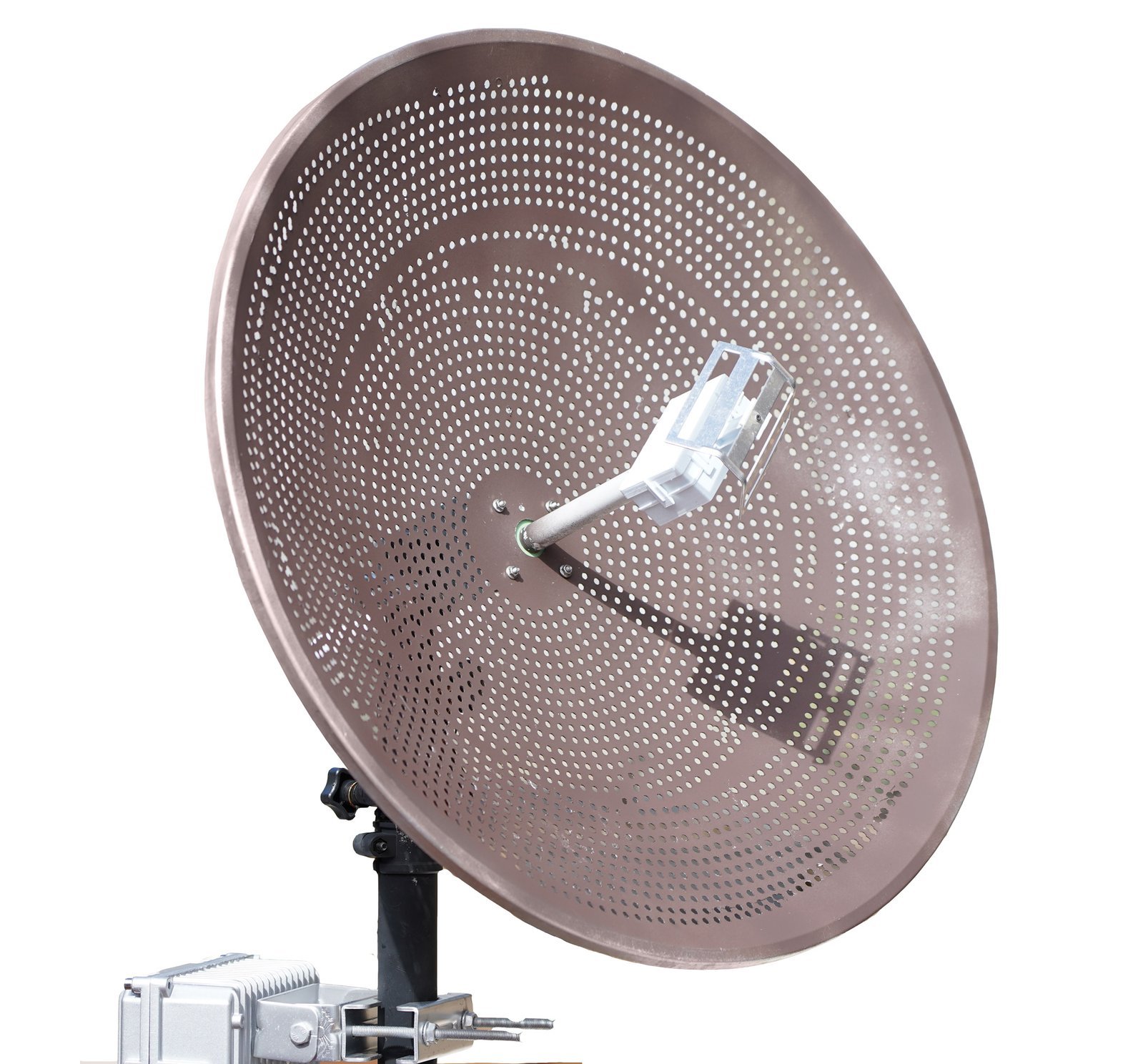
For the past few years we have been working on finding the best way to help beginners get started with L-band weather satellite reception and basic radio astronomy. We have now come up with a solution that we’re calling the ‘Discovery Dish’ – a lightweight 65 cm diameter dish and active filtered feed set.
Discovery Dish is a 65-cm diameter aluminum satellite dish and active filtered feed designed for receiving GOES HRIT, GK-2A LRIT, FengYun LRIT, NOAA HRPT, Metop HRPT, Meteor M2 HRPT and other weather satellites that operate around 1.69 GHz. The dish is designed to weigh under one kilogram, and it splits into three petals, making it easier to ship worldwide. The 1.69 GHz feed contains a built-in LNA right at the feed point, as well as filtering, which means that there is almost no noise figure loss from cables or connectors.
Note that the prototype images show an early non-petalized prototype with rough laser cut wind holes. The production version will obviously be a lot neater looking! […]
State-owned China Radio International is airing its content without attribution on commercial radio stations in Europe.
China has consistently and systematically pursued the dissemination of its narratives on the global stage, with the primary aim of shaping the international landscape to align with its strategic interests and ideological perspectives. These endeavors encompass a diverse array of tactics, including the acquisition of media enterprises, active engagement by Chinese ambassadors in both mainstream and fringe media outlets, the utilization of paid supplements, collaboration with pro-Kremlin media, and the steadily expanding presence of China across various social media platforms.
Recently, China Radio International (CRI), an official Chinese state media outlet broadcasting in multiple languages, has garnered attention for its establishment of partnerships with and provision of content to radio stations worldwide. Remarkably, CRI has effectively outsourced the production of China-related programming to local partners, often without transparently disclosing the sponsorship of content creation to the listeners. This strategy, known in Chinese as “borrowing a boat to go out on the ocean,” plays a pivotal role in laundering Beijing’s propaganda and fostering the acceptance of its messaging among local audiences.
One illustrative case of this approach within Europe involves two Czech radio stations, namely Radio HEY, a nationwide commercial radio station airing rock music, and Radio Color, which positions itself as “one of the last independent radios.” From 2019 to May 2023, these radio stations broadcasted a program titled “Barevný sv?t” (Colorful World), a nearly 30-minute segment aired six times a week, with the objective of acquainting Czech listeners with Chinese culture, language, and history. [Continue reading…]
When cheap digital TV dongles enabled radio enthusiasts to set up software defined radio (SDR) systems at almost zero cost, it caused a revolution in the amateur radio world: now anyone could tune in to any frequency, with any modulation type, by just pointing and clicking in a computer program. While this undoubtably made exploring the radio waves much more accessible, we can imagine that some people miss the feeling of manipulating physical buttons on a radio while hunting for that one faint signal in a sea of noise. If you’re one of those people, you’re in luck: [Kaushlesh C.] has built a portable, self-contained SDR system with real knobs and switches, called SDR Dock 1.0.
The heart of the system is a Raspberry Pi running GQRX, an open-source SDR program that supports many different RF modules. [Kaushlesh] used an Airspy HF+ Discovery, a compact receiver that can work the HF and VHF bands, but it’s easy to modify the SDR Dock to accept other types like those ubiquitous RTL dongles. A seven-inch LCD screen with integrated speakers forms the main output device, with everything powered by a 10,000 mAh lithium-polymer battery. [Continue reading…]
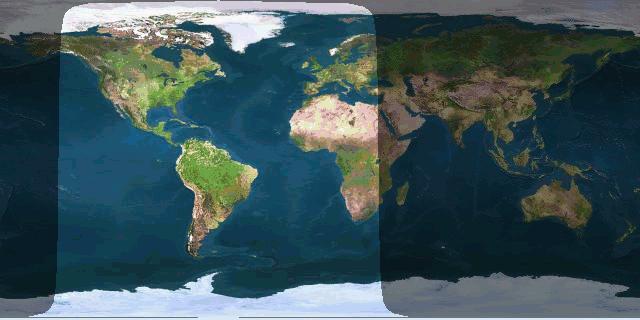
The “grey line” is a band around the Earth that separates daylight from darkness. Propagation along the grey line is very efficient. One major reason for this is that the D layer, The “grey line” is a band around the Earth that separates daylight from darkness. Propagation along the grey line is very efficient. One major reason for this is that the D layer, which absorbs HF signals, disappears rapidly on the sunset side of the grey line, and it has not yet built upon the sunrise side. Ham radio operators and shortwave listeners can optimize long distance communications to various areas of the world by monitoring this band as it moves around the globe. which absorbs HF signals, disappears rapidly on the sunset side of the grey line, and it has not yet built upon the sunrise side. Ham radio operators and shortwave listeners can optimize long distance communications to various areas of the world by monitoring this band as it moves around the globe.
Elliott’s short version: Some funky stuff can happen with propagation when the grey line is passing through your location.
So let’s have some fun for a couple of hours chasing MW DX along the grey line.
Here are the rules:
Frequency range is the medium wave band: 520-1710 kHz
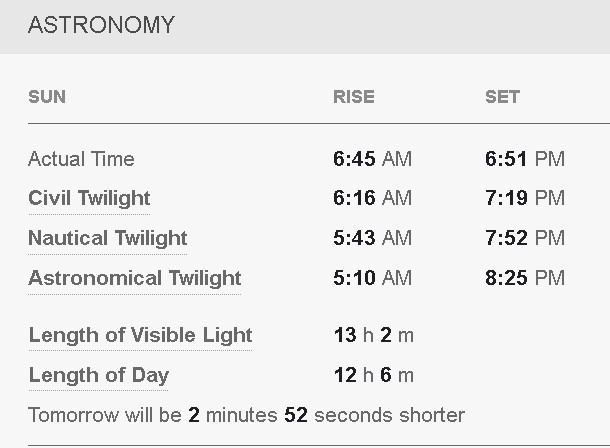
From one hour before Civil Twilight your local time on Saturday, October 14, to one hour after Civil Twilight at your location.
Any radio with any antenna, but must be the radio at your location (no using remote internet radios)
The listener must hear the signal in real time
The stations must be ID’ed by listening to the signal.
Your report should include:
Your name (or Internet handle)
Your receiver and antenna (stay with the same setup from beginning to end; if you use multiple setups, provide a separate report for each).
Your location
The time, the frequency, and the ID of each station heard
The total mileage of your top five most distant stations.
A final point: this is not a contest; it is a challenge. The reward for every participant will be fun and fellowship.
You can find when Civil Twilight begins at your location by visiting www.wunderground.com . Enter your location, click on “Full Forecast” then scroll down to the “Astronomy” section.

 Many thanks to SWLing Post contributor, Ulis Fleming, who shares the following article from KFIZ via Twitter. I love these articles where a mediumwave DXer blows the minds of a small AM radio station’s staff!