Category Archives: News

Steve tracks down the source of persistent radio interference and gets it addressed

Photo via Unsplash

Many thanks to SWLing Post contributor, Steve Allen (KZ4TN), who shares the following guest post:


Tracking Down Radio Frequency Interference

by Steve Allen, KZ4TN

I first noticed the RFI in late November 2019 as a steady buzz at around S9. It was present over most of the high frequency spectrum. I waited until the second week of December to see if you would end on its own, no such luck. I put an HF rig in my truck and started driving around the area to see if I could find a potential source. About a quarter mile from my home is a 161 KVA substation operated jointly by the Tennessee Valley Authority and my local electrical utility. When I parked in the driveway outside of the gated substation the sound of the interference was very strong and blanked the HF spectrum. I called the phone number on the gate and after an explanation of why I was calling I was connected to a fellow radio operator. I explained the situation and he said he would bring the issue to someone’s attention and get back to me.

A week went by and I didn’t hear back from the TVA. I called the person I spoke with previously and he said that the individuals that he spoke with questioned the validity of my findings. He was very helpful but said he didn’t have much clout with the TVA, RFI investigations were not his area of responsibility. I told him I would be happy to meet with someone from the TVA and show them what I had found. I also said I would contact my local electric utility and see if they had an RFI detector so we could eliminate their equipment. My initial contact at the TVA said he would keep trying to get someone to take this issue on and work with me to investigate. I said I would call him back next week.

I then called the local utility company and talked to someone there who was familiar with these kinds of issues. The local utility company owns the output side of the equipment at the substation. He told me he was going to perform an infrared (heat) inspection of their equipment at the substation mid January as part of their annual maintenance and will also check the low voltage utility lines near the substation. I told him that I didn’t notice this RFI until after they had a power outage nearby. He said he would try and get over earlier and check the power lines that run along the streets and look into the power outage history for this area.

All during this time I kept a daily log of the RFI including time of day, frequency effected and S unit level. I also logged the weather conditions. To eliminate the electronics in my house as a possible source I connected my transceiver to a 12 VDC battery and shut off the mains circuit breaker, the RFI did not change at all. I also visited the ARRL webpage that provide information on RFI including recordings of known RFI:

http://www.arrl.org/radio-frequency-interference-rfi

The ARRL is the best source I have found in finding and fixing RFI.

By December 27th,  no word back from anyone. I assumed that they were off for Christmas but decided to write a letter to the TVA as a follow up to what had happened so far. In early January I received and email from one of the TVA engineers who said he would contact a field engineer who would contact me. The next day I received an email from the field engineer who said he was going to be in the area on another job but would meet me at the substation.

So, of course as soon as I am making headway with finding the problem the RFI diminished to the point of not being a problem. By this time here in Northeast Tennessee the winter temps are in the 40s and the humidity is lower. For whatever reason, the RFI ended. I met with the field engineer and we agreed that if there is no RFI there is nothing to search for.

Fast forward to August, 2020. In June and July I had been operating digital, mostly FT8. I usually had the volume control at zero and as it was summer I was doing no shortwave listening. One day I decided to tune around the bands and found that the RFI was back as strong as it was during December at S4-S9 from 2-30 MHz. I emailed the principal engineer I had previously been in contact with at the TVA and he told me he would contact another field engineer and that he would come to my house with an RFI locator and start a thorough investigation. The next day I received an email from the field engineer and we scheduled a time for him come over.

Upon his arrival he connected his RFI locator to my vertical antenna and tuned across the spectrum. The locator immediately displayed the signal. He captured an electronic image and said that he could now drive around the area and try and find a match. A hour and a half later he called and said he was unsuccessful and wanted to come back  and make sure the signal was still present. Sure enough, it still displayed on his locator and he was puzzled why he could not find a similar signal while driving the area. He said he would send a copy of the recording to the TVA engineer and get back to me.

A few days later I heard back from him and he wanted to come over again and make another recording. I believe after discussing this issue with his supervisor he was going to use a different method of searching the area. After a couple of hours I received a phone call from the field engineer telling me that he thought he had found the source of interference. Using a parabolic antenna he had found two different utility poles that appeared to have defective lightening arrestors on them. Both are within a quarter mile of my QTH. These poles are the responsibility of the local electrical utility not the TVA. He said he would contact them and follow up with me in a few days.

In a couple of days the interference was very low to nonexistent. Shortly thereafter the engineer contacted me saying the local utility company had completed the repairs and wanted to know if the interference was still present. I said I hadn’t hear it in a couple of days and I would get back to him if it returned. A couple of weeks later I received an email from the field engineer detailing the incident, what he had done to locate the interference, and what was done to repair it. In his email he stated the service was provided at no cost by the TVA Right of Way and Elizabethton Electric Department through TVA’s Comprehensive Services Program (CSP). I am so appreciative of the Tennessee Valley Authority. The airwaves are now free of manmade interference and I am looking forward to another winter of operating and listening to shortwave radio. Here in the 21st century there are so many electronic devices that are capable of causing RFI. I am very thankful that my station is RFI free (for the time being).

Steve Allen, KZ4TN
Elizabethton, TN


Thank you so much for sharing your story, Steve. Only recently, we posted Emilio’s article about tracing interference to poorly made switching power supplies. Thank you for sharing how you approached your local utility company, in your case, to resolve your RFI!

Very encouraging! Readers note that you don’t always have to live with persistent RFI. If you know the source isn’t coming from within your home, sometimes it’s simply a matter of getting your local utilities company to investigate.

Deke Duncan of Radio 77 returns to the air

Many thanks to SWLing Post reader, James Copeland, who writes:

Hi Thomas,

I’ve got something that may be of interest to you and your readers:

The legendary Deke Duncan of Radio 77 will soon have his own regularly scheduled program on WLHA, an Internet radio station based in the U.S. As many of your readers know, Duncan gained fame after being featured in a BBC program in 1974 for broadcasting from a shed in his backyard to an audience of one – his wife – via a speaker in the living room.

Now, 46 years later, Duncan will appear on his first regularly-scheduled American program from 10 a.m. to noon U.S. Central time. (3 – 5 p.m. UTC).

At this point, it may be obvious that WLHA is not your average automated Internet radio station. It used to be the campus carrier-current station at the University of Wisconsin-Madison and was recently resurrected by Alumni via online streaming. Today it broadcasts 24/7 via the Internet and features DJ’s from the station’s past as well as newcomers from all over the country (and now the world) like Duncan who obviously did not attend UW. In addition to some pre-recorded shows, the station hosts a popular “Friday Night Live” call-in show from its Madison studios.

WLHA Program Director Kevin “Casey the K” Peckham decided Duncan’s personality would be a great addition to WLHA’s “Music and Malarkey” format. Duncan, who is still living in the UK, gladly accepted the offer and added, ” My wife, Pamela is thrilled to bits that her husband has finally fulfilled his dream to be on American radio.”

Duncan will be interviewed this Sunday the 11th at 7 a.m. during the Lee Harris show, which precedes his inaugural program on the station. The interview will also be repeated from 7 – 10 p.m. on Sunday night. We’re very excited to announce this new addition to our air staff and hope many of you will have a chance to tune in.

You can listen to WLHA on Live365, through our app for iOS and Android, Radio Garden, Amazon Alexa or directly through the website at lakeshore64.com.

James Copeland
WLHA News Director

Thank you for sharing, James! I’m certain a number of our readers will be happy to hear that Deke is on the air again!

Click here to read our previous post about Radio 77.

Click here to visit Lakeshore64.com.

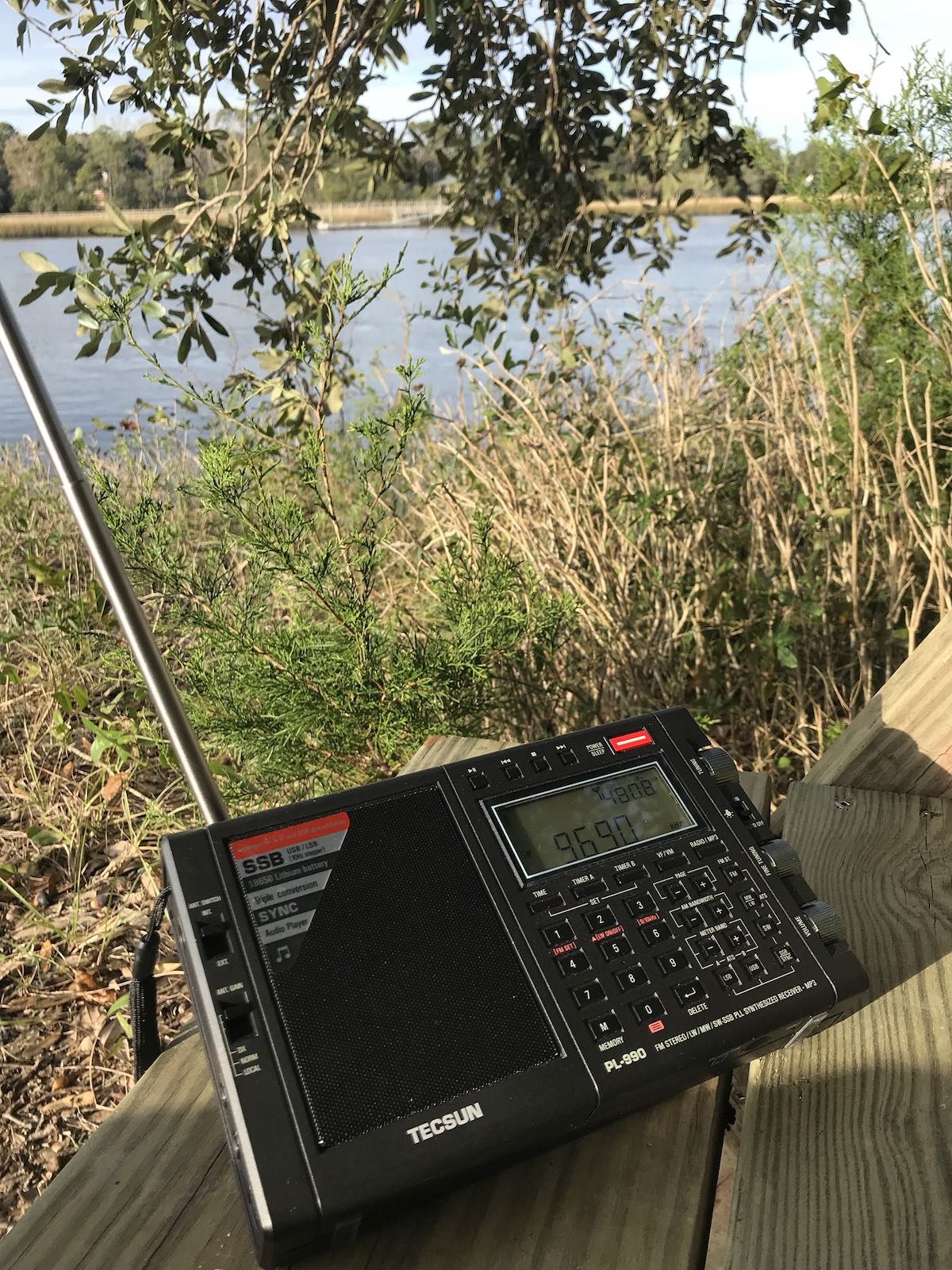
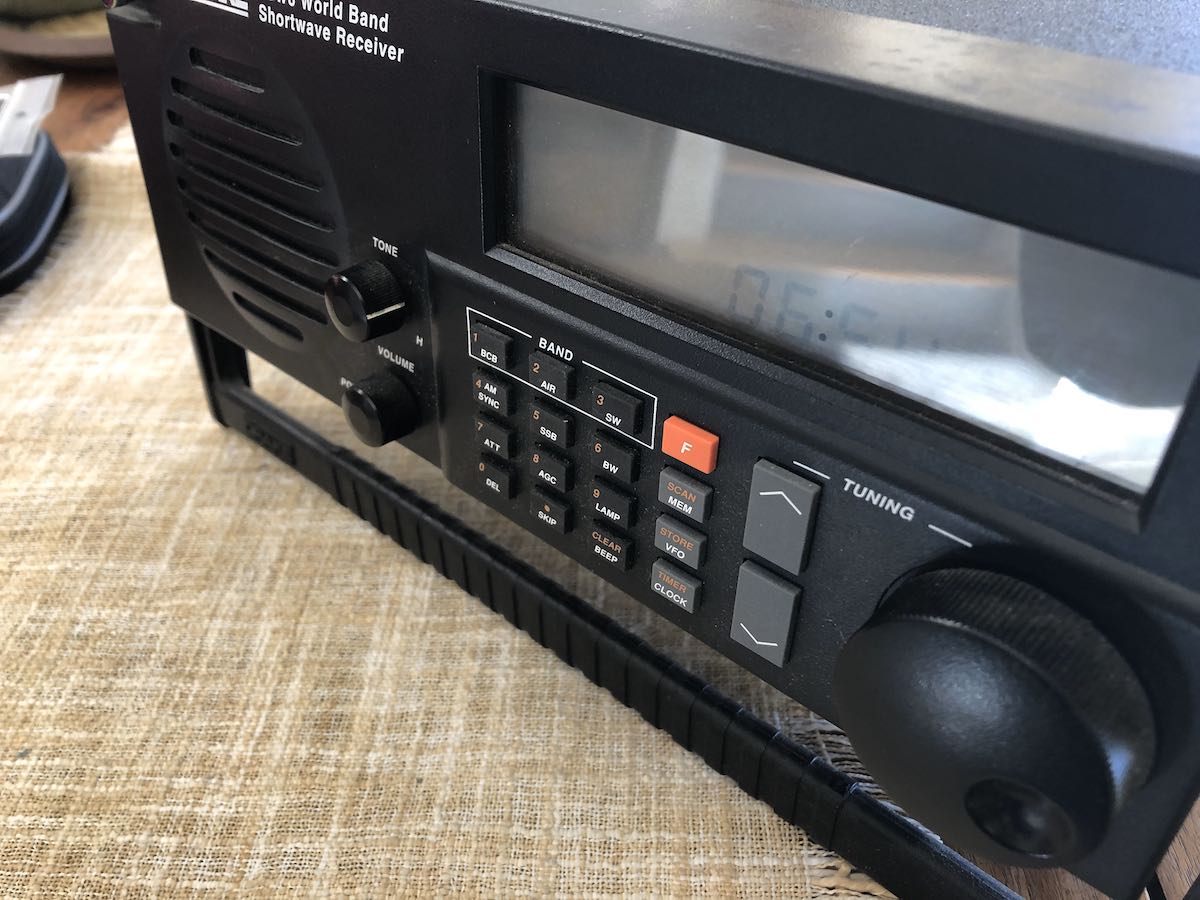
Anyone sorted out how to calibrate the Tecsun PL-990?

I mentioned in a previous post that one of the “hidden features” of the PL-990 series is the ability to calibrate the radio so that the frequency display is correct when say, you zero-beat an AM broadcaster/carrier in SSB mode.

For normal AM broadcast listening, you’d never notice the frequency discrepancy on the display. When I used the PL-990 in ECSS mode, though, my frequency display is a few Hertz off pretty consistently across the spectrum.

Our friend Gilles Letourneau (at the Official SWL Channel) recently told me that after a couple hours of tinkering with his PL-990 last weekend, he was able to calibrate it but was so deep into the process, he wasn’t able to document exactly how he achieved it. Of course, now that it’s accurate, he doesn’t want to inadvertently harm the calibration. I don’t blame him.

Big news is he’s confirmed that it’s possible.

I’m curious if any PL-990 or PL-990x owners have successfully calibrated their receiver. If so, please consider sharing your procedure with us!

UPDATE

Gilles comments…

“Tune a strong signal in AM .. like WWV then use LSB USB modes to fine tune the receiver as close to zero beat as possible. Then simply press and hold the USB key until display light flashes two times … you will be all set and calibration will work !”

Shortwave listening in the field with the Icom IC-705 transceiver

Yesterday, I took the new Icom IC-705 to the field for another Parks On the Air (POTA) activation. My goal at this particular activation was to make a couple of posts for QRPer.com: first, to test the new mAT-705 ATU on loan from Vibroplex, and secondly, make a short video about full break-in CW operation.

I also wanted to do a little shortwave listening after completing the activation. I had no idea what propagation would be like, but thought I’d tune around below the 20 meter band where the antenna was currently resonant.

I deployed the CHA Emcomm III Portable random wire antenna which, I must say, is a superb shortwave listening antenna for the field.

Since you can’t see the antenna in the first photo below, I marked up the second one. The blue line represents the 73′ radiator, and the green line the counterpoise:
Here’s the short video I made around the 22 meter band:

I had planned to make a few audio recordings via the built-in digital recorder but I left my MicroSD card at home. No worries, though, as I plan to make some recordings for readers to compare in the coming days if time allows.

If you have any questions about the IC-705, feel free to ask in comments.

A new Sangean ATS-909X model in the works? Two 909Xs lead Dan to a potential discovery…

Many thanks to SWLing Post contributor, DanH, who shares the following guest post:


How two Sangean ATS-909Xs led me to news of an ATS-909X2

by DanH

I decided to buy a second Sangean ATS-909X this summer. I operate shortwave portables on batteries and wanted the ability to switch radios if one ran low on power during a listening session. I received the new radio and used it for about a week before noticing slight differences between the two 909Xs. Then I noticed big differences with the power supplies and began to ask questions. The answers led me to the new Sangean ATS-909X2 mostly by accident. Rumors have circulated for years that the 909X would be the last shortwave portable made by Sangean. It now appears that the rumors are not accurate. Thanks to an anonymous source the true story begins to appear.

I purchased my first 909X in 2015. It was built in 2014 and has been used almost every day since it arrived. The firmware is v. 1.29, the color is black. My 909X is featured in SWL and DX videos I shoot for the YouTube channel Willow Slough DX.

The new 909X was purchased early in August. This radio was made late in 2019 and has firmware v. P01. Minor changes include the color of the magnetic metal piece on the radio’s kickstand and tightness of the volume control knob which has been loosened a little.  Another small change affects the beeper that sounds with certain keyboard commands. The beeper is now relatively soft-spoken.

The newer 909X features major changes made to the power supply including the AC/AC wall wart adapter. I use the 2014 909X with battery power for shortwave listening because AC operation introduces noise at different frequencies across the shortwave bands. Incidentally, internally generated noise like this happens with all of my shortwave portables when operated from AC power. The 909X is no exception. Portable SW radios made during the last 30 years just seem to do this regardless of make or brand.

The 2020 909X generates significantly less interference than my five-year old 909X. These radios have different model wall warts. The older radio is a 120 VAC / 60 Hz unit as opposed to 100 – 240 VAC / 50 – 60 Hz. The new adapter sports a ferrite core RF choke on the power line which is now shielded wire instead of small gauge zip line. So far, subtle traces of signal mixing from the new adapter are heard only when using my Sennheiser HD 280 Pro headphones. The power connection for the newer 909X is now center pin positive instead of center pin negative. Not surprisingly, the newer adapter does not work with the 2015 909X.

The search for a technical explanation for the mysterious (to me) and incompatible AC adapters required talking to several contacts. I found someone who earnestly wanted to discuss the 909X including the new AC adapter. That person floored me by saying “It’s the same adapter that will be on the 909X2.” That was last week…

Introducing the Sangean ATS-909X2

My unnamed source was happy to answer questions about the 909X2 and sent me leaked documents. The first is a sheet issued last spring listing some changes for the new radio. The second is a treasure trove: a 40+ page draft copy of the English language operating instructions for the 909X2 including line drawings. I hit gold and wasn’t even looking for it. This draft was issued earlier in the summer. I did some fascinating reading that evening.

At this point I want to caution readers that the 909X2 is very much a radio in development. The prototypes have yet to be distributed for evaluation although that is expected to happen soon. None of the features or component choices are set in stone at this point. Indeed, the very name of this radio may not be a done deal. I have heard the new model called either ATS-909X2 or ATS-909X Mk. II. Still, the draft copy of a manual that lists and explains operation of all of the many new features confirms that development is well underway. Production is rumored to begin in 2021. That date makes perfect sense as the 909X will be ten years old next year and Sangean likes to celebrate company anniversaries.

What will Sangean’s new multi-band shortwave flagship look like? The 909X2 shown in the draft booklet retains the size and form factor of the 909X to an amazing degree. The number and placement of buttons, switches, knobs and jacks remain the same. The functions of some controls may change and the location of some buttons on the radio may be switched around. A display menu will be added to operate many of the new features. Without taking a close look at how the outboard controls are labeled the 909X and 909X2 will look like siblings. A larger and much busier LCD for the 909X2 will be the most visible difference.

Here are some of the main features of the 909X2. Again, there may be changes before the final version is decided upon.

  • VHF AIR band in addition to LW / MW / SW / FM
  • Automatic Tuning System (ATS) for FM / LW / MW / SW bands
  • Total of 1674 radio station presets
  • Three memory banks for preset stations: store presets for different users and/or different areas or categories
  • Local/World Time with two customizable city names
  • FM RDS with PS, PTY, RT and CT features
  • Potentiometer-type RF Gain Control retained
  • Six-digit frequency display
  • SSB (Single Side Band): USB / LSB, 10/20 Hz tuning steps selectable
  • Three alarm timers with snooze
  • Larger display screen with more functions and improved backlight controls
  • New NiMH charge controller charges each 4xAA cell individually
  • Station presets/memory lock
  • Auto or manual bandwidth control
  • Selectable and band-specific bandwidth filtering for LW-MW / SW / FM / AIR
  • Tuning dial detents removed
  • 12-segment bar-graph S-meter plus signal strength and signal-to-noise displayed in dB

The new ATS-909X2 benefits from innovations that Sangean developed after the 909X was introduced in 2011. I’m looking forward to firing up this new radio as soon as I can get my hands on one.

DanH


Wow! Thank you for sharing your discovery, Dan! I, for one, welcome the new 909X version 2! Sangean is a solid radio manufacturer, so I would expect the new radio to perform at least as well as its predecessors. We’ll post updates as they become available.

Reading an interval signal in the waterfall

I’ve been doing a lot of SWLing with the new Icom IC-705. I suppose I’ve not much to post here other than to simply say: I think Radio Exterior de España‘s interval signal looks brilliant on the ‘705 waterfall. I captured this at the end of their scheduled broadcast around 22:02 UTC today.

Of course, the audio was pretty nice, too. Their interval signal is unmistakable:

I’ll admit: I’m loving the native recording capabilities of the IC-705. This came straight off of the MicroSD card. Bandwidth was set to 9 kHz.

The HobbyPCB IQ32 transceiver fills a special niche in the ham radio world

The following review was first published in the September 2020 issue of The Spectrum Monitor magazine:


The HobbyPCB IQ32 transceiver fills a special niche in the ham radio world

This summer, I’ve been exploring the world of general coverage QRP transceivers. I’ve been taking my LnR Precision LD-11, Elecraft KX3 and KX2 into the field; and I’ve just finished a comprehensive review of the Xiegu G90. I also have a TX-500 and IC-705 arriving in the near future [update].

Yes, I’ll admit, I’m a devotee of the “all-in-one” nature of the latest model portable QRP transceivers.

Most of the QRP transceivers now on the market are products of large, popular ham radio manufacturers. Usually, a company will come up with a product concept, follow through with their market research, then design, develop, and produce the radio. In fairness, that’s an over-simplification of the process, but let’s just call it a “top down” design approach––meaning, the product idea is generated within the company, and is often based upon customer feedback.

Not all ham radio products come about this way, though. Some have more “grassroots” or collaborative origin.

The HobbyPCB IQ32

(Image Source: HobbyPCB)

I first noticed the HobbyPCB IQ32 transceiver at the Dayton Hamvention a few years ago. I checked it out carefully at their booth, and recall a crowd gathering around their table. Noting this, I decided, at a later time, I would also find an opportunity to check out the radio in more detail.

A couple of months ago, I was working on my list of General Coverage QRP Transceivers and asked for help filling in details of any radios I’d forgotten. A reader commented and reminded me that the IQ32 was, indeed, general coverage.

At this point, I reached out to HobbyPCB and asked for a loaner unit to explore for a few weeks. The company very kindly sent one my way some weeks ago, and I’ve been testing it on the air ever since.

Form factor

When I received the IQ32 package, I was surprised by how lightweight this transceiver is:  a mere 1.5 lbs (700 grams) packs it all in one compact package.

The chassis is made of aluminum and incredibly sturdy. It even includes side panel extensions to protect the front faceplate and knobs.

The IQ32 sports a 3.2″ color LCD touch-screen display large enough to contain all of the functions, a spectrum display, and even an area for text––both transmitted and received in PSK31 and CW. The display is reminiscent of the uBITX V6 I recently reviewed. It is recommended that the operator uses a blunt plastic stylus (or retracted ballpoint pen) for navigating the color screen, since several of the  menu settings, memories, and the like require some fairly precise tapping. The graphic user interface (GUI) feels a bit like what I’d expect to find on a piece of test equipment: a bit old school, but nonetheless quite functional.

The main encoder and selector knobs are lightweight and made of some sort of plastic or nylon. They work quite well––but if I owned an IQ32, I believe one of the first things I’d do is replace those with a lightweight aluminum equivalent.

As I mentioned earlier, the weight of the IQ32 is very reasonable at 1.5 lbs. I don’t think I’d even notice it packed in a backpack.

The IQ32, like the recently released Lab599 TCX-500, lacks an internal speaker. However, my unit came with a speaker microphone, which works fine.

The right side panel of the IQ32 has a toggle power switch, power amplifier connection, power port (5mm X 2.1mm, positive tip), PS2 keyboard connector, USB Type A, and a BNC antenna port. The left side has a 3.5mm I/Q Output, 3.5mm headphone jack, 3.5mm speaker/mic port,  and a 3.5mm CW key input.

The IQ32 also has two legs that can be adjusted so that the radio will prop up at a comfortable angle for operation. The legs can be a bit finicky to adjust and keep in place, so I preferred using an angled radio support I use for my Elecraft KX3.

A collaboration

The IQ32 also feels like a project joint effort, bringing to mind the old chocolate-peanut butter cup commercial of a bygone era: “My chocolate got mixed with your peanut butter!” And or, “My peanut butter got mixed with your chocolate!”

Curious about this seeming blend of radio ideas, I reached out to Jim Veach (WA2EUJ) at HobbyPCB for more information; he gave me a little history behind the IQ32.

Jim writes:

The IQ32 is the fusion of two products: the HobbyPCB RS-HFIQ, and the STM32-SDR. 

The RS-HFIQ was designed to be a 80-10M, 5W soundcard-based SDR––similar to the popular Softrock SDRs with some expansions and revisions. 

The STM32-SDR was designed to work with a soundcard-based SDR and [thus] eliminate the need for a PC and provide stand-alone operation. 

Inside the IQ32 is a mostly stock RS-HFIQ (in fact, we offered an upgrade kit so RS-HFIQ owners could go the IQ32 route) and a custom version of the STM-32 […] specifically for the IQ32.

The original development of the STM32 [began] a few years ago when PSK31 was the digital mode du jour and [the] PS2 keyboard roamed the land. The firmware team recently released the current FW, which greatly expanded the CW modes and reworked the memory structure based on user input.

And there you have it: even though this unique little rig has been around for a few years, I’m impressed that they continue to refine it and upgrade the firmware. Indeed, if the community of IQ32 users grow, they may be able to do even more.

On the air

To be clear, my intention here isn’t to conduct a comparative review of the IQ32. I simply want to convey what I’ve learned in the process of playing with the rig and trying out some of its unique features.

Immediately after unboxing the radio, I hooked it up to my main skyloop antenna, plugged in the power supply that accompanied the radio, then plugged in the handheld speaker mic.

I discovered rather quickly that the IQ32 user interface takes a different approach than any other transceiver I’ve ever tested. Instead of one main user interface window in which you navigate modes, frequencies, and perhaps alter spectrum and bandwidth settings, the IQ32 has a different screen layout for each mode. It’s as if each mode––SSB, PSK31, CW, etc.––has its own “page.”

Despite the very minimal controls, you can adjust many of the IQ32s settings, macros, and memories in a very granular way via the settings pages using a stylus for fine control of the screen. On the flip side, during operation, it can be frustrating when adjustments need to be made quickly between the AF Gain, RF Gain, CW Speed, and AGC, as they all use the same multi-function knob and switching between them requires several screen taps––not as quick a process as one might prefer.

Indeed, the IQ32 isn’t immediately as intuitive as most commercially-marketed radios.  But once you fully understand the settings and modes pages, it becomes easy to navigate. Note: I would advise any future owner of an IQ32 to read the manual in advance. I did this, and it certainly helped. I should add here that the IQ32 manual is one of the most comprehensive I’ve read––especially considering its collaborative roots.

Now, let’s talk modes.

SSB

Since the IQ32 requires a PS2 keyboard for PSK31, and optionally for CW, I tried my hand at SSB first.

After learning how to switch modes and filter settings, I hopped on the air. Instead of calling CQ, I decided instead to seek a park activator in the POTA program via the POTA spots website. Within 10 minutes, I made contact with two parks: one in Pennsylvania and one in Florida on the 40 and 20 meter bands, respectively. While both parks gave me a “5×9” report, I seriously doubt it was accurate based on their own signal strength. (Some park activators, like contesters, only give 5×9 reports.)

Still, my success in contacting these two parks told me that the mic settings were probably suitable and that the audio had enough punch on 5 watts to be heard. To confirm, I called CQ a few times and listened to my own signal at a KiwiSDR site in Maryland. The signal was about 5×5, but the audio was clear, clean, and had excellent fidelity.

Over the past few weeks I’ve worked dozens of stations across North America with the IQ32.

PSK31

One of the very unique features of the IQ32 is its ability to natively encode and decode PSK31. This was the second mode I was eager to try.

To use PSK31 on the IQ32, a PS2 keyboard (or USB keyboard with PS2 adapter) must be connected. I searched my shack in vain for a PS2 keyboard, but fortunately, my friend Vlado (N3CZ) came to the rescue and let me borrow one of his keyboards.

Again, note: IQ32 beginners should certainly plan to read the PSK31 section of the IQ32 manual prior to attempting a PSK31 QSO.  For starters, you’ll want to enter in your personal information into the tags settings so that you can use your keyboard function keys to automatically send CQs and to answer calls. The manual will also walk you through any other necessary settings.

Once I had everything set up, I started calling CQ on the 20 meter band; unfortunately I had no luck snagging a station. This had less to do with the radio and much more to do with the mode, which has, alas, fallen out of popularity since the advent of FT8. It’s a shame, really, because although PSK31 is a digital mode, it feels much more like a proper QSO than FT8, in my opinion. While I have a lot of respect for FT8, with PSK31, you can, as we hams say, “rag-chew”––a much more personal interaction.

And rag-chewing is exactly what I did. I contacted a friend, we set a sched for a PSK31 QSO, and it was, indeed, fun. The IQ32 has a screen with enough text space so that it’s easy to follow and to read. In fact, with this radio, I don’t feel like a computer is needed.

With the keyboard attached, PSK31 just works…and works quite well. I really like the way this feature has been implemented in the IQ32.

CW

Truly, the IQ32 actually has a lot to offer the CW operator. The IQ32 supports Iambic keyer modes A and B, with speeds up to 35 wpm. You can also adjust the weight of the dits and dahs. The IQ32 doesn’t support full break-in QSK, however: there is a slight delay after sending before the relay puts the radio back into receive mode. At present, this delay is not manually adjustable but is, rather, based on the selected keyer speed.

I’ve been very pleased using the IQ32 in CW mode with my Begali paddles and Vibroplex single lever paddle.

Of course, a really unique feature of this rig is that it provides the operator with the means to use the PS2 keyboard to send CW, just as you can with the PSK31. At present, there is no CW decoder, but for those who feel their fist isn’t quite up to par, you can surprise the operator on the other end by sending perfectly formed and spaced CW by simply typing it on the keyboard.  Herein lies a very unique feature and application for the IQ32.

Indeed, as a frequent Parks On The Air (POTA) field activator, I rely very heavily on memory keyers to call CQ, send a park number, as well as give my thanks and 73s to those who contact me. Using a pre-programmed message means that I then have time to log a station while it sends, and to ensure my code is cleaner when I send park numbers––especially since I don’t exactly excel at sending strings of numbers!

With the IQ32, I find I can program full CW messages to play when I simply press one of the function keys on the keyboard. This gives me much better flexibility and control than, say, the built-in memory keyer on my venerable Elecraft KX2.

With the IQ32, a CW op would actually have the choice of never even touching a key, and just sending all messages with the keyboard. While I could never see myself doing that (as I quite enjoy sending CW with a key), the flexibility of pre-programming an array of CW memory messages and having them conveniently at hand is nonetheless quite appealing.

As a CW operator, I’m quite pleased with the IQ32. My only wish would be for a slightly shorter relay hang time for use in contesting or on Field Day.

The IQ32 Niche

While I wouldn’t necessarily recommend the IQ32 as a first transceiver to a newly-minted ham, I can certainly envision a niche market for this unique rig.

For one, I think the IQ32 could satisfy those operators who desire a very clean and stable transmitter. The IQ32 sports a Class A 5-watt power amplifier with individual low-pass filters for each band that exceed FCC requirements for spectral purity. It also has a Temperature-Compensated Crystal Oscillator (TXCO) for frequency stability––truly, this is not common in a radio of this price class.

For another, the IQ32 could be used as a driver for a transverter when operating on VHF or UHF. Another of its unique and useful features is that the user can set an offset to display the transverter output frequency rather than the IQ32-driven frequency.


And, finally, let’s face it: I know of few other radios that you can take to the field, hook up a keyboard, and natively send and decode PSK-31 transmissions. My KX2 can do this to a degree, but I have to input the text as CW, and the number of characters in the display is quite limited. The IQ32 is robust enough to permit you to carry on PSK-31 rag-chews, if you wish. If this is your thing, you’ll definitely want to play with this rig.

Being able to send CW with a keyboard and pre-programmed messages also means CW operators could make their workflow much more efficient in either the shack or the field.

In conclusion, I’ll admit that the IQ32 isn’t as intuitive as other radios and that the ergonomics leave room for improvement. But it’s still a cool little radio. If, after having read this tour of the IQ32, you feel like you’re in this radio’s niche market, then definitely reach out to HobbyPCB: I’ve found their customer care and support to be absolutely benchmark.

All in all, I’ve had a lot of fun tinkering with this unique general coverage QRP transceiver; I expect others like me will, too. Many thanks to HobbyPCB and the IQ32 crew for letting me take a deep dive into this very special little rig!

Click here to check out the IQ32 at HobbyPCB.


Do you enjoy the SWLing Post?

Please consider supporting us via Patreon or our Coffee Fund!

Your support makes articles like this one possible. Thank you!