Category Archives: Nostalgia

Rhode Island’s WWII farmhouse monitoring station

SX-99-DialMany thanks to SWLing Post reader, Mike (AC4NS), who shares a link to this fascinating article by Tom Mooney? in the TheProvidence Journal. Here’s an excerpt:

“There was nothing remarkable to see on Chopmist Hill in 1940 when, a year before the Japanese would attack Pearl Harbor and bring America into the war, a Boston radio technician by the name of Thomas B. Cave drove up Darby Road.

[…]Cave worked for the Intelligence Division of the Federal Communications Commission, charged with finding a hilltop in southern New England that could serve as one of several listening posts to detect radio transmissions from German spies in the United States.

What he discovered up at William Suddard’s 183-acre farm was nothing short of miraculous.

Because of some geographic and atmospheric anomalies, Cave reported he could clearly intercept radio transmissions coming from Europe — even South America.

As a Providence Journal story revealed after the war, military officials were initially skeptical. They wanted Cave to prove his remarkable claims that from Chopmist Hill he could pinpoint the location of any radio transmission in the country within 15 minutes.

The Army set up a test. Without telling the FCC, it began broadcasting a signal from the Pentagon. From atop the 730-foot hill in the rural corner of Scituate, it took Cave all of seven minutes to zero in on the signal’s origin.

In March 1941, the Suddards obligingly moved out of their 14-room farmhouse, leasing the property to the FCC.

Workers set off erecting scores of telephone poles across the properly, purposely sinking them deep to keep them below the tree line. They strung 85,000 feet of antenna wire — the equivalent of 16 miles — around the poles and wired it into the house.[…]”

Click here to read the full article in the The Providence Journal.

If you find this fascinating, you might also read this article about the Radio Secret Service in England.
Radio Caroline and a crystal radio: “The making of a rebel”

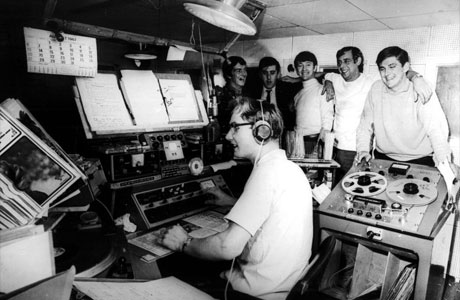
Radio Caroline circa 1960's.

Radio Caroline circa 1960’s.

Many thanks to SWLing Post reader Mike, who shares a link to this story from the blog
République No.6:

Growing up in Piennes Lorraine, Radio Caroline the making of a rebel

[A]t night with my younger brother we would listen to a “pirate radio station” on a boat that would put real good music on, crusing the international waters between England and France. He burst in laughter and told me: That’s Radio Caroline“. That was it. My brother and I would listen to that station nearly every night on an old “galena radio receiver” with a huge antenna hidden in the attic built with copper wire we stole at the mine. I mean we didn’t really steal it, it was everywhere. It was the wires used by miners to connect detonators to batteries when blowing new tunnels and locals were using it for all sorts of things, like holding parts in chicken coop to tie tomato or green bean plants to stakes and could be found everywhere.

Actually at first we set the antenna in our bedroom but somehow it wasn’t long enough not to mention mom who saw it and tore it down giving her an other excuse to punish us. So we decide it to place it in the attic where no one ever went.

The most difficult part was going to the attic, there wasn’t any stairs. We had to bring a ladder to the trap leading to it. Mom was watching us like a hawk, looking for any excuses to punish us.[…]

Read the full story at République No.6.

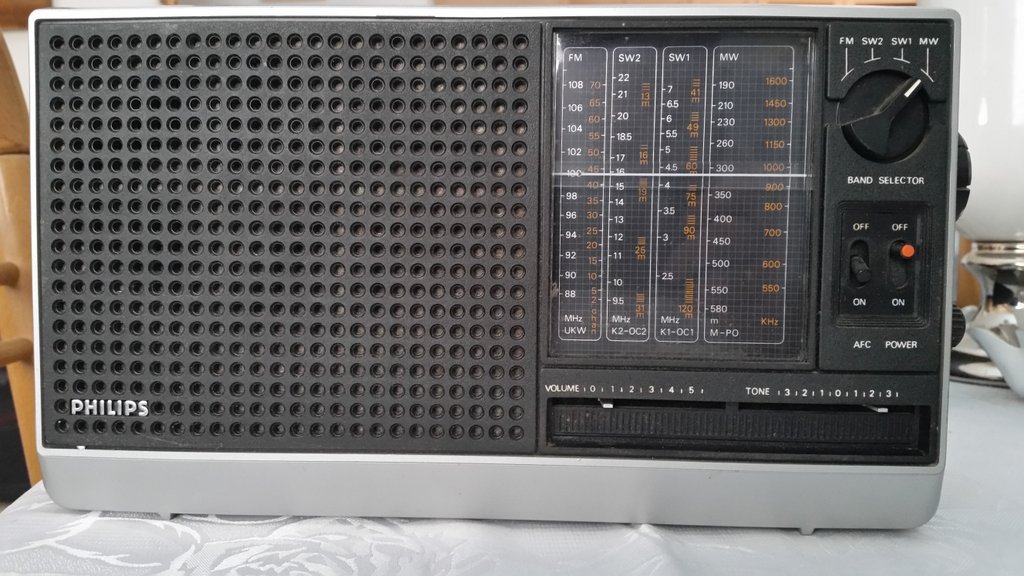
Moshe’s early birthday gift: a Philips 90AL765

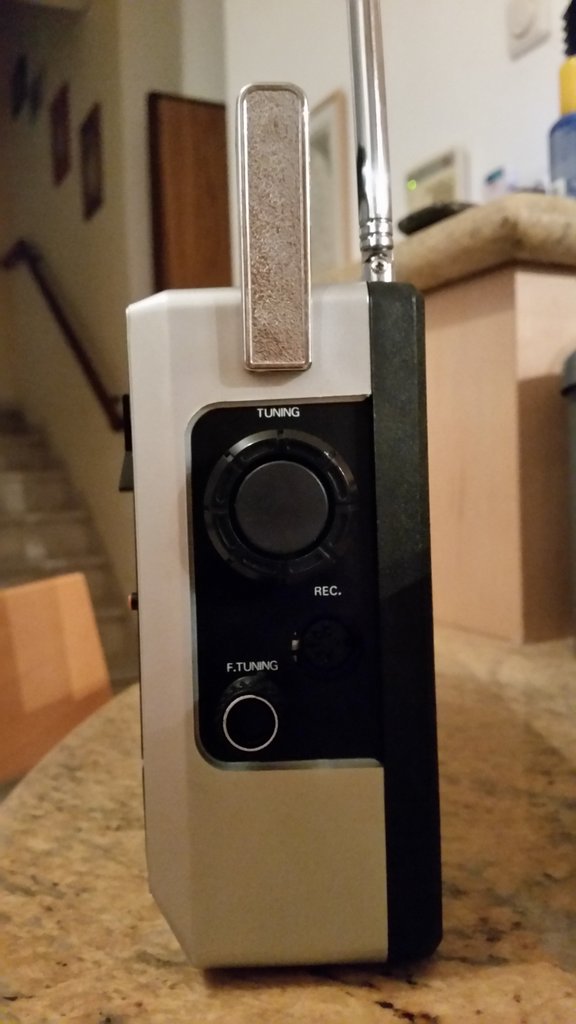
Philips-90AL765-FrontSWLing Post contributor, Moshe, writes:

After reading your post about your Panasonic RF2200 pre-birthday present, I decided I want to do the same. The radio I chose has a story behind it…

My Grandfather had the same exact radio. I used to play around with the radio as a child, (especially with the shortwave bands, looking for number stations…). When my Grandfather died, about 23 years ago, the radio disappeared.

I decided this is the radio I want for my birthday. I could not remember the maker of the radio, nor it’s model, but I remembered how it looked.

I spent many days looking for all variations like “portable transistor radio” and so on, until I found a photo on the Internet: I was looking for a Philips 90AL765 radio.

I found it on Ebay. A very kind seller from Australia had it.
I purchased and receive the radio on the 26th of June (my birthday was the 12th of July). As soon as I got the radio, I opened it up; it needed cleaning (the case itself and the contacts).

Philips 90AL765-Back

After cleaning the contacts and washing the case, the radio runs (and looks) like new. I thought I would have to recap the radio, but it sounded perfect and without even a hint of hum, so I left it as it is.

It has the volume and tone knobs missing, but it can be operated with no problem. Sound quality is amazing (I added a video of the radio playing All India Radio on 6155 kHz)–it works very well on all bands and is very sensitive. By ear, the bandwidth sounds like 8 kHz or more. Radio bands are: MW, SW (2 bands) And FM.

The shortwave band is divided in two: SW1: 2.3MHz- ~7.4MHz, SW2: ~9.4MHz- 22.5MHz. For fine tuning on shortwave, the radio has a “Fine Tuning” control, which is a potentiometer connected to a varicap.

If you place the control in the middle (It lacks a detent spot) and tune in a station, this control will put you spot-on (the receiver is very stable).

Some info about the radio: According to Radiomuseum.org, the radio is dated to 1977, and was made in Austria (mine and my Grandfather’s were made in Singapore).

It contains 13 transistors, 3 of them are can transistors (not plastic).

Tuning is slide ruler type, and the only connection is A DIN5 for recording (wired for mono).

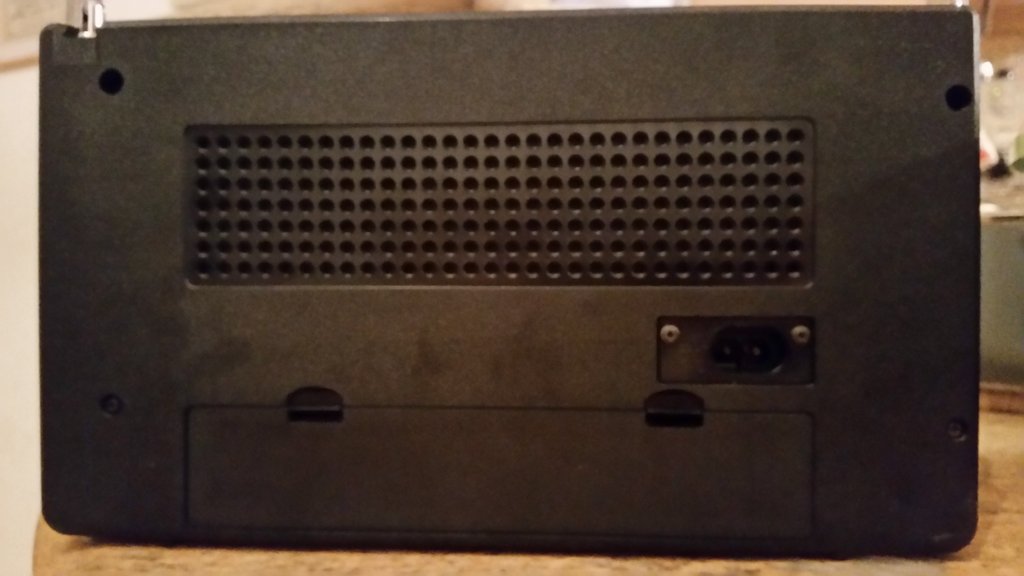
Philips 90AL765-Back2The radio can be operated from 4 D cells, or directly from AC (in the picture you can see the transformer). It can be operated from 230V or 120V. Note that if you move the plastic pin cover from the left pin to the right one, the center pin remains visible at all times. Also you will have to move the plastic cover piece on the back to the left.

The Ferrite is 14cm long, the telescopic antenna is 79cm fully extended, and it has an elbow joint that allows you to place the radio in your lap and still the antenna will point up with no problem. Only thing is that if the antenna is extended, the handle cannot change position since the antenna is in the way.

Philips 90AL765-Side

Width of the radio itself is 29cm (31cm with the handle and the knobs).
Depth is 7cm.
Height is 16.5cm (21cm with the handle).

All in all, it is a very fine radio and I love it!

Moshe, thanks so much for sharing your story!

Perhaps, one of the true virtues of sites like eBay is that they allow us to search the world for somewhat obscure devices that have such a strong family and nostalgic connections. Congratulations on your find!

CBK transmitter building to be demolished

cbk

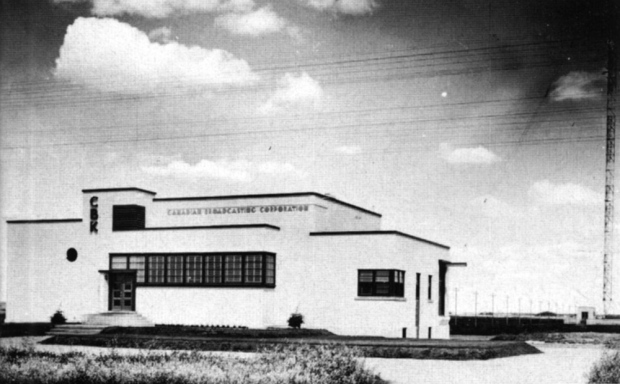
The CBK transmitter building in Watrous 1939 (Source: Dwight Kornelsen/ Watrousheritage.ca via CBC)

Many thanks to SWLing Post reader, Chris, who shares a link to this article from the CBC:

Historic CBK transmitter building in Watrous to be demolished

Most people who have grown up in the prairie provinces will have received their news via the CBC broadcast tower in Watrous.

The massive CBK building was established in 1939 as part of an overall CBC plan to bring programming to all parts of Canada. This was done with several well-placed 50,000 watt transmitters.

CBK was designed to serve all the prairie provinces, which is why Watrous was chosen as the site.

It is located in the centre of the populated portion of the prairies, and as a bonus it is located on a potash vein, making its ground conductivity one of the best on the continent.

In those days the technology for a single transmitter took up two floors of the building.

About 371 square metres was for the transmitter. That amount of equipment required a staff of six to maintain.

There was also a manager and living quarters for the staff.

During the Cold War, nuclear threat was a very real concern.

“The site was deemed important enough for communications that there was an armed guard protecting the transmitter,” said Stephen Tomchuk, transmitter supervisor for Saskatchewan.

“There was a fallout shelter built in the basement of the building that contained full facilities to be able to broadcast in the event of nuclear war,” added Tomchuk.[…]

Continue reading online…

The WSJ features Willis Conover

Willis Conover, The Voice of America (Source: Wikimedia Commons)(Source: Wall Street Journal via Any Sennitt)

The Radio Broadcaster Who Fought the Cold War Abroad but Remained Unheard at Home

By DOUG RAMSEY

During the Cold War, listeners in captive nations behind the Iron Curtain huddled around radios in basements and attics listening to the imposing bass-baritone voice of the man who sent them American music. His greeting—“Good evening, Willis Conover in Washington, D.C., with Music U.S.A.”—was familiar to millions around the world. At home, relatively few people knew him or his work. A proposal for a postage stamp honoring Conover may give hope to those who want the late Voice of America broadcaster to be awarded a larger mark of distinction.

For 40 years, until shortly before his death in 1996, Conover’s shortwave broadcasts on the Voice of America constituted one of his country’s most effective instruments of cultural diplomacy. Never a government employee, to maintain his independence he worked as a freelance contractor. With knowledge, taste, dignity and no tinge of politics, he introduced his listeners to jazz and American popular music. He interviewed virtually every prominent jazz figure of the second half of the 20th century. His use of the VOA’s “special English”—simple vocabulary and structures spoken at a slow tempo—made him, in effect, a teacher of the language to his listeners.

Countless musicians from former Iron Curtain countries have credited Conover with attracting them to jazz, among them the Czech bassists George Mraz and Miroslav Vitous, the Cuban saxophonist and clarinetist Paquito D’Rivera and the Russian trumpeter Valery Ponomarev. On the Conover Facebook page established in 2010, Ponomarev wrote that Conover had done as much for jazz “as Art Blakey, Duke Ellington, Horace Silver, Count Basie, Charlie Parker, Miles Davis and Dizzy Gillespie.” Conover’s New York Times obituary said, “In the long struggle between the forces of Communism and democracy, Mr. Conover, who went on the air in 1955 . . . proved more effective than a fleet of B-29’s.” In his publication Gene Lees Jazzletter, the influential critic wrote, “Willis Conover did more to crumble the Berlin Wall and bring about the collapse of the Soviet Empire than all the Cold War presidents put together.”[…]

Continue reading at the Wall Street Journal…

Regular SWLing Post readers know that I’m a huge fan of Willis Conover. Much like VOA’s Leo Sarkisian, Conover represented some of the best diplomacy this country has had to offer. [I’ve actually had the honor of meeting and interviewing Leo Sarkisian at his home in Maryland, a few years ago–one of the highlights of my career.]

Are there any SWLing Post readers out there who listened to Willis Conover from behind the “Iron Curtain?” Please comment!

Sony CRF-320 sighting on eBay


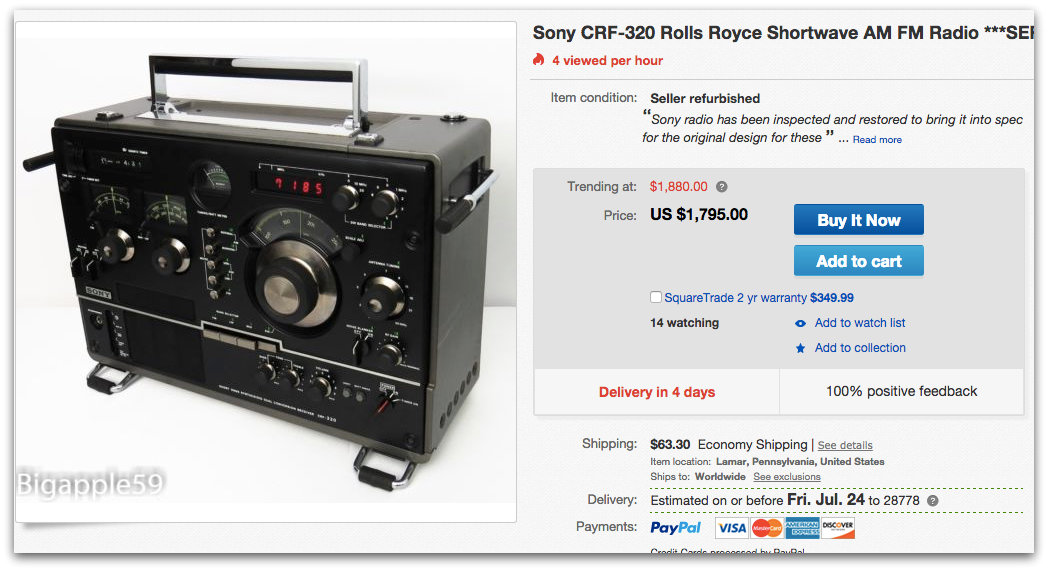
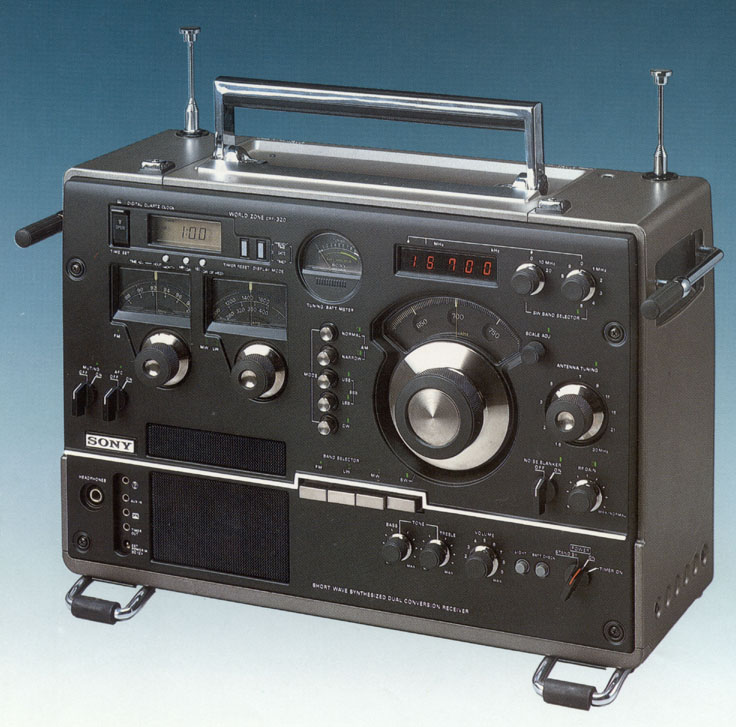
SonyThis morning, while scanning eBay, I ran across this serviced and restored Sony CRF-320. It’s listed with a BuyItNow price of $1,795.00 plus $63.30 shipping. Though that price seems steep to me, it appears these trend for $1,880 on eBay.

SonyCRF-320The CRF-320 is certainly a beautiful receiver and, aesthetically, everything I love about radios of the era. I’ve never had the pleasure of operating one, and–though I’m a bit of a radio collector–it’s simply out of my price range. If I ever manage to procure one, it’ll probably be a fixer-upper or a garage sale find. Well…one can dream…

I’ve heard the CRF-320 is a true performer. I’m very curious if any SWLing Post readers have one. If so, please comment with your thoughts or even a review!

Click here to search eBay for the Sony CRF-320.

Radio Cook Islands: Guy’s 1993 recordings

Many thanks to SWLing Post contributor, Guy Atkins, for the following guest post:


Radio Cook Islands

by Guy Atkins

(Photo: Guy Atkins)

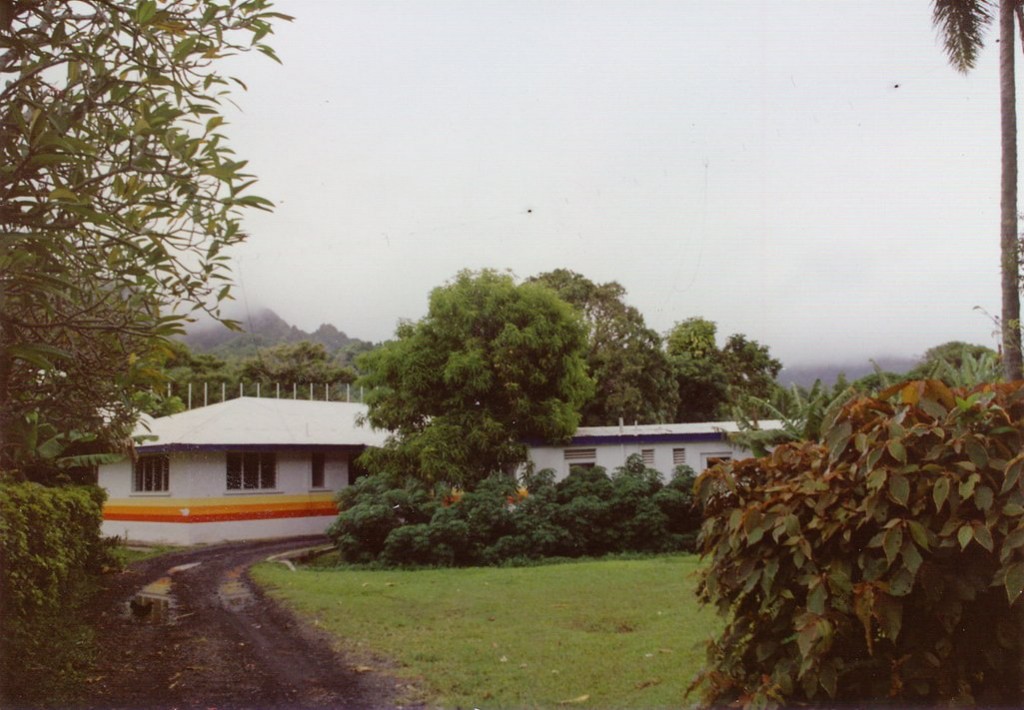
A view from the driveway entrance to the Radio Cook Islands studio in 1993. Insulators on an antenna (T2FD or multiband dipole) can be seen as dark spots against the cloudy sky. A feedline is also seen rising above the left side of the building. (Photo: Guy Atkins)

(Photo: Universal Radio)

(Photo: Universal Radio)

In 1993 I was fortunate to have the opportunity to visit Rarotonga with my wife, courtesy of a nice award through my company which afforded me an all-expenses-paid trip anywhere we’d like to go.

I chose the South Pacific island of Rarotonga, partly because I wanted to visit Radio Cook Islands after listening to their “island music” on 11760 and 15170 kHz through my teenage years.

During our visit to the island I recorded 90+ minutes of RCI on 630 kHz with a local quality signal using a Grundig Satellit 500 and a Marantz PMD-221 recorder.

Recordings

The programming of Radio Cook Islands is bilingual, and announcers are fluent in both English and Cook Islands Maori. Music selections on RCI encompass all styles, to appeal to many age groups. These recordings was scheduled to include as much local music as possible.

RCI programming includes all the hallmarks of a small, non-professional station: stuck records & tape carts, dead air, poor modulation, and other miscues.

However, that’s part of the flavor of local radio, and these errors are heard throughout this recording. Particularly noticeable is the bassy, over-modulation of the studio announcer during sign-on announcements.

Recording 1

Notes: National anthem & hymn; sign-on announcements & music.
Music; weather; sign-off announcements & national anthem.
Local & regional news; weather; ads; music.

Recording 2

Notes: “Party Time” music request show; weather; local ads; more music.

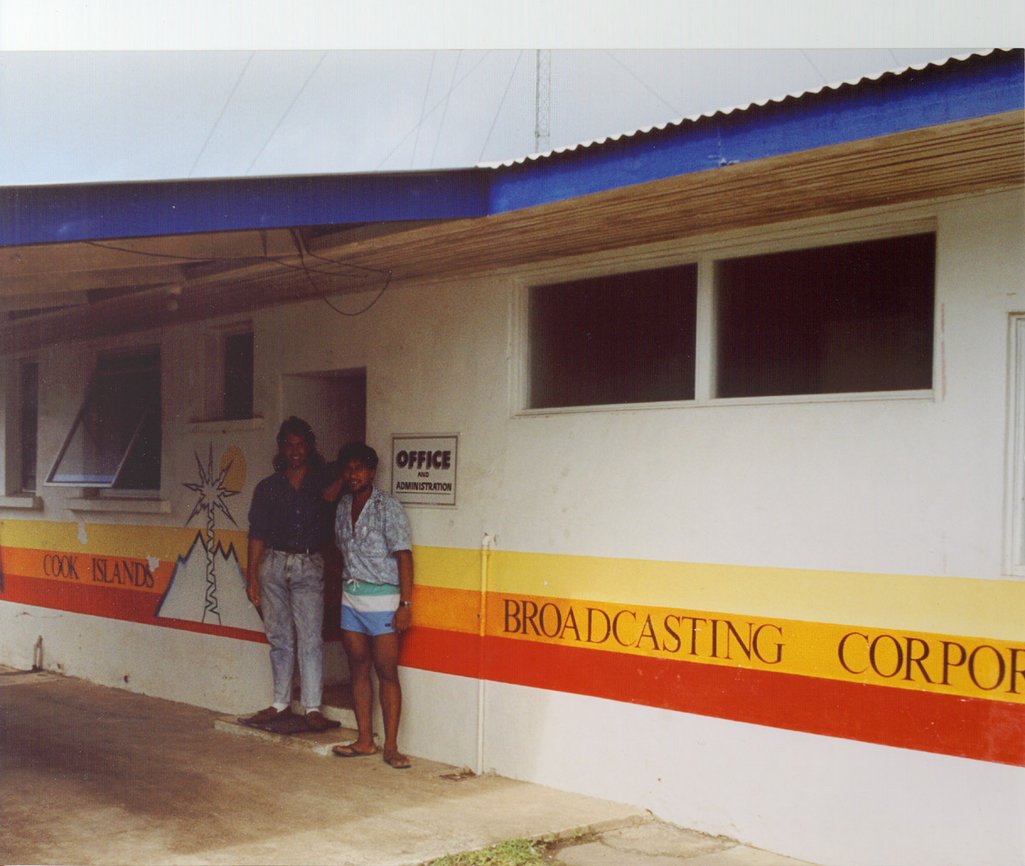
Two engineers from Radio Cook Islands, photographed during my visit in April, 1993. (Photo: Guy Atkins)

Two engineers from Radio Cook Islands, photographed during my visit in April, 1993. (Photo: Guy Atkins)

Sadly, RCI will likely never be on shortwave again; a fire in the local tele-comm building a few months before my 1993 visit destroyed RCI’s transmitter. I had an amusing exchange with the secretary when I visited; she insisted that their station was still on shortwave. Of COURSE we’re on the air she said, because “the frequencies are published right here in the newspaper!” The engineer and announcer confirmed, though, that the silence on their former frequencies was for real. They indicated they were covering the outer islands just fine with FM translators and had no intention of restarting shortwave.

Radio Cook Islands 630 kHz antenna on the school ground of Takitumu Primary School.

Radio Cook Islands 630 kHz antenna on the school ground of Takitumu Primary School.

RCI’s headquarters is in downtown Avarua, and their 5 kw transmitter (reported at half power, 2.5 kw in Dec. 2012) and modern quarter-wavelength vertical antenna is located in the town of Matavera (northeast side of Rarotonga).

Bing.com maps view of Radio Cook Islands antenna, 630 kHz at Takitumu Primary School, Matavera.

Bing.com maps view of Radio Cook Islands antenna, 630 kHz at Takitumu Primary School, Matavera.

The antenna is in the yard of Takitumu primary school; see photos from Bing Maps and Panaromio [above].

It sure brings back a flood of good memories when I listen to these MP3s! I’d love to visit the Cooks again sometime.


Many thanks for this wonderful stroll down memory lane, Guy–radio nostalgia at its best!

I, too, would love to visit the Cook Islands someday–it is on my bucket list. In the meantime, I’ll enjoy your recordings. Again, many thanks for your guest post!