Shortwave listening and everything radio including reviews, broadcasting, ham radio, field operation, DXing, maker kits, travel, emergency gear, events, and more
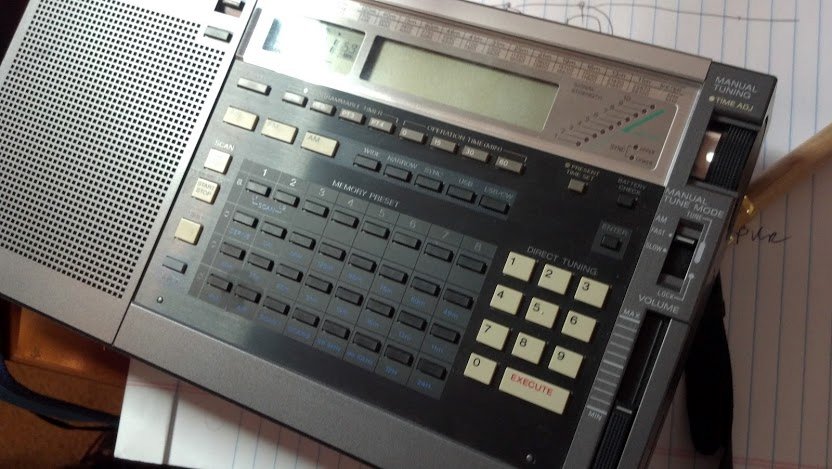
This morning, while scanning eBay, I ran across this serviced and restored Sony CRF-320. It’s listed with a BuyItNow price of $1,795.00 plus $63.30 shipping. Though that price seems steep to me, it appears these trend for $1,880 on eBay.
The CRF-320 is certainly a beautiful receiver and, aesthetically, everything I love about radios of the era. I’ve never had the pleasure of operating one, and–though I’m a bit of a radio collector–it’s simply out of my price range. If I ever manage to procure one, it’ll probably be a fixer-upper or a garage sale find. Well…one can dream…
I’ve heard the CRF-320 is a true performer. I’m very curious if any SWLing Post readers have one. If so, please comment with your thoughts or even a review!
Many thanks to SWLing Post contributor, Guy Atkins, for the following guest post:
Radio Cook Islands
by Guy Atkins
A view from the driveway entrance to the Radio Cook Islands studio in 1993. Insulators on an antenna (T2FD or multiband dipole) can be seen as dark spots against the cloudy sky. A feedline is also seen rising above the left side of the building. (Photo: Guy Atkins)
(Photo: Universal Radio)
In 1993 I was fortunate to have the opportunity to visit Rarotonga with my wife, courtesy of a nice award through my company which afforded me an all-expenses-paid trip anywhere we’d like to go.
I chose the South Pacific island of Rarotonga, partly because I wanted to visit Radio Cook Islands after listening to their “island music” on 11760 and 15170 kHz through my teenage years.
During our visit to the island I recorded 90+ minutes of RCI on 630 kHz with a local quality signal using a Grundig Satellit 500 and a Marantz PMD-221 recorder.
Recordings
The programming of Radio Cook Islands is bilingual, and announcers are fluent in both English and Cook Islands Maori. Music selections on RCI encompass all styles, to appeal to many age groups. These recordings was scheduled to include as much local music as possible.
RCI programming includes all the hallmarks of a small, non-professional station: stuck records & tape carts, dead air, poor modulation, and other miscues.
However, that’s part of the flavor of local radio, and these errors are heard throughout this recording. Particularly noticeable is the bassy, over-modulation of the studio announcer during sign-on announcements.
Notes: “Party Time” music request show; weather; local ads; more music.
Two engineers from Radio Cook Islands, photographed during my visit in April, 1993. (Photo: Guy Atkins)
Sadly, RCI will likely never be on shortwave again; a fire in the local tele-comm building a few months before my 1993 visit destroyed RCI’s transmitter. I had an amusing exchange with the secretary when I visited; she insisted that their station was still on shortwave. Of COURSE we’re on the air she said, because “the frequencies are published right here in the newspaper!” The engineer and announcer confirmed, though, that the silence on their former frequencies was for real. They indicated they were covering the outer islands just fine with FM translators and had no intention of restarting shortwave.
Radio Cook Islands 630 kHz antenna on the school ground of Takitumu Primary School.
RCI’s headquarters is in downtown Avarua, and their 5 kw transmitter (reported at half power, 2.5 kw in Dec. 2012) and modern quarter-wavelength vertical antenna is located in the town of Matavera (northeast side of Rarotonga).
Bing.com maps view of Radio Cook Islands antenna, 630 kHz at Takitumu Primary School, Matavera.
The antenna is in the yard of Takitumu primary school; see photos from Bing Maps and Panaromio [above].
It sure brings back a flood of good memories when I listen to these MP3s! I’d love to visit the Cooks again sometime.
Many thanks for this wonderful stroll down memory lane, Guy–radio nostalgia at its best!
I, too, would love to visit the Cook Islands someday–it is on my bucket list. In the meantime, I’ll enjoy your recordings. Again, many thanks for your guest post!
“Thought I’d forward you this information on the annual “Night of Nights” event on July 12 (U.S. local time)/July 13 UTC, which provides an opportunity for shortwave QSLs – assuming the listener understands Morse code!
I’m sure you’re familiar with this one-night-a-year happening, in which maritime radio stations rise from the dead and transmit Morse code messages again for a few hours.
As a guy who honed his CW sending skills by listening to these stations’ constantly repeating messages, I have a sense of nostalgia and gratitude toward these stations, which helped me obtain my first Novice license, WN9ICB, at the age of 15 … less than 2 months after I taped the WWV recording that I submitted.”
It’s that time of year again. Time to honor all those ops who came before us by preserving their skills, traditions and culture through on the air operations.
Why 12 July? Long time True Believers know the story. But it may be worth repeating for new arrivals and to remind everyone of the traditions we hope to keep alive.
On 12 July 1999 some very tough looking grizzled old radio pioneers had tears in their eyes as the last commercial Morse code radiogram was sent. It was the end of an era. And as the last beeps faded away into the static they witnessed the end of the career to which they had devoted their lives.
These men – and some women – had stood watch over the airwaves on shore and at sea. Theirs was mostly the business of maritime commerce. But when their ship was in peril they were called upon to send the most electrifying three letters in radio, S O S, knowing that all their fellow radio operators would press their earphones close to get every scrap of information and bring aid to their stricken ship.
Once, our coasts were dotted with great Morse code radio stations, all communicating with ships at sea. They’re all gone now… all except one, the one they called the Wireless Giant of the Pacific, located at Point Reyes.
On that sad day in 1999 another event took place. The Maritime Radio Historical Society (MRHS) was formed. We made it our life’s work to honor the men and women of wireless by restoring that wireless giant. One year and one minute later the giant’s voice once again spanned the oceas as we picked up the thread and kept the faith with our colleagues of the air.
Every year since, in an event that became known as the Night of Nights, Morse code station KPH has returned to the air, joined by KFS and the station of the MRHS, KSM.
This year our friends and colleagues at USCG station NMC have labored mightily to bring that storied call sign back to life on Morse code for the evening along with NMQ in Cambria, CA..
And station NMW in Astoria, OR will be on the air as well.
Stations WLO and KLB will join us again as hey have in years past.
This is a global and local event. Hundreds of listeners around the world will be waiting with their earphones on, waiting for the signals of the great station to once again arc over the dome of the Earth to their receivers.
You can be with us in person!
My buddy, Mike (K8RAT) also notes that this “Night of Nights” event may witness the last ever Morse communications from the US Coast Guard stations. Indeed, this is mentioned in the MHRS newsletter:
This may very well be the last time ever that USCG stations can be heard on the air using A1A (Morse) emission. As new equipment is installed the hardware and wiring for Morse has been progressively removed. And the personnel who knowledgeable in the art retire or are reassigned. So be sure to listen for these stations.
I’ll not only listen to this Night of Nights, but hope to record some of the stations as well.
The frequencies for this event are numerous! I have listed the USCG (NMC) frequencies below, but please check the MHRS newsletter for MRHS and other maritime station frequencies.
Many thanks to my buddy, Skip Arey (N2EI), who informed me that the American Radio History website has added 18 issues of the late Passport To World Band Radio to their free downloads archive. These issues span 1986-2009 and are free to download. What a treasure trove!
I’m writing to let you know of a “nostalgia radio” Windows wallpaper graphic I’ve made available to radio hobbyists. This design is called Hertzian Vision, and I created it three years ago for a few SDR enthusiasts/software authors in Finland. I’d like to offer it to your readers too.
My design was inspired by the SPARK Museum of Electrical Invention in Bellingham, Washington, which opened initially as a showcase for antique radios.
Here is a link to a folder with two sizes of the wallpaper:
[Update: if you have difficulty downloading the wallpaper via the link above, you can download them directly from the SWLing Post server by clicking here and here.]
Many of you know that I’m a huge fan of 99% Invisible–a podcast and radio show about “design, architecture & the 99% invisible activity that shapes our world.”
This past week, 99% Invisible’s episode, Voices on the Wire, featured Tony Schwartz, a recording pioneer, and Frank Conrad, a broadcasting pioneer. While not specifically about shortwave radio, you’ll hear how the ether weaved its way through both of their histories.
And, hey…if you happen to be chatting with Roman Mars anytime soon, ask him to do more shows on shortwave radio: a technology I consider to be the ultimate invisible medium!