Category Archives: Nostalgia

Victor Goonetilleke: The joy of DXing

SX-99-DialVictor Goonetilleke has kindly shared a passage he recently posted to Facebook. Victor pretty much sums up why I still listen to the shortwaves:

“For almost four score and 5 I enjoyed shortwave radio. Yes I was a DXer, and a dedicated listener. The thousands of hours of broadcasts I listened from the BBC, VOA, RNW, DW, RFI, Swiss Radio, NHK and many more of the international broadcasters influenced me over the years. The knowledge I gathered was transferred to hundreds of homes as I taught my students in class rooms and as a lecturer too in higher Colleges, in many social gatherings, day to day conversations with important people and everyday folks, what I gathered from my radio made them realize that there was a story out there.

And as the years went by one by one those stations started to go away and I became more and more a DXer and finally I have only those signals to bring me joy.

Tonight would you blame me for being a DXer, abandoned by the international broadcasters, if I sit back and enjoy this music through the crackle of shortwave and happy that I have a radio which few seems to understand these days.”

You can listen to the recording Victor made by clicking here: https://app.box.com/s/tcryw2ymt38gz8y6zaw4

I would also encourage you to read Victor’s guest commentary on BBG Watch which was prompted by the BBG pulling the (shortwave) plug on much of Asia.

Finally, in 2003, Jonathan Marks interviewed Victor Goonetilleke; you can watch the full interview below:

Visit with Victor Goonetilleke 2003 from Jonathan Marks on Vimeo.

A chat with Peter Homfray

Peter-HomfrayOn the topic of Radio Australia, Jonathan Marks writes:

“It doesn’t seem like 10 years ago that I sat down with Peter Homfray to discuss the early days of Radio Australia. What a truly fascinating person.”

A Chat with Peter Homfray from Jonathan Marks on Vimeo.

BBC World Service Documentary: “Hang On, I’ll Just Speak to the World”

BBC-WorldServiceMany thanks to Mike Barraclough who shares this documentary about the BBC World Service from 1982: “Hang On, I’ll Just Speak to the World.”

I’ve embedded video players and linked to each of the four parts on YouTube:

Part 1

Part 2

Part 3

Part 4

Listener Post: Tim Rahto

SP600Dial3Tim Rahto’s radio story is the latest in our series called Listener Posts, where I place all of your personal radio histories. If you would like to add your story to the mix, simply send your story by email!

In the meantime, many thanks to Tim for sharing his personal radio history:


Tim Rahto

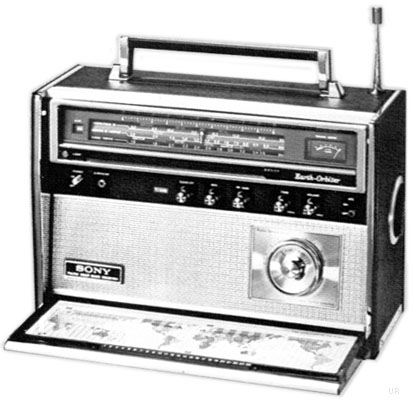
The Sony Earth Orbiter CRF-5100 (Source: Universal Radio)

The Sony Earth Orbiter CRF-5100 (Source: Universal Radio)

One night, when I was about six or seven, my brother put me in front of his Sony Earth Orbiter and changed my life forever. He handed me the earplug and told me that, if I was really quiet and didn’t bother him, I could hear stations from all over the world. His ploy to keep me occupied and out of his hair worked like a charm, as I was completely fascinated by what I heard.

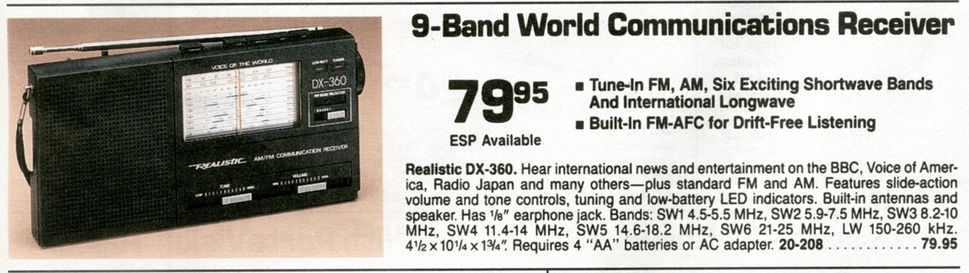
Fast forward about ten years later to 1987, when I received the best Christmas present ever: a Realistic DX-360. I remember staying up until the wee hours of the morning listening to the BBC, Radio Havana, and many other stations. Imagine my surprise when I found Radio Australia the next morning. Radio from Australia? How was that even possible!? For the next few years, that radio went with me just about everywhere, and serenaded me to sleep just about every night for years. Back then, my favorite stations included not only the BBC and Radio Australia, but also Monitor Radio and Super Power KUSW, the station that sent my my first ever QSL card. I still have it too.

RadioShack-DX360

One afternoon while I was in college, my roommate and I decided to stop into a local liquor store and do some comparative shopping. We were just about to leave when I turned around and found myself eye to eye with this beautiful old European style shortwave radio. It turned out that one of the proprietors, a guy by the name of Howard, was a ham, and sold old used radios out of the back of the store. I got to know Howard a little, and bought several radios from him. One day while visiting his store, he shows me the most beautiful thing made of metal I’d ever seen: a Hallicrafters SX-73. Believe it or not, he sold it to me for $75! I think Howard new it was worth ten times that, but he also knew I was a young radio nerd that would give it a good home. That radio was my main receiver for many years after that, and I still have it today. My estate executors can sell it when I’m gone. Until then, it’s a keeper.

Hallicrafters SX-73 (Source: radioreprints.com)

Hallicrafters SX-73 (Source: radioreprints.com)

These days, my shack is an odd mix of both the old and new. I have an old r390a that was recently overhauled by Rick Mish, and a Watkins Johnson WJ-8718a that was brought back up to spec by PCS associates. If I do my part, both of these cold war relics should give me decades of service. My latest addition to the shack is an Elad FDM-S2, which is an amazing receiver! I’ve never been much of an SDR guy, but this radio might change all of that. Stay tuned!

Anyways, thanks for letting me go down memory lane.


Many thanks, Tim, for sharing your memories with us! Snagging a Hallicrafters SX-73 for $75 was, indeed, an excellent deal. Sounds to me like Howard enjoyed feeding your interest in radio. Keep that old girl in good nick and you’ll have a radio that will outlast us all. Tell your executors to put it in the casket!

Click here to read our growing collection of Listener Posts, and consider submitting your own!

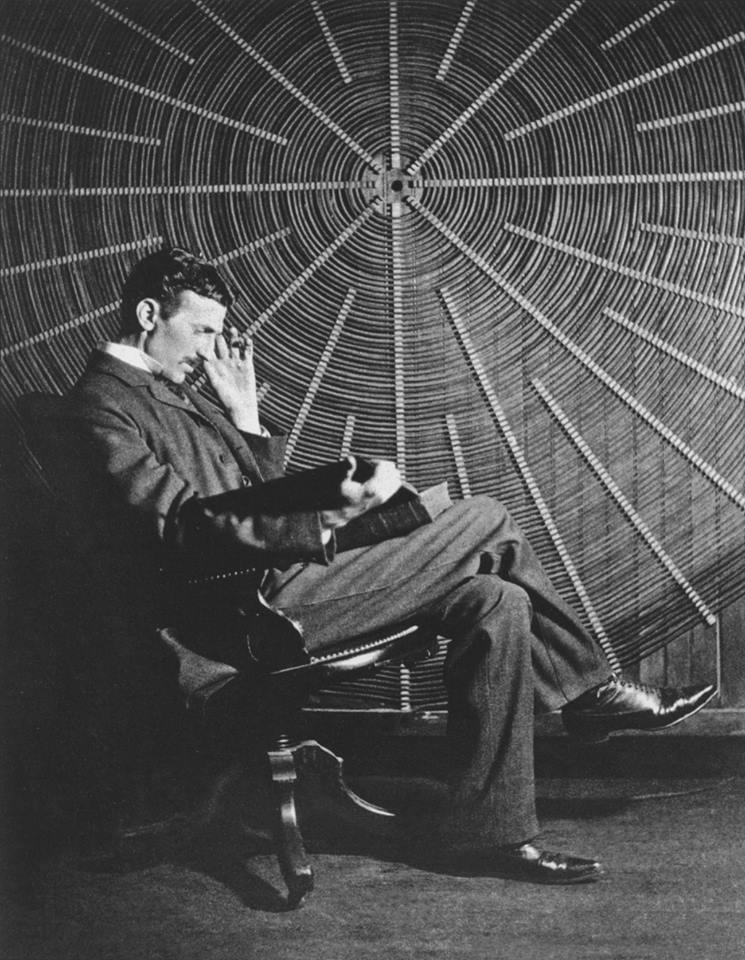
Remembering Nikola Tesla on his birthday

Mikola-Tesla
Today is Nikola Tesla’s birthday (lived July 10, 1856 – January 7, 1943) and I, for one, will be remembering him for his enormous contributions to our hobby.

If you’re not familiar with Tesla,  I highly recommend Margaret Cheney’s book, Tesla: Man Out of Time. In the meantime, I would at least encourage you to read his page on Wikipedia.

And if you’re in the mood for a mixture of fact and funny, check out The Oatmeal’s comic, “Why Nikola Tesla was the greatest geek who ever lived.” (Profanity warning!) In fact, Matthew Inman, the comic artist behind The Oatmeal has raised over $2 million dollars to create a Nikola Tesla museum in New York. Amazing…Looking forward to visiting that.

My thoughts? We need more Nikola Teslas on this planet–clearly, a man ahead of his time.

Hat tip to my buddy, Skip Arey, for sharing this dynamic photo of Tesla.

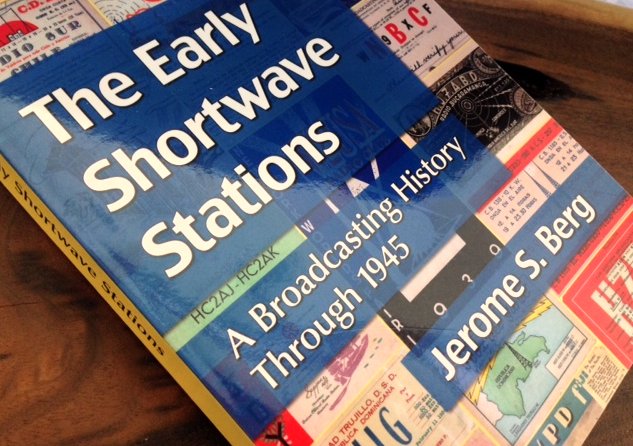
Book Review: “The Early Shortwave Stations: A Broadcasting History Through 1945”

The-Early-Shortwave-StationsAs a life-long student of the history of technology–radio or otherwise–I appreciate well-written, authoritative works of history on the subject. That is exactly what you’ll find in Jerome S. Berg’s The Early Shortwave Stations: A Broadcasting History Through 1945.  In these days during which shortwave is often viewed only as a legacy technology, it’s particularly fascinating to read about the days during which shortwave was new on the scene, exerting a disruptive influence, and threatening the established technology.

If you’re a shortwave radio enthusiast, you may already know of Jerome (Jerry) Berg; he is, without a doubt, one of the foremost historians of shortwave radio broadcasting and listening. His knowledge, moreover, grew out of his passion for the radio medium, and it shows in his writing. Berg has authored a series of history books on the subject on the subject of shortwave broadcast and listening, which this latest work joins:

I’m not sure how Berg manages to convey his vast store of knowledge in such a readable form, but he does so, and very successfully. As with the other works in this series, The Early Shortwave Stations is chock full of details all entirely relevant, and Berg manages to weave this complex and multifaceted history into a very comprehensive, comprehensible, and rich story that the reader will enjoy.

Moreover, I like the manner in which Berg presents the chapters in The Early Shortwave Stations: the first chapter sets the stage, covering radio broadcasting up to the point of the invention of shortwave; the chapters then coincide with a decade-by-decade account of shortwave broadcasting, e.g., chapter 2 covers the 1920s, chapter 3 the 1930s, and chapter 4 covers 1940-1945 (where Berg’s Broadcasting on the Short Waves, 1945 to Today picks up). Furthermore, each decade and chapter is covered year by year. This obviously makes for easy future reference: should you like to know was happening in shortwave broadcasting in 1931, simply turn to chapter 3 (page 82) to find out.

Berg also draws insightful conclusions in his summary and in chapter 5, which only made me want to buy his next volume, Broadcasting on the Short Waves, 1945 to Today.

I can say that I learned an extraordinary amount of radio history from The Early Shortwave Stations, and have enjoyed every minute of it. I’ve had this book for a little while now, and it soon became my bedside reading.  Indeed, it’s been wonderful capping off each day (or even starting it) with early shortwave history. I find that it puts many of the changes that are happening in the industry currently into perspective.

And I would be negligent if I didn’t mention the numerous illustrations and stunning images in The Early Shortwave Stations: there are enough QSL cards, radio ads, and other print nostalgia within its pages to make for good coffee table reading, too. Although its pages are printed in black and white, the photos and illustrations are sharp and of high quality.

The publisher of Berg’s books, McFarland–a leader in publishing academic and non-fiction works–prints in relatively small quantities, hence the price tag per volume is about $45.00. But I assure you that it’s a bargain for a book which so completely encapsulates early shortwave broadcasting history.  It’s a book that you will likely want to reference, and (if you’re like me) not only read, but read again and again.

The real test? I’ve placed The Early Shortwave Stations on the same shelf with my WRTH.

The Early Shortwave Stations: A Broadcasting History Through 1945 can be purchased directly from the publisher, McFarland, by clicking here or by calling their order line (800-253-2187).  I’m pleased to say that The Early Shortwave Stations is also available via the Amazon Kindle format at $16.12 US, possibly the best purchasing option for those living outside North America.  Enjoy!

Jerry Berg also maintains the excellent website, On The Shortwaves.  This one’s been in our list of links for many years, do check it out if you haven’t already.

Listener Post: Jeff Zang

SP600Dial3Jeff Zang’s radio story is the latest in our series called Listener Posts, where I place all of your personal radio histories. If you would like to add your story to the mix, simply send your story by email!

In the meantime, many thanks to Jeff for sharing his personal radio history:


 Jeff Zang

I have enjoyed your blog…indeed it has been a major factor in my getting the bug again after being away from shortwave for about 20 years.

wlsI had played around with DXing AM stations at night when I was around 10 or 11; I lived just outside of Washington DC and remember hearing WLS and WCFL at nighttime once WLMD went off the air (a daytime station only). Also WBZ in Boston and WBT in Charlotte were pretty easy to hear, as well as KMOX in St Louis.

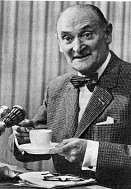
The original Happy Station Show host, Edward "Eddie" Startz. Photo courtesy of RNW.

The original Happy Station Show host, Edward “Eddie” Startz. Photo courtesy of RNW.

I first remember hearing shortwave on a trip to see my uncle circa 1973. He had a shortwave radio. I clicked it on and was fascinated to hear all the different languages and odd music coming from Middle Eastern stations. I also quite clearly remember stumbling on some bagpipe music; I first thought this must be from Scotland but it turned out to be the “Happy Station” show on Radio Netherlands. Straight away I was hooked.

My parents got me a cheap shortwave radio (can’t remember the make, it wasn’t very good). It did however pull in the BBC and Radio Australia well enough and I became a devoted fan of both stations. I quickly moved up to the Realistic DX 160 once I’d saved a bit of money. This was a great radio to do serious Dxing with; especially later in the ’70’s when the sunspot numbers really went through the roof during the solar max at that time. I remember hearing Uganda, All India Radio, Radio Cairo came in fairly well at the time…Plus I was able to hear some Pirates on the weekends and since it had a BFO I could listen to Hams for the first time.

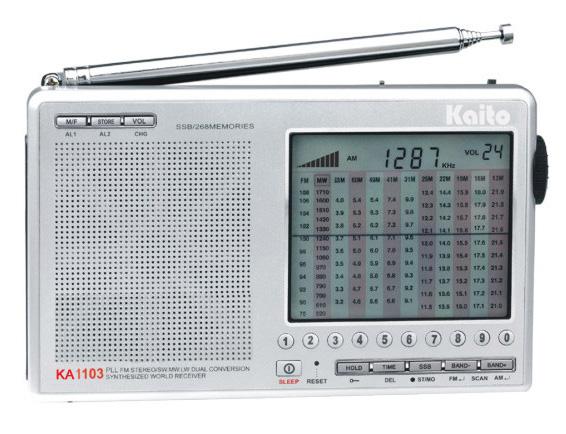
KA1103Somewhere around the early 1990’s I fell out of the hobby; had to concentrate on other things for a while. About 3 or 4 months ago I came across your blog and found myself getting the itch again. I now have a Kaito KA1103; amazing such a little radio can pull so much in. I’ve been reading your tips on what to listen to, have managed to catch some pirates and have enjoyed hearing Radio New Zealand in the mornings along with Radio Australia. I am sorry that so many of the stations I heard when I was a kid are now gone, SRI, Radio Netherlands, Radio Sweden, Radio Finland (I used to be a big fan of the latter two). But I have made up for this by doing some more ham DXing and also checking the Utility stations more often than I did years ago.

I just wanted to say Thanks for getting me into SWLing again.


Many thanks, Jeff, for sharing your story! I’m honored the SWLing Post had a part in your re-discovery of shortwave radio.

Click here to read our growing collection of Listener Posts, and consider submitting your own!