Category Archives: Nostalgia

Shortwave Radio Recordings: Marion’s Attic

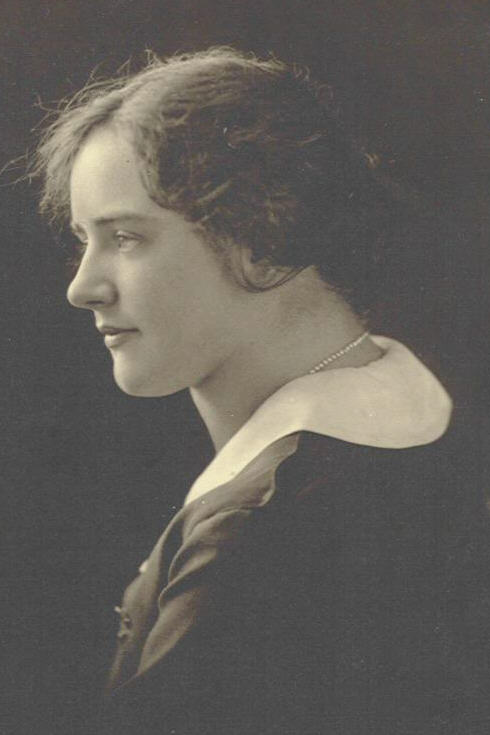
Marion Webster (Source: Marion's Attic)

Marion Webster (Source: Marion’s Attic)

If you’ve never heard Marion’s Attic on WBCQ, you don’t know what you’ve been missing–especially if you love early music recordings. Marion’s Attic describes the show as:

“[A] unique radio program, broadcasted on WBCQ, The Planet, [7.49] MHz (Shortwave Radio) every Sunday at 5 PM Eastern time. Hosted by Marion Webster & Kristina, and with occasional special guests.”

“Marion’s Attic is an eclectic radio program which plays original cylinder and disc records from the late 1890’s to the mid 1930’s. Having a library containing thousands of standard size cylinder records, dozens of 5 inch Concert Cylinders and an unknown amount of 78’s allows us to share unusual and forgotten music that you cannot hear anywhere else. What makes this special radio program unique is I play original records on the original phonographs when possible; many of which are over 100 years old. The theme varies from week to week; a show may feature popular songs from the early 1900’s one week, wild dance music from the roaring 20’s the next week.”

Marion’s Attic has been on WBCQ since September 21st, 1999 and is certainly one of their most popular shows. It’s quirky and authentic. I love it.

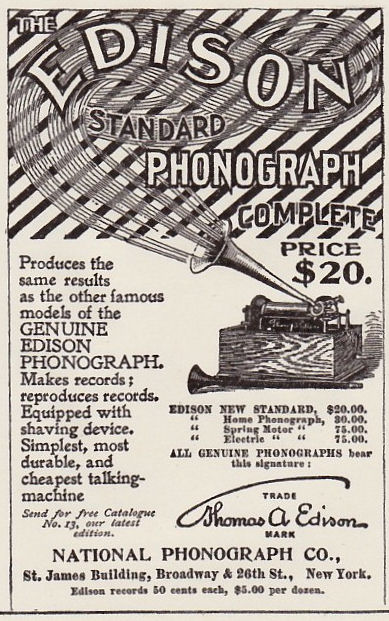
(Source: edisonphonology.com)

(Source: edisonphonology.com)

Mary tells us that each episode is recorded in her attic using simple recording equipment and original phonographs including:

  • 1898 Edison Home phonograph for brown wax cylinders
  • 1900 Columbia Graphophone AG for Concert Cylinders
  • 1908 Edison Standard Model D phonograph for 2 & 4 minute wax cylinders
  • 1913 Edison Amberola V phonograph for Blue Amberol cylinders
  • 1923 Edison London Upright phonograph for Diamond Discs
  • 1965 Gerrard electronic turntable for 78 rpm records

Yesterday afternoon, at 16:59 EST (21:59 UTC), I tuned to Marion’s Attic on 7,490 kHz and started recording. You’ll hear about one minute of WBCQ’s interval signal and station ID, then straight into Marion’s Attic. Click here to download the show as an MP3 or simply listen via the embedded player below:

If you missed Marion’s Attic yesterday, you can catch it again tonight on WBCQ–check out the full broadcast schedule below:

  • Sundays:  7,490 kHz, 05:00PM – 06:00PM ET (22:00 – 23:00 UTC)
  • Mondays: 5,110 kHz, 09:00PM – 10:00PM ET (02:00 – 03:00 UTC)

WBCQ is easily heard in North, Central and South America–also in Europe.

Marion and Kristina often give shout outs to their listeners. You can contact them at [email protected] or:

Marion’s Attic
P.O. Box 583
Coventry, CT 06238

Many thanks to Marion and Kristina for sharing your wonderful collection of early music recordings!  I’d also like to thank SWLing Post reader, Mike, who is a big fan of Marion’s Attic and unknowingly gave me a nudge to mention their show here.

Listener Post: John Mosman

Analog Radio DialJohn Mosman’s radio story is the latest in a new series called Listener Posts, where I will place all of your personal radio histories. If you would like to add your story to the mix, simply send your story by email!

In the meantime, many thanks to John for sharing his personal radio history:


John Mosman

My first QSL was from Radio Havana Cuba in 1962. I never was and not now a technical person around radios. The mysterious signals that came from all over the world just drew me in, all the different languages, music and the cold war rhetoric was simply fascinating.

National NC-60 (Source: DXing.com)

National NC-60 (Source: DXing.com)

My first receiver was a National NC-60 which with a simple wire antenna out to a tree worked very well. In those days the international broadcast bands were crowded and full of exotic stations.

Popular Electronics gave me a SWL call signs and mine is WPE9GIZ. I do not have the certificate anymore but the call sign is burnt into my memory.

As the years went on I upgraded receivers, first a Drake SW-4A then a Yaesu FRG-7 (Frog 7). To the Frog was added a digital frequency readout. I remember the controversy over Radio America and if the transmitter was actually located on Swan Island. The QSL card sure indicates it was.

The Yaesu FRG-7 "Frog 7"

The Yaesu FRG-7 “Frog 7”

Over the years I owned a Kenwood R-2000 and an ICOM 71A. For several years now I have a ICOM R75 which does not get much use. As is the case for many, the house is full electronic noise from computers and cable boxes. Not being technical enough I am not sure how to stop it or erect an antenna in our small yard that would reduce the interference.

I wince each time I learn of another SW broadcaster leaving the air and many third world country stations going to FM. However I still have all the QSL cards, all the great memories and you know, the National NC-60, now refurbished, is still in the “shack”.


Many thanks, John, for sharing your story! It makes me happy to know your National NC-60 has been refurbished.  We need to keep our antique radios in good working order. Those vacuum tubes will keep your radio room warm on cold nights!

Regarding the electronic noise your R75 hears in the house, you might consider investing in a mag loop antenna like those in the Wellbrook product line. It’s pricey, but certainly works to eliminate QRM.

Click here to read our growing collection of Listener Posts.

BBC Radio 4 Documentary: The World’s First Radio Station

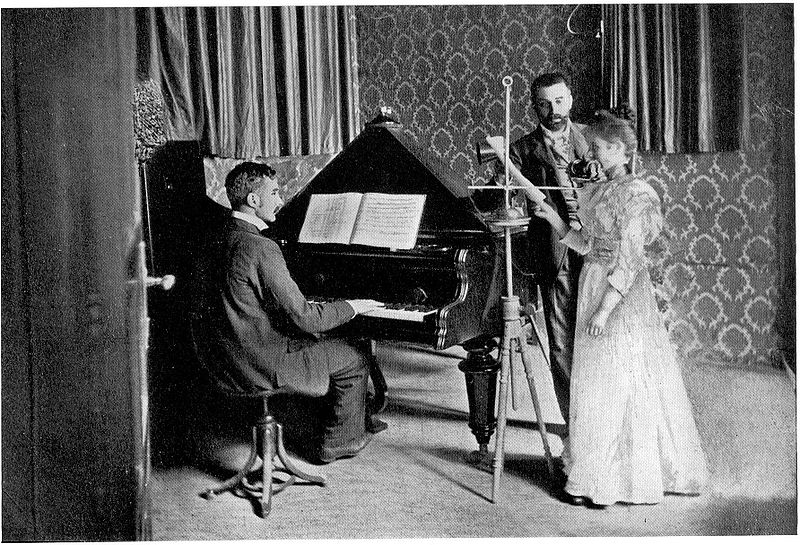
The concert room of Telefon Hírmondó (1901) Source: Wikimedia Commons

The concert room of Telefon Hírmondó (1901) Source: Wikimedia Commons

We’ve mentioned this 19th century broadcasting technology before; the “telephone newspaper.” If, like me, you found the technology fascinating, you’ll certainly love this BBC Radio 4 documentary The World’s First Radio Station.

Here is the description from BBC Radio 4:

We often think of the scheduled broadcasting of news, information and entertainment as having begun in the 1920s. But we’re wrong. It was in 1893 in Budapest that Theodore Puskas opened his Telefon Hirmondo or ‘Telephone Newspaper’.

Subscribers to this telephone service could enjoy a daily timetable of foreign, national and local news, sport, weather, fashion, stock market reports, language lessons, music, theatre and much more. It was delivered by a team of journalists, copy-writers, editors, announcers and engineers which would be familiar to any radio station today. To our ears, Telefon Hirmondo would have sounded uncannily modern. For example, there would be live relays of church services, theatre productions, concerts and opera performances and reports direct from parliament and sports events.

Laurie Taylor travels to Budapest to uncover this extraordinary story of ‘radio before radio’. He visits a special exhibition at the city’s postal museum and takes a look inside Hungarian State Opera, whose performances were broadcast live via Telefon Hirmondo from the 1890s.

Laurie explores the lengths to which Telefon Hirmondo went to market its product, hooking in not just domestic subscribers but hotels, restaurants, clubs, dental surgeries and barber shops. He also delves into the telephone’s early history to explain the confusion on both sides of the Atlantic over what the device was best used for.

How did Hungary come to lead the world in broadcasting, rather than the USA, Britain or France? The genius of Theodore Puskas is a large part of the explanation. Among the contributors, we hear from his descendant, Barbara Fally-Puskas.

Producer: Andrew Green
An Andrew Green production for BBC Radio 4.

Note that the documentary, produced by Andrew Green, will only be available online until Friday November 15, 2013. Click here to listen on the Radio 4 website.

Listener Post: Eric Weatherall

Eric Weatherall’s radio story is the latest in a new series called Listener Posts, where I will place all of your personal radio histories. If you would like to add your story to the mix, simply send your story by email!

In the meantime, many thanks to Eric for sharing his personal radio history:


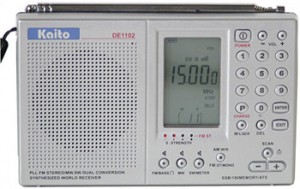
KA1102-300x189

In the summer of 2005, after a couple years of curiosity, I bought my first shortwave radio. Three popular portables at the time were the Sony ICF SW7600GR, Grundig YB400PE, and Sangean ATS-909. But after a bit of review browsing on Amazon, I learned about Kaito and chose the KA1102. The 1102 cost quite a bit less than the other three, but was reportedly very capable.

I remember the first night I turned it on. I was in my bedroom, staring at the blue-backlit screen, manually stepping through discouraging static. I’m not sure how I chose the frequencies; perhaps I already had an awareness of the broadcast bands. First I heard what sounded like an Asian language. Then I found an English broadcast, and I heard “coming to you from downtown Havana, Cuba.” To me, this was absolutely fascinating! My first id’ed station was from a foreign country. And maybe I could learn something about Cuba.

radio-havana-logoA few weeks later, I took my radio outside, where reception was much stronger and clearer. I tuned in to Radio Havana Cuba at 0500 UTC when they were scheduled to broadcast a strong signal in my direction. The mailbag show came on, and one of the letters included a request for a mojito recipe. So the hosts (Ed Newman and a female whose name I don’t recall) provided the drink recipe. I thought it was so cool to hear a mix of serious news, fun cultural info, and Cuban jazz. I wrote to the station via email, and they read my letter a few weeks later during another mailbag show.

Eric Weatherall


Many thanks, Eric, for sharing your story!

Readers, be sure to check out Eric’s blog: http://cobaltpet.blogspot.com/

Click here to read our growing collection of Listener Posts.

Whether fearsome or forgettable, The War of the Worlds left us with a gift

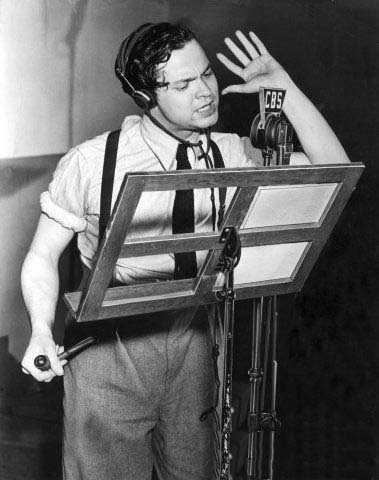
orson_wellesWithout a doubt, one of the most famous broadcasts in radio history––indeed, in American history––was Orson Welles’ radio production of the H. G. Wells’ classic sci-fi novel, The War of the Worlds.  A Halloween radio drama from the The Mercury Theatre on the Air series from the Columbia Broadcasting System (CBS)The War of the Worlds aired on October 30, 1938–exactly 75 years ago, today. And it’s still creating a stir…

Memorable legend?

The Welles’ production of The War of the Worlds invariably receives a side note or breakout in US history texts because of the unprecedented panic it incited in unsuspecting radio listeners during the tense period just prior to World War II, when radio was truly king of mass media and information.  Listeners reportedly took to the streets upon hearing the Mercury Theatre’s seemingly credible “accounts” of monsters from Mars invading New Jersey.
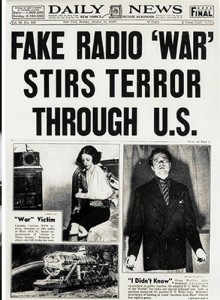
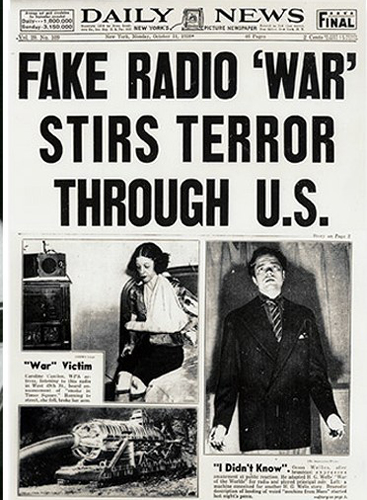
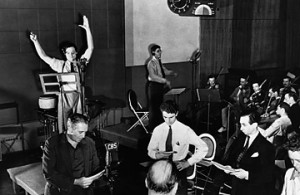
dailynews-WOTW-PanicBecause many listeners tuned in the production without hearing the Welles’ introduction to the drama, they heard what sounded like a live news report of Martians attacking our planet.  While it seems dubious today, what made Welles’ production so convincing was his innovative use of mock news breaks, and what listeners described as a “deafening” silence after a supposed “eyewitness report.” It sounded, in short, terribly authentic, and therefore convincing.

Few believe Welles was intentionally trying to trick his audience; rather, sources suggest he was attempting to treat his listening audience by infusing what would have otherwise been a fairly staid radio drama with imagination, creating a captivating thriller.

The result? By most accounts, Welles’ succeeded. Without doubt, The War of the Worlds propelled this young theatrical director into the public spotlight, onto the big screen, and made his name known the world over.

Last night I had the pleasure of viewing a brilliant documentary about The War of the Worlds on PBS’s American Experience. It told, in detail, of the events leading up to the production, the very convincing reasons why it had the impact it did, and offered entertaining listener accounts from letters sent to CBS. If you missed it,  you can watch it, too, by clicking here.

NPR’s RadioLab also devoted their most recent show to Welles’ production of The War of the Worlds. You can listen to their broadcast on their website, or via the embedded player below:

…Or forgettable myth?
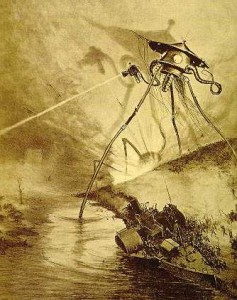
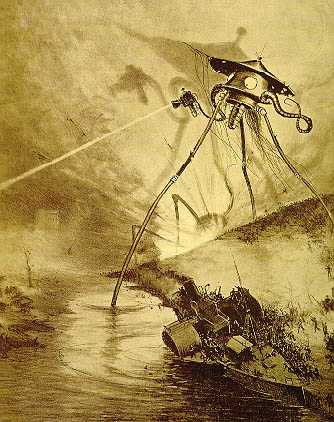
War-of-the-worlds-tripodThen this morning, I read a rather provocative article by  and  in Slate; their mutinous view of the impact of Welles’ The War of the Worlds broadcast flies in the face of the American Experience and RadioLab documentaries and, indeed, every history textbook which devotes space to Welles. These authors claim:

“The supposed [War of the Worlds] panic was so tiny as to be practically immeasurable on the night of the broadcast. Despite repeated assertions to the contrary in the PBS and NPR programs, almost nobody was fooled by Welles’ broadcast.”

The authors go on to explain that the myth of Welles’ mass hysteria was fabricated:

“How did the story of panicked listeners begin? Blame America’s newspapers. Radio had siphoned off advertising revenue from print during the Depression, badly damaging the newspaper industry. So the papers seized the opportunity presented by Welles’ program to discredit radio as a source of news. The newspaper industry sensationalized the panic to prove to advertisers, and regulators, that radio management was irresponsible and not to be trusted.”

I encourage you to read the full Slate article, however, as it goes into much greater detail supporting the author’s assertions, which I find both logical and compelling.

But that’s not all.  This afternoon, while writing this post, NPR published a new article about The War of the Worlds, highlighting the Slate piece and the American Experience and RadioLab productions, but drawing no conclusions of their own. Click here to read the full NPR post.

Strangely, nothing I’ve read so far about The War of the Worlds mentions what I feel to be most obvious.

So, what came of it?
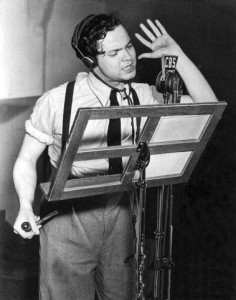
welles-war-of-the-worldsI believe Welles’ controversial radio production did something for radio listeners regardless of the level of panic it may––or may not––have engendered. Welles’ Halloween production left them (and us) with a gift. How so?

Prior to the dense radio propaganda surrounding World War II, The War of the Worlds undoubtedly made radio listeners, from that point forward, seriously question what they were hearing over the air. It forced them to listen with a skeptical ear, to realize that no matter how “real” a report might sound, not to assume its authenticity just because it was broadcast on the radio––or, for that matter, printed on the page of a newspaper. This was to become an invaluable tool in the coming days of American involvement in the war, especially for GIs desperate for news from the home front while propaganda seized the media.  Whether during Welles’ thrilling production or in the news frenzy that followed,  radio’s power had been publicly highlighted, and that power was sure to have an enormous impact on the coming world war.

In conclusion, perhaps we need another such event in this age of television and Internet. All too many people no longer question what they see, read, or hear from either source; these readers/viewers accept reporting of any stripe with blind faith, swallowing news bites and opinion pieces like digital candy. Then they tweet…and re-tweet.

Indeed, this is a common complaint I hear from many shortwave radio listeners.  I suspect this is because we, in contrast, tend to be motivated by hearing the many differing voices on the air and allowing our grey matter––our brains––to discern fact from fiction.

We owe Welles a debt of gratitude.

But don’t take my word for it…
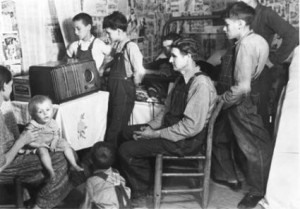
RadioListeniningRegardless:  whether Welles created widespread or merely local panic, or whether you even buy my theory that this production taught us to question what we hear, it’s difficult to deny that the Orson Welles’ production of The War of The Worlds was a brilliant, ground-breaking radio drama.  And, I would add, great seasonal entertainment. Fortunately for us, almost 75 years later (nearly to the minute!), we can listen to archived recordings of the original CBS production.

If you would like to hear the original, simply click here to download the broadcast as an MP3, or listen via the embedded player below.

Happy Halloween!  Enjoy (and keep your hat on, folks):

BBC World Service Radio Archive: how you can help

The BBC World Service Radio Archive (Prototype) contains over 50,000 digital recordings, spanning 45 years of the World Service; indeed, more than the BBC can tag and categorize by hand. Read below to learn how you can create a login with the archive, browse, listen to and tag recordings if you wish.

(Source: BBC Research and Development)

BBCWSArchive

BBC Research & Development is running an experiment with the BBC’s World Service radioarchive to demonstrate how to put large media archives online using a combination of algorithms and people. With your help we aim to comprehensively and accurately tag this collection of BBC programmes.

This prototype website includes over 50,000 English-language radio programmes from the BBC World Service radio archive spanning the past 45 years, which have all been categorised by a machine. You can explore the archive, listen to the programmes and help improve it by validating and adding tags.

[Click here for more details…]

Many thanks to Mike Barraclough for the tip!

Listener Post: Ed McCorry

Ed McCorry’s radio story is the latest in a new series called Listener Posts, where I will place all of your personal radio histories. If you would like to add your story to the mix, simply send your story by email!
In the meantime, many thanks to Ed for sharing his personal radio history:


Ed McCorry (KI4QDE & WDX2PNH)

How did I get my start in SWL’ing? Well I suppose it was a lot like many other people way back in the 60’s.

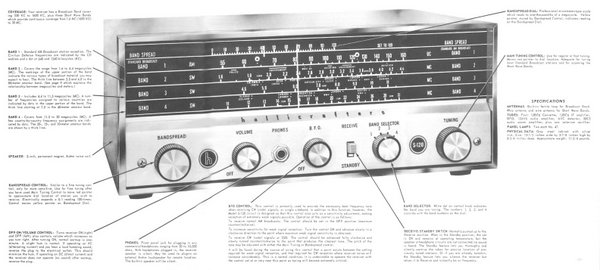
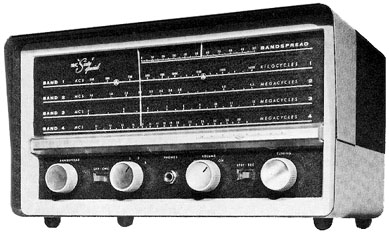
Hallicrafters-S-120As I remember, I was always a tinkerer with a keen interest in all things electrical, taking things apart and putting them back together, not always without modification or in working order. I was a freshman in high school (1962) and was working on a project with a classmate at his house one day and found out he was a ham. I had heard about this but this was the first time I had met someone who had radio equipment. He was new to the hobby and had a Hallicrafters S-120 receiver (didn’t everyone?) and a Morse code transmitter. He showed me how it worked and we listened for awhile and I was hooked.

Back in those days living in New Jersey, we had a black and white TV and received the three major network feeds and a few independents from New York. The stations went off the air sometime around two in the morning and there wasn’t a whole lot to watch anyway so I was always looking for something to do. Shortwave radio was the answer!

Like a lot of other families back then we had all the necessities we needed but there wasn’t any extra money to go buy a radio (the S-120 cost $65.00, a weeks pay). Well by doing odd jobs and mowing lawns I was able to save up to buy a used 4 band shortwave radio for $25.00 (can’t remember the brand). I threw some wire out of the window for an antenna and I was in business. I would listen for hours to places I had only read about. Little did I know then that it would still be a hobby when I was 65 years old!

(Image: RFCafe)

(Image: RFCafe)

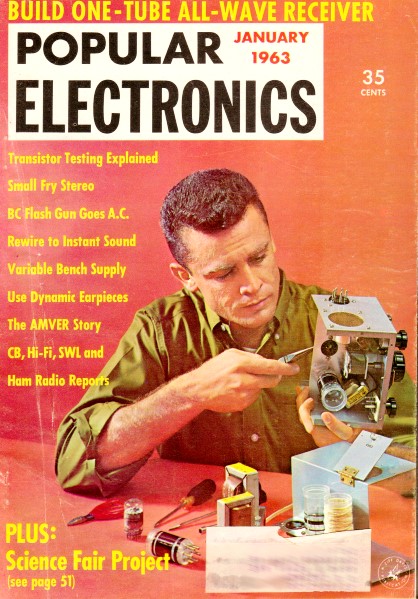
From there I started reading Popular Electronics where Hank Bennett had a shortwave column, registered SWL’s and gave out call signs. Mine was WPE2PNH. From that column I learned how to send reception reports and get QSL cards. There were so many stations back then. I got a job after school and finally had the money to go buy that S-120. Meanwhile I was taking electronics in school and building some of the simpler projects from PE.

After High School I was in the military for the next 8 years and had the S-120 with me when I was in the States but between going to Viet Nam and Thailand for 3 years and everything else going on there wasn’t much time for SWL’ing. However, I did build my first of around 30 Heathkits back then. It was a Q-Multiplier for the S-120.

After I left the service I got back into listening and in 1978 I wrote Hank Bennett who had left PE and started his own SWL registration and he changed my call sign to WDX2PNH (still have the certificate on the wall).

I was never interested enough in all those years to go get my ham ticket until I was on a Search and Rescue team in 1995 that required it. So I received my Technician license, KI4QDE, and until recently spent much more time listening than talking. I’m pretty much 2 meters but I will probably upgrade to General in the near future as it seems that there is less to listen to month after month with the BCB stations cutting short wave.

So here we are, many years, radios, antenna’s and QSL’s later, I consider myself lucky growing up when I did. Times were much simpler, (even though we were afraid of being blown up by an H-bomb) we were at the beginning of a technical explosion, and we made due with what we had. I wonder if I was 13 years old today if I would have the same enthusiasm about radio as I did back then. Probably not, I’m sure radio seems old fashioned to the kids today with all the computer games, internet, smart phones etc. Sure there is more information available to the SWL on the internet but in my opinion it’s also killing the hobby. It’s to bad progress has to leave some good things in the dust…

73,
Ed McCorry
KI4QDE & WDX2PNH
Willow Spring, North Carolina


Many thanks, Ed, for sharing your story!
Click here to read our growing collection of Listener Posts!