Shortwave listening and everything radio including reviews, broadcasting, ham radio, field operation, DXing, maker kits, travel, emergency gear, events, and more
Wow, I really liked Mike’s walk down memory lane. I saw several of my own dream receivers:
S-38E. Indeed, this little monster did add some danger to your life. AKA “The Widow Maker,” I gave one to my cousin’s husband so he could listen to what the commies on Radio Moscow were saying. He later told me that the receiver had given him a shock. I now have TWO S-38Es in my shack (two more than I really need). I have installed isolation transformers in both of them, so they have lost the one element (danger!) that made them attractive.
HA-600A. I got this one for Christmas in 1972. The A model is MUCH better than the plain vanilla HA-600. I recently got another HA-600A and found serious deficiencies in the Product Detector. Has anyone else noticed these problems? BACKGROUND INFO AND A PLEA FOR MORE INFO HERE: https://soldersmoke.blogspot.com/search?q=HA-600A+Product+Detector
HQ-100. Got one in the Dominican Republic. Fixed it up, repairing damages caused by radio life in the tropics. Disabled the goofy audio amplifier circuitry. I now wonder if this receiver might benefit from the insertion of a 455 kc ceramic filter.
NC190. Wow “Cosmic Blue” Perhaps this was an early influence that led to “Juliano Blue?”
HQ-180. “18 tubes and almost as many knobs!” FB!
HRO-500. Love the dial.
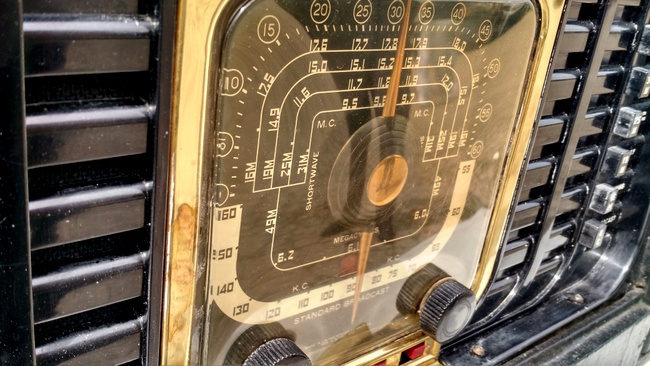
Transoceanic. Never had one, but built a BFO for the Transoceanic that W8NSA took with him to SE Asia during the war.
Cooling Radio Station was at the UK end of a point-to-point, shortwave signal beamed from Lawrenceville, New Jersey. The site of the station was carefully selected as the antenna, MUSA (Multiple Unit Steerable Antenna), upon which it depended to receive the incoming transmission, had to be: directly aligned with Lawrenceville NJ, USA; two miles long; comprised of an array of 16 individual rhombic antenna; and have an area of three miles in front of the MUSA that would be free from radio interference. The 16 rhombic antenna were strung between 60ft high telegraph poles; each side was 315ft long with internal angles of 140 degrees. The signal from each antenna was sent to the station via a core coaxial cable sheathed in a watertight copper tube and buried in a central trench.
This vital communications link, between the US and British governments at the very highest level, operated from 1942 until the early 1960s. Although a transatlantic telegraph cable had been in use since 1866, there was no telephone cable until 90 years later, in 1956. An initial shortwave system was set up in 1929, but was of poor quality. The Post Office set up and ran Cooling Radio Station solely for the reception side of two way, shortwave, voice channels with the United States. Land was purchased in 1938 and the building was completed in 1939. The receiver used 1,079 valves and was considered to be the most complex radio built. It was connected to the adjacent MUSA (Multiple Unit Steerable Antenna) and could receive 4 incoming radio telephone channels. It was officially in use on the 1st July 1942. This may well have been because German intelligence services were able to break the scrambler / encryption device available in 1939. By 1943, Bell Laboratories in the US had developed SIGSALY, a far more secure scrambler system. (This system was so well screened and secure that German records captured at the end of WW2 showed that they were not aware that transmissions were person to person, direct voice contact.) SIGSALY was installed in the basement of Selfridges department store in Oxford Street with extensions to 10 Downing Street, the Cabinet War Rooms and the US Embassy amongst others. The US transmitter was located at Lawrenceville, New Jersey, while UK transmissions were made from Rugby to the US receiver at Manahawkin, New Jersey.
Radio Waves: Stories Making Waves in the World of Radio
Because I keep my ear to the waves, as well as receive many tips from others who do the same, I find myself privy to radio-related stories that might interest SWLing Post readers. To that end: Welcome to the SWLing Post’sRadio Waves, a collection of links to interesting stories making waves in the world of radio. Enjoy!
n March 2, the BBC World Service announced that it was restarting four-hour daily shortwave transmissions in English to Ukraine. The decision to resume Ukrainian shortwave broadcasts came after Russian forces began to deliberately target Ukrainian communications equipment, including the Kyiv television tower.
Why do these four-hour daily transmissions matter so much when the world supposedly has moved away from radio and adopted social media and the Internet? Isn’t shortwave an obsolete, century-old technology that harkens back to memories of World War II and the Cold War?
Despite its age, shortwave remains an enduring tool in the global fight against disinformation. In part, this is due to its unique broadcasting qualities. FM and broadcast television can only travel to just beyond the horizon. But shortwave can travel vast transcontinental and transoceanic distances. It accomplishes this feat by bouncing between the ionosphere and the earth—over mountains, skyscrapers, and digital firewalls.
It’s this last obstacle that’s most important here. Russia is demonstrating that it can destroy Ukraine’s television and FM broadcasting infrastructure. It can use hackers and such Kremlin-affiliated subversive agencies as the Internet Research Agency to take down or otherwise block Internet sites of Western and Ukrainian media agencies seeking to provide accurate information about the conflict. Cellphones only have limited range; they need towers to transmit longer distances. Russia has demonstrated that it can shut down cellphone communications in areas of Ukraine it has captured or is shelling, including nuclear power plants.
What about satellite reception? In theory, satellite reception can break through these issues. Last week, Starlink CEO Elon Musk sent “a truckload of satellite dishes” to Ukraine to provide “space Internet service.” But Russia can identify the satellite signals, seek to jam them, and locate those who have the dishes in Ukrainian areas now under its control.
This leaves shortwave, the venerable analog signal infamous for how it fades in and out as each wave is received. Shortwave cannot be hacked. It cannot be bombed or otherwise destroyed because it is being transmitted from far outside Ukraine. Shortwave is notoriously difficult to jam, despite Russia and China’s best efforts. The shortwave signal is always drifting slightly, making it difficult to precisely focus jamming equipment. The shortwave signal can also be more powerful than that of the jammer, effectively overriding the interference.
Shortwave only works if people listen. Fortunately, many Ukrainian families likely still have old, often cheap Soviet-era shortwave sets in their basements that can be powered by batteries or wall sockets. They are usually small and can be easily hidden from prying eyes. Some can even fit in a pocket. Shortwave radios can also be brought in as nonlethal aid. [Continue reading…]
LEBANON, Tenn. (WSMV) – Right now, the people of Ukraine need positive messages. One Lebanon family found a way to give them that with what they do best – a radio broadcast.
We all know there’s AM and FM radio, but there’s also shortwave radio. It’s listened to on a small device the size of a phone. While it may not be common in the U.S., radio personalities said it’s how people in Europe listen to radio continents away.
From the comfort of his home, Ted Randall brought comfort to those who need it most.
“We are broadcasting to the Ukraine and Russia,” Randall explained. “We are playing American rock and roll because our email responses have been saying, ‘please, no news, we are tired of hearing the news.’” [Continue reading…]
Overnight shows at BBC Radio 5 Live have been temporarily suspended due to a shortage of staff at the station’s MediaCity HQ.
BBC World Service will be rebroadcast instead until at least April 4th 2022.
Weekday overnight presenter Dotun Adebayo tweeted yesterday saying there will be no shows through the night until further notice, with a reply coming from weekend overnight host Hayley Hassall confirming the news.
An increase in COVID cases at the station means more staff are off work than usual.
A BBC spokesperson told RadioToday: “Due to increased COVID cases, we have temporarily suspended our overnight programming and will broadcast BBC World Service instead.”
The overnight show usually runs from 1am till 5am.
One retailer said last week’s sales of battery-powered radios were triple that of the same time last year.
Electronics retailers in Finland have seen increased sales of battery-powered radios in the past few weeks, suggesting that some residents are preparing for the possibility of a coming emergency situation.
Sales of portable radios began to tick up at the electronics chain store Veikon Kone in Sodankylä, shortly after Russia’s deadly invasion of Ukraine, according to shop manager Jukka Haavisto.
“Radio sales rose to an entirely new level than they were,” he explained, adding that battery-powered radios were products that mostly sold in the summer.
“It’s a surprise to everyone and there are already availability issues,” Haavisto said.
Portable radio sales have doubled at the electronics store chain Gigantti, according to the retailer’s sales manager, Sami Kinnunen, who noted that last week’s sales were about triple that of the same time last year.
“We’re selling all kinds of radios, but ones with batteries are the most popular. It can be said that the change is significant, but we’re not talking about sales of thousands, but rather hundreds,” Kinnunen explained, noting that some models have sold out.
A noticeable uptick in sales of radios at electronics retailer Verkkokauppa.com has been seen on a weekly basis, according to the firm’s commercial director, Vesa Järveläinen.
He said the most popular radios were basic FM models that sell for around 20 euros.
“Right now we’re often selling about 100 radios a week, while before the increase the figure was a few dozen or so,” Järveläinen said. [Continue reading…]
ASHEVILLE, N.C. (WLOS) — At the Asheville Radio Museum, Tim McVey tunes in an RCA Radiola 20, built in 1927 but still kicking.
“This one still requires that you manipulate two dials to tune it in, and you have another dial here that fine tunes this dial. And this controls the filaments in the tubes,” says McVey, as he tunes the sound of several radio stations with static, down to one station with clear sound.
McVey retired from the FBI and moved from the Washington D.C. area to the mountains a year and a half ago.
“I get giddy thinking about it, because Tim has been such a remarkable addition to the museum,” says Asheville Radio Museum Curator Stuart Smolkin.
Smolkin says McVey has restored some of the most important radios in the museum, built in the 1920’s and 30’s, preserving a vital part of communications history.
“Without radio, we would not have cell phones,” Smolkin explains. “We would not have GPS. We would not have wireless internet routers, or wireless Bluetooth speakers. The list goes on and on.”
McVey tunes in another radio, this one from 1931, sounding great. [Continue reading…]
Many thanks to SWLing Post contributor, Mark (AE2EA), who writes:
Hi Thomas,
FYI, The AWA just posted a presentation by Andy Flowers, K0SM, about amateur radio transmitters from the 1920s & early 30s. Andy is a builder of beautiful early transmitters, among other ham radio pursuits like 10GHz and up microwave work.
Here’s the latest blurb from the AWA:
If you were an amateur radio operator 100 years ago, and wanted a transmitter, you had one choice, you built a breadboard transmitter from scratch, often with components you made yourself. Today, some hams still do this, with designs from the early years of ham radio. AWA member Andy Flowers, K0SM, is one of those modern day vintage transmitter breadboarders.
Join Andy as he explains how early radio amateurs built their own breadboard transmitters with handmade parts, and put them on the air without killing themselves (well, most of the time.)
Radio Waves: Stories Making Waves in the World of Radio
Because I keep my ear to the waves, as well as receive many tips from others who do the same, I find myself privy to radio-related stories that might interest SWLing Post readers. To that end: Welcome to the SWLing Post’sRadio Waves, a collection of links to interesting stories making waves in the world of radio. Enjoy!
New Zealand’s Minister for Broadcasting and Media Kris Faafoi has announced the government’s decision to create a new public media entity by merging RNZ and TVNZ.
According to Faafoi, ensuring New Zealanders continue to have access to reliable, trusted, independent information and local content sits at the heart of the decision.
“The public media sector is extremely important to New Zealanders in providing them with high quality, independent, timely and relevant media content,” Faafoi said.
“But we know the media landscape is changing and the sector is having to adapt to increased competition, changing audience demands and ways of accessing media, falling revenue, and new and emerging digital platforms. We need public media which is responsive to these changes and can flourish.
“RNZ and TVNZ are each trying to adjust to the challenges, but our current public media system, and the legislation it’s based on, is focused on radio and television.
“New Zealanders are among some of the most adaptive audiences when it comes to accessing content in different ways; like their phones rather than television and radio, and from internet-based platforms. We must be sure our public media can adapt to those audience changes, as well as other challenges that media will face in the future.”
“The new public media entity will be built on the best of both RNZ and TVNZ, which will initially become subsidiaries of the new organisation. It will continue to provide what existing audiences value, such as RNZ Concert, as well as better reaching those groups who aren’t currently well served; such as our various ethnic communities and cultures,” Faafoi said[…]
Battery radios and satellite internet both have jobs to do
In communist Eastern Europe a shortwave radio was a vital piece of equipment for anyone wanting to stay ahead of the censors. Stations such as the bbc World Service, Radio Free Europe and Voice of America broadcast news, entertainment and rock-and-roll across the Iron Curtain.
After the cold war ended, shortwave radios gave way to television and the internet, and the broadcasts were wound down. But on March 3rd, in the aftermath of Russia’s invasion of Ukraine, the bbc announced their return. The World Service has begun nightly news broadcasts into Ukraine and parts of Russia (see map). Continue reading →
Many thanks to SWLing Post contributor, Nick Hall-Patch, who shares the following announcement:
The International Radio Club’s Reprints collection of 900+ articles about antennas, radio propagation, receivers, accessories, plus items of general interest to MW DXers, continues to grow. We’ve published an update to the index, at https://www.ircaonline.org/editor_upload/File/reprints/irca-reprint-index.pdf , so that everyone can get access to these latest additions.
We’re also pleased to start offering reprints that did not initially appear in IRCA’s DX Monitor, but are not easily found elsewhere. For example, we’ve obtained permission from the family of the late prolific author, Dallas Lankford, to organize and republish his out of print articles.
(if you’ve used the index before, you may need to refresh the browser page to see the latest update, dated December 2021)